Full mission transcript
Every chapter of Cassini, in sequence.
Day 0
The Seven-Year Road
October 15, 1997 · 08:43 UTC
At 08:43 UTC on October 15, 1997, a Titan IVB/Centaur lifted off from Launch Complex 40 at Cape Canaveral carrying the largest and most complex interplanetary spacecraft ever launched — NASA's Cassini orbiter, with the European Space Agency's Huygens probe bolted to its flank and Italy's high-gain antenna crowning the stack. It did not leave quietly. Cassini's three radioisotope generators carried about 32.7 kilograms of plutonium-238, and eleven days before launch some 800 protesters had gathered at the Cape's gates — 27 were arrested, a lawsuit followed, and the chant 'Stop Cassini, don't be a weenie!' made the local papers. The fears were a launch accident, and a riskier moment still to come: a return pass by Earth in 1999.
There was no direct road to Saturn. Too heavy to fly straight, Cassini flew the VVEJGA gravity-assist gauntlet instead: Venus on April 26, 1998, Venus again on June 24, 1999, then home — skimming 1,171 kilometres above Earth at 03:28 UTC on August 18, 1999, stealing 5.5 kilometres per second of speed — and finally Jupiter on December 30, 2000. To reach a planet 1.4 billion kilometres away, Cassini flew roughly 3.5 billion.
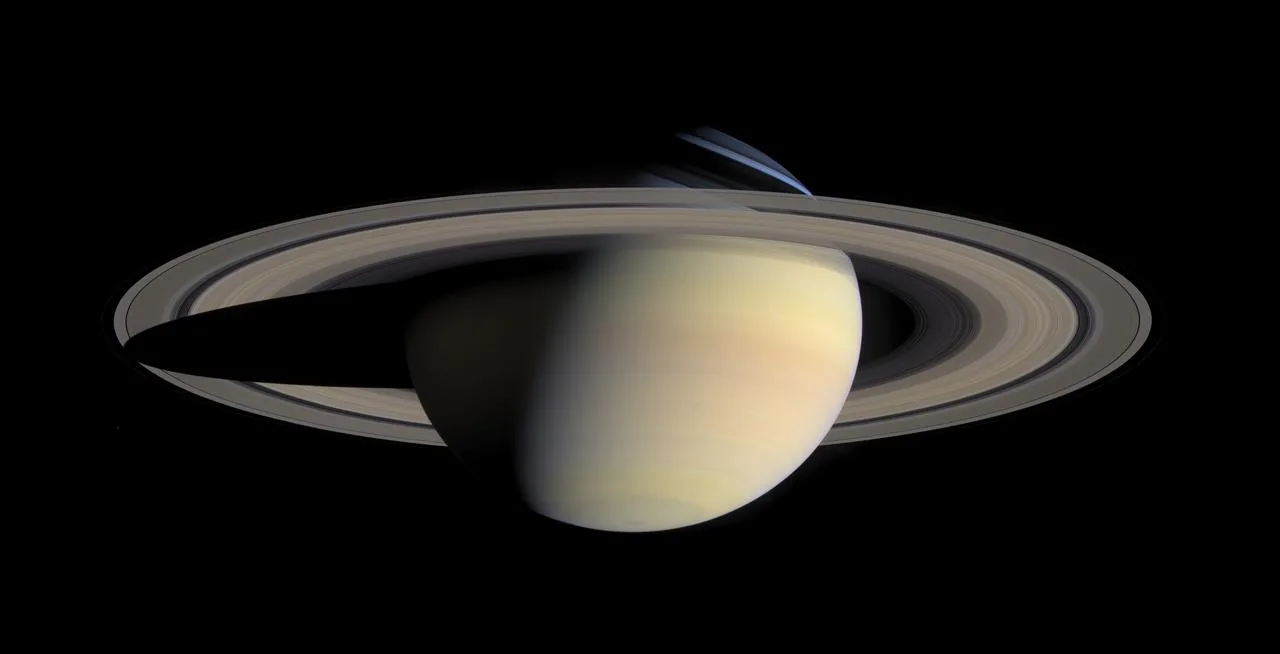
On July 1, 2004, after six and a half years of cruise, the spacecraft climbed through the gap between Saturn's F and G rings and lit its main engine. The Saturn Orbit Insertion burn ran 96 minutes, from 01:12 to 02:48 UTC, bleeding off speed until the planet's gravity closed around it. Cassini had become the first spacecraft ever to orbit Saturn — and almost immediately, its radio instrument began picking up the planet's eerie auroral song.
Day 2,648
Huygens Falls to Titan
January 14, 2005 · 11:38 UTC
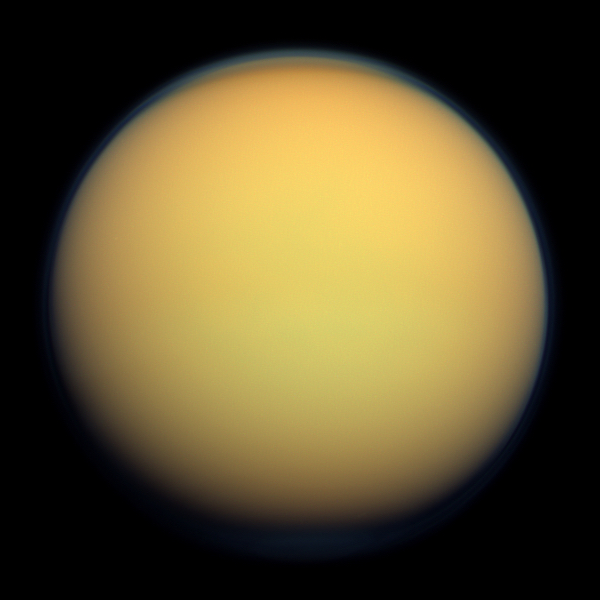
On Christmas Day 2004, at 02:00 UTC, springs pushed Huygens away from Cassini at 0.35 metres per second, spinning at 7.5 rpm for stability. Europe's probe coasted alone for twenty days and four million kilometres toward a moon whose surface no one had ever seen — Titan, wrapped in orange smog thicker than Earth's atmosphere.
At 09:05:52 UTC spacecraft time on January 14, 2005, Huygens hit the top of that atmosphere at 1,270 kilometres altitude and braked from about 18,000 to 1,400 km/h in three minutes, its heat shield doing the violence so the instruments wouldn't have to. Parachutes opened around 160 kilometres up, and for 2 hours and 27 minutes the probe drifted down through the haze, microphones and sensors live — its descent data later reconstructed in the lab into the alien-wind audio you can hear below. One wound marred the day: a receiver channel aboard Cassini was never commanded on, costing half the images — 350 survived — and the Doppler wind measurement, which radio telescopes on Earth heroically recovered from the probe's raw carrier signal. Green Bank had caught that faint heartbeat at about 10:25 UTC Earth time, proof the probe was alive under its parachute.
At 11:38:11 UTC spacecraft time, Huygens touched down at roughly 5 metres per second on a methane-soaked floodplain strewn with rounded pebbles of water ice, at −179 °C. It was the first landing in the outer solar system — on a moon of Saturn, the most distant touchdown ever made, a record it still holds. And here the light-time ledger of this story opens: confirmation did not reach Earth until about 12:45 UTC, sixty-seven minutes after the fact. Huygens kept transmitting from the surface for 72 minutes, until Cassini — its only relay — set below Titan's horizon, still carrying the probe's last words.
Day 2,829
The Water Worlds
July 14, 2005 · 00:00 UTC
Enceladus was supposed to be a footnote — a bright little iceball about 500 kilometres across. Then, on February 17, 2005, Michele Dougherty's magnetometer team watched Saturn's field lines drape around it as if the moon had an atmosphere. The signature repeated on March 9. On the strength of that magnetic whisper, the team lobbied to drop the planned July 14 flyby from around 1,000 kilometres to under 175 — and Cassini flew through measurable water vapour. That November, the cameras caught the proof in backlight: fountains of ice erupting from the 'tiger stripe' fractures at the south pole. The discovery belongs to both — the magnetometer that sensed it, and the imaging team that saw it.
The plumes, it turned out, feed Saturn's entire E ring — Enceladus writes itself across the system. Cassini kept going back, 23 targeted flybys in all, each bolder: on October 9, 2008, it skimmed just 25 kilometres above the surface at 17.7 kilometres per second, and on October 28, 2015, it made its deepest deliberate dive through the plume itself, about 49 kilometres up, drinking from an alien ocean's spray.
The payoff landed in April 2017: molecular hydrogen in the plume — the unmistakable chemistry of hot water reacting with rock on a seafloor. Beneath its ice, Enceladus has hydrothermal vents, the same kind of environment where some biologists think life on Earth began. Cassini had not found life. It had found a place where life would have something to eat.
Day 3,202
Titan Revealed
July 22, 2006 · 00:00 UTC
Huygens had given Titan a face; Cassini gave it a geography. On July 22, 2006, the orbiter's radar swept across the moon's far north and found what generations of scientists had only theorized: a lake district. Dozens of radar-dark, dead-flat patches — liquid on the surface of another world. Across 127 targeted Titan flybys, the maps grew: by 2007-08 the radar had resolved true seas, Kraken Mare and Ligeia Mare, the latter spanning roughly 126,000 square kilometres — and all of it filled not with water but with liquid methane and ethane at −179 °C.
By mission's end, about 60 percent of Titan's terrain above 60° north had been mapped, and some 14 percent of it was covered by lakes — three seas and hundreds of smaller bodies, the only open surface liquid known anywhere in the solar system beyond Earth. And Titan moved: Cassini watched methane storms darken the equator, and a radar-bright 'Magic Island' appear, vanish, and reappear in Ligeia Mare as the seasons turned. This was not a dead moon with puddles. It was a working hydrological cycle running on natural gas.
Titan's atmospheric chemistry proved just as rich — a photochemical factory churning out organic molecules that Cassini's instruments catalogued for years. The groundwork outlived the mission: in 2017, astronomers using the ALMA observatory on Earth detected vinyl cyanide in Titan's atmosphere, a molecule theorists had proposed could form cell-like membranes in liquid methane — a discovery built directly on the chemical map Cassini left behind.
Day 4,799
The Long Mission
December 5, 2010 · 00:00 UTC
On December 5, 2010, Cassini's radio instrument heard lightning. A storm had ignited in Saturn's northern hemisphere — and it did not stop. By late January 2011 the Great White Spot had wrapped clear around the planet, a band of churning cloud tens of thousands of kilometres long, its lightning cracking more than ten times a second; the radio static of Saturn's storms is what you can hear below. The electrical fury didn't fully subside until August 28, 2011. Saturn, the serene ringed jewel, had shown its violence.
The longer Cassini stayed, the stranger Saturn got. At the north pole it filmed the hexagon — a six-sided jet stream 30,000 kilometres across with 500 km/h winds, first glimpsed by Voyager — capturing its first full-colour movie in December 2012 and watching the pole itself shift from winter blue to summer gold. The moons kept pace: Iapetus wore an equatorial mountain ridge over 20 kilometres high, and Hyperion tumbled past in 2005 looking like a sponge the size of a city-state.
The mission simply refused to end. The four-year prime mission closed on June 30, 2008; the Equinox extension carried it to October 2010; the Solstice extension, announced February 3, 2010, carried it to 2017. The ledger of those thirteen years in orbit: 294 orbits, 453,048 images, 3,948 scientific papers, and scientists from 27 nations.
And once, the mission paused to look home. On July 19, 2013, Cassini slid into Saturn's shadow and photographed the backlit rings — with Earth a pale blue dot 1.44 billion kilometres away in the frame. For the first time in history, the public was told in advance that their picture was being taken from the outer solar system and invited to go outside and wave. They called it The Day the Earth Smiled.
Day 6,103
The Decision to Die
July 1, 2014 · 00:00 UTC
Cassini was never sterilized. In 1997, nobody scrubbed it to planetary-protection standards for ocean worlds, because in 1997 nobody knew Saturn had ocean worlds. Then Cassini found them. Its own discoveries wrote its death sentence: once Enceladus was known to hide a habitable ocean, the rules were unambiguous — a dead, uncontrolled Cassini could never be left adrift where it might one day crash into Enceladus or Titan and seed them with Earth's microbes.
The decision came in 2010, alongside the Solstice extension: fly until 2017, budget the propellant to spend everything, and end the mission deliberately, inside Saturn itself. The flight team called the endgame 'the proximal orbits.' NASA put the name to a public vote — more than 2,000 entries came in — and in July 2014 announced the winner: the Grand Finale.
The plan was audacious: 22 final orbits threading the roughly 2,400-kilometre gap between Saturn's cloud tops and the innermost ring — a place no spacecraft had ever flown, where models said the dust should be survivable and the team planned to fly the first pass with the big dish held forward as a shield, just in case. The destination science had demanded for decades would be bought with the spacecraft's life.
Day 7,133
The Grand Finale
April 26, 2017 · 00:00 UTC
On April 22, 2017, Titan gave Cassini its last gravitational push — a final close flyby that bent the orbit inside the rings. Four days later, on April 26, the spacecraft made the first of 22 weekly dives through the 2,400-kilometre gap between Saturn and its innermost ring, its high-gain antenna held forward as a shield. The gap turned out to be emptier than anyone dared hope. Cassini was flying where nothing built by humans had ever flown, once a week, like a commute.
The science from inside the gap rewrote the textbooks one last time. Gravity measurements pinned the rings' mass at 1.54×10¹⁹ kilograms — about 0.41 times the moon Mimas — a lightness that reads most naturally as young rings, perhaps only tens of millions of years old, though the debate remains honestly open: later modelling showed ancient rings could evolve to look this way too. 'Ring rain' was caught in the act, organic-laced material streaming from the rings into the atmosphere. And one mystery deepened: Saturn's magnetic field proved almost perfectly aligned with its spin axis — something dynamo theory says should not happen — and Cassini died without an answer.
On September 11, 2017, a distant pass by Titan — about 119,000 kilometres out, the engineers called it 'the goodbye kiss' — bent the orbit irrevocably into the planet. Three days later, at 19:59 UTC spacecraft time on September 14, Cassini took its final image: the dark patch of cloud, gently lit by ringshine, where it would strike the atmosphere the next morning. Then it turned its antenna toward Earth and never looked away again.
Day 7,275
Loss of Signal
September 15, 2017 · 11:55 UTC
Cassini hit Saturn's atmosphere about 1,500 kilometres above the cloud tops at more than 110,000 km/h, eight instruments live, its mass spectrometer tasting the planet's air and streaming the data home in real time — science to the literal last second. The thrusters fought to keep the antenna on Earth as the atmosphere thickened. The reconstruction tells it plainly: the spacecraft held its own for 91 seconds, the thrusters ramping to 100 percent for the final twenty before the ship began to tumble, the signal slipped off Earth, and Cassini broke apart and burned — becoming, atom by atom, part of the planet it had studied.
But that is not when we heard it. All of it had already happened — at about 10:32 UTC, spacecraft event time. For 83 more minutes, Cassini's final transmission was still in flight, crossing 1.4 billion kilometres of space at the speed of light: a ghost signal from a spacecraft that no longer existed. In mission control at JPL, the room watched the carrier hold, and hold, and hold — listening to the voice of the already-dead, and unable to do anything but wait for the silence to arrive. At 11:55:46 UTC Earth-received time, the 70-metre dish in Canberra lost the lock. The line on the screen dissolved into noise.
Julie Webster called the loss of signal from the ops console, and moments later project manager Earl Maize keyed his loop for the last time — warning the room that within the next forty-five seconds the spacecraft itself would follow its signal into history, then thanking his team and formally closing the mission. You can hear it below: the call, the words, and the applause that followed — the sound of several hundred people letting go of a spacecraft at once.
Cassini died so that its own discoveries could live. Somewhere under Titan's orange haze, the Huygens probe still sits on its floodplain of ice pebbles; inside Enceladus, the ocean still vents into space, pristine, waiting for the next visitor. 'Cassini may be gone,' Linda Spilker said that morning, 'but its scientific bounty will keep us occupied for many years.' The spacecraft is part of Saturn now. It was always going to be — the only question the team ever answered was how, and they chose the way that protected everything it had found.
Control room · NASA/JPL broadcast - 11:52:48 UTC Barber (commentary): Radio signal looks wonderful. X band and S band, two different radio bands, still getting the signal from Cassini.
- 11:54:46 UTC Barber (commentary): Radio signal still holding, 30 seconds.
- 11:55:28 UTC Barber (commentary): We crossed our zero time.
- 11:55:52 UTC Radio science (ops loop): Flight director, radio science. We have loss of signal.
- 11:56:27 UTC Webster (flight director): Okay, we call loss of signal at 11:55:46 for the S band. That would be the end of the spacecraft.
- 11:56:55 UTC Maize (project manager): There may be a trickle of telemetry left, but you just heard the signal from the spacecraft is gone, and within the next 45 seconds so will be the spacecraft.
- 11:57:10 UTC Maize (project manager): I hope you're all as deeply proud of this amazing accomplishment. Congratulations to you all. This has been an incredible mission, an incredible spacecraft, and you're all an incredible team.
- 11:57:25 UTC Maize (project manager): I'm going to call this the end of mission. Project manager off the net.
Sources: NASA Science — Cassini Grand Finale Overview · JPL — NASA's Cassini Spacecraft Ends Its Historic Exploration of Saturn (2017) · ESA — Europe Reaches New Frontier: Huygens Lands on Titan (2005) · JPL — Reconstructing Cassini's Plunge Into Saturn (2018) · Iess et al. — Measurement and Implications of Saturn's Gravity Field and Ring Mass (Science, 2019)
Answers come only from the Cassini mission record above.
Continue your journey

The moment in history
Moment
Cassini-Huygens launches to Saturn
The moment in history
The mission file
Mission
Cassini-Huygens
The mission file
Experience it
World
Titan
Experience it
From the same era
Experience
Hubble
From the same era
From the same era
Experience
Building the ISS
From the same era
From the same era
Experience
Voyager
From the same era