Full mission transcript
Every chapter of Building the ISS, in sequence.
Day 0
Sunrise
November 20, 1998 · 06:40 UTC
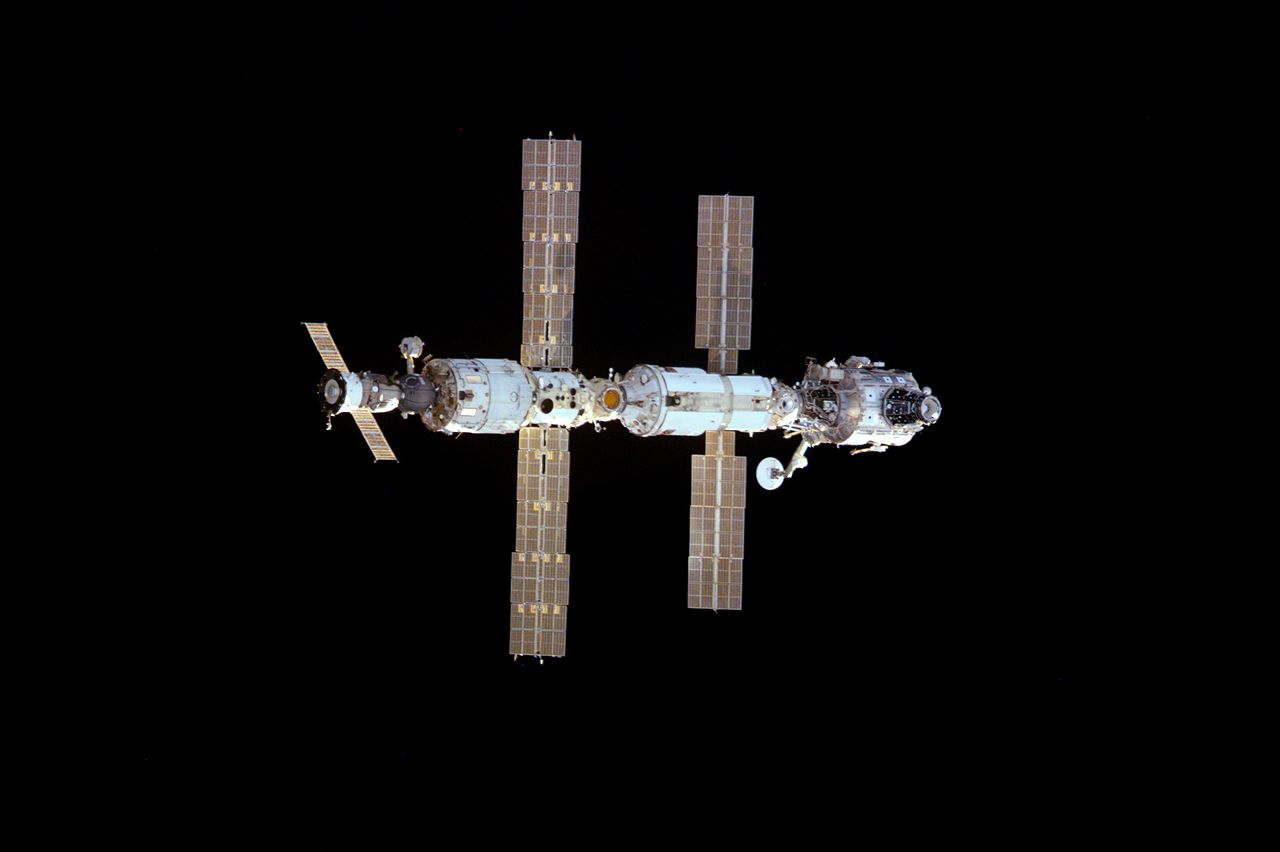
At 06:40 UTC on November 20, 1998, a Proton-K rocket climbed away from Site 81/23 at Baikonur Cosmodrome carrying a 19,323-kilogram cylinder named Zarya — 'Sunrise'. It settled into a 220 × 340 kilometre orbit inclined 51.6 degrees, later raised to roughly 386 kilometres circular. At 12.56 metres long, alone above the Earth, it was the entire International Space Station.
Zarya was built on a quiet contradiction that defined the whole project: assembled by the Khrunichev factory in Moscow, it was built under subcontract to Boeing, for NASA — a US-funded, US-owned module with Russian engineering in its bones. Formally the Functional Cargo Block, or FGB, it would do everything in the station's early years: propulsion, attitude control, power, and storage.
Behind that single module stood a partnership of five space agencies representing 15 countries. Nobody aboard, nothing attached. Day zero.
Day 16
Unity
December 6, 1998 · 23:47 UTC
Sixteen days after Zarya, Space Shuttle Endeavour launched on STS-88 — December 4, 1998, 08:35:34 UTC — carrying the American-built Unity node. On December 5 at 23:45 UTC the crew mated Unity to Endeavour's docking system. Then, on December 6 at 23:47 UTC, astronaut Nancy Currie reached out with the shuttle's robotic arm and grappled Zarya — the first time the arm had ever been used to join two spacecraft. The docking mechanisms captured at 02:07 UTC on December 7, and at 02:48 the hooks and latches drove home — two modules became one station.
Over three spacewalks — December 7, 9, and 12, running 7 hours 21 minutes, 7 hours 2 minutes, and 6 hours 59 minutes — Jerry Ross and James Newman connected 40 cables and connectors between the two modules, wiring the infant station into a single spacecraft.
On December 10 at 19:54 UTC the crew opened Unity's hatch, then Zarya's at 21:12 UTC. Commander Bob Cabana had arranged the moment with care: he and cosmonaut Sergei Krikalev floated into the new station side by side, so that no single nation could claim to have entered the International Space Station first.
Day 713
Someone Is Always Home
November 2, 2000 · 09:21 UTC
On October 31, 2000, at 07:52 UTC, Soyuz TM-31 lifted off from Baikonur carrying commander William Shepherd, Soyuz commander Yuri Gidzenko, and flight engineer Sergei Krikalev. Two days later — November 2, 09:21 UTC — they docked to the aft port of the Zvezda module. Roughly ninety minutes after that, the hatch opened, and the station has never been empty since.
The first hours were unglamorous and essential: turning on the lights, starting the hot water dispenser, activating the toilet, equalising pressure between the modules — then a televised session with Moscow flight control, joined by Russian space agency chief Yuri Koptev and NASA Administrator Dan Goldin. Years later, Gidzenko recalled Shepherd's verdict that day: 'Now we can live. We have lights, we have hot water, and we have toilet.'
Shepherd also radioed a request: permission to use the call sign 'Alpha'. Mission control authorised 'Station Alpha' for the duration of the Expedition 1 mission. Their home was three pressurized modules — Zarya, Unity, Zvezda — plus the Soyuz and a Progress freighter. The clock of continuous human habitation had started ticking.
Day 813
Destiny
February 10, 2001 · 17:35 UTC
Through the winter, the first crew turned an outpost into a home. When new hardware arrived in December 2000, Shepherd's radio commentary was characteristically dry — 'The weight room is open.' At Christmas, the crew sent a message down: 'As the most ‘forward deployed’ citizens of the planet at this moment, We, the first expedition crew aboard Space Station Alpha, send our holiday greetings to Earth.'
Then came the science. STS-98 launched on February 7, 2001, at 23:13:02 UTC carrying Destiny, the US laboratory. On February 10, astronaut Marsha Ivins flew the shuttle's robotic arm, grappling the lab at 17:35 UTC and berthing it onto Unity's forward port that afternoon. The crew floated inside the next day.
Destiny changed what the station was for. Twenty-eight feet long, it added 32,000 pounds of spacecraft and grew the station's habitable volume by 41 percent. It launched with just 5 of an eventual 24 equipment racks — empty shelves waiting for two decades of experiments. The science heart of the US Orbital Segment was beating.
Day 1,534
The Longest Pause
February 1, 2003 · 13:59 UTC
On February 1, 2003, Space Shuttle Columbia broke apart during re-entry at the end of STS-107 — a standalone science mission that never visited the station — killing all seven astronauts aboard. The station played no part in the tragedy, but the tragedy froze the station in place: the shuttle fleet was grounded, and assembly stopped for nearly four years.
The half-built outpost was kept alive by two-person caretaker crews — Expeditions 7 through 12 — rotating up and down on Russian Soyuz capsules. 907 days passed between Columbia and the STS-114 return-to-flight on July 26, 2005, and even that was a logistics and test flight, not assembly. So was STS-121 in July 2006.
Construction finally resumed with STS-115, launched September 9, 2006, at 15:14:55 UTC. On September 12, the crew installed the P3/P4 truss — 17.5 tonnes and 45 feet of girder and solar wings — the first new piece of station in almost four years. The pause was over.
Day 3,772
Full Power
March 19, 2009 · 18:17 UTC
Discovery launched on STS-119 on March 15, 2009, at 23:43 UTC, carrying S6 — the final segment of the station's truss. Spacewalkers bolted it to the starboard end of the backbone on March 19, and on March 20 the last pair of solar array wings unfurled. For the first time, all eight wings stretched out from a truss 310 feet — 94 metres — end to end.
The numbers became the station's signature: array pairs spanning 73 metres, a total wingspan of 109 metres, and 75 to 90 kilowatts of electrical power. The orbiting construction site finally had the energy budget of the laboratory it was always meant to be.
The power enabled people. On May 29, 2009, Soyuz TMA-15 arrived and Expedition 20 began — the first six-person resident crew, and the first time all five partner agencies had crew members aboard simultaneously. The station was no longer a project. It was a neighbourhood.
Day 4,107
The Window
February 17, 2010 · 05:25 UTC
STS-130 launched on February 8, 2010, at 09:14 UTC with the last major American-segment rooms: Tranquility, berthed to Unity's port side on February 12, and the Cupola — both provided by ESA and built by Thales Alenia Space in Turin, Italy. On February 15, the station's arm moved the Cupola to its permanent home on Tranquility's Earth-facing side.
On the mission's third spacewalk, Robert Behnken and Nicholas Patrick removed the launch locks from the Cupola's shutters. Then, on February 17, astronaut Terry Virts opened them from inside — the main 80-centimetre nadir window, the largest ever flown in space, swinging clear at 05:25 UTC. Seven windows looked down on Earth at once.
Station commander Jeffrey Williams gave mission control the first review. The Cupola became the station's defining room — part control tower for arriving spacecraft, part observation deck for the only neighbourhood with sixteen sunrises a day.
Day 4,626
Mission Complete
July 21, 2011 · 09:57 UTC
Endeavour flew last on May 16, 2011 — STS-134, launched 12:56 UTC. On May 19, the crew unberthed the Alpha Magnetic Spectrometer at 06:59 UTC and bolted it to the S3 truss by 09:46 UTC: the final assembly act of the shuttle era, completing the US Orbital Segment. The station itself was not finished — Russia would add the Nauka module in July 2021 and Prichal that November — but the American segment the shuttle was built to deliver was done.
Atlantis closed the programme with STS-135, a logistics run launched July 8, 2011, at 15:29 UTC. When her wheels stopped at Kennedy Space Center on July 21 at 09:57 UTC, commander Chris Ferguson keyed his mike one last time. The last shuttle left behind a finished American segment: 42 assembly flights — 37 by shuttle, 5 by Russian Proton and Soyuz rockets — had built a 419,725-kilogram station, piece by piece.
On November 2, 2025, the International Space Station marked 25 years of continuous human habitation. More than 290 people from 26 countries have visited. More than 270 spacewalks have assembled and maintained it. Over 4,000 experiments have flown. It circles roughly 400 kilometres up at about 17,500 miles per hour, sixteen orbits a day — a home above the world, with the lights still on.
Sources: NASA — ISS Facts and Figures · NASA — Zarya Module · NASA — International Space Station: 25 Years · NASA History — 20 Years Ago, Space Station Construction Begins · ESA — Cupola
Answers come only from the Building the ISS mission record above.
Continue your journey
Continue your journey
Story
The International Space Station: 25 Years of Living in Space
Continue your journey

The moment in history
Moment
International Space Station — Zarya module launched
The moment in history
Continue your journey
Moment
First permanent ISS crew arrives
Continue your journey
Continue your journey
Program
Commercial Crew Program
Continue your journey
Build it yourself
Build it
Orbital Assembly Hangar — build the Space Stations
Build it yourself
Build it yourself
Build it
ISS — the real station — the digital twin
Build it yourself