Full mission transcript
Every chapter of Voyager, in sequence.
Year 0
Two Ships, One Window
August 20, 1977 · 14:29 UTC
In 1964, a JPL summer hire named Gary Flandro noticed something in the orbital mechanics: Jupiter, Saturn, Uranus, and Neptune were drifting into an arrangement that occurs roughly once every 175 years. A spacecraft that caught the window could use each planet's gravity to fling itself to the next, cutting the trip to Neptune from around 30 years to just 12. NASA called the idea the Grand Tour — and in December 1971, the budget axe fell on it. What survived was a scaled-down rescue: two Mariner-derived spacecraft, renamed Voyager.
Voyager 2 left first. At 14:29:44 UT on August 20, 1977, a Titan IIIE-Centaur lifted it away from Launch Complex 41 at Cape Canaveral. Sixteen days later, at 12:56:01 UT on September 5, Voyager 1 followed on a faster trajectory — overtaking its twin by December 1977 and reaching Jupiter four months earlier. Two ships, one window that would not open again for generations.
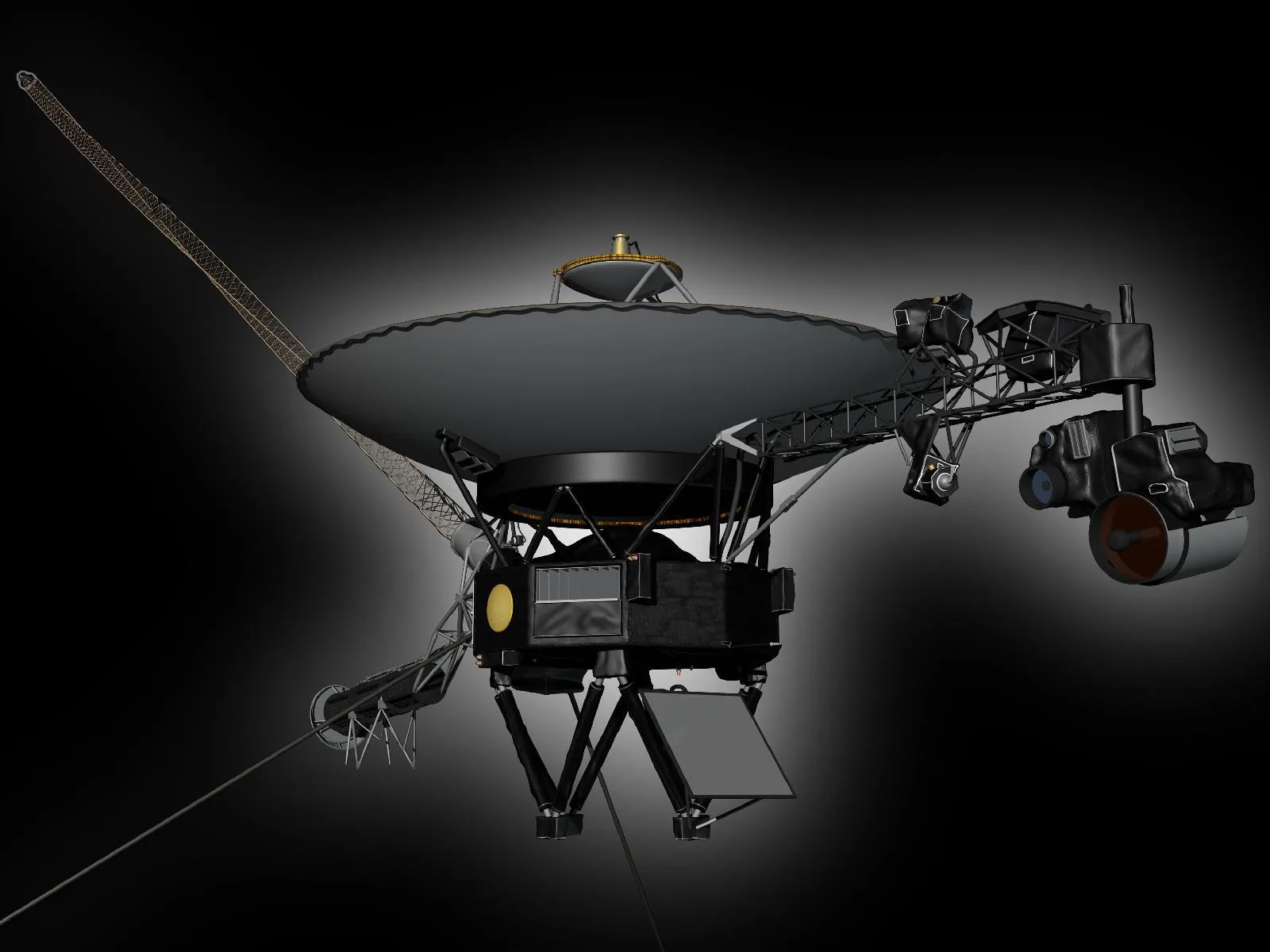
Each carried a message. Bolted to its side: a 12-inch gold-plated copper disk holding 115 analog-encoded images, greetings in 55 languages, the sounds of surf, wind, thunder, and whale song, and roughly 90 minutes of music — assembled by a committee chaired by Carl Sagan, sealed in an aluminum jacket etched with a pulsar map pointing back to Earth. Powered by three radioisotope generators producing about 470 watts at launch, the twins set out on a mission that would cost $865 million through Neptune — and outlive nearly everyone's expectations.
Year 2
The Kingdom of Jupiter
March 5, 1979 · 12:05 UTC
Voyager 1 swept past Jupiter at 12:05 UT on March 5, 1979, passing 277,400 kilometres above the cloud tops — the convention used for every flyby distance in this story. On the way in, its cameras had assembled time-lapse approach movies that set the Great Red Spot churning for the first time — a storm revealed as a living, breathing thing.
The discovery that defined the encounter came four days after closest approach. On March 9, 1979, JPL optical-navigation engineer Linda Morabito was examining a navigation frame taken the day before when she found a gigantic plume — some 300 kilometres tall — arcing off the limb of the moon Io. It was a volcano in mid-eruption: the first active volcanism ever seen beyond Earth.
The hits kept coming. Voyager 1 detected lightning in Jupiter's clouds — another first beyond Earth — discovered the planet's faint ring, and found the moons Thebe and Metis. When Voyager 2 made its own pass at 22:29 UT on July 9, 1979, about 645,000 kilometres out, it added the moon Adrastea, photographed the fractured ice shell of Europa, and confirmed that Io's plumes were still erupting four months on. Jupiter was not a static portrait. It was a kingdom in motion.
Year 3
Saturn, and the Price of Titan
November 12, 1980 · 23:46 UTC
Hours before reaching Saturn itself, Voyager 1 dove to within about 6,490 kilometres of Titan — the encounter mission planners wanted most. What it found was a moon wrapped in an opaque atmosphere of roughly 90 percent nitrogen, laced with methane and organic compounds, its surface completely hidden. Then, at 23:46 UT on November 12, 1980, the spacecraft made its closest approach to Saturn, 64,200 kilometres above the cloud tops — finding five new moons, the G-ring, and winds of up to 1,800 kilometres per hour.
Titan had a price. The trajectory that delivered the flyby bent Voyager 1 inexorably northward, up and out of the plane of the planets — ending its planetary mission forever. The road not taken could have carried it on to Pluto in 1986. And there had been a starker contingency still: had Voyager 1 missed Titan, Voyager 2 would have been retargeted to try again — sacrificing Uranus and Neptune to do it.
It didn't come to that. Voyager 1 delivered, and its twin was free to keep flying the Grand Tour. On August 26, 1981, at 01:21 UT, Voyager 2 made its own pass, 41,000 kilometres above Saturn's clouds, its path bending onward — toward a planet no spacecraft had ever seen up close.
Year 8
Uranus, in the Shadow of Challenger
January 24, 1986 · 17:59 UTC
At 17:59 UT on January 24, 1986, Voyager 2 passed 81,500 kilometres above the cloud tops of Uranus. No spacecraft had ever been there. None has been since. Everything humanity knows of that pale, sideways world from close range was gathered in those few days, in more than 7,000 images.
The encounter delivered ten new moons — with an eleventh, Perdita, found in 1999 hiding in the archived Voyager frames — plus two new rings, and a magnetic field tilted roughly 60 degrees from the planet's rotation axis and offset from its centre by about a third of its radius. The closest flyby of the encounter belonged to the moon Miranda: from around 29,000 kilometres, Voyager 2 photographed a fractured surface broken by cliffs 20 kilometres high.
Four days after closest approach, on January 28, 1986, Space Shuttle Challenger was lost with its crew. The Uranus story vanished from the front pages overnight. The only visit humanity has ever made to that planet was overshadowed within a week of happening — a discovery without its moment.
Year 12
Neptune: The Last Picture Show
August 25, 1989 · 03:56 UTC
At 03:56 UT on August 25, 1989, Voyager 2 skimmed about 4,800 kilometres above Neptune's cloud tops, over the planet's north pole — the closest pass of either Voyager's entire journey, and the final planetary encounter of the mission. Twelve years after launch, the Grand Tour was reaching its last world.
Neptune did not disappoint. An Earth-sized storm — the Great Dark Spot — rode the disk alongside a fast-moving companion cloud nicknamed Scooter, driven by winds of up to 2,000 kilometres per hour, the fastest measured on any planet. Voyager 2 found six new moons and four rings. And then there was Triton: orbiting backwards, venting active nitrogen geysers, wearing a pink methane-ice polar cap, and registering −235 °C (−391 °F) — the coldest body Voyager ever measured.
At JPL, flyby night became a celebration remembered as 'the last picture show.' Vice President Dan Quayle visited. Carl Sagan was there. And Chuck Berry — whose 'Johnny B. Goode' rides on the Golden Record aboard both spacecraft — performed for the engineers who had flown the tour. Ed Stone, who served as project scientist for fifty years, remembered the encounters with a scientist's plainest superlative.
Year 12 · Feb 1990
The Pale Blue Dot
February 14, 1990 · 04:48 UTC
Carl Sagan had argued for it for years: before Voyager 1's cameras went dark, turn them around. On February 14, 1990 — from roughly 6.0 billion kilometres out, 3.7 billion miles, about 40 astronomical units, looking down on the planets from some 32 degrees above the ecliptic — Voyager 1 shot a 60-frame mosaic of the solar system it was leaving behind. The Family Portrait. The final frames, including Earth's, were taken at 4:48 GMT, just 34 minutes before the cameras were powered off forever.
The mosaic caught Venus, Earth, Jupiter, Saturn, Uranus, Neptune, and the Sun. Mercury was lost in the Sun's glare, Mars in scattered light in the optics, Pluto too dim to register. Earth — every life, every history — spanned 0.12 of a single pixel, a pale speck suspended in a band of scattered sunlight.
The sequence was planned by imaging team members including Candy Hansen. For its 30th anniversary in 2020, engineer Kevin M. Gill reprocessed the original data as 'Pale Blue Dot Revisited' — the version shown here — using modern techniques while honouring the intent of the people who planned it. Sagan gave the dot its meaning four years after the shutter closed, in his 1994 book.
Year 35
Crossing the Threshold
August 25, 2012 · 00:00 UTC
The Sun blows a bubble around itself — the heliosphere — and leaving it happens in stages. Voyager 1 crossed the termination shock, where the solar wind abruptly slows, in December 2004 at about 94 AU; Voyager 2 followed in August 2007 at about 84 AU. Beyond lay the heliosheath, and beyond that the heliopause: the boundary where the Sun's plasma finally yields to the plasma of interstellar space. On August 25, 2012, at around 121 to 122 AU, Voyager 1 crossed it — the first human-made object to enter interstellar space. It has not left the solar system; the Sun's gravitational realm extends through the Oort cloud, tens of thousands of years of travel still ahead.
Proving the crossing took a year, and it took sound. Voyager 1's plasma instrument had died back in 1980, so Don Gurnett's plasma wave team at the University of Iowa had to listen instead: when solar outbursts set the surrounding plasma ringing, the oscillations had jumped from roughly 300 hertz to 2–3 kilohertz — the signature of plasma about 40 times denser, plasma that could only be interstellar. NASA announced the result on September 12, 2013. Those rising tones — real spacecraft data converted to audio — are what you can hear below.
Voyager 2 crossed on November 5, 2018, at a different place and a different time — and with its plasma instrument still alive, the measurement was direct and unambiguous. The announcement came on December 10, 2018. Two ships, both out among the stars' weather, still reporting back through antennas like the 70-metre dish at Canberra.
Year 48
Still Talking
April 17, 2026 · 00:00 UTC
On November 14, 2023, Voyager 1 began transmitting gibberish — a single failed memory chip had corrupted its flight data system. The fix meant relocating code across the surviving memory in pieces — surgery performed by radio on a 46-year-old computer. On April 20, 2024, readable engineering data returned — and the room at JPL erupted; that moment is the recording below. By June 13, 2024, science was flowing again from all four instruments then active.
The rescues kept coming. In March 2025, engineers revived Voyager 1's primary roll thrusters — dormant since 2004 and long considered dead — before the Canberra dish went down for upgrades. But power is the unforgiving ledger: about 470 watts at launch, around 220 watts by 2022, falling roughly 4 watts a year — an estimated 205 to 210 watts by mid-2026. So instruments are being switched off to buy years: Voyager 1's cosmic ray subsystem in February 2025, Voyager 2's low-energy charged particle instrument that March, and on April 17, 2026, Voyager 1's own LECP — leaving it two working instruments, the plasma wave subsystem and the magnetometer. Voyager 2 still runs three, and the team hopes to keep its cosmic ray subsystem alive through the 50th anniversary in 2027.
The story is still being written. A coordinated low-power reconfiguration the team calls 'the Big Bang' — testing on Voyager 2 in mid-2026, Voyager 1 no earlier than July — could even allow a shut-down instrument to be restarted. Voyager 1 is now roughly 25.8 billion kilometres out, more than 23 light-hours from home, and in November 2026 it becomes the first spacecraft a full light-day from Earth; Voyager 2 trails at about 21.4 billion kilometres. With careful rationing, at least one instrument per spacecraft may keep reporting into the 2030s. And whatever happens to the radios, the Golden Records ride on — two messages in bottles, just setting out.
Sources: NASA — Voyager Fact Sheet · NASA Science — Voyager 1 · NASA Science — Voyager 2 · NASA Science — Voyager Golden Record Overview · JPL — Voyager 1 Embarks on Historic Journey Into Interstellar Space (2013)
Answers come only from the Voyager mission record above.
Continue your journey

The moment in history
Moment
Voyager 2 launches — only spacecraft to visit Uranus and Neptune
The moment in history
The mission file
Mission
Voyager 1
The mission file
From the same era
Experience
Cassini
From the same era
From the same era
Experience
Hubble
From the same era
From the same era
Experience
Building the ISS
From the same era