
USA · NASA / JPL / SpaceXmissionrobotic
October 14, 2024
Europa Clipper launches to Jupiter's icy moon
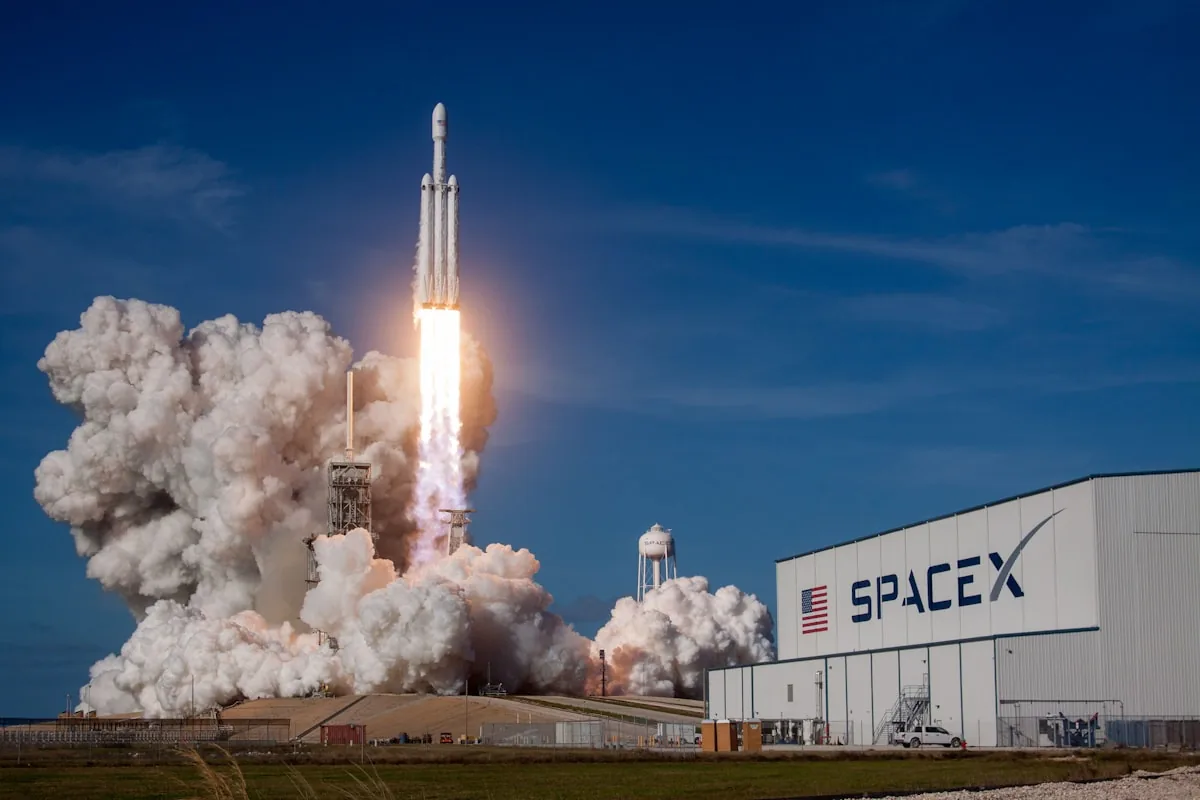
At 12:06 p.m. on 14 October 2024, a Falcon Heavy thundered off Pad 39A at Kennedy Space Center carrying the largest spacecraft NASA has ever built for a planetary mission. Days earlier, Hurricane Milton had torn across Florida and forced the rocket back into shelter, delaying the launch from 10 October. Now all three boosters burned without recovery, every drop of propellant spent on flinging roughly 5,900 kilograms of spacecraft toward Jupiter. The destination was not the giant planet itself but its fourth-largest moon, Europa, whose cracked ice shell is believed to hide a salty ocean containing more liquid water than all of Earth's oceans combined.
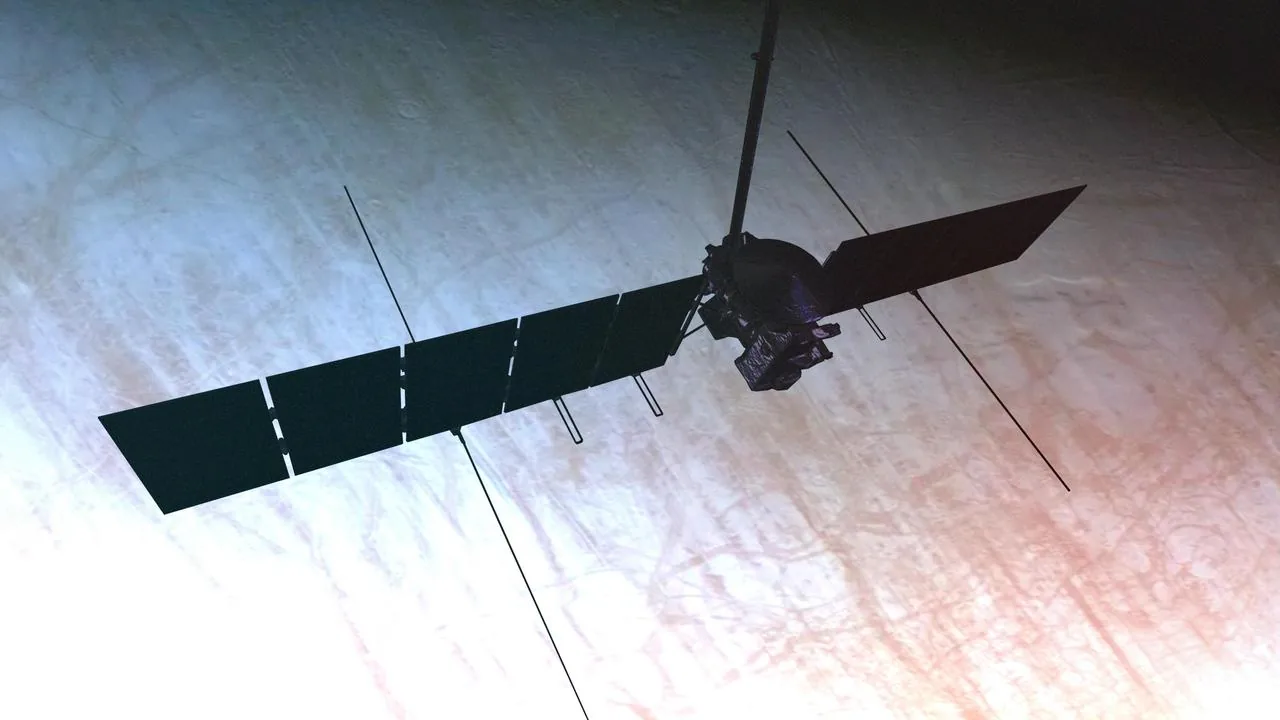
Europa Clipper is built on a grand scale because its job demands it. Its twin solar arrays stretch 30.5 meters tip to tip, the span of a basketball court, sized for sunlight 25 times weaker than Earth's. It carries nine instruments plus a gravity experiment: ice-penetrating radar to sound the shell, cameras and spectrometers to map the surface, and sensors to taste any plumes venting from below. Bolted to its vault, which shields the electronics from Jupiter's ferocious radiation, is a plate engraved with a poem by U.S. Poet Laureate Ada Limón and a microchip carrying 2.6 million names from the public.
The spacecraft cannot fly straight to Jupiter; even Falcon Heavy fully expended could not throw it that hard. Instead it looped past Mars on 1 March 2025 and returns by Earth in December 2026, stealing momentum from both before arriving in April 2030. There it will enter orbit around Jupiter, not Europa, and conduct 49 flybys of the moon, dipping as low as 25 kilometers above the ice while spending most of each orbit outside the worst radiation. The $5.2 billion mission nearly stumbled months before launch, when engineers feared its transistors could not survive Jupiter's radiation belts; painstaking analysis showed they would recover between flybys, and Clipper was cleared to fly.
What waits at Europa is the most promising habitable environment known beyond Earth. The mission will not search for life directly; it will determine whether the ingredients for life, water, chemistry and energy, coexist beneath the ice. Flying in loose formation with ESA's JUICE spacecraft, which reaches the Jovian system in 2031, Clipper will define the next era of astrobiology. If its radar and spectrometers confirm a warm, chemically rich ocean, the question of life beyond Earth will have a specific address.
“NASA leads the world in exploration and discovery, and the Europa Clipper mission is no different.”
Mission Data
Launched
14 Oct 2024, 16:06 UTC, Falcon Heavy
Spacecraft mass
≈5,900 kg fueled
Solar array span
30.5 m
Journey
2.9 billion km; Jupiter arrival Apr 2030
Europa flybys planned
49, as close as 25 km
Mission cost
≈$5.2 billion
Key Facts
Even with all three Falcon Heavy cores expended, Clipper is too massive to fly direct: it borrows speed from Mars (March 2025) and Earth (December 2026) to reach Jupiter in 2030.
The spacecraft carries a vault plate engraved with Ada Limón's poem 'In Praise of Mystery', a microchip holding 2.6 million names submitted by the public, and waveforms of the word 'water' spoken in 103 languages.
Months before launch, engineers discovered Clipper's MOSFET transistors might fail in Jupiter's radiation; analysis showed they would anneal, effectively self-healing between flybys, and the mission launched on time.
Clipper will orbit Jupiter, not Europa, threading 49 flybys that dive to 25 kilometers above the ice and then retreat, a trajectory designed to survive radiation that would destroy a dedicated Europa orbiter.
Hurricane Milton forced the launch to slip from 10 to 14 October, with the spacecraft riding out the storm sealed in its hangar at Kennedy Space Center.
Why It Mattered
Europa Clipper is the first mission ever dedicated to assessing the habitability of an ocean world, and its launch turned the search for life from a telescope question into a flight program. Together with ESA's JUICE, it commits the 2030s to the icy moons, where liquid water has likely persisted for four billion years. The mission also marked an institutional shift: NASA's flagship planetary spacecraft left Earth on a commercial rocket, after Congress freed it from the Space Launch System and saved roughly two billion dollars. Whatever Clipper finds beneath the ice, by 2031 humanity will know whether the solar system's most promising alien ocean is a place where life could exist.
NASA/Amber Jean Notvest
Official sourceContinue your journey
Mission
Europa Clipper
The mission behind this moment

Moment
Polaris Dawn — first commercial spacewalk
From the same era
Moment
Starship Super Heavy booster caught by launch tower
From the same era

Moment
Starship Flight 6 — propulsive soft splashdown
From the same era

Moment
Parker Solar Probe makes closest-ever approach to the Sun
From the same era