Image: SpaceIL
Beresheet
Mission Profile
| Launch date | 2019-02-22 |
|---|---|
| Launch site | Cape Canaveral Air Force Station, Space Launch Complex 40, Florida |
| Launch vehicle | Falcon 9 Block 5 (rideshare with PSN-6 and S5) |
| Spacecraft | Beresheet — IAI-built 585-kg single-stage lander |
| Target | Moon |
| Type | Robotic |
| End date | 2019-04-11 |
| Recovery | Impact debris field on Mare Serenitatis (LRO-confirmed dark smudge) |
| Landing site | 32.5956°N, 19.3496°E (Mare Serenitatis impact site) |
| Cost | ~US$100M (crowdfunded / philanthropic) |
| Mass | 585 kg wet; 150 kg dry |
| Duration | 48-day phasing-loop transit; ~30 seconds of powered descent before LOC |
| Partners | SpaceIL (mission lead), Israel Aerospace Industries (spacecraft prime), NASA (LRA, DSN tracking), UCLA (magnetometer) |
| Instruments | UCLA magnetometer, NASA laser retroreflector, Arch Mission lunar library nano-disc |
Overview
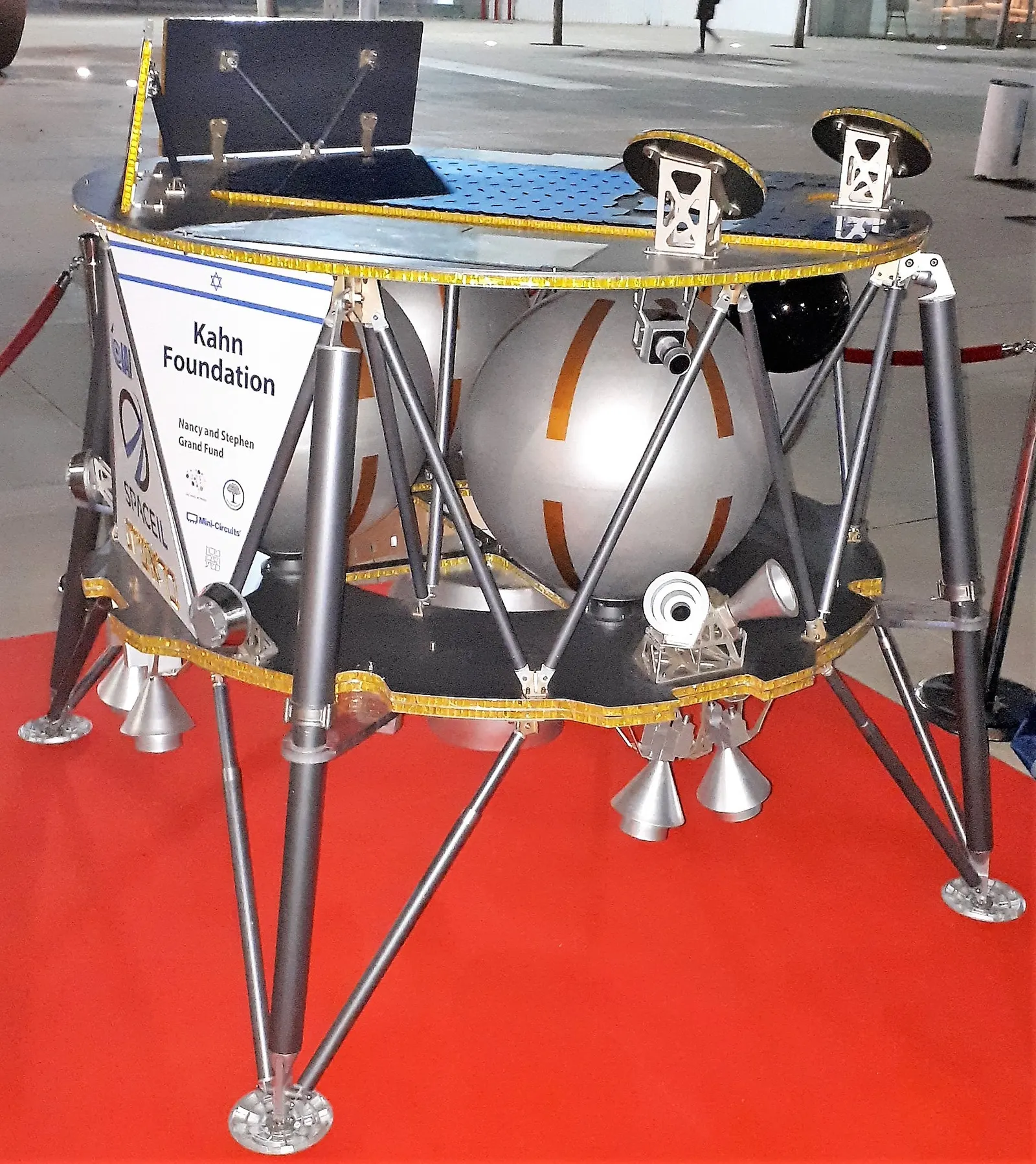
Beresheet ("In the Beginning" in Hebrew) was the first privately funded mission to attempt a lunar landing and the first Israeli spacecraft to leave Earth orbit. Originated as a Google Lunar XPRIZE entry by the nonprofit SpaceIL and built by Israel Aerospace Industries, the 585-kilogram lander launched as a rideshare payload on a Falcon 9 in February 2019 and reached lunar orbit through a propellant-efficient phasing-loop trajectory that took 48 days. Its powered descent began on 11 April 2019 over Mare Serenitatis, but an inertial measurement unit reset triggered the main engine to cut out at approximately 14 km altitude. Telemetry showed engineers restarting the engine, but Beresheet had lost too much altitude to recover, and it impacted the lunar surface at roughly 500 m/s. NASA's Lunar Reconnaissance Orbiter later imaged the dark smudge marking the crash site. Despite the loss, Beresheet was a landmark: it shattered the assumption that lunar landing required nation-state budgets — total program cost was approximately US$100 million, crowdfunded through Israeli philanthropy. SpaceIL's open post-mortem set a cultural norm of public failure-review that NASA's CLPS program now expects from contractors, and Beresheet 2, a twin-lander follow-on, was restructured in 2023 with a 2027 target.
Mission Objectives
Achieve the first Israeli — and first private — soft lunar landing
not-met
Survey Mare Serenitatis magnetic anomalies with a UCLA-supplied magnetometer
not-met
Deploy a NASA-supplied laser retroreflector for ranging experiments
not-met
Deliver the Arch Mission lunar library payload to the surface
partial
Catalyze Israeli STEM engagement and a domestic space-tech sector
achieved
Vehicle Specifications
Spacecraft (wet mass)
- Mass
- 585 kg
Includes ~435 kg of MMH/MON propellant.
Spacecraft (dry mass)
- Mass
- 150 kg
Among the lightest soft-lander attempts in history.
Main engine
Nammo LEROS 2b (400 N) bipropellant; UK-built.
Bus dimensions
- Dimensions
- ~1.5 m tall × 2.0 m across landing legs
Compact four-leg geometry designed for a ~1.5 m drop.
Magnetometer
UCLA-supplied science payload to measure crustal magnetic anomalies.
Key Milestones
2019-02-22
Launch on Falcon 9 from CCAFS SLC-40 at 01:45 UTC
2019-04-04
Lunar orbit insertion via low-energy phasing trajectory
2019-04-11
Powered descent initiated at 19:23 UTC
2019-04-11
IMU2 reset triggers main-engine cutoff at ~14 km altitude
2019-04-11
Engine restart attempted; insufficient altitude for recovery
2019-04-11
Impact at ~500 m/s on Mare Serenitatis
Key Achievements
First privately funded mission to reach lunar orbit
First Israeli spacecraft to operate beyond Earth orbit
Lowest-cost lunar attempt in history at ~US$100 million
Validated low-energy phasing-loop trajectory now standard for small commercial landers
Only Google Lunar XPRIZE entrant to actually reach the Moon (even after the prize expired)
Catalyzed Beresheet 2 (twin-lander follow-on, restructured 2023)
Photo Gallery
Legacy & Significance
Beresheet failed gracefully and in public, and that is precisely why it matters. Until 2019, every entity that had soft-landed on the Moon was a nation-state. Beresheet broke the assumption that lunar landing required national-scale budgets — but it also demonstrated that the failure modes (sensor faults, engine-restart timing, late-descent attitude) were stubbornly unforgiving regardless of how cheap the bus was. Every commercial lander since — ispace Hakuto-R, Astrobotic Peregrine, Intuitive Machines IM-1, Firefly Blue Ghost — has cited Beresheet's IMU-reset failure mode in their FMEA reviews. SpaceIL's open post-mortem also seeded the Israeli space ecosystem: Helios, SpacePharma, Ramon.Space, and the IAF's space directorate all trace recruiting back to the Beresheet cohort.