Image: Shujianyang via Wikimedia Commons (CC BY-SA 4.0)
Shenzhou 5
Mission Profile
| Launch date | 2003-10-15 |
|---|---|
| Launch site | Jiuquan Satellite Launch Center, LA-4/SLS-1 |
| Launch vehicle | Long March 2F (Y5) |
| Spacecraft | Shenzhou 5 |
| Target | Low Earth Orbit |
| Type | Crewed |
| End date | 2003-10-15 |
| Recovery | Land recovery — Siziwang Banner main landing site, Inner Mongolia |
| Mass | 7,840 kg |
| Duration | 21 hours, 23 minutes |
Overview
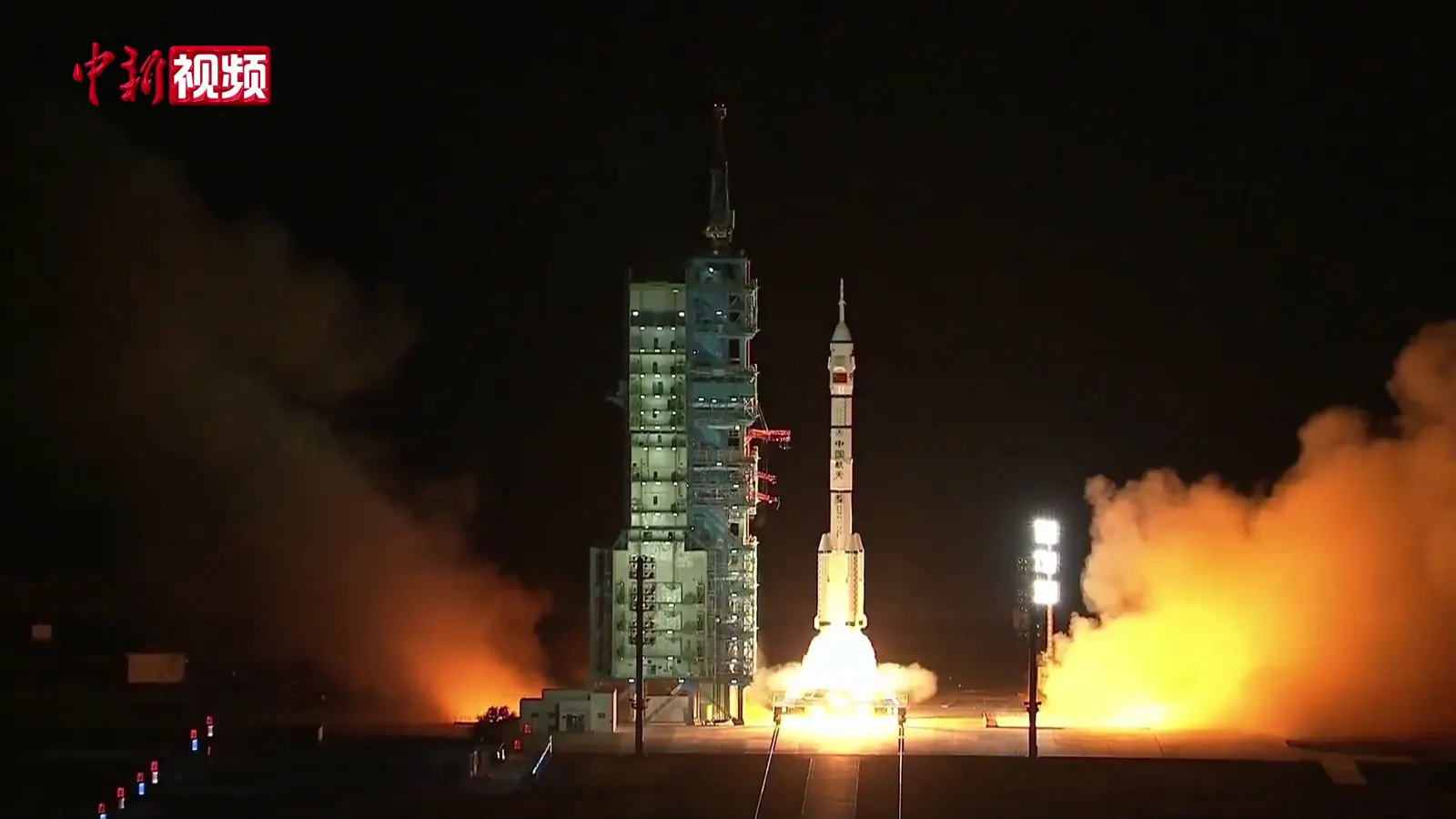
At 09:00 Beijing time on 15 October 2003 (01:00 UTC), a Long March 2F rocket climbed away from the Gobi Desert at Jiuquan carrying Yang Liwei, a 38-year-old People's Liberation Army Air Force pilot selected just hours before flight from a three-man pool. With that single launch China became the third nation, after the Soviet Union and the United States, capable of sending humans to space independently. Yang's 7,840 kg Shenzhou 5 spacecraft entered a 332 × 336 km orbit inclined 42.4 degrees and circled Earth 14 times in 21 hours and 23 minutes. On the seventh orbit he displayed the flags of the People's Republic of China and the United Nations on live television and greeted "people all over the world." Mission rules kept him in the descent module throughout; the orbital module stayed aloft for extended uncrewed operations after separation. The descent module parachuted onto the Inner Mongolian grassland at 22:22 UTC, 6:23 a.m. Beijing time on 16 October, and Yang climbed out unaided and in good condition — a near-flawless first flight that closed the opening chapter of China's three-step human spaceflight strategy.
Crew
Yang Liwei
Commander
First Chinese national in space; his only spaceflight
Key Milestones
2003-10-15
Liftoff from Jiuquan at 01:00:03 UTC (09:00 Beijing time); orbit insertion roughly ten minutes later
2003-10-15
Yang Liwei displays the flags of China and the United Nations during the seventh orbit
2003-10-15
Re-entry module lands in Siziwang Banner, Inner Mongolia, at 22:22:48 UTC after 14 orbits
2003-10-16
Yang Liwei egresses the capsule unaided at dawn Beijing time and is declared in good condition
Key Achievements
Made China the third country to achieve independent human spaceflight, after the Soviet Union and the United States
Completed 14 Earth orbits in 21 hours 23 minutes on China's first crewed attempt
Validated the Long March 2F / Shenzhou crewed system end-to-end, from launch and life support to parachute land recovery
Yang Liwei returned in good condition and egressed the capsule unaided
Legacy & Significance
Shenzhou 5 ended a four-decade duopoly on independent human spaceflight and turned a five-mission uncrewed test campaign into a national triumph watched by hundreds of millions. Yang Liwei became a household name and the template for the taikonaut corps, while the mission's success unlocked funding and political momentum for everything that followed — multi-crew flights, spacewalks, orbital laboratories and ultimately the Tiangong space station. It remains the symbolic founding moment of China as a spacefaring power.