James Webb Space Telescope (JWST)
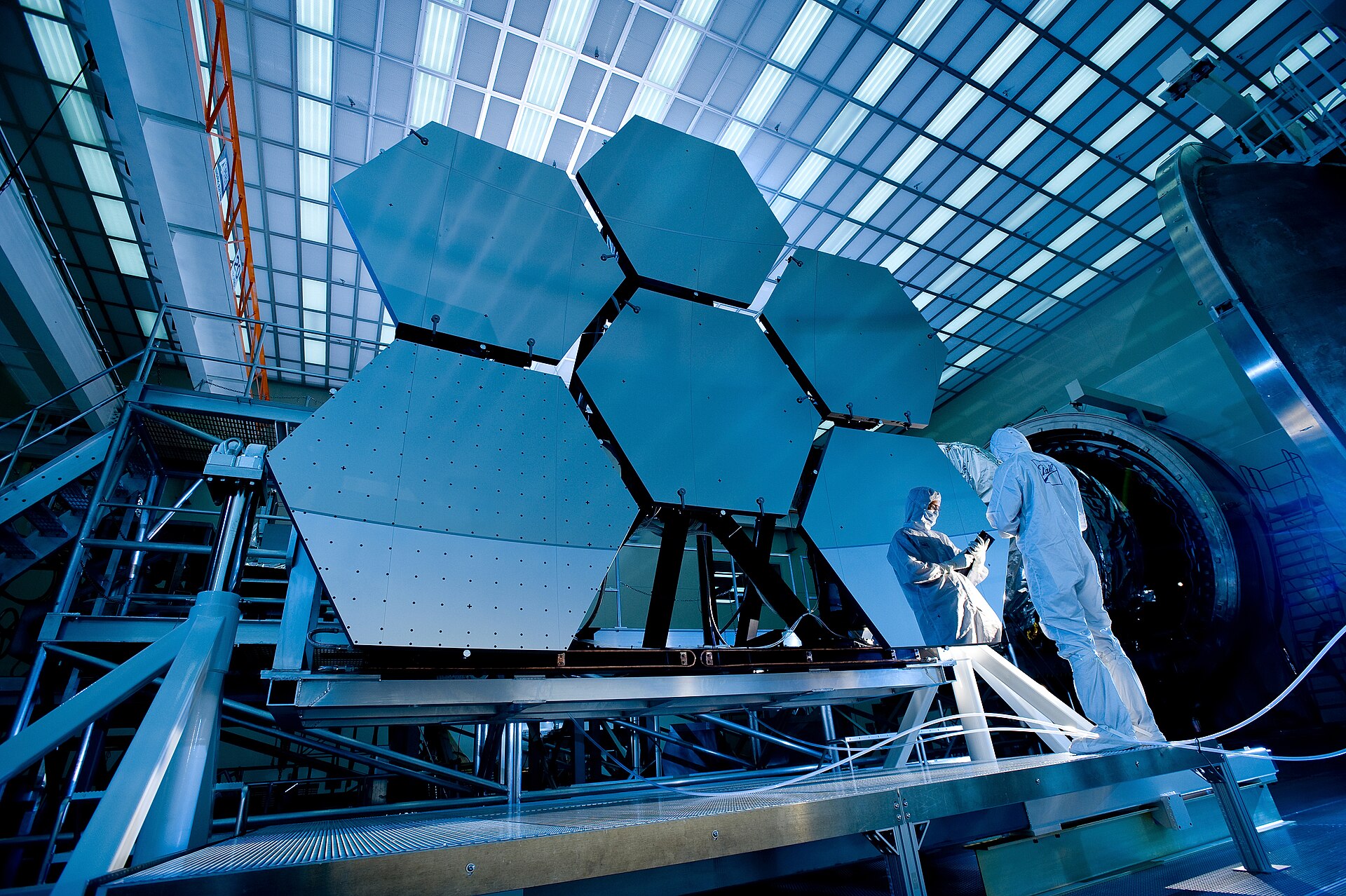
JWST is the most ambitious space telescope ever flown — a $9.7B lifecycle / $8.8B development NASA-ESA-CSA infrared observatory with a 6.5m segmented gold-coated beryllium primary mirror, operating at the Sun-Earth L2 Lagrange point since January 2022 [1][2]. After a tortured 25-year development history that drove cost growth from $0.5B (1996) to nearly twenty-fold, JWST launched flawlessly on Ariane 5 on Christmas Day 2021, fully unfolded by January 8, 2022, and has since produced the deepest infrared images of the universe ever obtained — discovering galaxies at z>14 within the first 290M years after the Big Bang and characterizing the atmospheres of dozens of exoplanets including TRAPPIST-1 system worlds [3][4][5].
Funding & Contract Structure
Total committed: $9.7B lifecycle cost ($8.8B development + $0.9B operations) per NASA OIG IG-19-006; vs. $5B 2010 baseline and $1B 1996 initial estimate — approximately 8.7x growth over original baseline and 1.9x over rebaseline [2]
Annual run-rate: FY2025 enacted operations budget: ~$172M/year for STScI flight operations + science support + propellant management; funded through 2027 minimum [9]
Procurement vehicle: COST-PLUS — Government pays incurred costs plus a fee — contractor bears low risk; cost overruns common.
Congressional status: Bipartisan congressional support through three rebaselines; FY2027 budget request continues full operations funding [9]
GAO / CRS findings
| Date | Finding |
|---|---|
| NASA OIG IG-19-006 set JWST lifecycle cost at $9.7B following $1B cost growth from the 2011 rebaseline; identified launch slips totaling 6.5 years and 14 monthly cost-growth events between 2017-2018[2] | |
| GAO-20-220 found NASA's revised October 2018 launch date of March 2021 was still at high risk of further slips due to integration challenges; launch ultimately slipped to December 2021[11] |
Beneficiary Breakdown
| Contractor | Role | Share | Ticker |
|---|---|---|---|
| Northrop Grumman | prime | Prime contractor for the spacecraft bus, sunshield (five layers, Kapton + aluminum), and integration; ~$3.5B in JWST contract value over 20-year development[6] | NOC |
| BAE Systems (formerly Ball Aerospace) | sub | 18 beryllium primary mirror segments (1.32m each), backplane support structure, and aft optics subsystem; acquired by BAE Systems February 16, 2024 for $5.6B[7] | BA.L |
| L3Harris Technologies | sub | Optical telescope element integration heritage from ITT/Exelis pre-acquisition; ongoing engineering support; on-orbit anomaly resolution[8] | LHX |
| Airbus Defence and Space | sub | NIRSpec near-infrared spectrograph (ESA-funded) and MIRI mid-infrared instrument cooler subsystems; ESA prime contractor[12] | AIR.PA |
| Arianespace | supplier | Ariane 5 ECA launch vehicle (flight VA256, December 25, 2021); ESA-supplied launcher under partnership agreement; precision injection eliminated ~10 years of station-keeping propellant[13] | private |
| Honeywell International | sub | Fine Steering Mirror and FGS / NIRISS Canadian instrument hardware via CSA contribution; high-precision mechanical assemblies[14] | HON |
Key Milestones
Project initiated as the Next Generation Space Telescope (NGST) with $0.5B initial estimate
Northrop Grumman selected as prime contractor; project officially renamed James Webb Space Telescope
Project rebaseline at $8.8B development cost (vs. $5B 2010 baseline) and 2018 launch date
JWST launches on Ariane 5 flight VA256 from Kourou, French Guiana on December 25, 2021 at 12:20 UTC
Primary mirror unfolding completes January 8, 2022; arrival at Sun-Earth L2 Lagrange point completes January 24, 2022
First full-color science images released July 12, 2022 including Webb's First Deep Field
First detection of carbon dioxide in an exoplanet atmosphere (WASP-39b) using NIRSpec
Spectroscopic confirmation of galaxy JADES-GS-z14-0 at z=14.32, light from ~290M years after the Big Bang
BAE Systems completes acquisition of Ball Aerospace for $5.6B; JWST mirror manufacturer becomes BAE Systems Space & Mission Systems
JWST Cycle 5 GO program begins; ~3,000 observing hours allocated
Primary mission concludes; transition to extended-mission phase
Catalysts
| Date | Event | Sentiment |
|---|---|---|
| JWST Cycle 5 General Observer program — ~3,000 hours allocated across exoplanet atmospheres, high-z galaxy spectroscopy, and Solar System targets[10] | neutral | |
| Joint JWST + Roman / HST early-release observations of high-redshift galaxy populations; coordinated multi-observatory campaign begins[15] | bullish | |
| NASA Senior Review of operating missions evaluates JWST extension funding for FY2028+ alongside HST and Chandra; recommend continued full operations expected[9] | neutral | |
| JWST primary mission concludes (Cycle 8); transition to extended-mission phase; remaining propellant supports operations through ~2042[1] | neutral |
Risk Register
Competitive Landscape
Investability Map
| Ticker | Exposure | Note |
|---|---|---|
| NOC | medium | Northrop Grumman captured ~$3.5B in JWST development revenue and continues to provide spacecraft engineering support during operations. JWST is closed-loop revenue but cements NOC's reputation for complex deployable space systems — a credential leveraged in Roman, HWO and military deployable apertures. |
| LHX | low | L3Harris (via legacy ITT/Exelis acquisition) holds engineering-services scope for ongoing on-orbit anomaly resolution; modest annual revenue with low downside but minimal upside. |
| BA.L | low | BAE Systems acquired Ball Aerospace in February 2024 for $5.6B; JWST mirror manufacturing is heritage rather than ongoing revenue, but the franchise underpins BAE's bid posture on Roman, HWO, and CHIME constellation. |
| HON | low | Honeywell's mechanical-assembly content on JWST is closed-loop; no material forward-revenue exposure but heritage value for Roman fine-steering mirror bid. |
Not investment advice. Figures as-quoted from cited sources.
Sources
- [1] NASA — James Webb Space Telescope mission overview (Agency budget doc, accessed )
- [2] NASA OIG IG-19-006 — NASA's James Webb Space Telescope (Feb 2019); $9.7B lifecycle cost (GAO / CRS report, accessed )
- [3] NASA — JWST launch and deployment timeline (Dec 25, 2021 launch through Jan 24, 2022 L2 arrival) (Agency budget doc, accessed )
- [4] NASA — Webb's First Deep Field image release (July 12, 2022) (Agency budget doc, accessed )
- [5] NASA / STScI — JWST science highlights (JADES-GS-z14-0 at z=14.32; WASP-39b CO2; TRAPPIST-1 atmospheres) (Agency budget doc, accessed )
- [6] Northrop Grumman — James Webb Space Telescope program page (Official company site, accessed )
- [7] BAE Systems — Space & Mission Systems (formerly Ball Aerospace) JWST mirror heritage; Feb 2024 acquisition close (Official company site, accessed )
- [8] L3Harris Technologies — Mission Systems heritage including ITT/Exelis JWST optical telescope element integration (Official company site, accessed )
- [9] NASA — Fiscal Year 2027 Budget Request; Astrophysics Division line items (Agency budget doc, accessed )
- [10] Space Telescope Science Institute (STScI) — JWST observing programs and Cycle 5 announcement (Agency budget doc, accessed )
- [11] GAO-20-220 — NASA: Assessments of Major Projects (JWST schedule risk; Mar 2020) (GAO / CRS report, accessed )
- [12] ESA — JWST mission page (NIRSpec instrument, Ariane 5 launcher contribution) (Agency budget doc, accessed )
- [13] Arianespace — Ariane 5 flight VA256 JWST launch (Dec 25, 2021) (Official company site, accessed )
- [14] Canadian Space Agency — JWST contribution: FGS / NIRISS (Agency budget doc, accessed )
- [15] STScI — coordinated JWST + Roman + HST early-release observation planning (Agency budget doc, accessed )
- [16] NASA — JWST micrometeoroid impact on mirror segment C3 (May 2022) post-impact analysis (Agency budget doc, accessed )
- [17] SpaceNews — JWST MIRI medium-resolution spectrograph grating wheel anomaly and workarounds (Industry trade press, accessed )