Nancy Grace Roman Space Telescope
The Nancy Grace Roman Space Telescope is NASA's next astrophysics flagship — a 2.4m wide-field infrared survey observatory operating at the Sun-Earth L2 Lagrange point, with a 0.281 square-degree field of view 100x larger than Hubble's, targeting dark energy, exoplanet microlensing, and infrared time-domain astronomy [1][2]. Roman uses a 2.4m primary mirror donated by the National Reconnaissance Office in 2012, has a $4.3B development cost cap set by Congress in 2018, and is targeting an October 2026 launch on a SpaceX Falcon Heavy [3][4]. The mission anchors prime contracts at NASA Goddard (integration), BAE Systems / Ball Aerospace (Wide Field Instrument and bus components), L3Harris (optical telescope element), Northrop Grumman (avionics and pointing), and Teledyne (H4RG-10 detectors) [5][6][7][8].
Funding & Contract Structure
Total committed: $4.3B development cost cap set by Congress and confirmed by FY2018 appropriation; lifecycle cost including five-year prime mission projected at $4.5-4.8B [4]
Annual run-rate: Development peak FY2024-25 of ~$510M/year; ramps down to ~$60-80M/year Phase E operations after October 2026 launch [9]
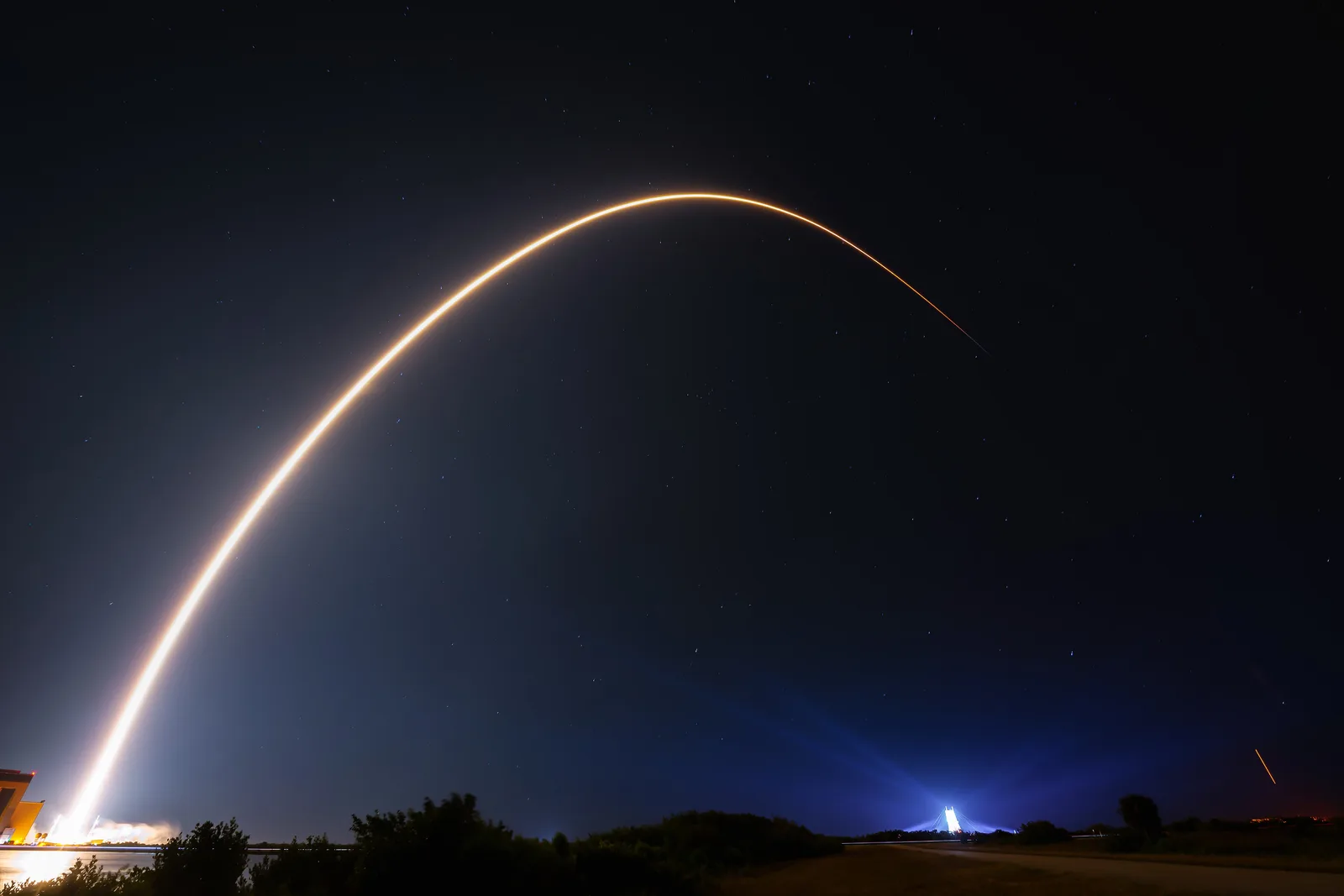
Per launch: SpaceX Falcon Heavy launch contract awarded July 2023: $255M (fully-expendable configuration, direct injection to Sun-Earth L2) [7]
Procurement vehicle: COST-PLUS — Government pays incurred costs plus a fee — contractor bears low risk; cost overruns common.
Congressional status: Bipartisan congressional support; survived FY2018 and FY2019 White House proposed cancellations through congressional appropriations override; FY2027 budget request funds completion and operations [9]
GAO / CRS findings
| Date | Finding |
|---|---|
| NASA OIG IG-24-014 found Roman on track for October 2026 launch and within $4.3B cost cap; flagged Wide Field Instrument environmental testing as on the critical path through 2025[12] | |
| GAO-22-105212 NASA Major Projects assessment found Roman cost and schedule within commitment but noted Coronagraph Instrument descope from required to technology demonstration in 2018 as cost-control measure[13] |
Beneficiary Breakdown
| Contractor | Role | Share | Ticker |
|---|---|---|---|
| BAE Systems (formerly Ball Aerospace) | prime | Wide Field Instrument (WFI) prime contractor — Roman's primary survey camera and largest single subcontract on the program at ~$310M; acquired by BAE Systems February 2024[5] | BA.L |
| L3Harris Technologies | prime | Optical Telescope Assembly (OTA) prime contractor — integrates the donated 2.4m NRO primary mirror with the secondary mirror system; ~$320M subcontract from Goddard[6] | LHX |
| Northrop Grumman | sub | Spacecraft bus and pointing-control system — formerly Orbital ATK heritage; provides the precision pointing required for Roman's 0.011-arcsec stability requirement[14] | NOC |
| Teledyne Imaging Sensors | supplier | 18 H4RG-10 4K×4K HgCdTe infrared focal-plane arrays for the Wide Field Instrument; sole-source supplier with heritage from JWST NIRCam and Euclid[8] | TDY |
| SpaceX | supplier | Falcon Heavy launch services contract awarded July 2023 at $255M; fully-expendable configuration with direct injection to Sun-Earth L2[7] | private |
| JAXA | sub | International contribution to the Coronagraph Instrument (CGI) — Japanese consortium providing detector subsystems and optical components[15] | private |
Key Milestones
WFIRST identified as top-priority large mission by the New Worlds, New Horizons decadal survey
National Reconnaissance Office donates two 2.4m mirrors to NASA; one selected as Roman's primary mirror
Congress sets $4.3B development cost cap in FY2018 NASA appropriation; overrides White House cancellation proposal
Mission renamed Nancy Grace Roman Space Telescope (from WFIRST) to honor NASA's first chief astronomer
NASA awards SpaceX $255M Falcon Heavy launch contract for direct injection to Sun-Earth L2
Spacecraft integration at NASA Goddard begins; KDP-E (launch-readiness) review completes
BAE Systems completes acquisition of Ball Aerospace for $5.6B; Roman WFI prime becomes BAE Systems Space & Mission Systems
Nancy Grace Roman Space Telescope launches on SpaceX Falcon Heavy (NET October 2026)
L2 arrival, instrument commissioning, first-light imaging; Cycle 1 GO call for proposals
Galactic Bulge Time Domain Survey begins; first joint Roman + JWST coordinated observations
Five-year prime mission concludes; extended-mission decision pending Senior Review
Catalysts
| Date | Event | Sentiment |
|---|---|---|
| Roman pre-launch environmental testing and final integration at NASA Goddard; Wide Field Instrument vibration / thermal-vacuum certification completes[4] | bullish | |
| Nancy Grace Roman Space Telescope launches on SpaceX Falcon Heavy from KSC LC-39A on a direct injection to Sun-Earth L2 (NET October 2026)[7] | bullish | |
| L2 arrival and instrument commissioning; first-light imaging from the Wide Field Instrument expected ~3 months after launch[1] | bullish | |
| First Roman Cycle 1 General Observer call for proposals; ~25% of survey time available to guest observers[11] | neutral | |
| Galactic Bulge Time Domain Survey (GBTDS) begins delivering exoplanet microlensing detections at population-statistical scale; first joint Roman + JWST coordinated observing campaigns[11] | bullish | |
| Roman five-year prime mission concludes; extended mission decision pending Senior Review[1] | neutral |
Risk Register
Competitive Landscape
Investability Map
| Ticker | Exposure | Note |
|---|---|---|
| BA.L | high | BAE Systems' acquired Ball Aerospace business holds the Wide Field Instrument prime contract (~$310M) — Roman's largest single subcontract. Roman is a strategic credential for HWO and future flagship instrument competitions. |
| LHX | high | L3Harris holds the Optical Telescope Assembly prime contract (~$320M); Roman is one of L3Harris's most visible flagship space science wins and underpins bid posture on HWO and Earth-observation flagships. |
| NOC | medium | Northrop Grumman provides the spacecraft bus and precision pointing system; modest Roman content vs. its Artemis and JWST franchise but high heritage value. |
| TDY | medium | Teledyne Imaging Sensors is the sole-source supplier of H4RG-10 detectors for Roman's Wide Field Instrument; franchise leveraged across JWST NIRCam, Euclid, Roman, and emerging Earth-observation programs. |
Not investment advice. Figures as-quoted from cited sources.
Sources
- [1] NASA Goddard — Nancy Grace Roman Space Telescope mission portal (Agency budget doc, accessed )
- [2] NASA — Roman Space Telescope renaming announcement (May 20, 2020) (Agency budget doc, accessed )
- [3] NASA — Roman primary mirror history; 2012 NRO mirror donation (Agency budget doc, accessed )
- [4] NASA — Roman Space Telescope mission overview and budget commitment (Agency budget doc, accessed )
- [5] BAE Systems (formerly Ball Aerospace) — Roman Wide Field Instrument program page (Official company site, accessed )
- [6] NASA JPL — Roman Coronagraph Instrument program page (Agency budget doc, accessed )
- [7] NASA — SpaceX Falcon Heavy launch contract for Roman ($255M, July 2023) (Agency budget doc, accessed )
- [8] Teledyne Imaging Sensors — H4RG-10 infrared focal-plane arrays for Roman Wide Field Instrument (Official company site, accessed )
- [9] NASA — Fiscal Year 2027 Budget Request; Astrophysics Division line items (Agency budget doc, accessed )
- [10] NASA — Roman Space Telescope launch trajectory and L2 mission orbit (Agency budget doc, accessed )
- [11] Space Telescope Science Institute — Roman science operations and observing program (Agency budget doc, accessed )
- [12] NASA OIG IG-24-014 — NASA's Management of the Nancy Grace Roman Space Telescope (June 2024) (GAO / CRS report, accessed )
- [13] GAO-22-105212 — NASA Assessments of Major Projects (Roman cost / schedule status April 2022) (GAO / CRS report, accessed )
- [14] Northrop Grumman — Space precision pointing and spacecraft bus heritage (Official company site, accessed )
- [15] JAXA — Roman Coronagraph Instrument international contribution (Agency budget doc, accessed )
- [16] SpaceNews — Roman Space Telescope launch readiness review (2024) (Industry trade press, accessed )