The Body That Rewired Indian Space
Every headline about India's private space boom -- Skyroot's rockets, Pixxel's hyperspectral satellites, Agnikul's 3D-printed engines -- eventually points back to a single acronym that almost nobody outside the industry can spell out: IN-SPACe. The Indian National Space Promotion and Authorization Centre is not a launch company, not a satellite builder, and not a research lab. It is a regulator and a promoter, and it is the piece of institutional plumbing that made everything else possible.
Before 2020, building anything that flew to space in India was effectively a government monopoly. There was no legal channel for a private company to authorize a launch, license a satellite, or access the Indian Space Research Organisation's test stands. A country that had already reached Mars and the lunar south pole had, paradoxically, no front door through which a startup could walk. IN-SPACe was created to be that door. This piece explains the machinery -- what IN-SPACe is, how it fits alongside ISRO and NSIL, the specific reforms it administers, and where the framework still has holes.
Why IN-SPACe Was Created: The 2020 Reforms
The reform moment came in June 2020, when the Union Cabinet approved a restructuring of India's space governance and announced the creation of IN-SPACe as an autonomous, single-window agency under the Department of Space. The diagnosis behind the move was straightforward. ISRO was both the sector's only operator and, implicitly, its gatekeeper -- an arrangement that gave private firms no neutral party to approve their activities and no assurance of fair access to national infrastructure they had helped fund through taxes.
The single-window concept is the core idea. Instead of a private company negotiating separately with ISRO for facilities, with the Department of Space for policy clearance, and with various ministries for spectrum and site permissions, IN-SPACe was designed as one desk that hands, hand-holds, and authorizes non-governmental entities across the whole lifecycle: launch vehicles, satellites, ground stations, and data services. It also became the body that promotes -- actively courting industry, running the registration portal, and brokering access to ISRO's premises and expertise. The results speak to the pent-up demand it unlocked: India had a single registered space startup in 2014, and by early 2026 the count on the IN-SPACe portal had crossed 300 and, by some counts, 400 registered commercial entities, up from 54 in 2020.
The Three-Body Structure: ISRO, NSIL, and IN-SPACe
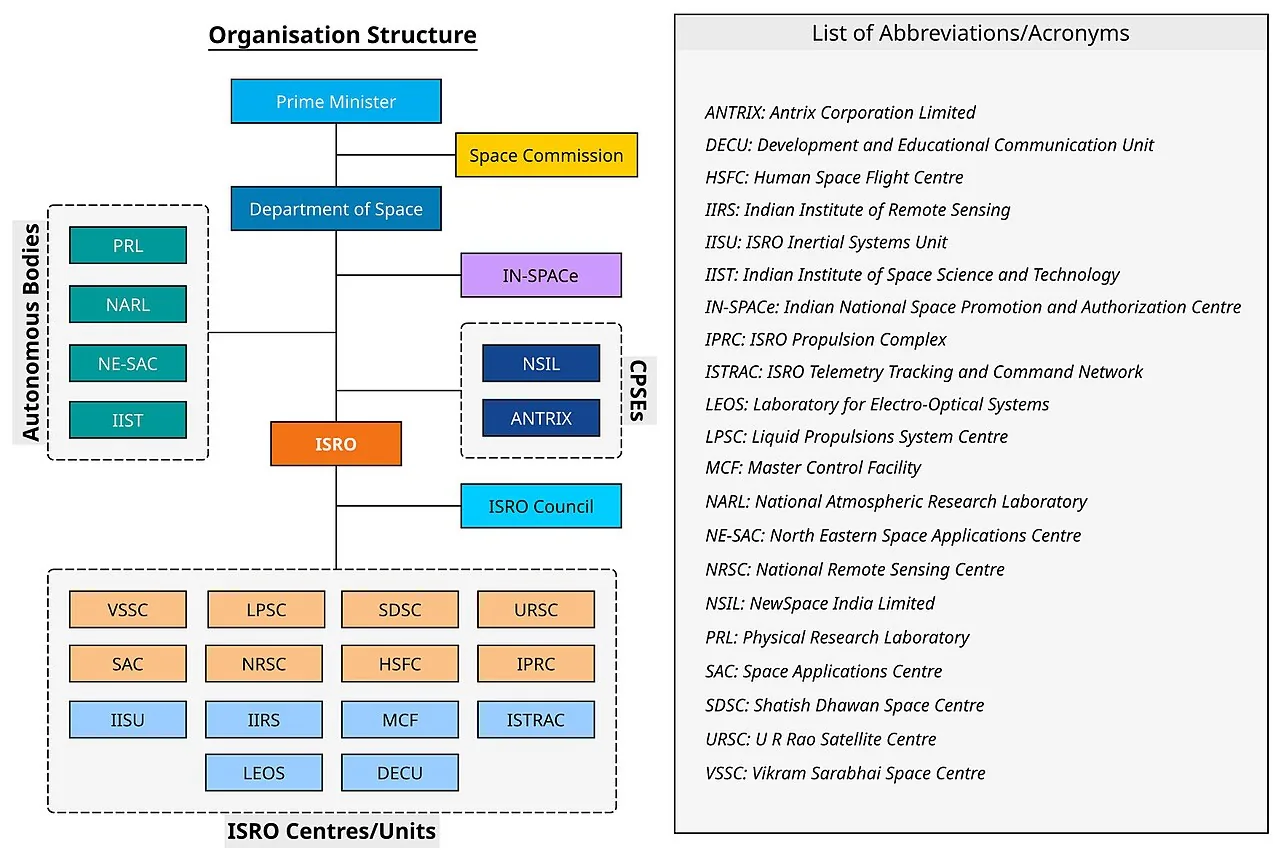
To understand IN-SPACe, you have to see it as one leg of a deliberately separated triad. India did not simply bolt a regulator onto ISRO; it split the space enterprise into three institutions with distinct mandates, a division the Indian Space Policy 2023 later codified.
ISRO is now steered toward research and development. Its job is to push the frontier -- advanced launch vehicles, deep-space missions, human spaceflight -- and to progressively hand off routine, operational, and commercial work to industry rather than doing it in-house forever.
NewSpace India Limited (NSIL), incorporated in 2019, is ISRO's commercial arm -- a public-sector company that owns and operates commercial launches, transfers ISRO-developed technologies to industry, and productizes the agency's know-how. NSIL is the seller and the operator; it carries the commercial risk on missions like on-demand satellite launches and has announced plans to invest on the order of a billion dollars scaling high-technology manufacturing.
IN-SPACe is the promoter, authorizer, and regulator -- the referee, not a player. It does not own rockets or sell launches. It grants authorizations, arbitrates access to shared facilities, and champions the private sector.
The logic of the split is to remove the conflict of interest baked into the old model. When the same organization builds, sells, and approves, a competing startup can never be sure the deck is not stacked. By separating R&D (ISRO), commerce (NSIL), and authorization (IN-SPACe), India tried to give private entrants a regulator whose incentives are not tied to any single operator's balance sheet.
The Reforms IN-SPACe Administers
A regulator is only as consequential as the rules it enforces, and the substance of India's opening lives in three policy layers that IN-SPACe now sits atop.
The Indian Space Policy 2023. Released in April 2023, this is the foundational document. It formally delineates the roles above, and -- crucially -- it declares that non-governmental entities may carry out the full sweep of space activities: building and operating satellites, providing launch services, running ground stations, and disseminating remote-sensing data. It reframed the private sector from an occasional ISRO vendor into an independent participant, with IN-SPACe as the authorizing authority for that participation.
FDI liberalization (2024). In February 2024 the Union Cabinet approved, and an April 2024 gazette notification implemented, a sweeping change to foreign-investment rules. Rather than a single blanket figure, India adopted a graded framework calibrated to strategic sensitivity: up to 100 percent FDI under the automatic route for manufacturing satellite components, systems, and sub-systems and the ground and user segments; up to 74 percent automatic for satellite manufacturing and operation (beyond that requires government approval); and up to 49 percent automatic for launch vehicles, associated systems, and spaceport creation. This unlocked foreign capital and technology partnerships for a sector that had been almost entirely closed to overseas money.
Authorization in practice. Day to day, IN-SPACe issues the authorizations that let private activity happen: clearances for satellite operations, launch campaigns, ground-station deployment, and data services, plus coordination on spectrum and launch-site access. It also runs the pipe for technology transfer -- more than 70 ISRO-developed technologies have been moved to private industry through the NSIL/IN-SPACe channel. The most striking example came in September 2025, when Hindustan Aeronautics Limited signed a technology-transfer agreement with NSIL, ISRO, and IN-SPACe for the Small Satellite Launch Vehicle, paying around Rs 511 crore for a license to mass-produce SSLV rockets -- the first time an entire Indian launch vehicle was handed to a private manufacturer.
Money on the Table: The ₹1,000 Crore Fund and Beyond
Authorization removes barriers; capital builds companies. India recognized that a permissive regime alone would not seed a domestic industry against deep-pocketed American and Chinese rivals, so the state layered financial support on top of the regulatory reforms.
In October 2024 the Union Cabinet approved a ₹1,000 crore venture-capital fund dedicated to space startups, to be deployed under the aegis of IN-SPACe over roughly five years, with annual investments in the ₹150-250 crore range aimed at backing on the order of 40 companies. Rather than a grant scheme, it is structured as equity investment across growth stages -- roughly ₹10-30 crore for growth-stage firms and ₹30-60 crore for later-growth companies. After the Securities and Exchange Board of India cleared it on October 31, 2025, IN-SPACe and SIDBI Venture Capital signed the agreement to operationalize the fund, targeting launch systems, satellite manufacturing, payloads, in-space services, and data applications. In February 2026, the government moved to add a further ₹500 crore Technology Adoption Fund to help startups absorb and commercialize technologies.
This matters because private venture capital in India, while growing, is thin for capital-intensive hardware with long payback horizons. A government anchor investor de-risks the category and signals durability, and it is a large part of why cumulative funding into Indian space startups has crossed half a billion dollars, with roughly $150 million flowing in during 2025 alone. The macro ambition these instruments serve is explicit: lift India's space economy from about $8.4 billion to roughly $44 billion by 2033, raising its share of the global market from about 2 percent toward 8 percent.
The Gaps: A Regulator Without a Law
For all the momentum, the Indian framework has a structural weakness that industry watchers and IN-SPACe's own leadership acknowledge: IN-SPACe still lacks statutory backing. It was created by executive decision, not by an act of Parliament, and it currently authorizes private launches, satellites, and ground stations by drawing on the delegated powers of the Department of Space and ISRO rather than a law of its own.
The missing piece is the long-delayed Space Activities Bill. A draft was first circulated for public comment back in 2017, and it has never become law. A comprehensive statute would define offences and penalties, set clear entry conditions for private operators, and -- most importantly for a spacefaring nation -- allocate liability for damage caused by space objects, honoring India's obligations under the UN space treaties while shielding startups from open-ended exposure. A well-drafted bill is also expected to enable accessible, affordable insurance for high-value assets, a barrier that has been prohibitive for young companies. In May 2026, IN-SPACe chairperson Pawan Goenka indicated that a fresh draft would soon go to stakeholder ministries for consultation, but as of mid-2026 the sector is still operating on policy and executive authorization rather than primary legislation. Until the bill passes, an authorization from IN-SPACe rests on administrative footing rather than an unambiguous legal one -- a source of uncertainty for foreign investors and insurers weighing long-duration commitments.
How It Compares: India's Model Versus the US FAA/FCC Split
It helps to measure IN-SPACe against the regulatory system it partly emulates. In the United States, commercial space is governed by a fragmented set of agencies: the Federal Aviation Administration's Office of Commercial Space Transportation licenses launches and reentries, the Federal Communications Commission authorizes spectrum and orbital slots for satellites, the National Oceanic and Atmospheric Administration licenses commercial remote-sensing imagery, and NASA acts as an anchor customer and technology partner but not a regulator. Authority is distributed, and each function sits with a different specialized body backed by decades of statute.
India took the opposite architectural bet: consolidate. IN-SPACe is deliberately a single window meant to fold launch authorization, satellite licensing, and facility access into one desk, in the way an entrepreneur might wish the FAA, FCC, and NOAA were merged. That consolidation is a genuine advantage in speed and simplicity for a young ecosystem -- one relationship instead of four. But the US system has one thing India's does not yet possess: a firm statutory foundation for each regulator. The FAA and FCC derive their powers from Congress, not from an executive order that borrows another agency's authority. India has the cleaner org chart; the United States has the settled law. The Space Activities Bill is precisely the instrument that would let India keep its streamlined single-window design while giving it the durable legal backbone the American patchwork already enjoys. Get that combination right, and India will have built something neither model currently offers in full: one door, firmly bolted to statute.