Beyond the Giant's Shadow
For decades, India's space story had a single protagonist: the Indian Space Research Organisation. ISRO built satellites on shoestring budgets, launched Mars orbiters for less than the cost of a Hollywood film, and landed on the Moon's south pole before anyone else. It earned the nation's adoration and the world's respect. But here is the thing about a space agency that inspires an entire generation -- eventually, that generation wants to build rockets of its own.
India's private space sector has exploded into life. With over $400 million in cumulative funding, more than 190 registered space startups, and a regulatory framework purpose-built to encourage commercial participation, India is rapidly developing one of the most vibrant private space ecosystems outside the United States. What makes this story particularly compelling is that it is happening in a country where, until very recently, building a rocket was something only the government was allowed to do.
The Policy Breakthrough
The turning point came in 2020. The Indian government introduced a series of reforms that fundamentally reshaped who could participate in the space sector. The creation of the Indian National Space Promotion and Authorization Centre -- IN-SPACe -- established a dedicated regulatory body to authorize and supervise private space activities. IN-SPACe was designed to be a single-window clearance system, cutting through the bureaucratic thickets that had previously made it nearly impossible for private companies to operate in space.
Alongside IN-SPACe, the government created NewSpace India Limited (NSIL) as ISRO's commercial arm, tasked with transferring technologies from the national agency to private industry. The draft Space Activities Bill further clarified the legal framework for private launches, satellite operations, and liability. The message from New Delhi was unmistakable: India's space future would be built not just by ISRO, but alongside ISRO.
These reforms unleashed a wave of entrepreneurial energy. Engineers who had trained at ISRO, IITs, and IISc suddenly had a path to build their own companies. Venture capital firms that had been watching the global New Space movement finally had a regulatory framework they could underwrite. The results have been remarkable.
Skyroot Aerospace: India's First Private Rocketeer
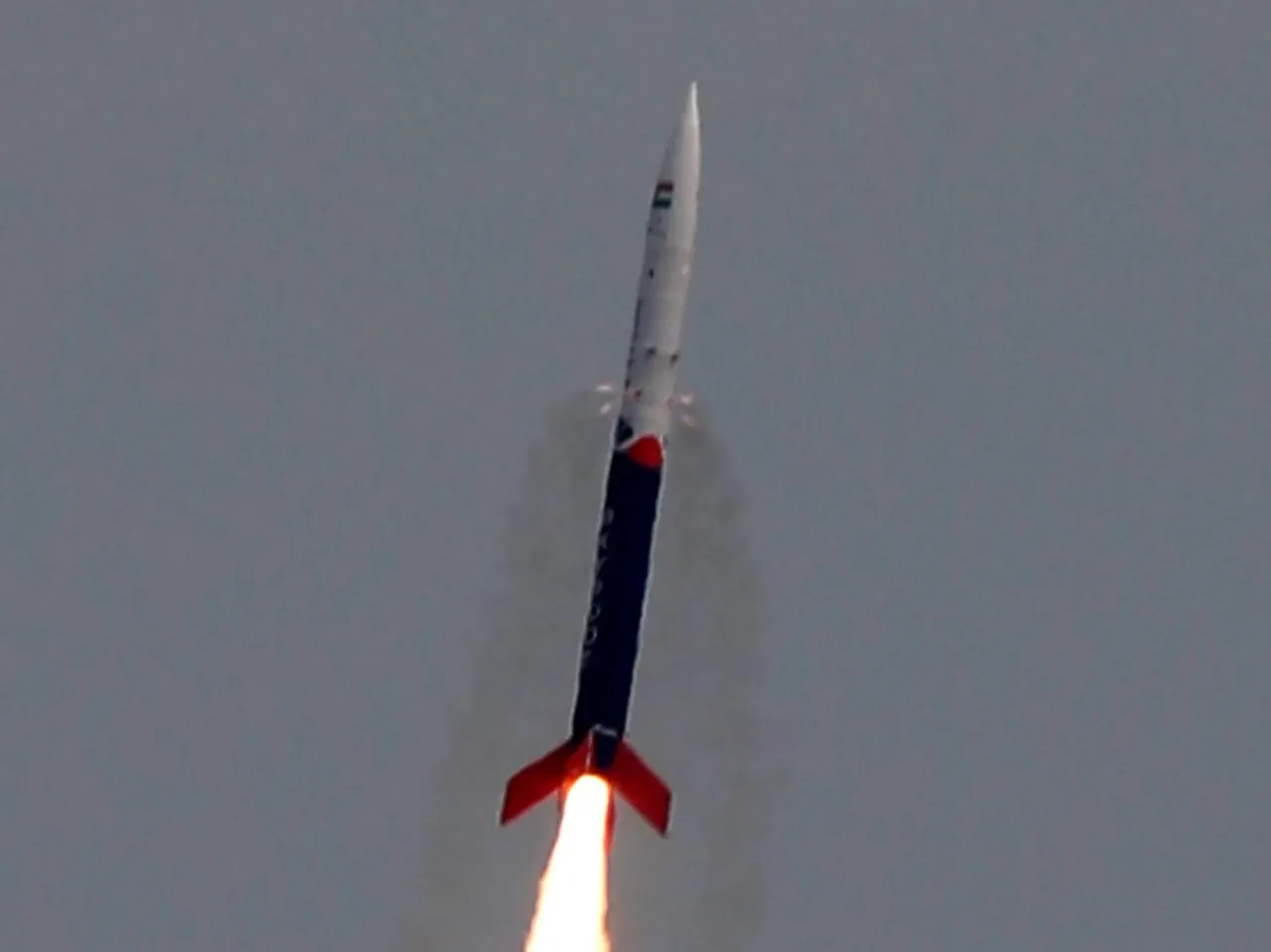
On November 18, 2022, a small solid-fueled rocket named Vikram-S lifted off from ISRO's Sriharikota launch complex and flew to an altitude of 89.5 kilometers. The flight lasted just 300 seconds. But those five minutes changed Indian space history permanently. Vikram-S, built by Hyderabad-based Skyroot Aerospace, became the first rocket developed by an Indian private company to reach space.
The mission, named "Prarambh" (meaning "the beginning" in Sanskrit), was a suborbital technology demonstrator, but it validated critical systems including the rocket's solid-fuel motor, avionics, and carbon-composite structures. Skyroot had developed the vehicle in remarkably compressed timelines, having been founded only in 2018 by Pawan Kumar Chandana and Naga Bharath Daka, both former ISRO engineers.
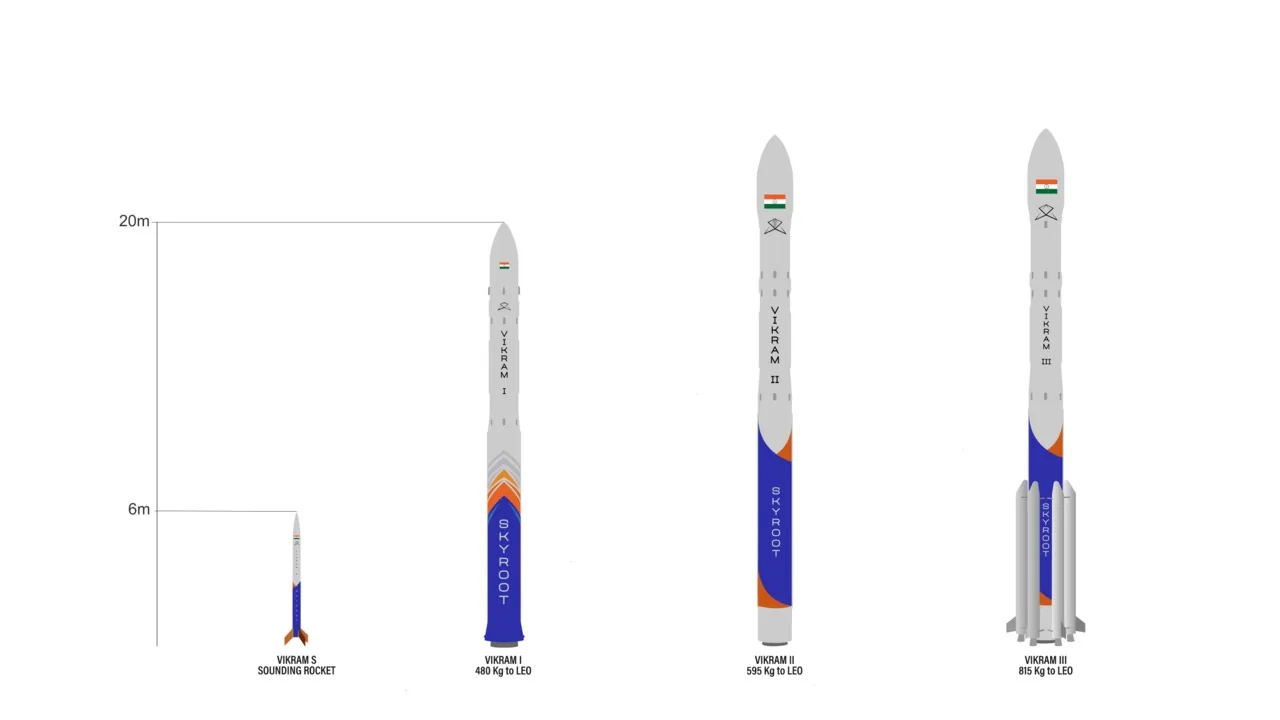
Skyroot's ambitions extend well beyond suborbital flight. The company is developing Vikram-1, a small orbital launch vehicle designed to deliver approximately 480 kilograms to low Earth orbit and 300 kilograms to sun-synchronous orbit. Vikram-1 uses a combination of solid and liquid propulsion stages, with Skyroot having successfully test-fired its Dhawan-1 liquid engine (named after ISRO's founding father, Satish Dhawan) and its Kalam-5 solid motor. The company has raised over $100 million across multiple funding rounds, with investors including Singapore's GIC, Nexus Venture Partners, and others. Vikram-1's orbital debut is one of the most anticipated events in the Indian space calendar.
Agnikul Cosmos: The 3D-Printing Revolutionaries
If Skyroot represents the methodical path from ISRO heritage to private launch, Agnikul Cosmos represents something wilder -- a willingness to rethink rocket manufacturing from the ground up. Founded in 2017 by Srinath Ravichandran and Moin SPM, and incubated at the Indian Institute of Technology Madras, Agnikul has developed what it claims is the world's first single-piece 3D-printed semi-cryogenic rocket engine.
The engine, named Agnilet, is manufactured as a single monolithic component using additive manufacturing techniques. Traditional rocket engines are assembled from hundreds or thousands of individually machined parts, each requiring its own tooling, quality checks, and assembly steps. By printing the entire engine as one piece, Agnikul dramatically reduces manufacturing complexity, cost, and lead time. The Agnilet engine runs on liquid oxygen and aviation-grade kerosene, and it was successfully test-fired at ISRO's facilities -- a notable example of the government agency supporting rather than competing with its private-sector successors.
In 2024, Agnikul launched its Agnibaan SOrTeD (Sub Orbital Technology Demonstrator) vehicle from the Satish Dhawan Space Centre. The test flight, while suborbital, was a critical milestone that validated the 3D-printed engine in actual flight conditions. Agnikul's long-term vision is the Agnibaan platform -- a modular, configurable launch vehicle that customers can customize based on their payload requirements, scaling the number of engines to match mission needs. The company has raised approximately $40 million in funding and has built its own launchpad at Sriharikota, a first for an Indian private firm.
Pixxel: Hyperspectral Eyes in the Sky
Not every Indian space startup is building rockets. Pixxel, founded in 2019 by Awais Ahmed and Kshitij Khandelwal when they were just 21 and 22 years old, is building something arguably even more transformative: a constellation of hyperspectral imaging satellites that can see the Earth in ways no human eye ever could.
While conventional Earth observation satellites capture images in a handful of spectral bands, Pixxel's satellites image in over 150 bands across the visible and infrared spectrum. This hyperspectral capability can detect subtle chemical signatures invisible to standard cameras -- identifying crop stress before it becomes visible, detecting methane leaks from oil and gas infrastructure, monitoring water quality in real time, and mapping mineral deposits with unprecedented precision.
In 2024, Pixxel launched six of its Firefly satellites, building out the initial constellation that the company plans to expand into a larger fleet offering near-daily global coverage. Pixxel has raised over $80 million in funding, with backing from Google, Radical Ventures, Blume Ventures, and others. The company has also secured contracts with government agencies and private enterprises globally. In a country where agriculture employs hundreds of millions of people and climate change threatens food security, Pixxel's technology is not just commercially interesting -- it is strategically vital.
Dhruva Space, Bellatrix, and Digantara: The Supporting Cast
The depth of India's space startup ecosystem extends well beyond the headline companies.
Dhruva Space, based in Hyderabad, is building satellite platforms and deployment systems. The company has developed satellite deployers that have already flown on ISRO's PSLV rocket, and it is working on its own small satellite platforms for a range of applications. Dhruva represents the critical but often overlooked infrastructure layer -- the companies that build the buses, adapters, and support systems that the broader industry depends on.
Bellatrix Aerospace, founded in 2015 and based in Bengaluru, is tackling one of the most important challenges in modern spacecraft design: propulsion. The company has developed green propulsion systems that use non-toxic propellants, replacing the hydrazine-based thrusters that have been standard for decades but pose significant health and environmental hazards. Bellatrix's electric propulsion systems are designed for satellite orbit-raising and station-keeping, and the company is also developing a space launch vehicle upper stage. With the growing global regulatory pressure to move away from toxic propellants, Bellatrix is positioned at a critical technology frontier.
Digantara, headquartered in Bengaluru, is addressing a challenge that grows more urgent with every satellite launch: space situational awareness. As low Earth orbit becomes increasingly congested, the ability to track space debris and predict collisions is no longer optional -- it is essential for the safety and sustainability of all space operations. Digantara is building a constellation of dedicated space-based sensors to provide real-time tracking of objects in orbit, complementing ground-based radar and optical systems. The company has already launched a demonstration satellite and has secured contracts with both Indian and international customers.
The ISRO Relationship: Competition or Collaboration?
One of the most interesting dynamics in India's space startup scene is the relationship between the new private companies and ISRO itself. Unlike in the United States, where NASA's relationship with commercial providers sometimes involved tension and institutional resistance, ISRO has been remarkably supportive of the private sector from the outset.
ISRO has shared launch facilities, testing infrastructure, and technical expertise with startups. Skyroot and Agnikul both launched from ISRO's Sriharikota complex. ISRO's technology transfer programs have made propulsion, materials science, and avionics know-how available to private firms. IN-SPACe has actively worked to streamline approvals rather than obstruct them.
This collaborative approach makes strategic sense. ISRO's scientists and engineers understand that the agency cannot single-handedly meet India's growing space needs -- from expanding broadband connectivity to monitoring climate change to building a domestic launch industry that can compete globally. The private sector is not replacing ISRO. It is extending ISRO's legacy into a broader, more commercially dynamic ecosystem.
The Road Ahead
India's space startup sector faces real challenges. The regulatory framework, while improved, is still maturing. Access to specialized manufacturing facilities and testing infrastructure remains limited compared to the United States or China. The total funding pool of $400 million-plus, while impressive by Indian standards, is modest compared to the tens of billions flowing into Chinese and American commercial space ventures.
But the trajectory is unmistakable. India produces more STEM graduates than any other country on Earth. Its software engineering talent is world-class and increasingly turning toward hardware. The cost advantages that made ISRO legendarily efficient are now available to private companies that can build satellites and rockets at a fraction of what their Western competitors spend.
The generation that watched Chandrayaan-3 land on the Moon is not content to simply watch anymore. They are building the companies, raising the capital, and developing the technology to make India a major player in the global commercial space economy. The startup boom is just the beginning. The real launch is still ahead.