The Two Engineers Who Quit ISRO to Build a Rocket
In the summer of 2018, two young engineers walked away from the most prestigious address in Indian spaceflight. Pawan Kumar Chandana and Naga Bharath Daka had both trained at IIT Kharagpur before joining the Indian Space Research Organisation, where they worked on launch-vehicle design at the Vikram Sarabhai Space Centre — the beating heart of India's rocket program. They had helped build the very machines that made ISRO legendary. And yet they left, because they had convinced themselves of something that, in 2018, sounded almost heretical in India: that a private company could build an orbital rocket, and that the moment to start was now.
The company they founded in Hyderabad in June 2018 was named Skyroot Aerospace. Chandana took the CEO and CTO roles; Daka became COO. From the beginning, the two framed the venture not as a rival to ISRO but as an heir to it — a way of extending the agency's hard-won engineering culture into a commercial, scalable business. Every product Skyroot has since built carries that reverence in its name. The rockets are called Vikram, after Vikram Sarabhai, the father of the Indian space program. The engines honor the giants of Indian science: Kalam, Raman, Dhawan. This is a company that never forgot where it came from, even as it set out to do something the country had never allowed a private firm to do before.
Prarambh: The Day a Private Rocket Reached Space
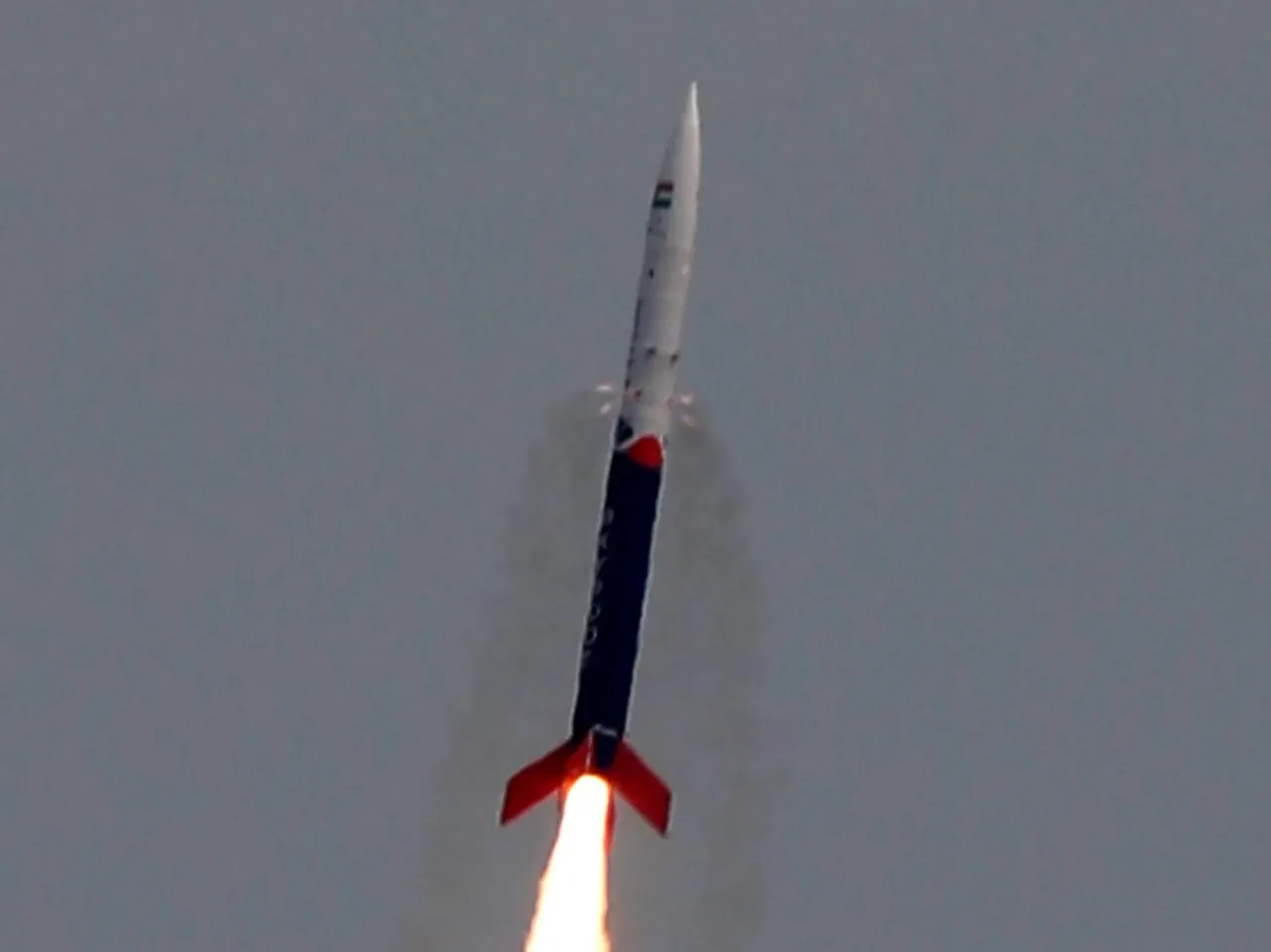
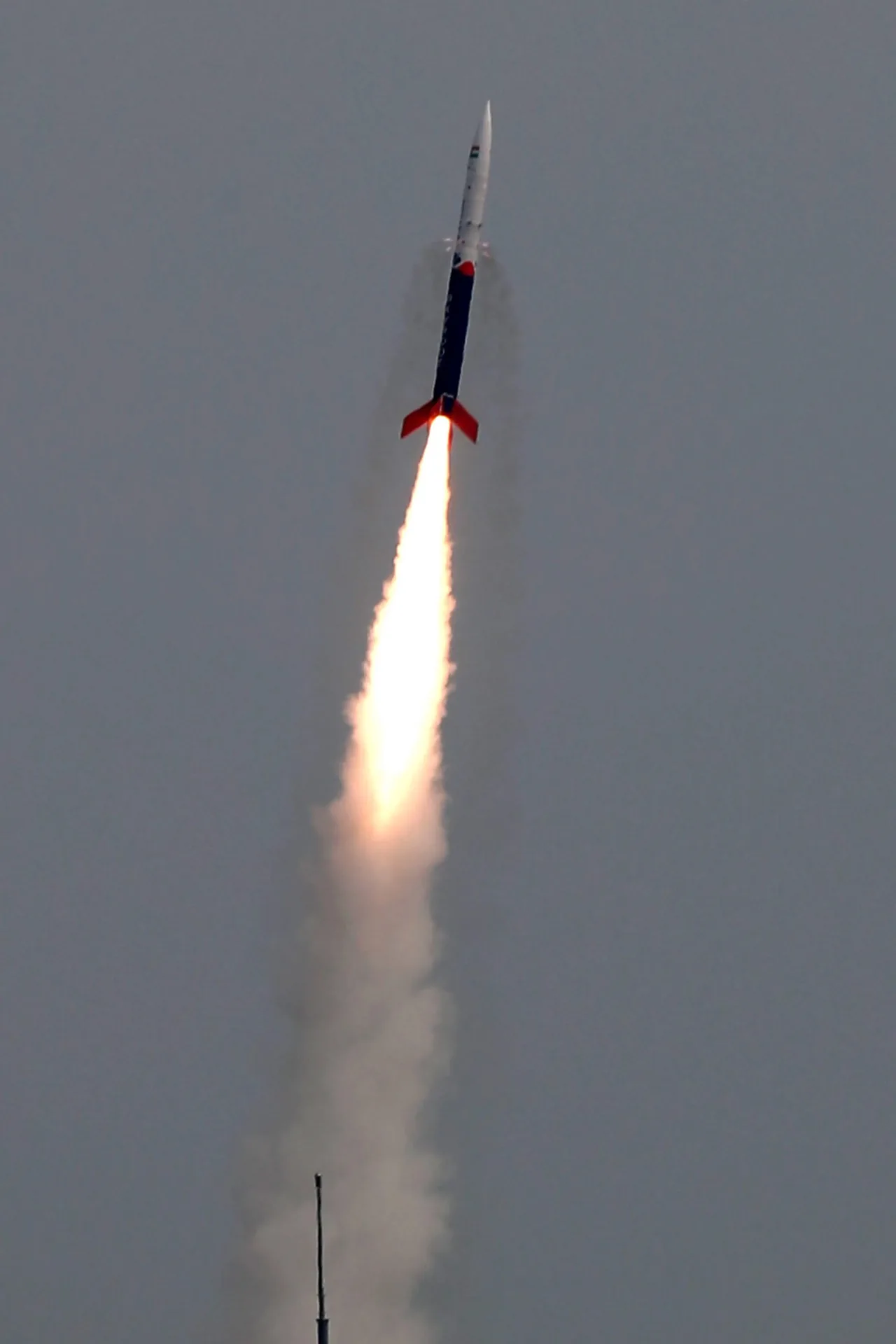
For four years, Skyroot was a promise on paper and a series of engine test-fires. That changed on November 18, 2022. From ISRO's Satish Dhawan Space Centre at Sriharikota, a slender solid-fueled rocket named Vikram-S rose off the pad, climbed to an altitude of 89.5 kilometers, and arced back to Earth after a flight of roughly five minutes. It was suborbital, it carried only a handful of small demonstrator payloads, and it never came close to orbit. None of that mattered. Vikram-S had become the first rocket built by a private Indian company ever to reach space.
The mission was named "Prarambh" — Sanskrit for "the beginning" — and the choice was deliberate. Prarambh was not an end in itself but a systems-validation flight, a way to prove in the harshest possible environment that Skyroot's avionics, its solid propulsion, its carbon-composite airframe, and its telemetry all worked together as designed. It also validated something less tangible but just as important: that India's newly liberalized space regime actually functioned. Skyroot flew Vikram-S under the first authorization ever granted by IN-SPACe, the Indian National Space Promotion and Authorization Centre created in 2020 to license private space activity. Prarambh was proof that a startup could design a rocket, secure a government launch range, and fly — all in a country where, a few years earlier, building rockets had been the exclusive business of the state.
Vikram-1: The All-Carbon-Composite Orbital Machine
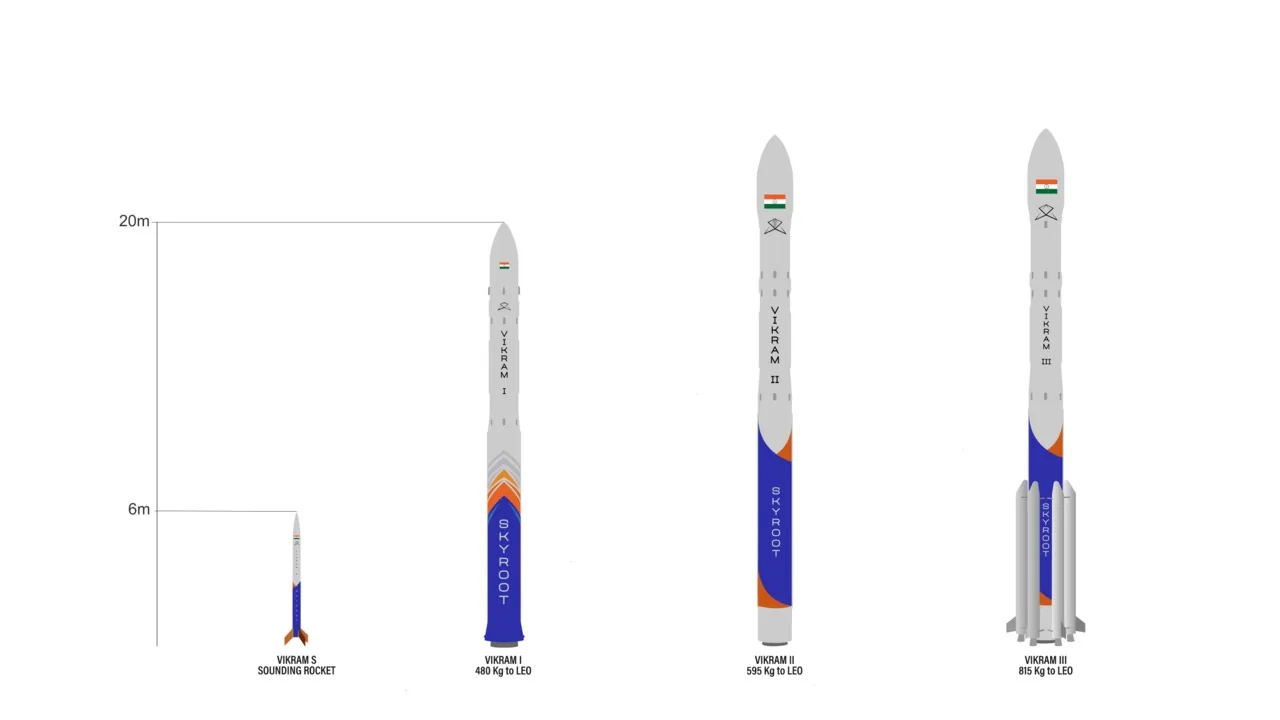
Suborbital flight makes headlines; orbit makes a business. Skyroot's real product is Vikram-1, and it is a considerably more ambitious animal than the sounding rocket that preceded it. Standing about 23 meters tall — roughly a seven-storey building — Vikram-1 is a three-stage small-lift launch vehicle designed to place up to 350 kilograms of payload into low Earth orbit, with a lower capacity to the higher, sun-synchronous orbits that Earth-observation satellites prefer.
What sets Vikram-1 apart from most rockets in its class is its structure. The vehicle's airframe is built almost entirely from carbon composite rather than aluminum alloy, a choice that shaves mass and lets the rocket carry more payload for its size. On top of that lightweight skeleton sits a propulsion stack that reads like a roll-call of Indian science. The lower stages are powered by the Kalam series of solid rocket motors — the Kalam-1200 anchors the first stage — named for former president and missile scientist A.P.J. Abdul Kalam. The upper stage is driven by the Raman liquid engine, named for Nobel laureate C.V. Raman, and here Skyroot leans hard into modern manufacturing: every Raman engine is 3D-printed, collapsing the part count and the production timeline of a component that would traditionally take months to machine and assemble. The company has publicly test-fired vacuum-optimized variants of the Raman engine, methodically retiring the technical risks between Prarambh and orbit.
The cumulative result is a vehicle with an unusually high degree of indigenous content — Skyroot claims over 90 percent of Vikram-1 is domestically manufactured. That figure is not just national pride; it is a cost story. Building at home, on India's labor and supply base, is central to Skyroot's pitch that it can undercut established small-lift rivals on price.
Mission Aagaman: The Countdown to India's First Private Orbit
As of July 2026, that pitch is about to meet reality. Skyroot's maiden orbital flight — christened "Mission Aagaman," Sanskrit for "arrival" — is imminent. In late April 2026 the company ceremonially flagged off the Vikram-1 hardware from its Hyderabad facility to Sriharikota, and by the start of July all of the rocket's stages had been integrated and stacked at the launch pad. Skyroot has announced a launch window running from July 12 to August 4, 2026, with the flight targeted for no earlier than July 12, subject to final assembly checks, range clearance, and weather at the Satish Dhawan Space Centre.
The naming, again, tells the story the company wants told. If Prarambh was "the beginning," Aagaman is "the arrival" — the moment India's private launch capability actually shows up at orbital velocity. The stated objectives of this first flight are appropriately measured: collect real-time performance data across every subsystem, validate the design parameters that will feed future vehicles, and demonstrate the full propulsion stack in flight. Skyroot, like every launch company before it, knows that first flights are as much about learning as about success. A maiden orbital attempt is the single hardest thing a new rocket firm does, and history is unkind — the majority of debut small-lift flights worldwide have failed or fallen short. A clean insertion would make Skyroot the first private company to reach orbit from Indian soil. Even a partial flight would generate the flight data the program needs to iterate.
The Roadmap: Vikram-2, Vikram-3, and the 3D-Printed Dhawan Engine
Skyroot has never treated Vikram-1 as the destination. The company's roadmap climbs steadily up the payload curve. Vikram-2 is envisioned as a roughly one-ton-class vehicle — nearly triple Vikram-1's capacity — and it is here that Skyroot's most technically audacious hardware comes into play. Back in September 2020, the company unveiled the Dhawan-1, named for ISRO's legendary former chairman Satish Dhawan: India's first privately developed cryogenic rocket engine, fully 3D-printed and built with a regenerative cooling design. Crucially, Dhawan runs on liquefied natural gas and liquid oxygen — the methane-and-LOX combination that leading global operators have embraced for its cleaner, more reusable-friendly characteristics — rather than the more toxic or complex propellants of older upper stages.
Beyond Vikram-2 sits Vikram-3, a still-larger configuration intended to push Skyroot into heavier smallsat and constellation-deployment work. The through-line across all three vehicles is a shared, modular propulsion philosophy: 3D-printed engines, indigenous solids and liquids, and a cryogenic upper stage that lets the same architecture scale rather than be redesigned from scratch. If Vikram-1 proves the concept, the Dhawan-powered vehicles are meant to prove the economics.
From Garage to Unicorn: The Funding Story
Rockets are expensive, and Skyroot's cap table reflects how seriously investors have come to take Indian launch. Over successive rounds — seed, Series A, and a landmark Series B in October 2023 that raised roughly $51 million at a valuation near $519 million — the company assembled a roster of blue-chip backers that would be the envy of any Western launch startup: Singapore's sovereign fund GIC, Temasek, Sherpalo Ventures, Lightspeed, and Infosys among them. In early 2026 it added structured debt, reportedly around 100 crore rupees from BlackRock-managed funds, to bridge the program to the launch pad.
The defining moment came on May 7, 2026. Skyroot closed a Series C of roughly $60 million — a mix of equity and structured debt — co-led by Sherpalo Ventures, GIC, and BlackRock, with participation from Arkam Ventures, Playbook Partners, and the Shanghvi Family Office. The round valued the company at $1.1 billion, making Skyroot India's first space-technology unicorn. Cumulatively the company has now raised on the order of $160 million. The timing was pointed: the unicorn label arrived just weeks before Vikram-1 reached the launch pad, giving Skyroot both the balance sheet and the brand to pull top engineering talent that smaller rivals struggle to keep.
The Competition and the Hard Road Ahead
Skyroot's greatest asset is also, in a sense, its greatest exposure: it is first, and it is alone at the front. Domestically, its closest rival is Agnikul Cosmos, the IIT Madras-incubated firm building fully 3D-printed engines and India's only private launchpad — a distinctive technology story, but one that trails Skyroot to the orbital milestone with roughly half the funding. Globally, the field is far more crowded and battle-hardened. Rocket Lab's Electron has flown dozens of orbital missions; Firefly's Alpha is operational; and, tellingly, Skyroot competes not only with foreign firms but with ISRO itself, whose Small Satellite Launch Vehicle targets the same 350-to-500-kilogram class with actual flight heritage.
The risks compound from there. A maiden-flight failure would push commercial revenue into 2027 and likely force an emergency raise, because a $160 million war chest funding both Vikram-1 operations and Vikram-2 development burns fast. Skyroot remains pre-revenue, with a manifest of letters of intent that convert to real contracts only once orbit is demonstrated. India's foreign-investment and export-control rules for space, while liberalizing, are still partly undefined, adding drag to cross-border deals. And the fundamental physics never relents: clustered ignition, stage separation, and orbital insertion are unforgiving, and no amount of capital or heritage guarantees a clean first flight.
Yet the setup is genuinely unmatched among Indian private space firms. Skyroot holds the country's first private-launch authorization and a framework agreement granting access to Sriharikota's pads and range — infrastructure worth hundreds of millions that no foreign competitor can replicate. It has a credible, largely indigenous technology stack, a unicorn balance sheet, and the policy tailwind of an Indian government targeting a multi-fold expansion of its space economy by the mid-2030s. The two engineers who quit ISRO in 2018 have already made history once, with Prarambh. In the window between July 12 and August 4, 2026, they will find out whether they can make it a second time — and turn India's first private rocket company into its first orbital one.