Two Bets on the Same Sky
India liberalized its launch sector in 2020, and almost immediately two companies emerged as the standard-bearers of a private rocket industry that had never before been allowed to exist. Hyderabad's Skyroot Aerospace and Chennai's Agnikul Cosmos are both chasing the same prize -- to be the first private Indian company to put a satellite into orbit -- but they are getting there in strikingly different ways. One is a war chest and a methodical, ISRO-heritage engineering march to the pad. The other is a manufacturing moonshot built around a rocket engine you can print in three days.
This is not a survey of India's sprawling 190-plus space startups. It is a head-to-head: two launch companies, two philosophies, and a race whose first checkered flag is now days away. As of July 2026, Skyroot has pulled decisively ahead in the sprint to orbit, but the longer contest -- who builds the more durable business -- is far from settled.
The Race to First Orbit: Skyroot Is Ahead
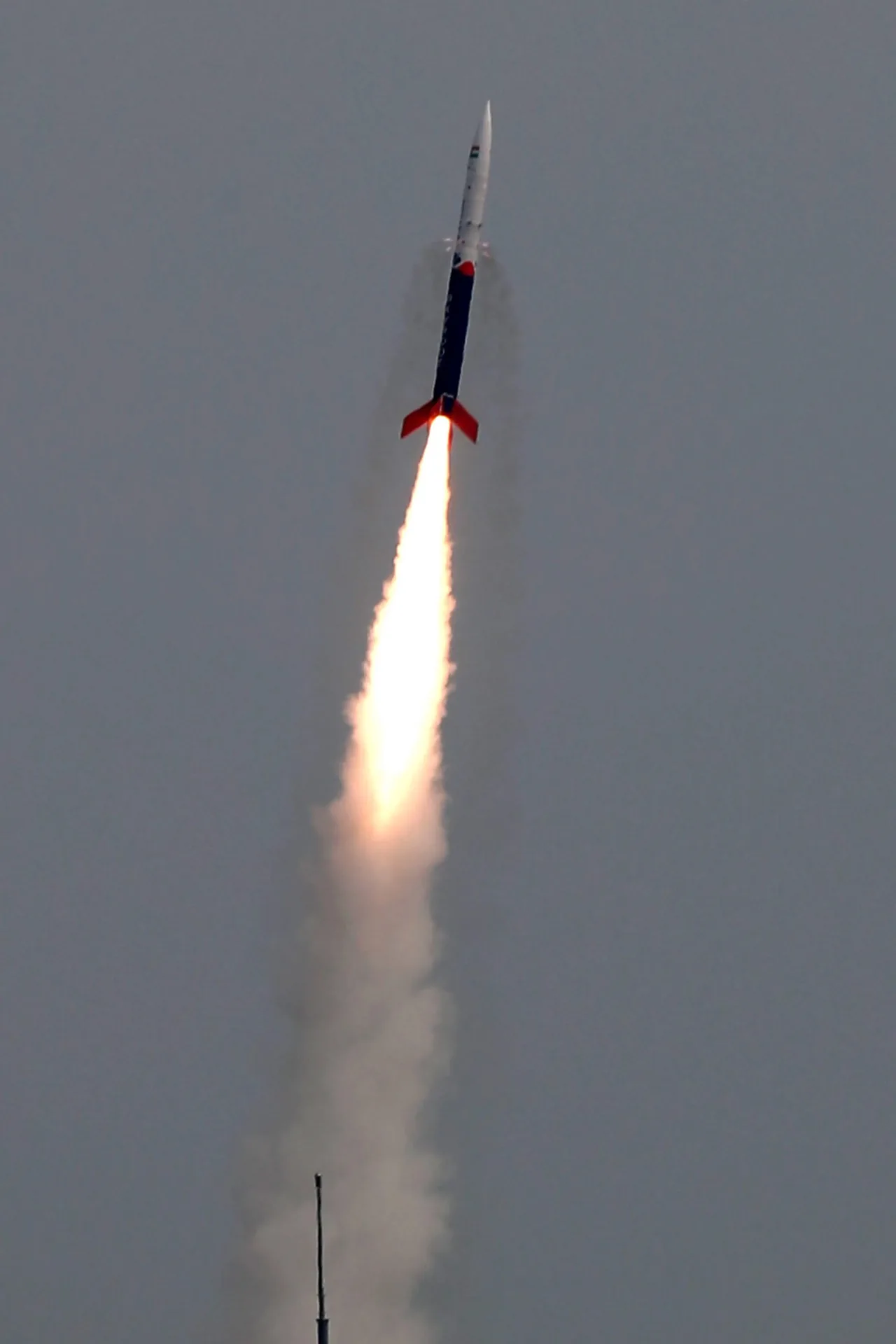
The immediate story is a clear lead. Skyroot has stacked its Vikram-1 rocket at the First Launch Complex of the Satish Dhawan Space Centre in Sriharikota and, in early July 2026, announced a launch window of July 12 to August 4 for its maiden orbital flight, branded "Mission Aagaman." If it succeeds, Vikram-1 becomes the first privately built and privately operated rocket to reach orbit in Indian history -- a milestone that until now belonged exclusively to ISRO. It would be Skyroot's second flight overall, following the suborbital Vikram-S "Prarambh" hop in November 2022 that first proved a private Indian company could build a rocket at all.
Agnikul, by contrast, is still on the runway. In May 2026 the company successfully fired four of its 3D-printed Agnilet engines together -- a critical step toward the clustered first stage that Agnibaan needs -- and CEO Srinath Ravichandran has described the remaining work as perfecting simultaneous multi-engine ignition and stage separation. Agnikul had once eyed an early-2026 orbital attempt; that has now slipped to later in 2026 or into 2027. Agnikul's own historic first came earlier, in May 2024, when its Agnibaan SOrTeD demonstrator flew a controlled suborbital mission from a launchpad the company built itself -- the world's first flight of a single-piece 3D-printed engine. But a suborbital demonstrator is a different animal from an orbital vehicle, and on the orbital scoreboard, Skyroot is roughly a year in front.
Two Rockets, Two Philosophies
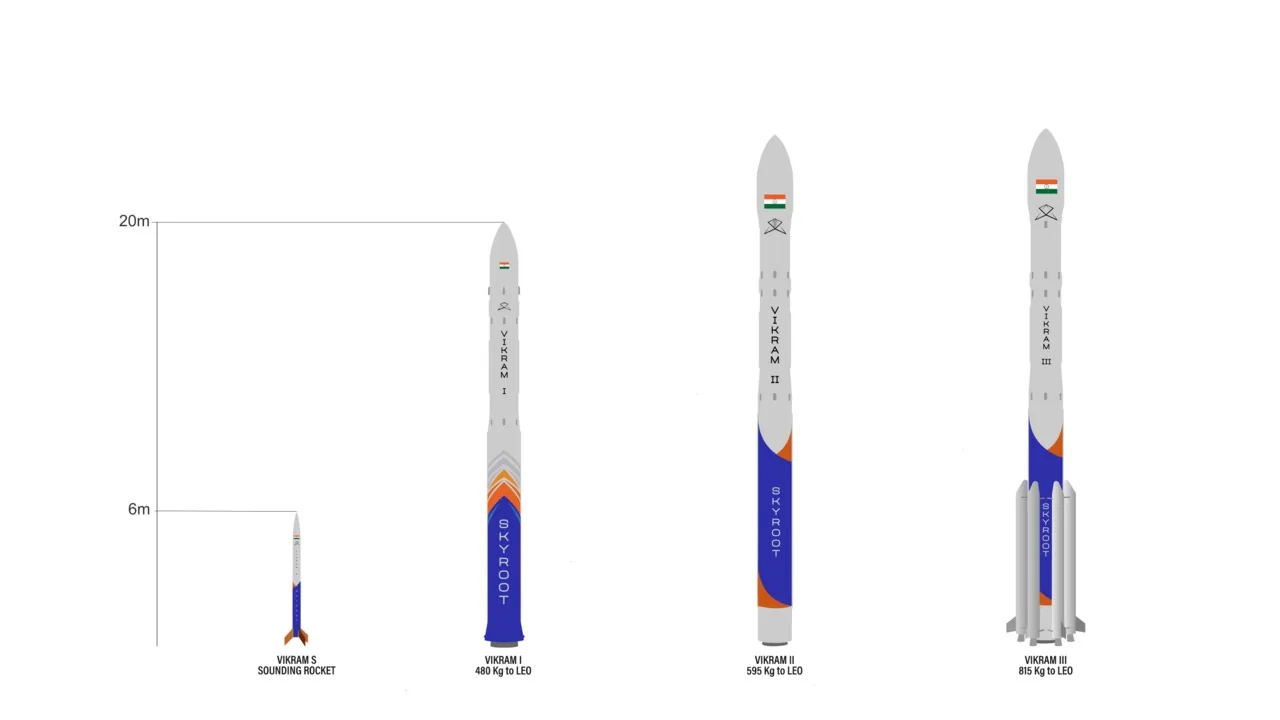
The contrast in vehicles is the contrast in worldviews. Vikram-1 is a 23-meter, all-carbon-composite rocket built for structural efficiency and manufacturing repeatability. Its architecture is deliberately conservative where it matters: three solid-propellant stages -- the Kalam-1200, Kalam-250, and Kalam-100 motors -- do the heavy lifting, topped by a liquid Raman orbital-adjustment module using a cluster of storable-propellant thrusters for precise orbit insertion. Solid motors are simpler to qualify and store, which suits Skyroot's goal of a reliable, cadence-friendly workhorse. Skyroot's differentiation is in materials and propulsion manufacturing -- 3D-printed solid, liquid, and cryogenic engines across the Kalam and Raman families, and a carbon-composite airframe that claims over 90% indigenous content.
Agnibaan is the opposite instinct: modularity as a product feature. It is a two-stage vehicle whose first stage clusters up to seven Agnilet engines, and Agnikul's pitch is that customers configure the rocket to the payload rather than the payload to the rocket -- "launch anywhere, anytime." The Agnilet engine itself is the headline act: a single-piece, fully 3D-printed semi-cryogenic engine produced as one monolithic Inconel print in roughly 72 hours, with no assembly of hundreds of machined parts. It is a genuine world-first, and it compresses a propulsion supply chain that takes traditional rivals six to twelve months. The trade-off is risk concentration: clustering seven engines with clean stage separation is historically one of the most common failure modes for a new small-lift vehicle, and everything rides on a single engine architecture and a single launch site.
Vikram-1 vs Agnibaan: The Spec Sheet
| Attribute | Skyroot Vikram-1 | Agnikul Agnibaan |
|---|---|---|
| Company / HQ | Skyroot Aerospace, Hyderabad | Agnikul Cosmos, Chennai |
| Founded | 2018 | 2017 (IIT Madras incubation) |
| Payload to LEO | ~350 kg (up to ~480 kg to 45° LEO) | ~300 kg |
| Stages | 3 solid (Kalam) + liquid orbital module (Raman) | 2, clustered up to 7 engines |
| Propulsion | 3D-printed solid + liquid; carbon-composite airframe | 3D-printed single-piece semi-cryogenic (Agnilet) |
| Key differentiator | Carbon composite + modular solid motors, ~90% indigenous | Fully 3D-printed configurable engine, ~72-hr print |
| Suborbital first flight | Vikram-S, Nov 2022 | Agnibaan SOrTeD, May 2024 |
| Orbital debut status | Launch window July 12 – Aug 4, 2026 ("Aagaman") | Targeted late 2026 / H1 2027 |
| Launch infrastructure | ISRO framework agreement, Sriharikota pad | Own private pad (ALP) + mission control at Sriharikota |
The specs sit close on paper -- both target the sub-350-kg dedicated smallsat band -- but the engineering routes to that number could hardly be more different. Skyroot leans on proven solid-motor physics and airframe mass savings; Agnikul bets that additive manufacturing rewrites the economics of the liquid engine.
Follow the Money: A $1.1B Unicorn vs a $500M Challenger
Capital is where the gap widens most. In May 2026 Skyroot became India's first space-tech unicorn, closing a roughly $60M round (about $50M equity plus $10M structured debt) at a $1.1 billion post-money valuation and lifting cumulative funding to around $160M. The cap table reads like a sovereign-wealth roll call: Sherpalo Ventures and GIC co-led, with BlackRock-affiliated debt, plus earlier backing from Temasek, Lightspeed, and Infosys. Timing the unicorn round just weeks before the maiden flight was no accident -- it hands Skyroot the balance sheet to absorb a launch setback and still make a second attempt.
Agnikul is the leaner challenger. Its most recent material round, in November 2025, was about $17M at a $500M-plus valuation, bringing cumulative funding to roughly $75-80M -- less than half of Skyroot's war chest. What Agnikul lacks in raw capital it partly offsets in political and institutional capital: in March 2026 the Tamil Nadu government's TIDCO took a direct equity stake of about $3M, the first time an Indian state government has bought into a private space company, and the company remains anchored to IIT Madras. That is a distinctive kind of moat, but it does not change the arithmetic. At current burn, Agnikul will likely need a Series D within 18 to 24 months to reach steady commercial cadence, while Skyroot's runway looks materially deeper.
Where They Sit Against the Global Field
Neither company competes only with the other. The reference point for the whole small-lift class is Rocket Lab's Electron, which has flown more than 50 times, carries roughly 300 kg to LEO for a sticker around $7.5M, and launched 21 times in 2025 alone -- a cadence and flight-heritage moat that no Indian entrant is close to matching. Firefly's Alpha aims higher on mass (over 1,000 kg to LEO) but has struggled with reliability and is transitioning to a Block II upgrade. Europe's Isar Aerospace, Rocket Factory Augsburg, and PLD Space are all racing through their own maiden-flight campaigns.
Against that field, the Indian pitch is cost. Both Skyroot and Agnikul argue their sub-$7.5M price points can undercut Electron on a dedicated-launch basis, riding India's lower labor and manufacturing base and deep indigenous content. But price only matters once you have flown. Rocket Lab's advantage is not its rocket -- it is 50-plus successful launches and a backlog north of $2 billion. The single most valuable asset in this market is a track record, and that is precisely what both Indian companies still lack. The first orbital success will convert a spec sheet into a manifest; the first orbital failure will convert a manifest back into a slide deck.
IN-SPACe and the ISRO Relationship
None of this exists without policy. The 2020 reforms and the creation of IN-SPACe -- a single-window authorization body -- are what made private launch legal in India, and both companies are marquee beneficiaries. Skyroot holds a formal IN-SPACe authorization and an ISRO framework agreement granting access to Sriharikota's pads, range, and tracking infrastructure that would cost hundreds of millions to replicate. Agnikul went a step further and, with ISRO's support, built and operates India's first and only private launchpad and mission control complex at Sriharikota. India's subsequent lifting of foreign-investment caps is what let GIC, BlackRock, and Sherpalo anchor Skyroot's unicorn round in the first place.
Crucially, the posture here is collaboration, not the institutional friction that marked NASA's early commercial-crew era. ISRO shares facilities, testing, and expertise rather than guarding them, and IN-SPACe frames private launch as an extension of the national program aiming for a roughly $44B space economy by 2033. That tailwind lifts both companies -- but it also means neither can claim it as a differentiator over the other.
What Winning Looks Like
The near-term scoreboard is simple: Skyroot's Mission Aagaman is the event that could crown a first mover. A clean orbital debut in the July-August window unlocks Skyroot's commercial manifest, likely triggers an up-round, and positions it as the default Indian smallsat ride -- a plausible IPO candidate later in the decade once the one-ton-class Vikram-2 and its cryogenic upper stage are flight-proven. A maiden-flight failure -- and historically only about half of small-lift maiden orbital flights succeed -- would push commercialization into 2027 and put that $160M balance sheet to work as insurance.
But "winning" the longer race is not the same as launching first. Agnikul's thesis is that manufacturing speed and configurability, not first-to-orbit bragging rights, decide who builds the more scalable business. If the Agnilet architecture delivers rockets faster and cheaper than anyone can machine them, the company that prints engines in 72 hours could out-cadence a rival that got to orbit a year sooner. The realistic outcome is not a single winner but a division of the field: Skyroot as the funded, cadence-oriented workhorse for standard smallsat rides, and Agnikul as the bespoke, launch-on-demand specialist for customers who need a specific orbit on a specific date. India's small-lift market may prove big enough for both -- especially if their real competition turns out to be Rocket Lab, not each other. The first data point arrives when Vikram-1 clears the tower.