Spending six months on the International Space Station is the equivalent of aging several years in a matter of months — at least in certain physiological systems. Microgravity, the near-absence of the gravitational loading our bodies evolved under for millions of years, systematically dismantles adaptations that took billions of years of evolution to develop. Bone crumbles. Muscles atrophy. The heart shrinks. Fluid shifts toward the head, raising intracranial pressure and potentially damaging eyesight. And those are just the well-characterized effects.
Space medicine — the discipline dedicated to understanding, preventing, and treating the health consequences of spaceflight — is one of the most fascinating intersections of biology, physics, and medicine. The stakes are high: without effective countermeasures, long-duration missions to Mars (estimated 18–24 months round trip, with 6–7 months each way in transit) may not be humanly survivable in their current form.
The Fluid Shift Problem: Why Astronauts Look Like They're Upside Down
Within the first hours of reaching microgravity, astronauts experience a dramatic redistribution of body fluids. On Earth, about 70% of our body's fluid is in the lower body — gravity keeps it there. In microgravity, this gradient disappears. Fluid redistributes cephalad (toward the head), giving astronauts a characteristic puffy-faced, congested appearance and causing a sensation like hanging upside down that persists for days.
The immediate effects are uncomfortable: nasal congestion, headaches, and a reduced sense of thirst (the body compensates for the apparent fluid overload by suppressing thirst and increasing urine output, leading to a net fluid loss of 1–2 liters in the first week).
The more serious long-term consequence is intracranial pressure. Elevated fluid pressure in the skull can cause a condition called Spaceflight-Associated Neuro-ocular Syndrome (SANS), characterized by:
- Optic disc edema (swelling of the optic nerve where it meets the eye)
- Flattening of the posterior globe (the back of the eyeball becomes slightly flattened)
- Choroidal folds (wrinkles in the retina)
- Hyperopic shifts (astronauts who had perfect vision may need reading glasses)
SANS has been documented in approximately 40% of ISS astronauts on long-duration missions. Scott Kelly, who spent 340 days on the ISS, required prescription glasses for the first time after his year in space. The condition can be permanent in some cases. Understanding and preventing SANS is one of the highest-priority problems in space medicine, because it could disqualify some individuals from long-duration missions entirely.
Bone Loss: The Calcium Drain
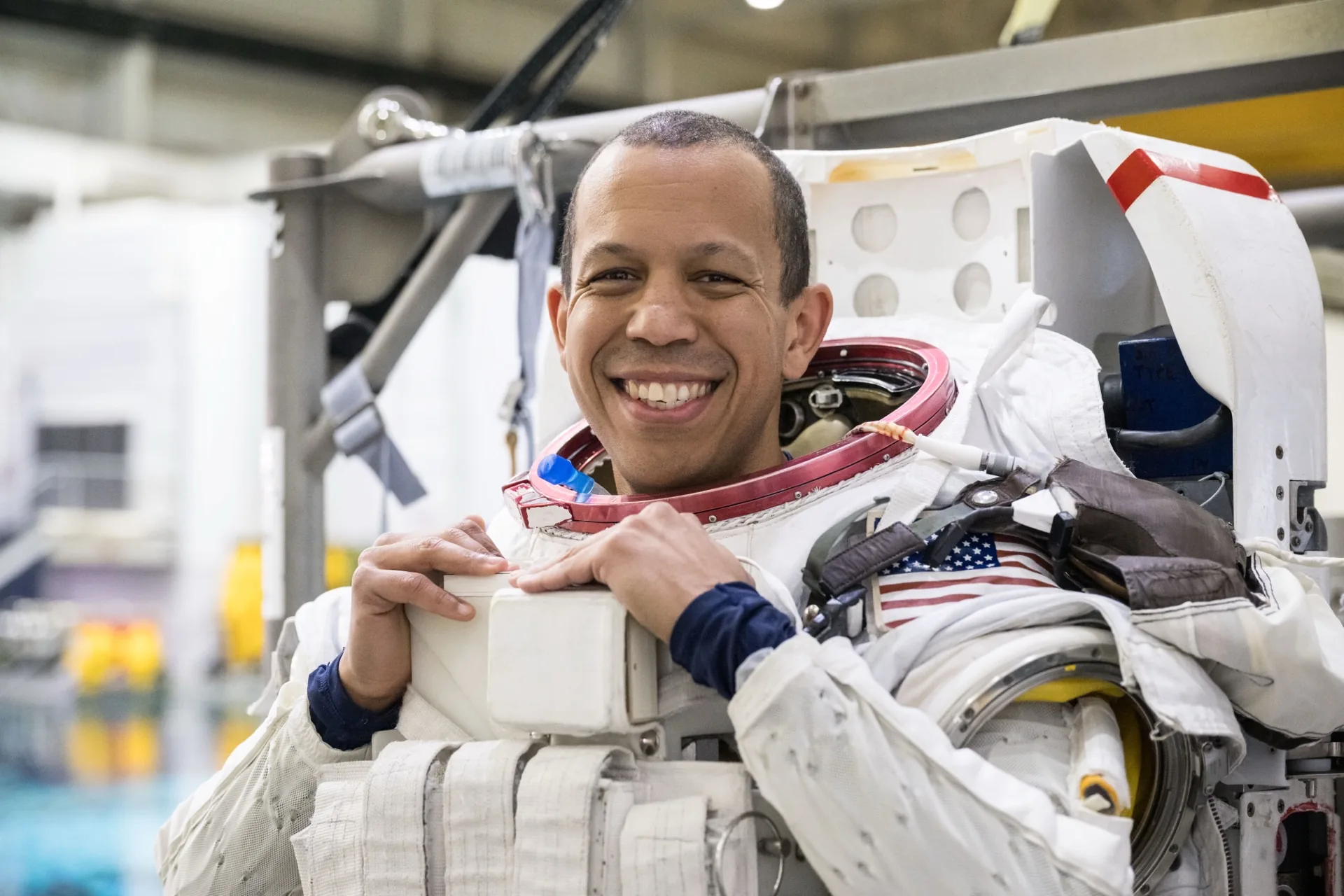
Bone is not static — it is continuously being broken down (osteoclast activity) and rebuilt (osteoblast activity) throughout life. Mechanical loading — the stress of supporting weight under gravity — is a primary signal that drives osteoblast activity. Remove gravity, and bone remodeling shifts strongly toward net bone loss.
ISS astronauts lose approximately 1–2% of bone mineral density per month in weight-bearing bones (lumbar spine, femur, tibia, pelvis). This is roughly equivalent to 10 years' worth of age-related bone loss compressed into one year. After a 6-month mission, a 35-year-old astronaut has bone density that might correspond to a 45–50-year-old on Earth.
The good news: exercise countermeasures work, and bone largely recovers over 2–3 years back on Earth. The ISS's ARED (Advanced Resistive Exercise Device) allows astronauts to simulate heavy resistance training loads of up to 272 kg despite being weightless. Astronauts who use ARED consistently show significantly less bone loss than those who rely on earlier, less effective exercise equipment.
For a Mars mission, recovery time on Earth is not an option — the crew would need to function on arrival on Mars (gravity 0.38g) after 6+ months in transit microgravity. Current exercise protocols would need to be significantly more effective, or pharmacological interventions (bisphosphonates, parathyroid hormone analogs) would be needed to maintain bone during transit.
Muscle Atrophy: Use It or Lose It, Amplified
The same mechanical unloading that causes bone loss causes muscle atrophy. Postural muscles — those that work continuously on Earth against gravity — are particularly affected. The quadriceps, hip extensors, and calf muscles can lose 20–30% of their mass in a 3-month mission without countermeasures.
Interestingly, it's not just mass but fiber type composition that changes. Slow-twitch endurance fibers (Type I) convert toward fast-twitch (Type II) characteristics in microgravity — reducing endurance and increasing fatigue. This matters practically: an astronaut returning from a long mission may be physically incapable of self-rescue or emergency egress from a spacecraft without assistance.
After the Space Shuttle era, when some crews returned barely able to stand, NASA and other agencies developed the current regime of 2.5 hours of daily exercise aboard the ISS. This has substantially mitigated muscle atrophy, though it has not eliminated it. The ISS exercise day essentially eliminates 2.5 hours of science and operations time — a significant operational cost.
Cardiovascular Deconditioning
The heart is a muscle that responds to its workload. In microgravity, the heart pumps against reduced vascular resistance — blood flows more easily when it's not fighting gravity — and the heart's functional load decreases. Over months, the heart muscle actually shrinks in mass (cardiac atrophy). This is distinct from the pathological cardiac atrophy caused by disease; it's a direct adaptation to reduced demand.
The more operationally dangerous effect is orthostatic intolerance — the inability to maintain adequate blood pressure and cerebral perfusion when standing upright after returning to gravity. Upon landing, many astronauts cannot stand unassisted; some faint. The fluid loss from the first week in space reduces total blood volume, and the cardiovascular system has adapted to a "headward" distribution. Returning to Earth's gravity while in this state can cause fainting, falls, and injury.
Cardiovascular Countermeasures
Exercise helps significantly — aerobic exercise on the ISS's treadmill and cycle ergometer maintains cardiac output capacity. The Lower Body Negative Pressure (LBNP) suit, which applies negative pressure to the lower body to simulate gravitational fluid distribution, is used for pre-landing preparation and is being studied as a more regular countermeasure for both cardiovascular and SANS management.
Fluid loading — drinking salt water solutions before reentry to expand blood volume — is a standard pre-landing procedure for ISS crews.
Radiation: The Invisible Threat
Earth's magnetic field and atmosphere shield us from most cosmic radiation. In low Earth orbit, the ISS sits just inside the Van Allen radiation belts and receives roughly 10x the radiation dose of someone on the Earth's surface. In deep space — on a Mars transit — radiation exposure increases to roughly 40x surface levels, with no magnetic field protection and an equivalent of about 0.66 mSv/day (the annual recommended limit for radiation workers is 20 mSv; a Mars round trip would expose crew to roughly 900+ mSv).
Scott Kelly's year-long ISS mission research (the famous NASA Twin Study comparing Scott's changes to those of his identical twin Mark, who remained on Earth) showed changes in DNA methylation patterns, telomere length, gene expression, and the microbiome. Many of these changes reversed after Kelly's return to Earth, but some persisted.
The cancer risk from deep-space radiation is estimated to increase lifetime cancer mortality probability by 3–5% for a Mars mission — a risk that falls within NASA's current acceptable exposure limits (3% career excess cancer mortality risk) for most ages and sexes. However, female astronauts are more sensitive to radiation-induced cancer, particularly breast and lung cancer, which creates equity concerns for crew selection.
Radiation Shielding Approaches
Water is an excellent radiation absorber per unit mass. Some Mars transit vehicle designs propose lining crew quarters walls with water storage tanks to reduce radiation exposure during solar particle events (intense bursts of radiation from solar flares). Polyethylene and borated plastics are also better radiation shielders per unit mass than aluminum. Active magnetic shielding — generating a miniature magnetic bubble around the spacecraft — is theoretically superior but technically challenging at useful scales.
Pharmaceutical countermeasures are under investigation. Antioxidant cocktails, DNA repair enzyme activators, and radiation-adaptive drugs are in various stages of research.
Space Psychology: The Mind Under Pressure
Physical health is not the only concern. The psychological dimensions of long-duration spaceflight — isolation, confinement, interpersonal friction, communication delays, monotony, and the particular stress of known risk — are increasingly recognized as mission-critical factors.
ISS crews experience "third-quarter phenomenon" — a well-documented dip in motivation, mood, and work performance in the third quarter of long missions. Communication delays with Earth (up to 24 minutes one-way for Mars) mean crews become functionally autonomous; they cannot ask Earth for guidance in real time during emergencies. Crew cohesion and conflict resolution become survival skills.
NASA's HI-SEAS (Hawaii Space Exploration Analog and Simulation) and the Mars-500 ground simulation (520 days in Moscow) have studied the psychological effects of isolation and communication delay. The Russian Mars-500 crew, simulating a Mars mission in 2010–2011, experienced significant sleep disruption, sedentariness, and reduced crew engagement — without any physical spaceflight hazards.
What NASA and Partners Are Doing About It
The Human Research Program (HRP) at NASA's Johnson Space Center coordinates research across all five "Evidence Reports of Risks" categories: behavioral health, space radiation, human factors, musculoskeletal, and sensorimotor adaptation. The program has developed detailed "gaps" — specific research questions that must be answered before committing to Mars missions.
International partners (ESA, JAXA, Roscosmos) all have parallel programs. The ESA's HERA (Human Exploration Research Analog) at JSC and the MELiSSA project studying closed-loop life support contribute significantly.
Promising near-term developments include:
- Artificial gravity: A short-radius centrifuge (SRC) that crews would use for 30–60 minutes per day to periodically restore gravitational loading. Several SRC designs have been studied; a flight demonstration has been discussed as an ISS addition
- Radiation pharmaceuticals: Compounds that reduce radiation sensitivity or accelerate DNA repair, inspired by animal models (tardigrades, naked mole rats, certain bacteria with extraordinary radiation resistance)
- Personalized countermeasure protocols: Genetic and physiological profiling to predict individual susceptibility to SANS, bone loss, and radiation effects, allowing tailored prevention
Key Takeaways
- Microgravity causes systematic breakdown of systems evolved for 1g: bone, muscle, cardiovascular, and visual systems are all affected
- Spaceflight-Associated Neuro-ocular Syndrome (SANS) — including potential permanent vision changes — affects ~40% of long-duration ISS astronauts and is a high-priority unsolved problem
- Bone loss of 1–2% per month is mostly reversible with exercise countermeasures and post-flight rehabilitation, but the pace makes Mars missions challenging
- Radiation exposure during a Mars transit will be roughly 40x Earth surface levels, with a ~3–5% increased lifetime cancer mortality risk
- Current ISS exercise protocols require 2.5 hours/day — effective but operationally costly
- No human has yet experienced Mars-transit duration in microgravity combined with deep-space radiation — many critical data points will only come from actual Mars mission planning
- The ISS continues to be the primary laboratory for all these questions, making it indispensable to the human spaceflight program beyond low Earth orbit