Before the International Space Station, before Mir, and before the idea of permanent human habitation in orbit became routine, there was Skylab -- a bold, improvised, and sometimes terrifying experiment that proved human beings could live and work in space for months at a time. Launched on May 14, 1973, and occupied by three successive crews over the following nine months, Skylab was America's first space station. It was built from hardware originally designed to send astronauts to the Moon, nearly destroyed within minutes of reaching orbit, saved by the ingenuity and courage of its first crew, and ultimately abandoned to a fiery, uncontrolled reentry that scattered debris across the Australian outback. Its story is one of the most dramatic and consequential chapters in the history of human spaceflight.
Origins: A Space Station Built from Moon Rocket Leftovers
The idea of a crewed space station had been central to American space ambitions since well before the Apollo program. Wernher von Braun, the architect of the Saturn V rocket, had envisioned a rotating wheel-shaped station as early as the 1950s. But by the late 1960s, with Apollo winding down and NASA's budget shrinking, the agency needed a way to maintain a human presence in space without the cost of developing entirely new hardware.
The solution was elegant in its pragmatism. Engineers at the Marshall Space Flight Center in Huntsville, Alabama, proposed converting the S-IVB -- the third stage of the Saturn V rocket -- into a habitable space station. The S-IVB was a cylinder 6.6 meters (21.7 feet) in diameter and 14.7 meters (48.1 feet) long. During a normal Apollo mission, this stage would fire its single J-2 engine to propel the spacecraft toward the Moon, then be discarded. For Skylab, the hydrogen fuel tank of an S-IVB would be emptied, outfitted with floors, walls, storage lockers, a galley, sleeping quarters, a shower, and scientific equipment, and launched as a fully furnished orbital workshop.
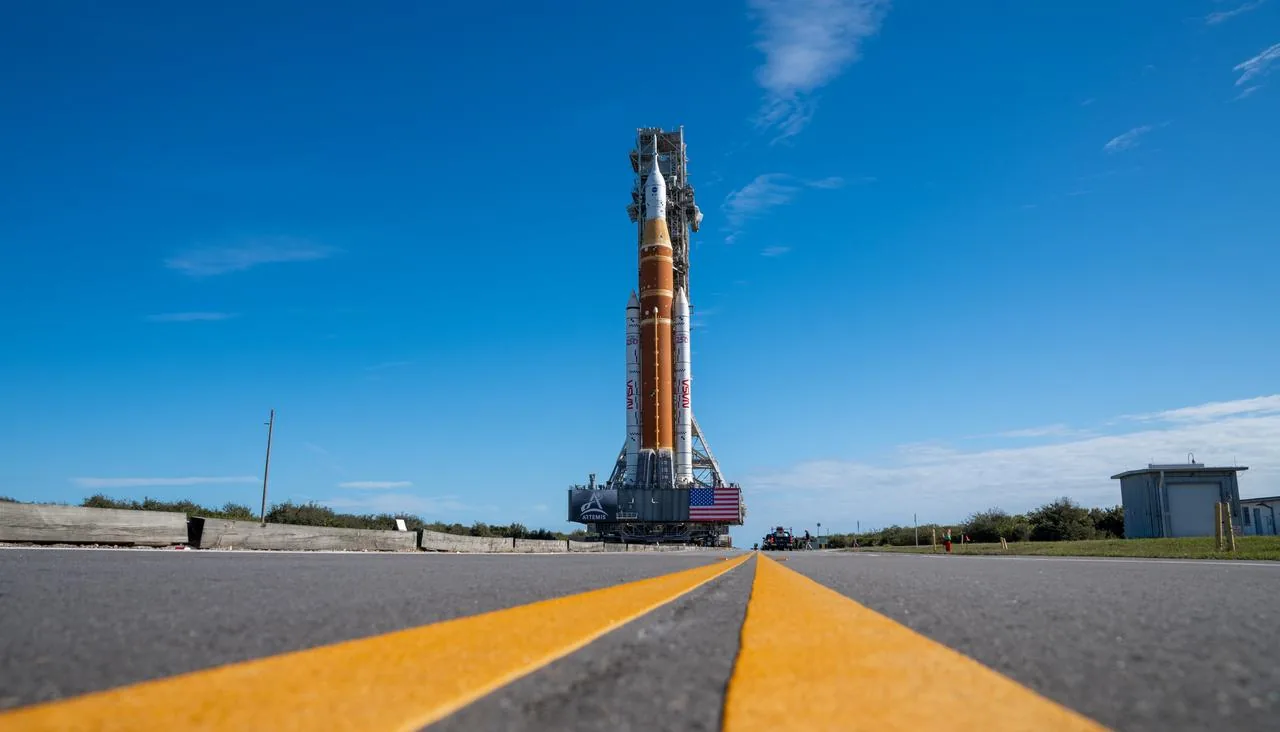
The concept went through several iterations. An earlier plan called "wet workshop" would have used a spent S-IVB stage after it had burned its fuel during launch, with astronauts converting the empty tank into living quarters in orbit. This was eventually abandoned in favor of the "dry workshop" approach, where the S-IVB was fully outfitted on the ground before launch. This was possible because NASA had leftover Saturn V rockets from canceled Apollo missions (Apollo 18, 19, and 20 had all been cut from the budget). The last remaining Saturn V -- designated SA-513 -- would carry the station itself into orbit.
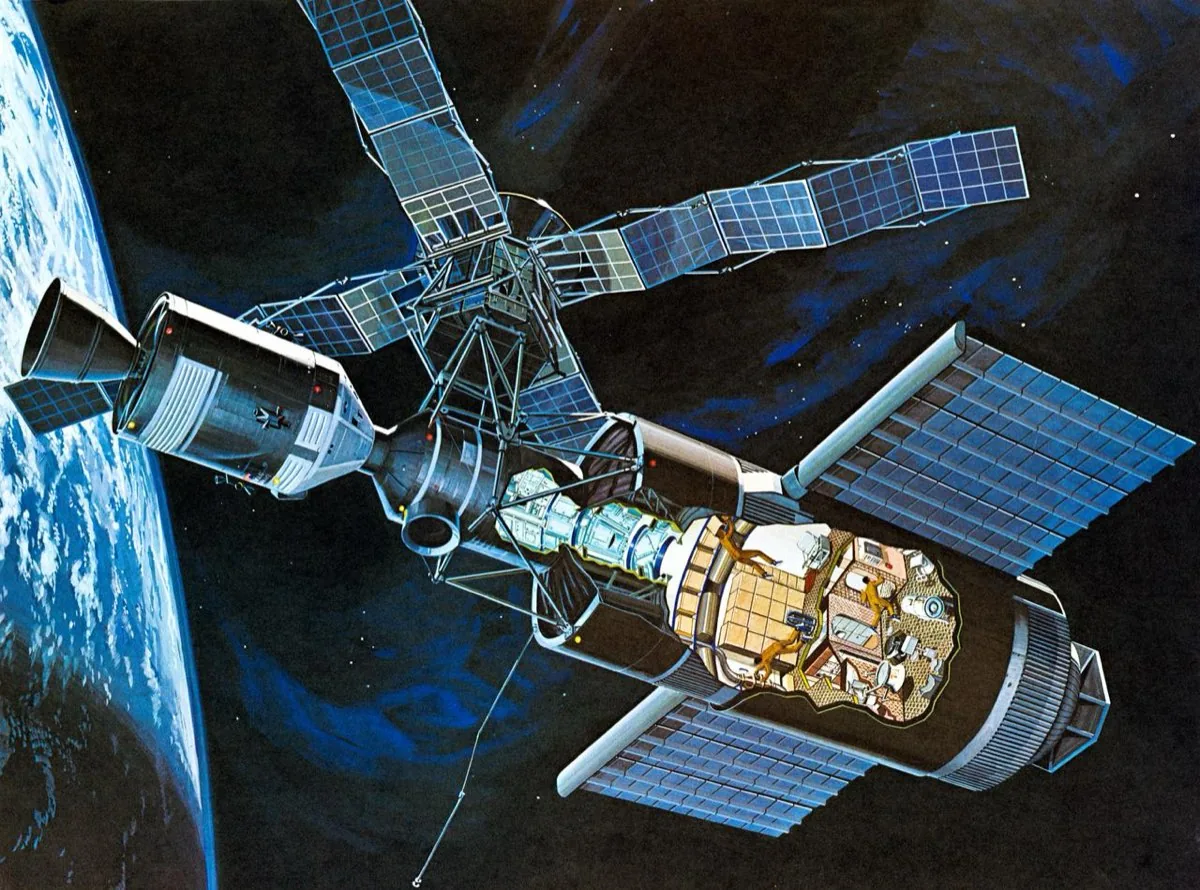
Skylab was not just the converted S-IVB stage. The complete station consisted of several modules: the Orbital Workshop (the converted S-IVB, which served as the primary living and working space), the Airlock Module (which provided the means for spacewalks and connected the workshop to the docking adapter), the Multiple Docking Adapter (which allowed Apollo Command/Service Modules to dock with the station), and -- most importantly for science -- the Apollo Telescope Mount (ATM), an enormous solar observatory mounted on a truss structure at one end of the station. The entire assembly measured 36 meters (118 feet) long and had a habitable volume of approximately 283 cubic meters (10,000 cubic feet), making it the largest crewed spacecraft ever launched up to that time. Its mass at launch was approximately 77,088 kilograms (170,000 pounds).
Launch Day Disaster: May 14, 1973
Skylab launched unmanned atop the Saturn V from Kennedy Space Center's Launch Complex 39A at 1:30 p.m. EDT on May 14, 1973 -- the same pad that had sent Apollo 11 to the Moon four years earlier. The rocket performed flawlessly during the ascent. But 63 seconds after liftoff, at an altitude where aerodynamic forces on the vehicle were at their peak, something went catastrophically wrong.
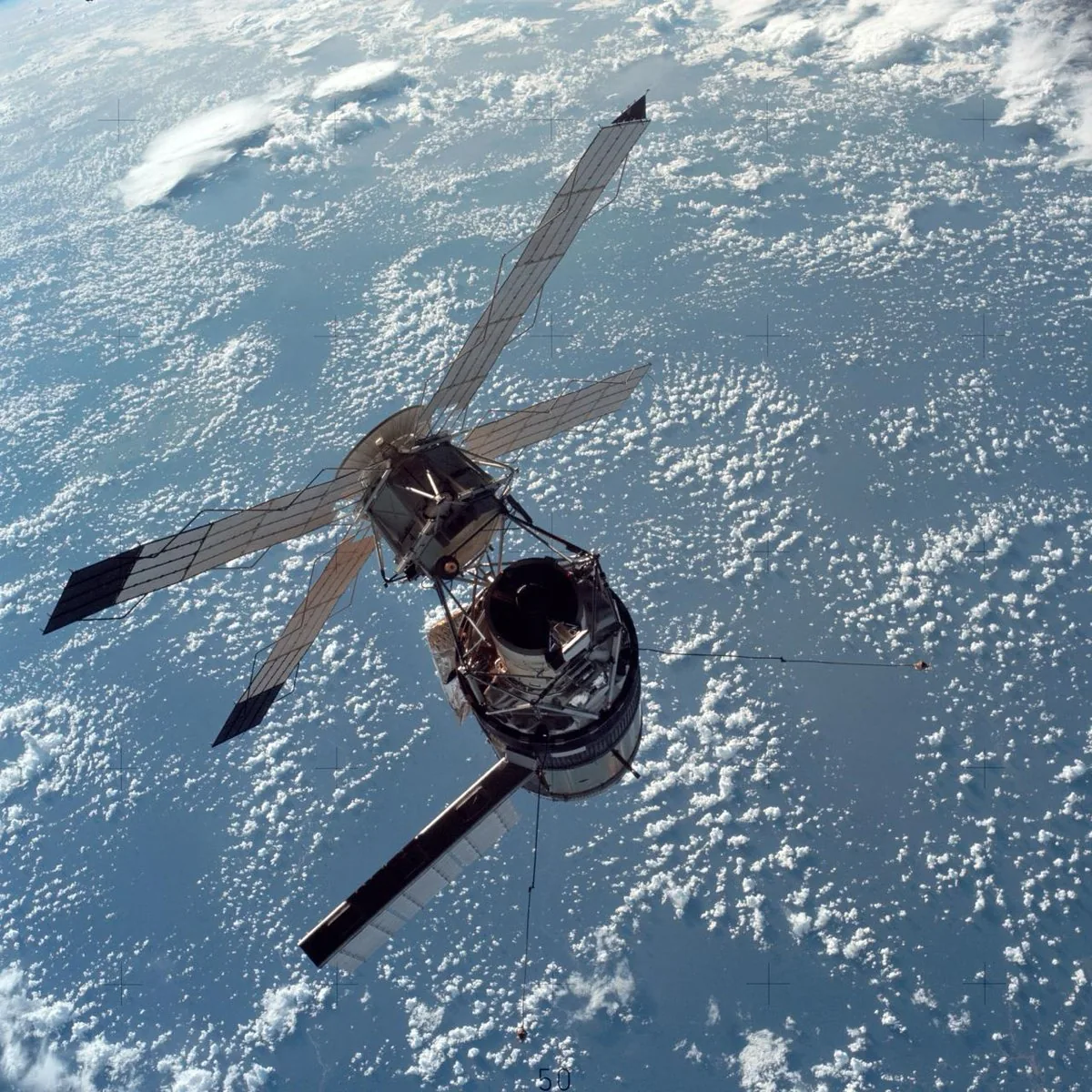
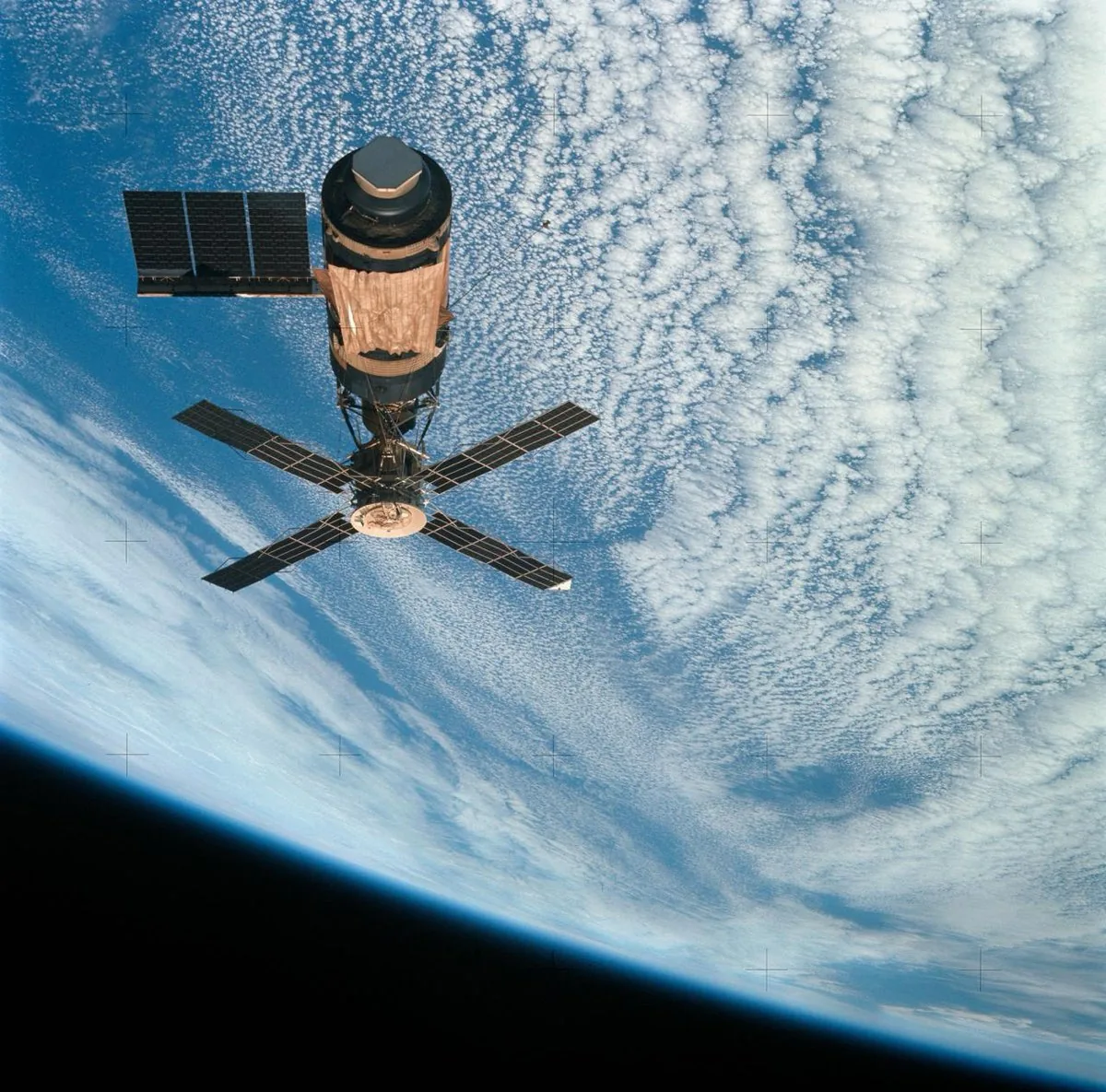
The micrometeoroid shield -- a thin aluminum shell wrapped around the Orbital Workshop that was designed to protect the station from tiny space debris and also serve as a thermal blanket to keep the interior cool -- tore away from the station. As it ripped free, the shield snagged one of the two main solar array wings and tore it completely off the station. Debris from the shield jammed the second solar array wing, pinning it against the side of the workshop and preventing it from deploying.
The station reached orbit, but it was in desperate trouble. Without the micrometeoroid shield, the workshop's exterior was exposed directly to the Sun. Interior temperatures quickly climbed toward 52 degrees Celsius (126 degrees Fahrenheit) -- hot enough to outgas toxic fumes from materials inside and render the station uninhabitable. Without the two main solar arrays, Skylab had only the four smaller solar panels on the Apollo Telescope Mount for electrical power, providing roughly half the electricity the station needed. Food and film inside the workshop were at risk of spoiling. The most ambitious space station ever built appeared to be dead on arrival.
NASA scrambled. The crewed launch of Skylab 2, originally scheduled for the next day, was postponed by ten days while engineers on the ground frantically designed and tested solutions. Teams at the Johnson Space Center in Houston and the Marshall Space Flight Center worked around the clock. They developed two key devices: a deployable parasol sunshade that could be pushed through a small scientific airlock on the workshop and unfurled like an umbrella to shade the exposed hull, and a set of long-handled tools that the crew could use during a spacewalk to cut the debris jamming the remaining solar array wing and free it to deploy.
The Rescue: Skylab 2 Saves the Station
On May 25, 1973, eleven days after the station's crippled launch, the Skylab 2 crew lifted off aboard an Apollo Command/Service Module launched on a smaller Saturn IB rocket. The crew was commanded by Charles "Pete" Conrad Jr., a 42-year-old Navy captain who had already flown in space three times, including walking on the Moon during Apollo 12. The Science Pilot was Joseph Kerwin, a 41-year-old physician and the first medical doctor to fly in space for NASA. The Pilot was Paul Weitz, a 40-year-old Navy commander on his first spaceflight.
Their first task was one of the most unorthodox repair attempts in spaceflight history. During the rendezvous approach, Conrad flew the Apollo spacecraft close to the crippled station so the crew could assess the damage. They could see the missing micrometeoroid shield and the single remaining solar array wing, pinned flat against the workshop by a strap of torn aluminum debris.
Before docking, the crew attempted a daring stand-up EVA. Weitz leaned out of the open Command Module hatch, connected to the spacecraft by a tether, and attempted to free the stuck solar panel using a long pole with a hook-like tool on the end. Conrad held Weitz's legs while simultaneously piloting the Apollo spacecraft to keep it positioned next to the station. Kerwin monitored systems from inside. Despite several aggressive attempts -- at one point Weitz was pulling so hard that he was rocking the entire 77-ton station -- the solar panel would not budge. The crew gave up, docked with Skylab, and went to sleep.
The next day, Conrad and Kerwin entered the sweltering station. The interior temperature had dropped somewhat after ground controllers oriented the station to minimize solar heating, but it was still dangerously hot. Working quickly, the crew opened the scientific airlock in the workshop, assembled the parasol sunshade (a sheet of aluminized Mylar and nylon measuring roughly 6.7 by 7.3 meters, or 22 by 24 feet), and deployed it through the airlock using telescoping poles. When the parasol unfurled and spread over the exposed hull, the effect was dramatic. Interior temperatures began dropping almost immediately, eventually settling to a comfortable 21 degrees Celsius (70 degrees Fahrenheit) within a few days.
But the power problem remained. On June 7, two weeks into the mission, Conrad and Kerwin performed one of the most heroic spacewalks in NASA history. They exited the station, made their way along the exterior of the workshop to the stuck solar array wing, and set to work. Using cable cutters mounted on a long pole, Conrad snipped the aluminum strap that held the panel down. The wing did not spring open as expected -- it had been pressed flat for so long that its deployment mechanism had lost much of its spring tension. Conrad attached a rope to the wing, and both astronauts pulled. When the wing finally broke free, it flung open with such force that Conrad was catapulted backward on his tether, tumbling away from the station. He was unhurt, and the solar array locked into its fully deployed position. Power levels surged. Skylab was saved.
The Skylab 2 crew remained aboard for 28 days, from May 25 to June 22, 1973, conducting solar observations, Earth resources photography, and medical experiments on the effects of spaceflight on the human body. They returned to Earth having accomplished one of the greatest repair missions in the history of space exploration.
Skylab 3: Science in Full Swing
The second crew arrived on July 28, 1973, and would stay for 59 days, more than doubling the American endurance record. The Skylab 3 crew consisted of Commander Alan Bean (who had walked on the Moon during Apollo 12), Science Pilot Owen Garriott, and Pilot Jack Lousma.
The mission was not without its own drama. Shortly after arriving, all three crew members experienced severe space motion sickness. Lousma and Garriott were particularly affected, and the crew's productivity suffered during the first few days. Concerns about the astronauts' health prompted discussions at NASA about whether the mission should be cut short. The crew recovered, however, and went on to accomplish an extraordinary volume of scientific work.
One early priority was reinforcing the station's thermal protection. The original parasol sunshade deployed by the Skylab 2 crew was beginning to degrade in the harsh space environment. During a spacewalk on August 6, 1973, Garriott and Lousma deployed a new twin-pole sunshade -- a larger, more robust thermal cover that was erected over the original parasol. This second sunshade, designed and built on the ground during the interval between missions, used two 16.5-meter (55-foot) poles to stretch an aluminized fabric over the damaged hull. It performed excellently and protected the station for the remainder of its operational life.
The Skylab 3 crew logged 1,081 hours of experiments during their 59-day stay. They exposed 76,000 frames of solar imagery using the Apollo Telescope Mount, conducted 333 hours of Earth resources observations, and performed detailed medical studies on their own physiological adaptation to weightlessness. They also discovered that long-duration spaceflight, while causing measurable bone density loss and cardiovascular deconditioning, did not produce any effects that were unmanageable or permanent at the 59-day mark. This was critical data. No one had ever stayed in space this long, and no one knew for certain what would happen. The Skylab 3 crew returned to Earth on September 25, 1973, in strong physical condition.
Skylab 4: Record-Breakers and the "Mutiny" That Wasn't
The third and final crew launched on November 16, 1973, for what would become an 84-day mission -- the longest crewed spaceflight in history at that time. The Skylab 4 crew was entirely composed of spaceflight rookies: Commander Gerald Carr, Science Pilot Edward Gibson, and Pilot William Pogue.
From the beginning, the mission was grueling. NASA had packed the crew's schedule with an extraordinarily dense timeline of experiments, maintenance tasks, and observations. The agency was acutely aware that this was Skylab's last mission and wanted to extract every possible hour of scientific return. The crew, all first-time astronauts still adapting to life in weightlessness, struggled to keep up with the relentless pace.
Tensions built throughout December 1973 and into January 1974. The crew felt overworked. Mission Control felt the astronauts were underperforming. Communications became strained. Then, on December 28, 1973, something happened that has been widely mythologized as the first "strike in space." According to the popular version of the story, the Skylab 4 crew turned off their radio and took an unscheduled day off, refusing to communicate with Mission Control.
The reality was more nuanced and less dramatic, though still significant. What actually occurred was a scheduling dispute and a breakdown in communication. The crew did not turn off their radio or refuse to work. Rather, they had a frank discussion with Mission Control about the unsustainable pace of the schedule. Commander Carr, in particular, communicated clearly that the crew needed more autonomy in planning their work day and more unscheduled time for rest and personal activities. NASA listened.
After the conversation, Mission Control restructured the crew's schedule, providing more flexibility and free time. The result was immediate: crew productivity and morale improved dramatically. The Skylab 4 astronauts went on to accomplish more scientific work than either of the two previous crews. By the end of the mission, they had conducted 56 spacewalks and experiments outside the station, taken over 75,000 solar images, made extensive observations of Comet Kohoutek (which passed through the inner solar system during their stay), and performed numerous Earth resources and materials science experiments.
They returned to Earth on February 8, 1974, after 84 days, 1 hour, and 16 minutes in space -- a record that would stand for American astronauts until the Shuttle-Mir program in the mid-1990s. Despite the tensions during the mission, all three astronauts were in excellent physical condition upon their return, providing the most compelling evidence yet that humans could endure long-duration spaceflight.
However, none of the three Skylab 4 crew members ever flew in space again. Whether this was a consequence of the scheduling dispute or simply a reflection of the limited flight opportunities in the years between Skylab and the Space Shuttle remains debated.
The Science of Skylab: Rewriting What We Knew
Skylab's scientific legacy is immense and often underappreciated. Across its three crewed missions, the station hosted 270 scientific and technical experiments. The total crew time spent performing experiments exceeded 2,000 hours.
The Apollo Telescope Mount was arguably the station's single greatest scientific instrument. Mounted on a cruciform structure at the forward end of the station and equipped with eight separate telescopes and instruments observing the Sun in wavelengths from visible light to X-rays, the ATM produced what were, at the time, the most detailed and comprehensive observations of the Sun ever made. Skylab crews captured over 175,000 solar images and made groundbreaking observations of solar flares, coronal holes, and the solar corona. These observations fundamentally advanced our understanding of solar physics and remained reference data for solar scientists for decades.
Earth resources experiments used a suite of cameras and sensors to photograph and study the planet below. The crews captured thousands of images covering agriculture, geology, oceanography, meteorology, and environmental monitoring. This work demonstrated the practical value of crewed Earth observation from orbit and contributed to the development of later Earth-observing satellite programs.
Medical experiments were perhaps the most consequential for the future of human spaceflight. The three Skylab crews served as test subjects for extensive studies of how the human body adapts to weightlessness over periods of 28, 59, and 84 days. Researchers tracked bone mineral loss, cardiovascular changes, vestibular adaptation, blood volume shifts, and muscular atrophy. The data showed that while the body does undergo significant changes in microgravity -- including a loss of bone density at a rate of roughly 1 to 2 percent per month and measurable muscle atrophy -- these effects were manageable with exercise and did not prevent astronauts from functioning effectively or recovering fully upon return to Earth. This was foundational knowledge. Without Skylab's medical data, the ISS program and its year-long missions would have been planned in far greater uncertainty.
Materials science experiments took advantage of the microgravity environment to study crystal growth, metal alloys, and fluid dynamics in ways impossible on Earth. While many of these experiments were exploratory, they laid the groundwork for decades of materials research aboard the Space Shuttle and the ISS.
The Fall: Skylab's Fiery Return to Earth
After the Skylab 4 crew departed in February 1974, the station was placed in a stable orbit and powered down. NASA had hoped that the Space Shuttle, then under development, would be ready in time to visit Skylab, potentially boosting it to a higher orbit or even refurbishing it. A plan was developed to attach a Teleoperator Retrieval System -- essentially a remotely controlled rocket booster -- to the station during a Shuttle mission.
It was not to be. The Space Shuttle program suffered repeated delays. Columbia, the first Shuttle orbiter, would not fly until April 1981 -- years too late. Meanwhile, Skylab's orbit was decaying faster than predicted. Increased solar activity during the late 1970s heated and expanded Earth's upper atmosphere, increasing atmospheric drag on the station and accelerating its orbital decay.
By late 1978, it was clear that Skylab would reenter the atmosphere before the Shuttle could reach it. NASA reactivated the station's control systems remotely in an attempt to manage the reentry and aim the debris footprint at an unpopulated ocean area. Controllers used the station's control moment gyroscopes to adjust its orientation, trying to influence when and where the breakup would occur.
On July 11, 1979, Skylab reentered the atmosphere. Despite NASA's efforts, the breakup did not go entirely as planned. The station proved more structurally robust than expected. Large fragments survived reentry and fell not only across the Indian Ocean, as intended, but also across a wide swath of sparsely populated Western Australia, stretching from the coast southeast of Perth to the goldfields region inland.
No one was injured. But the debris fall caused a global media sensation. Residents of the small town of Esperance, in the Shire of Esperance, found chunks of Skylab scattered across the surrounding countryside. Some pieces were substantial -- oxygen tanks, structural beams, segments of the workshop floor. In a moment of cheeky humor that became one of the most beloved footnotes in space history, the Shire of Esperance issued NASA a $400 fine for littering. NASA never officially paid the fine. It was not settled until 2009, when a radio DJ in the United States organized a listener-funded campaign that raised the money and sent it to Esperance, thirty years after the fact.
Legacy: The Foundation for Everything That Followed
Skylab flew for six years, was crewed for only 171 days, and hosted just nine astronauts. By the standards of the International Space Station -- which has been continuously occupied since November 2000 and has hosted over 270 people from 21 countries -- it was a brief and modest undertaking. But its importance to the history of human spaceflight is difficult to overstate.
Skylab proved, for the first time, that humans could live and work productively in space for months at a time. It demonstrated that a damaged spacecraft could be repaired in orbit through ingenuity and courage. It showed that scientific research of the highest caliber could be conducted aboard a space station. It revealed both the physiological challenges and the psychological demands of long-duration spaceflight -- and showed that both could be managed. It established that crew autonomy and reasonable scheduling were not luxuries but operational necessities for missions lasting weeks or months.
The medical data gathered during the three Skylab missions informed the design of exercise regimens and health monitoring protocols that are still used, in evolved form, aboard the ISS today. The solar science from the Apollo Telescope Mount remained the gold standard for decades. The station's Earth observation work helped build the case for the remote sensing programs that now provide critical data on climate change, agriculture, and natural disasters.
Perhaps most importantly, Skylab demonstrated the concept of the space station itself -- a permanent human outpost in orbit where science, technology development, and international cooperation could flourish. Without Skylab's success, the political and technical case for building the ISS would have been far harder to make.
When Pete Conrad, Joe Kerwin, and Paul Weitz crawled into the sweltering, crippled hull of Skylab in May 1973 and began the improbable work of bringing it back to life, they were not just saving a space station. They were proving that humanity could make a home beyond Earth -- however temporary, however improvised, however far from perfect. That lesson endures. Every astronaut who has floated through the modules of the ISS, every scientist who has analyzed data from a microgravity experiment, every engineer who has designed hardware for a future lunar or Martian habitat, owes a debt to the nine men who lived aboard a converted rocket stage in low Earth orbit more than fifty years ago.
Skylab was America's first space station. In many ways, it was the beginning of everything that followed.