AtmosphereDemonstration — lab/mission-tested
CO₂ Atmosphere
Global atmosphere (95.3% CO2 by volume)
Estimated Quantity
Average 600 Pa surface pressure (0.6% of Earth)
Pressure varies seasonally by ~25% as CO2 freezes/thaws at poles
As of 2021-01-01
Location & ISRU Feasibility
Where
Global (~95% CO₂); demonstrated in situ at Jezero Crater (18.4°N 77.5°E)
Extraction feasibility
High feasibilityUniformly available everywhere on the surface and the only Mars ISRU feedstock with a flight-proven extraction technology, though scaling to propellant quantities demands substantial continuous power.
Extraction technology
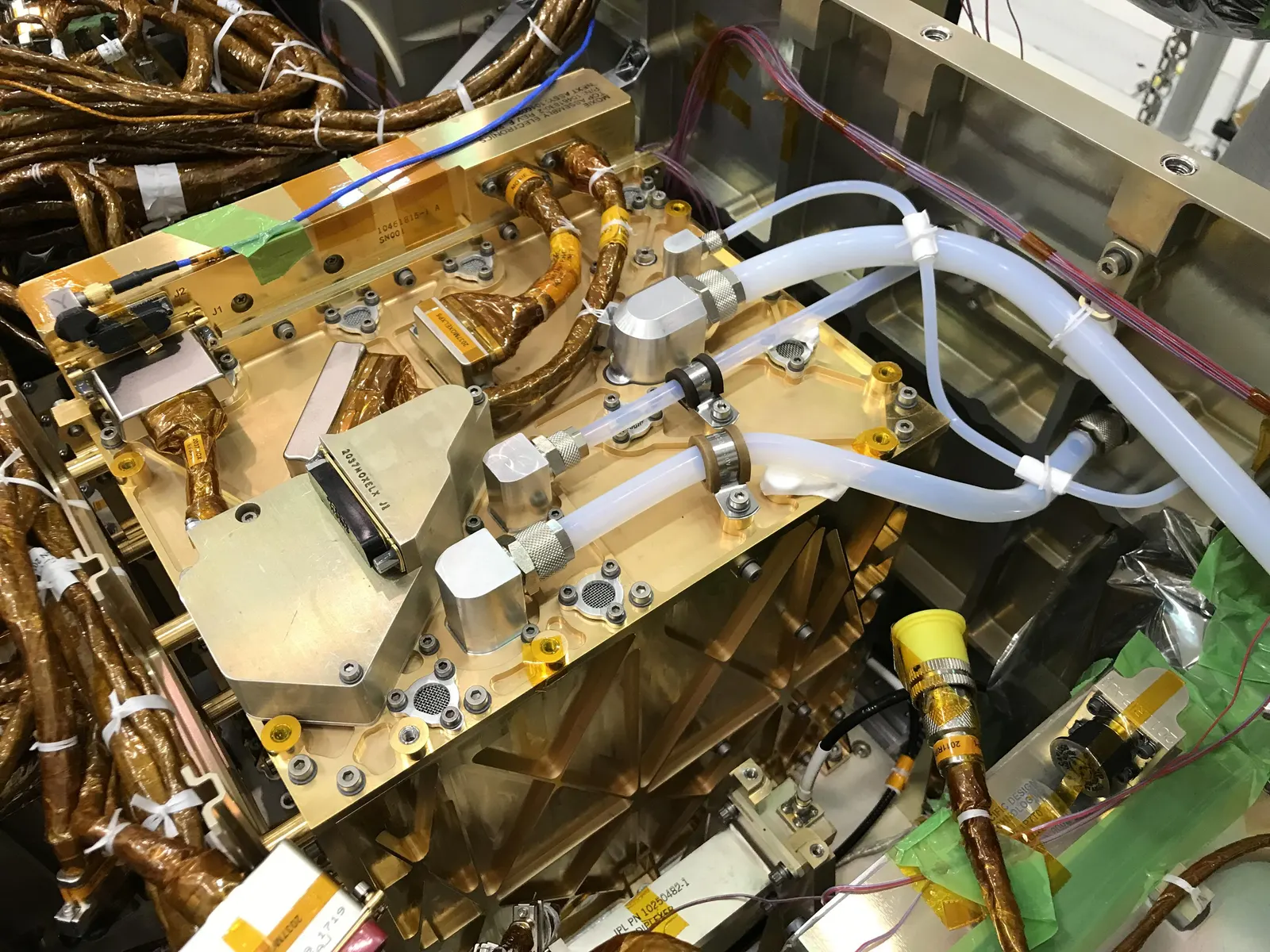
MOXIE demonstrated solid-oxide electrolysis of atmospheric CO₂ into O₂ on Perseverance (2021–2023): 122 g across 16 runs at up to 12 g/hr and 98%+ purity — the first ISRU demonstration on another planet.
Overview
Mars's thin CO2 atmosphere is paradoxically its most abundant ISRU feedstock. NASA's MOXIE instrument on Perseverance demonstrated oxygen production from CO2 in 2021 — the first ISRU demonstration on Mars. Full-scale MOXIE-like system ('MOXIE+') could produce the oxygen needed to fill a Mars Ascent Vehicle propellant tank over 26 months. CO2 can also be processed into CO/O2 bipropellant or combined with electrolyzed H2 to produce methane via Sabatier reaction.
ISRU Application
MOXIE on Perseverance demonstrated O2 production from CO2 via SOXE (solid oxide electrolyzer) — 6g/hour at scale needed for launch propellant means scaling to 25 kg/day for MAV
Reality Check
Atmospheric density is only 0.6% of Earth's — thin enough that large collectors are needed; power requirements are substantial
Sources
- [1] NASA JPL (MOXIE) — retrieved 2026-06-13
- [2] NASA Perseverance/MOXIE — retrieved 2026-06-01
Confidence: high · Last verified 2026-06-01
← All Mars ResourcesContinue your journey
Build it yourself
Build it
Surface Systems Laboratory — build the Mars Habitats
Build it yourself
Continue the story
Mars resource
Volcanic Basaltic Minerals
Continue the story
Continue the story
Mars resource
Potential Geothermal Energy
Continue the story
Continue the story
Mars resource
Iron Oxide Regolith (Martian Soil)
Continue the story
Continue the story
Mars resource
Perchlorate Compounds (ClO4⁻)
Continue the story

Continue the story
Mars resource
Polar Water Ice Caps
Continue the story