STEP 1 · structure
Spacecraft Bus
The bus is the boxy body at the bottom that holds Webb's batteries, computers, radio, and steering.
Why it exists: Every part of Webb needs power, a brain, and something to point it, and the bus does all three of those jobs.
Without it: With no body to hold the machinery, none of the other pieces have anywhere to attach or any power to run.
For engineers: Solar pressure on the tennis-court sunshield exerts a constant torque, so an aft momentum trim flap balances most of it while the reaction wheels absorb the rest, unloaded by thrusters that also make the small station-keeping burns holding Webb's L2 halo orbit every few weeks.
Webb is steered mainly by spinning reaction wheels; it almost never fires a thruster to point, which would nudge its orbit and shake the mirror.
Source: NASA — Webb FAQs (Northrop Grumman as prime contractor)STEP 2 · power
Solar Array
A row of solar panels on the sun side turns sunlight into all the electricity Webb needs.
Why it exists: Webb runs on electricity, and out in space the only outlet is the Sun, so it carries its own solar panels.
Without it: With no solar panels there is no electricity, and every computer, heater, and camera aboard goes dark.
For engineers: It is sized near two kilowatts to cover degradation over the mission, while the observatory itself draws only about one kilowatt.
Webb runs on roughly the power of a household kettle, about one kilowatt, a million miles from the nearest wall socket.
Source: NASA — Webb Deployment (solar array deploys first)STEP 3 · comms
High-Gain Antenna
A dish antenna that beams Webb's pictures and data all the way back to Earth.
Why it exists: Webb's photos are useless if they can't get home, so it needs a strong radio dish to send them across space.
Without it: With no antenna, Webb could take amazing images but never share a single one with anyone.
For engineers: Ka-band moves in a couple of hours what S-band would need days to send, so Webb contacts the DSN's 34-metre antennas two to three times a day.
Webb's antenna is aimed by a gimbal so the dish can track Earth without the whole telescope turning and spoiling an exposure.
Source: NASA — How Do We Communicate With Webb? (Ka-band, high-gain antenna, DSN)STEP 4 · thermal
Sunshield
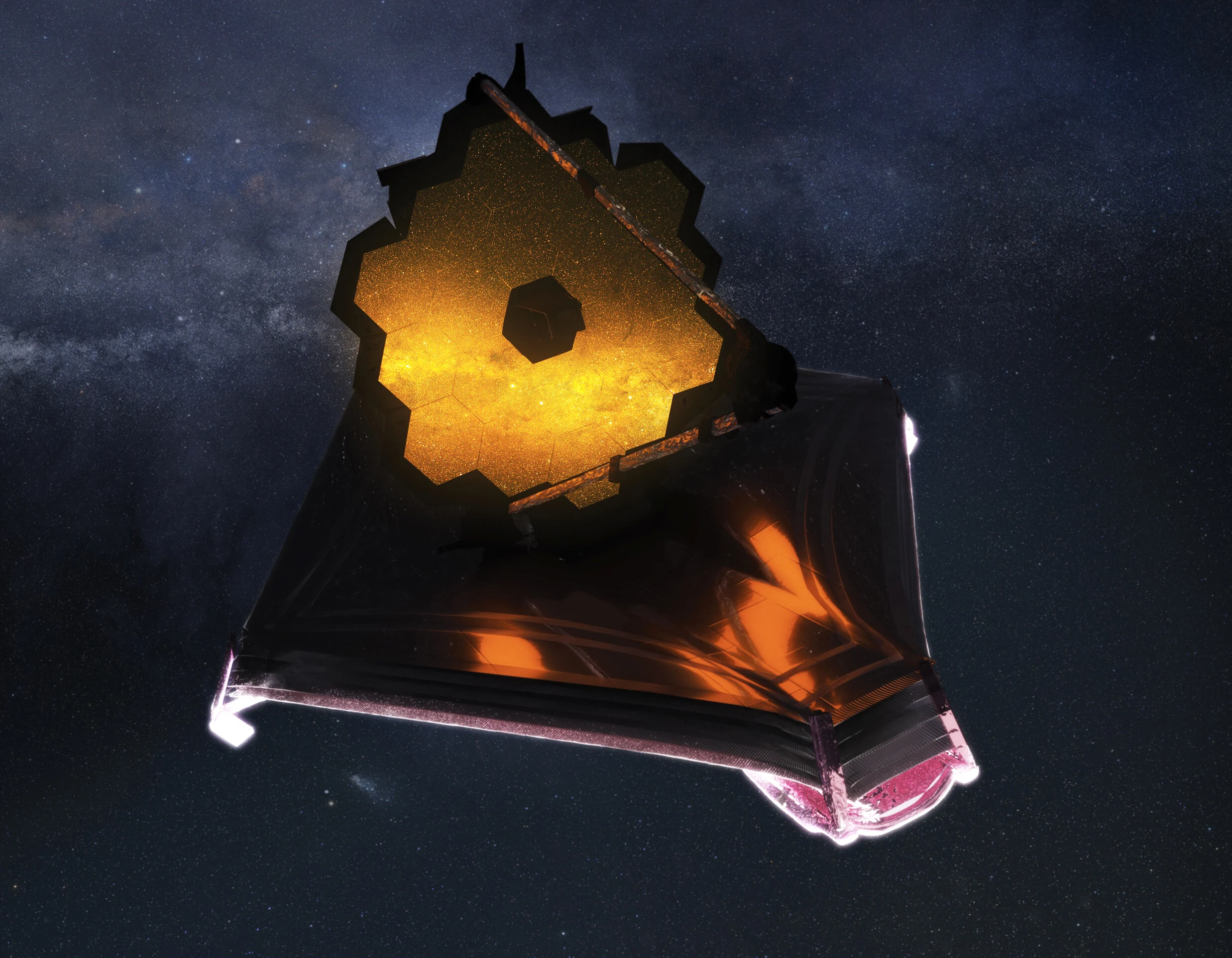
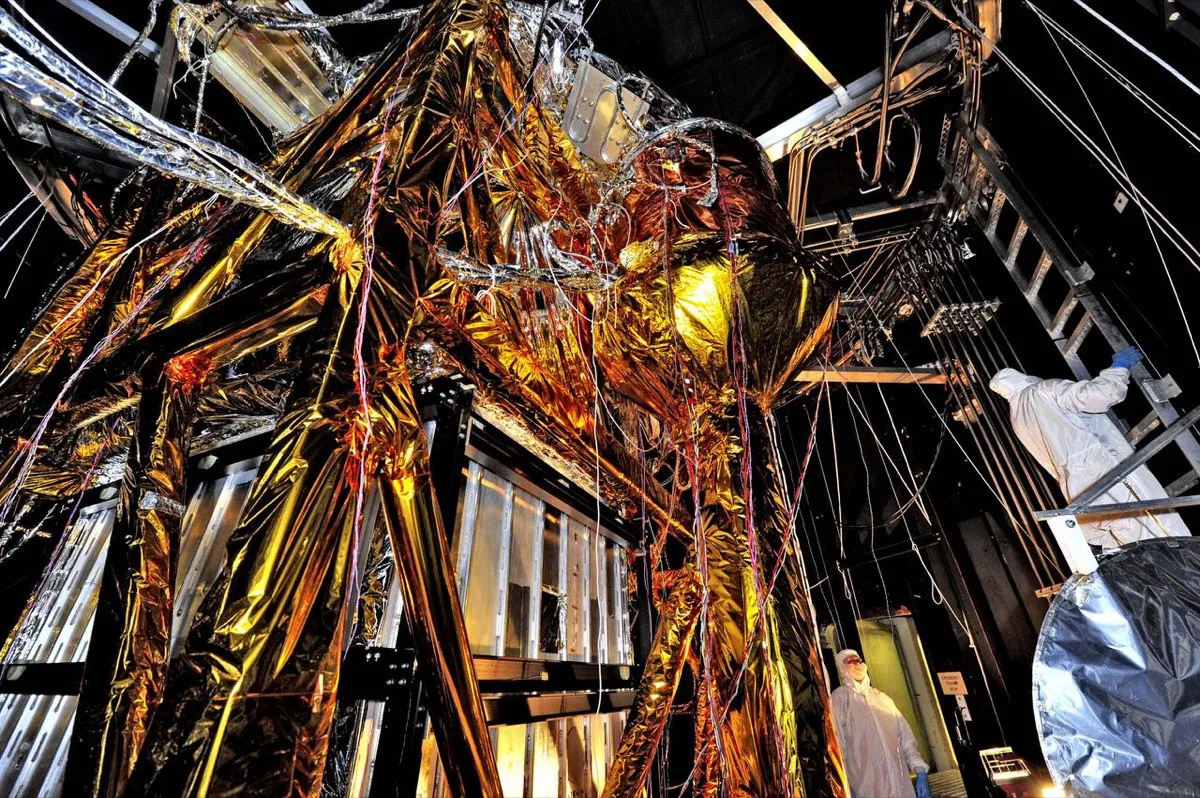
Five giant silver sheets, as big as a tennis court, that act like a super-sunshade for the telescope.
Why it exists: Webb sees heat as light, so it must hide from the Sun's warmth to keep its mirrors freezing cold and dark.
Without it: Without the sunshade the Sun's heat would blind Webb, drowning faint starlight in its own warm glow.
For engineers: It gives sun protection like SPF one million, holding the hot side near 110 C while the cold side falls below minus 235 C so the optics can reach under 50 K.
The five layers are each thinner than a human hair, yet together they cut the Sun's heat by a factor of roughly a million.
Source: NASA — Webb's SunshieldSTEP 5 · structure
Deployable Tower Assembly
A black telescoping pipe that pushes the whole telescope up and away from its warm body.
Why it exists: The mirrors must sit far from the warm machinery so they can get cold, so a tower lifts the two apart in space.
Without it: Without the tower the cold telescope stays pressed against the warm body and can never chill down.
For engineers: The standoff both makes physical clearance for the sunshield membranes to tension and breaks the conductive heat path from the warm sun-side structure to the cryogenic optics.
For launch the entire telescope was folded down onto the bus; the tower's first job in space was simply to stand the observatory up.
Source: NASA — Webb's Deployable Tower Assembly Extends in SpaceSTEP 6 · structure
Backplane (Primary Mirror Backplane)
The strong black frame that all 18 mirror pieces bolt onto, like the spine behind the mirror.
Why it exists: The mirror pieces must line up perfectly and never wobble, so they need a rock-steady frame to sit on.
Without it: Without the frame the mirror pieces have nothing to hold them together in one smooth curve.
For engineers: At temperatures below minus 240 C it must hold the optical bench essentially motionless so the segments can be co-phased to a common focus.
The backplane holds the mirror steady to about one ten-thousandth the width of a human hair, while swinging from room temperature to below minus 240 C.
Source: NASA — Webb's BackplaneSTEP 7 · optics
Primary Mirror
A giant golden mirror made of 18 six-sided pieces that fold out like petals to catch starlight.
Why it exists: The bigger the mirror, the fainter and farther the things it can see, so Webb's is huge and gold to grab infrared light.
Without it: With no main mirror there is nothing to collect the light, and Webb has nothing at all to see with.
For engineers: Beryllium holds its figure at cryogenic temperatures and the roughly 132 actuators across the observatory let the segments be aligned to nanometers into one perfect mirror.
All the gold on Webb's mirror would fit in a golf ball, about 48 grams spread just a few hundred atoms thick.
Source: NASA — Webb's MirrorsSTEP 8 · optics
Secondary Mirror
A small round mirror out on three long legs that bounces the caught light back down to the cameras.
Why it exists: The big mirror aims light at this little one, which then sends it to the instruments hiding behind the big mirror.
Without it: Without the little mirror the caught light has nowhere to go and never reaches the cameras.
For engineers: It forms the second element of the optical train, folding the primary's beam toward the fine-steering optics and the instruments, so it is aligned to nanometers.
Webb's secondary mirror rode to orbit folded against the primary, then swung out on struts nearly 7.6 metres long and latched into place.
Source: NASA — Webb's Mirrors (secondary mirror 0.74 m)STEP 9 · instrument
NIRCam (Near-Infrared Camera)
Webb's main near-infrared camera, the one behind most of its famous, colorful deep-space photos.
Why it exists: It takes sharp pictures in the near-infrared light that lets Webb peer through dust and back in time.
Without it: Without this camera Webb loses its sharpest near-infrared eye and most of its iconic images.
For engineers: Redundancy is deliberate: NIRCam is also the observatory's wavefront sensor — weak lenses in its filter wheels defocus star images for phase retrieval, and without a working module Webb cannot measure or co-phase its own 18 segments.
The same camera that took Webb's most famous images also acted as its optometrist, sensing tiny mirror errors so the 18 segments could be aligned.
Source: NASA — Webb's Scientific InstrumentsSTEP 10 · instrument
NIRSpec (Near-Infrared Spectrograph)
An instrument that splits starlight into a rainbow to reveal what distant objects are made of.
Why it exists: Colors hidden in the light tell us a galaxy's makeup, distance, and speed, so Webb carries a rainbow-splitter.
Without it: Without it Webb can photograph galaxies but can't read what they are actually made of.
For engineers: About a quarter-million micro-shutters — each roughly 100 by 200 microns, swept open magnetically and latched electrostatically — cut a custom slit mask in orbit, so one exposure captures about 100 faint spectra instead of one.
NIRSpec's micro-shutter array has about a quarter-million tiny doors, each openable on command, so Webb can grab roughly 100 spectra in a single exposure.
Source: NASA — Webb's Scientific InstrumentsSTEP 11 · instrument
MIRI (Mid-Infrared Instrument)
The one instrument that sees mid-infrared light, so it has to be kept even colder than the rest.
Why it exists: Mid-infrared reveals cool dust and distant galaxies, but the instrument must be frozen extra-cold to detect it.
Without it: Without it Webb can't see the coolest dust clouds and the faintest, most distant glows.
For engineers: Si:As detectors drown in their own dark current well above 7 K, and passive cooling bottoms out near 40 K — so a cryocooler with compressors on the warm bus precools helium in a pulse-tube stage, then expands it through a Joule-Thomson valve at the instrument to hold 7 K.
MIRI is so sensitive to heat that it needs its own refrigerator, chilling to 7 K, colder than the rest of the already-frozen telescope.
Source: NASA — Webb's Scientific InstrumentsSTEP 12 · instrument
FGS/NIRISS
A guide sensor that locks onto a star to hold Webb perfectly still, plus a bonus camera.
Why it exists: If Webb drifts even a little, its long exposures blur, so a guide sensor keeps its aim rock-steady.
Without it: Without it Webb can't hold still on a target and its long exposures smear into a blur.
For engineers: Closing the pointing loop through the fine-steering mirror rather than the reaction wheels is what holds the line of sight steady to a few milliarcseconds across hours-long exposures — lose guiding and every instrument's data smears.
Canada's Fine Guidance Sensor is Webb's ticket aboard: it keeps the telescope locked on target to within a few thousandths of an arcsecond.
Source: NASA — FGS/NIRISS (Canadian Space Agency contribution)