Too big to launch in one piece
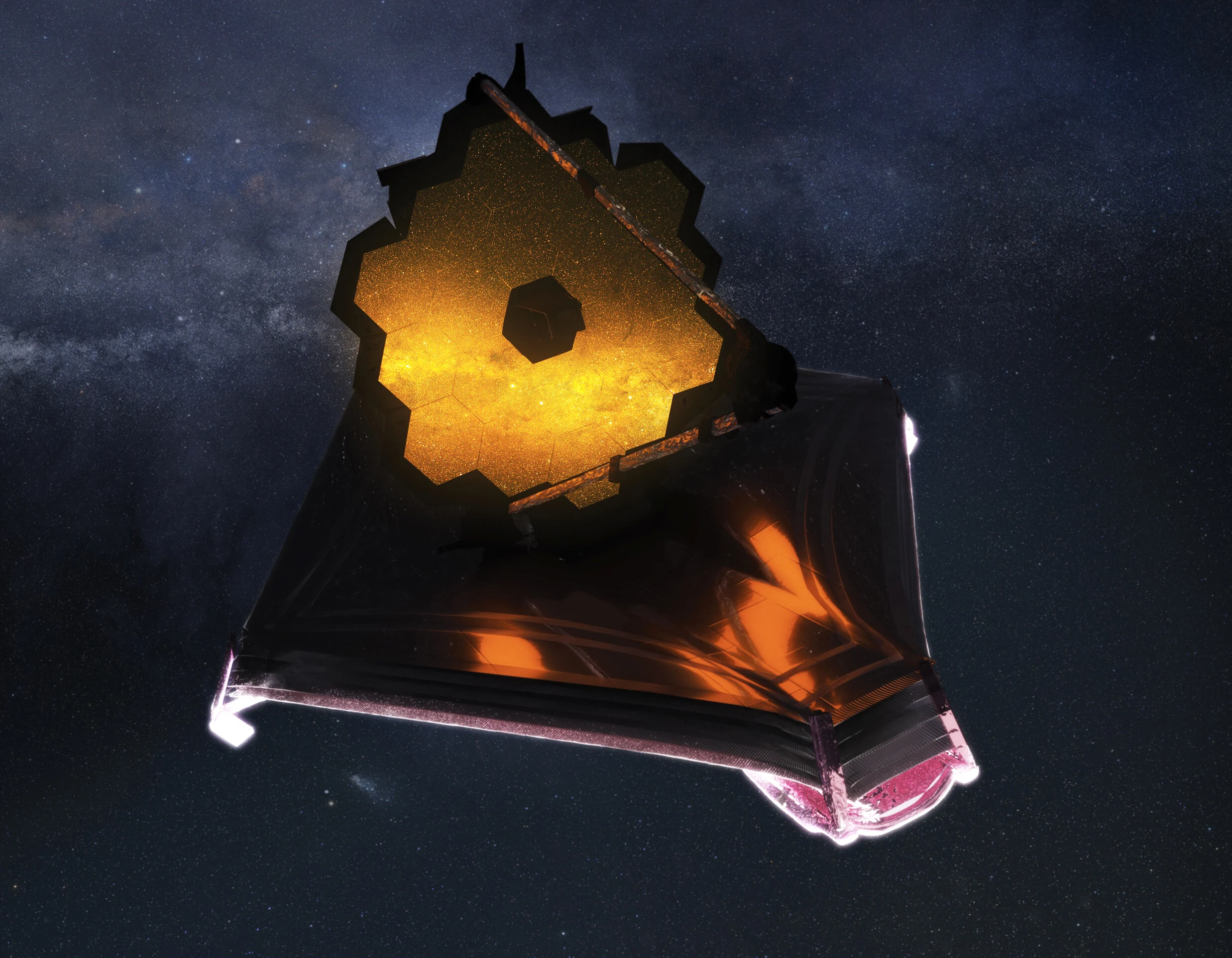
A 6.5 m mirror can't fit in any fairing, so it's built from 18 hexagonal beryllium segments — each 1.32 m across and coated in gold 100 nm thick — that fold into three panels and open in space.
BUILD · SPACE TELESCOPES · THE OBSERVATORY
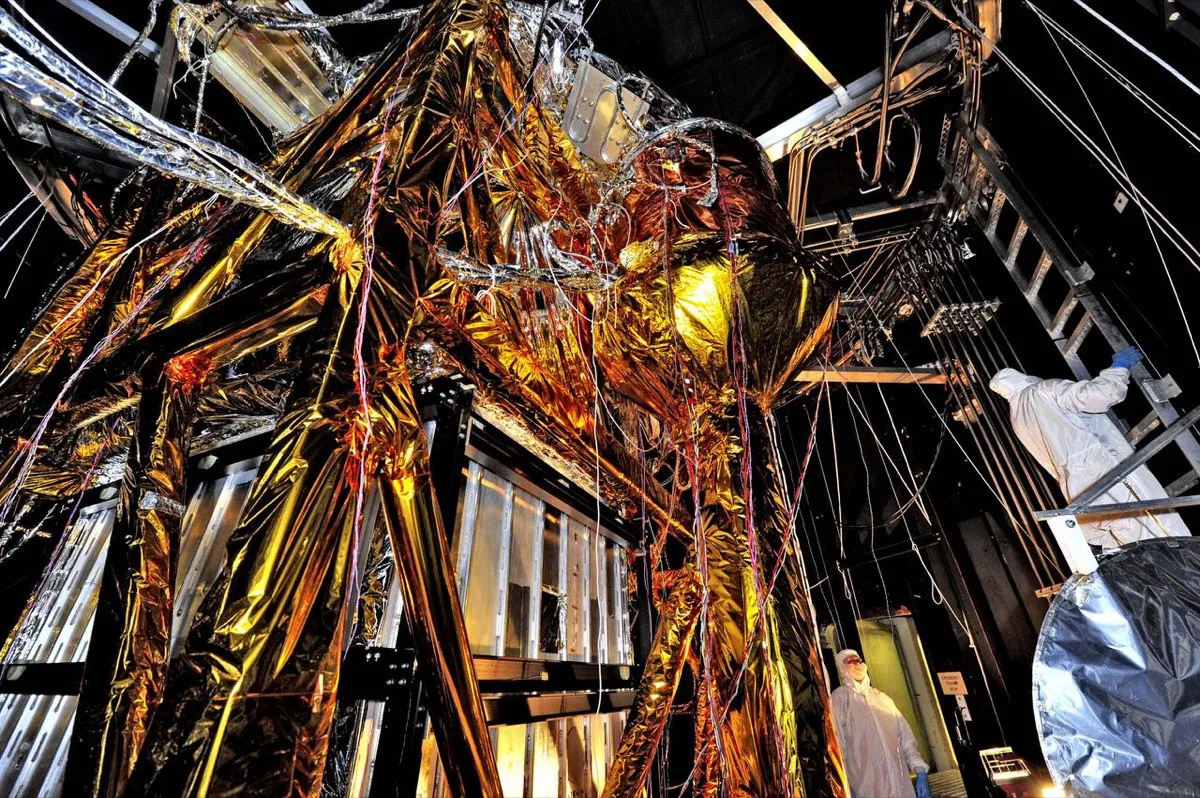
18 gold hexagons and a five-layer sunshield the size of a tennis court — folded to fit a rocket, then unfolded a million miles away where no one could ever fix it.
Three ways to know it. Realisticflies NASA's own model of Webb out in deep space, a small distant Earth at its back. Engineering lets you take it apart — unfold the mirror, sunshield, tower and secondary in the order Webb really deployed at L2, recolour the beryllium-and-gold optics by material, or x-ray the cold instruments hiding behind the mirror. Deployment flies The Great Unfolding — from an Ariane 5 fairing over Kourou through every one-shot mechanism to first light.
Everything you see had to unfold itself perfectly through hundreds of one-shot mechanisms, 1.5 million km from the nearest wrench.
The deployment sequence the simulator flies, step by step — from the launch pad at Kourou on 25 December 2021 to a fully open telescope a million miles away. Every mechanism here had to work the first time; there was no repair mission to L2.
L+0 · 25 Dec 2021
An Ariane 5 climbs out of French Guiana with Webb folded into a package barely 4.5 metres wide; minutes up, the fairing halves split and fall away.
If it fails: If the fairing hangs on, the mission ends before it begins.
L+33 minutes
Moments after the upper stage lets go, the solar array swings open and Webb starts making its own power.
If it fails: Until it opens, the battery is all Webb has — hours of life, not decades.
L+1 day
The gimballed high-gain antenna swings free and points home, opening the Ka-band line to the Deep Space Network.
If it fails: No antenna, no downlink — a perfect telescope that can't say what it sees.
L+3 days
The forward and aft pallets fold down, opening the case that carries all five folded sunshield membranes.
If it fails: Pallets that stick keep the shield boxed — and the optics warm and blind.
L+4 days
The Deployable Tower Assembly extends 1.2 metres, lifting the mirrors and instruments away from the warm spacecraft bus.
If it fails: Without that gap there is no room for the shield to unfold — and no cold side.
L+5 days
A small aft flap swings out to balance the steady push of sunlight on the huge shield, sparing the thrusters.
If it fails: Without this trim tab, Webb burns irreplaceable fuel just fighting sunshine.
L+5 days
Protective covers roll clear and the five membranes — each thinner than a human hair — meet space for the first time.
If it fails: A cover that clings pins the folded membranes to the pallet for good.
L+6 days
Two mid-booms motor out to port and starboard, pulling the sunshield to its full tennis-court width.
If it fails: One stalled boom leaves the shield half-open and the telescope half-blind.
L+7–10 days
Over several days, motors tension all five layers into separate taut surfaces with vacuum gaps between them.
If it fails: Slack or torn layers can't cascade heat away, and the cold side never nears −235 °C.
L+11 days
The tripod unfolds and locks the 0.74-metre secondary mirror out in front of the great gold eye.
If it fails: No secondary, no image — every photon the primary gathers would miss the instruments.
L+12 days
The aft ADIR radiator panel flips open so the cold cameras and spectrographs can dump their heat to deep space.
If it fails: Trapped heat would slowly blind the infrared detectors it took a generation to build.
L+13 days
The port wing of the primary mirror rotates into place and latches, carrying three of the 18 gold segments.
If it fails: A wing that won't latch leaves the 6.5-metre mirror forever incomplete.
L+14 days
The starboard wing swings home and latches — Webb is fully deployed, with 344 single-point failures all behind it.
If it fails: The last big one-shot mechanism; there is no repair mission 1.5 million km out.
L+1–4 months
Cruising out to L2, 1.5 million km away, Webb phases its 18 segments to within billionths of a metre until they focus as one mirror.
If it fails: Eighteen unaligned mirrors are eighteen small telescopes; aligned, they are one great eye.
A 6.5 m mirror can't fit in any fairing, so it's built from 18 hexagonal beryllium segments — each 1.32 m across and coated in gold 100 nm thick — that fold into three panels and open in space.
Webb sees heat as light, so the five-layer sunshield drops the cold side to about −235 °C. Without it, the Sun's warmth would drown the faint infrared it was built to catch.
A deployable tower lifts the optics away from the ~110 °C bus; without that separation the mirror could never chill to its operating temperature.
Sources: NASA — Webb's Mirrors, Webb's Sunshield, Webb Deployment. Geometry modelled to NASA figures (6.5 m primary of 18×1.32 m segments; ~21×14 m, 5-layer sunshield).
You've unfolded the telescope — now look through it at the deepest images ever taken.