Full mission transcript
Every chapter of Apollo–Soyuz, in sequence.
L−3 years
Rivals Agree to Meet
May 24, 1972 · 00:00 UTC
In May 1972, in the thaw of détente, Richard Nixon and Alexei Kosygin signed an agreement that would have been unthinkable a decade earlier: the United States and the Soviet Union would fly a joint mission in space. The two nations that had spent fifteen years trying to beat each other to every 'first' would now try to meet.
It was as much an engineering problem as a political one. Apollo breathed pure oxygen at low pressure; Soyuz held a sea-level mix of nitrogen and oxygen. Their docking systems were incompatible by design. NASA and the Soviets built a special Docking Module — an airlock and a new androgynous docking ring — so the two ships, and their two atmospheres, could finally join.
L−7h 30m
Soyuz Rises First
July 15, 1975 · 12:20 UTC
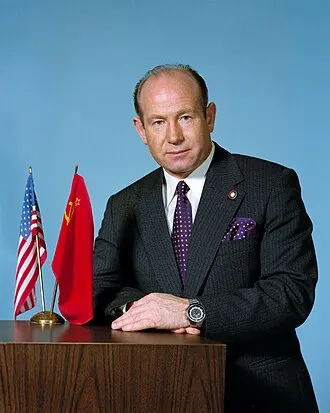
On the morning of 15 July 1975, Soyuz 19 lifted off from Baikonur carrying commander Alexei Leonov — the first human ever to walk in space, a decade earlier — and flight engineer Valeri Kubasov. For the first time, the normally secretive Soviet program launched live on television, its success announced to the world before the spacecraft even reached orbit.
Seven and a half hours behind them, on a pad in Florida, an American crew waited their turn.
T+00:00:00
Apollo Follows
July 15, 1975 · 19:50 UTC
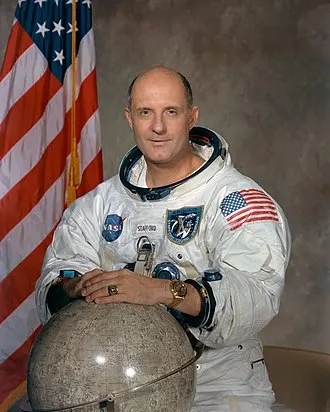
That evening a Saturn IB — the last Apollo rocket ever to fly with a crew — carried Tom Stafford, Vance Brand, and Deke Slayton up from Launch Complex 39B. For Slayton it was the end of an impossibly long wait: one of the original Mercury Seven, grounded for ten years by an irregular heartbeat, he finally reached space on this flight, at fifty-one.
Tucked behind their capsule rode the Docking Module — the adapter that would let them reach the Soyuz already circling overhead.
T+1d 20h
Rendezvous and Capture
July 17, 1975 · 16:09 UTC
For two days Apollo chased the Soyuz around the planet, trimming its orbit until the two specks became one. With Stafford flying the active approach, Apollo eased its new docking ring against Soyuz's and the latches closed, 220 kilometres above the Earth.
'We have capture,' Stafford called. From Moscow, Leonov radioed back that Soyuz and Apollo were now shaking hands — even before their crews could.
T+1d 23h
The Handshake
July 17, 1975 · 19:19 UTC
Three hours after docking, the hatches between the two worlds swung open. Tom Stafford floated into the tunnel and reached through to Alexei Leonov, and — high over Western Europe, near where Soviet and American soldiers had met at the Elbe thirty years before — the commander of an American ship and the commander of a Soviet ship shook hands in orbit.
They had learned each other's languages for this. They exchanged flags and gifts, shared a meal, and read messages from Brezhnev and President Ford. For a few days, the two superpowers were one crew.
T+2d
Forty-Four Hours as One Crew
July 18, 1975 · 00:00 UTC
The ships stayed joined for nearly two days. The crews moved back and forth between them, ran joint experiments — an artificial solar eclipse created by Apollo so Soyuz could photograph the Sun's corona, materials and biology studies — and gave joint television tours in two languages.
Then they undocked, parted, and went home separately. Soyuz 19 landed on the steppe of Kazakhstan; Apollo flew on alone for a few more days.
T+9d 01h
The Last Splashdown of an Era
July 24, 1975 · 21:18 UTC
On 24 July 1975, the Apollo capsule dropped into the Pacific near Hawaii and was lifted aboard the USS New Orleans. It was the last flight of an Apollo spacecraft, and the last time Americans would splash down in the ocean for forty-five years — until a Crew Dragon returned in 2020.
Apollo–Soyuz closed the Space Race not with another 'first,' but with a handshake. The trust built in that orbit ran straight forward through Shuttle–Mir to the International Space Station — where, ever since, Americans and Russians have lived and flown together among the stars.
Sources: NASA — Apollo-Soyuz Test Project · NASA History — The Partnership (ASTP)
The people who flew it
Meet the Apollo–Soyuz crew
Answers come only from the Apollo–Soyuz mission record above.