Full mission transcript
Every chapter of Apollo 13, in sequence.
T+00:00:00
Launch
April 11, 1970 · 19:13 UTC
At 2:13 p.m. EST on April 11, 1970, Saturn V SA-508 lifted off from Launch Complex 39A carrying commander Jim Lovell, command module pilot Jack Swigert — a backup crew member who had replaced Ken Mattingly just 72 hours earlier after a measles-exposure scare — and lunar module pilot Fred Haise. It was to be NASA's third lunar landing, targeting the Fra Mauro highlands.
The ascent was not flawless. During the S-II second-stage burn, the centre engine shut down about two minutes early. The remaining four J-2 engines burned longer to compensate, and the S-IVB third stage made up the rest. Apollo 13 reached Earth orbit on schedule — but the mission's pattern of near-misses had already begun.
T+55:54:53
"Houston, We've Had a Problem"
April 14, 1970 · 03:07 UTC
Roughly 330,000 kilometres from Earth, the crew performed a routine stir of the cryogenic oxygen tanks. Oxygen tank 2 exploded — the result of damaged wire insulation — rupturing a side panel off the service module and crippling the command module's power, oxygen supply, and main propulsion. Swigert's report was almost matter-of-fact: 'Okay, Houston, we've had a problem here.' Lovell confirmed: 'Houston, we've had a problem. We've had a Main B Bus undervolt.' Then, staring out the window, he saw the ship venting gas into space and understood what they were facing.
The Moon landing was aborted immediately. Mission Control in Houston pivoted from exploration to survival, beginning a four-day improvisation that would test every engineer, flight controller, and astronaut involved.
Air-to-ground · NASA transcript - T+55:55:20 Swigert: Okay, Houston, we've had a problem here.
- T+55:55:28 Lousma (CAPCOM): This is Houston. Say again, please.
- T+55:55:35 Lovell: Houston, we've had a problem. We've had a Main B Bus Undervolt.
- T+55:55:42 Lousma (CAPCOM): Roger. Main B Undervolt.
- T+56:09:07 Lovell: It looks to me, looking out the hatch, that we are venting something. We are venting something out into the... into space.
T+58:40:00
The Lifeboat
April 14, 1970 · 05:53 UTC
With the command module Odyssey losing power and breathable oxygen, the crew moved into the lunar module Aquarius. Aquarius was designed to support two astronauts for roughly two days on the lunar surface — not three men for a four-day rescue across deep space. Every watt and every fraction of a litre of water had to be rationed from the moment they closed the hatch.
Odyssey was powered down to preserve its batteries for the one critical moment still ahead: reentry. The spacecraft that was supposed to take them to the Moon was now their lifeboat, and the crew settled in for a cold, uncertain journey home.
T+77:08:00
Around the Moon
April 15, 1970 · 00:21 UTC
To use the Moon's gravity for a free-return slingshot toward Earth, the crew had to fly around the far side. Two hours past the far side, a precisely-timed burn of Aquarius's descent engine accelerated their return. As they swung behind the Moon, they passed through a radio blackout — alone with a broken spacecraft at the far edge of their journey.
At that moment, the Apollo 13 crew set a record that stands to this day: the farthest any human beings have ever been from Earth — approximately 400,171 kilometres. It is a record earned not in triumph but in crisis, a reminder that exploration and danger are inseparable.
T+93:00:00
The Mailbox
April 15, 1970 · 16:13 UTC
Carbon dioxide was rising to dangerous levels inside Aquarius. The lunar module used round lithium-hydroxide canisters to scrub CO₂ from the air; the command module's square canisters — of which there were spares — were physically incompatible. The crew faced suffocation unless engineers on the ground could devise an adapter from whatever was aboard: plastic bags, cardboard from a flight-plan binder, a hose, and duct tape.
Flight controllers assembled the parts on their desks in Houston and read the instructions step by step to the crew over the radio. The improvised scrubber — dubbed 'the mailbox' — worked. It was one of the most celebrated acts of problem-solving in space history, turning potential catastrophe into a manual for ingenuity under pressure.
T+105:18:00
Cold and Dark
April 16, 1970 · 04:31 UTC
With all non-essential systems shut down to preserve power, the cabin temperature inside Aquarius fell to approximately 3 °C. Condensation formed on the walls and instrument panels. Water was rationed to around 0.2 litres per person per day — far below the minimum recommended intake. The crew barely slept. The mission that had been planned as a geological expedition to Fra Mauro had become a test of human endurance.
Course corrections were performed without the inertial guidance platform that normally did the work; instead, the crew used Earth's terminator — the line dividing the sunlit from the dark hemisphere — as a visual reference to align the burn manually. Each manoeuvre had to be right. There was no margin for error.
T+141:29:56
The Long Blackout
April 17, 1970 · 16:42 UTC
Before reentry the crew jettisoned the service module, and for the first time got a clear look at the damage: an entire exterior panel had been blown away by the explosion, exposing the gutted interior. They photographed the wreckage as it drifted away, then powered up Odyssey on its carefully-reserved batteries. As the lifeboat was released, CAPCOM Joe Kerwin radioed up the farewell — 'Farewell, Aquarius, and we thank you' — and Lovell answered: 'She sure was a good ship.'
Odyssey hit the atmosphere and the radio blackout began — and ran roughly a minute and a half longer than predicted. Around the world, television audiences watched in silence. Then, at 1:07 p.m. EST on April 17, 1970, three orange-and-white parachutes appeared over the South Pacific.
Air-to-ground · NASA transcript - T+141:29:56 Lovell: Five. LM jettison.
- T+141:30:05 Kerwin (CAPCOM): Okay, copy that. Farewell, Aquarius, and we thank you.
- T+142:36:18 Kerwin (CAPCOM): Okay; We just had one last time around the room and everybody says you're looking great.
- T+142:38:36 Kerwin (CAPCOM): Okay LOS is about a minute or a minute and a half; in entry attitude, we'd like Omni Charlie, and welcome home. Over.
- T+142:38:45 Swigert: Thank you.
- T+142:46:03 Kerwin (CAPCOM): Odyssey, Houston standing by. Over.
- T+142:46:08 Swigert: Okay, Joe.
- T+142:49:17 Swigert: We got two good drogues.
- T+142:50:06 Kerwin (CAPCOM): Odyssey, Houston. We show you on the mains, it really looks great.
T+142:54:41
Home
April 17, 1970 · 18:07 UTC
Odyssey splashed down in the South Pacific Ocean near American Samoa at 1:07 p.m. EST on April 17, 1970. Recovery helicopters from USS Iwo Jima reached the capsule within minutes. All three astronauts — Jim Lovell, Jack Swigert, and Fred Haise — came home safely. The mission had lasted 5 days, 22 hours, and 54 minutes.
NASA called Apollo 13 a 'successful failure.' No landing was made, no science was done at Fra Mauro. But the mission proved that the agency's engineering culture, its obsessive rehearsal of contingencies, and the ability of crew and ground to think under pressure could bring three men back from the edge of deep space. It remains the most studied rescue in the history of human spaceflight.
Air-to-ground · NASA transcript - T+142:54:44 Photo 1 (recovery): Photo 1 observes splashdown at this time.
- T+142:54:56 Photo 1 (recovery): The three chutes are displaced. They're in the water.
Sources: NASA Apollo 13 Mission Overview · NASA Apollo 13 Mission Details
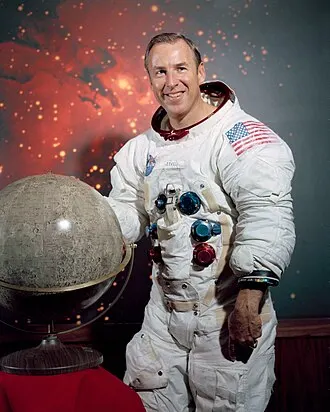
The people who flew it
Meet the Apollo 13 crew
The people who lived these seconds. Open a profile to read who they were.
Answers come only from the Apollo 13 mission record above.
Test yourselfMission debrief: 5 questions — ace it (80%+) to earn the Debrief Ace badge
Mission debrief1 of 5
What failed first on Apollo 13?
Myths to bust
“The famous line is 'Houston, we have a problem.'”
That's the 1995 film. Jack Swigert first radioed 'Okay, Houston, we've had a problem here,' and Jim Lovell repeated 'Houston, we've had a problem.'
“The explosion blew a hole in the crew's cabin.”
The tank exploded in the Service Module — a separate section behind the crew cabin. The crew felt a bang and watched their oxygen and power die, but their cabin never lost pressure.
Words that matter
- free-return trajectory
- — A path that uses the Moon's gravity to sling a spacecraft back toward Earth without a major engine burn.
- Lunar Module (LM)
- — The two-person lander — on Apollo 13, used as a lifeboat for three astronauts.
- CO₂ scrubber
- — A canister of lithium hydroxide that removes exhaled carbon dioxide from cabin air.
- Mission Control
- — The team in Houston that monitored the spacecraft and worked every problem alongside the crew.
- re-entry blackout
- — The minutes when ionized air around the returning capsule blocks all radio contact.
Teach with thisReady-made lesson: Apollo 13: Failure Is Not an Option 40 minAges 11–14 · Ages 14–18
Launch in Classroom Mode Printable worksheetSpaceflight history · Free, no sign-up · NGSS MS-ETS1-1, HS-ETS1-2, HS-ETS1-3
Students will be able to
- Reconstruct the sequence of events from the oxygen tank failure to splashdown
- Explain how the Lunar Module served as a lifeboat and why its systems were pushed past design limits
- Practice engineering problem-solving under constraints (the CO₂ scrubber adapter)
- Evaluate why Apollo 13 is called a 'successful failure'
Where to pause & what to say
1.The explosion— at “"Houston, We've Had a Problem"”
Fifty-six hours into the flight, oxygen tank 2 in the Service Module exploded after a routine stir. Listen to how calm the voices are. The crew and Mission Control don't know yet how bad it is — they diagnose it step by step, instrument by instrument. Point out that oxygen here isn't mainly for breathing: the fuel cells that make the ship's electricity and water need it too.
- Why do the astronauts and Mission Control sound so calm? Is that training, personality, or procedure?
- The crew first thought an instrument might be lying to them. How do you check whether a sensor is wrong or reality is wrong?
2.Moving into the LM— at “The Lifeboat”
The Command Module is dying — so the crew powers it down and moves into the Lunar Module, a lander built to keep two people alive for about two days. Now it must keep three people alive for four. Ask the class: what would you ration first? The answer surprises most students — water was the tightest constraint, and the crew cut to about a fifth of normal intake.
- The LM was never designed for this. What does that tell you about building margin into engineering designs?
- If you had to shut down almost everything to save power, how would you decide what stays on?
3.The square peg in a round hole— at “The Mailbox”
Three people breathing in a two-person cabin means carbon dioxide builds up to dangerous levels. The Command Module has spare scrubber canisters — but they're square, and the LM's sockets are round. Mission Control engineers dumped every loose item the crew had onto a table and built an adapter from covers of the flight plan, plastic bags, a sock, and duct tape — then read the crew instructions to build their own. This is the most famous improvisation in spaceflight history.
- Why did the engineers on the ground limit themselves to only the objects the crew actually had on board?
- What school subject was most useful in this moment — and would you have thought to call it 'engineering'?
4.Re-entry— at “The Long Blackout”
Re-entry blackout normally lasts about three minutes. Apollo 13's stretched well past four — and nobody on the ground knew if the heat shield had been damaged in the explosion. Let the silence in the room sit for a moment before the parachutes appear. This is April 17, 1970: the whole world was listening.
- Why couldn't anyone know the heat shield's condition before re-entry?
- What do you think the extra minute of silence felt like in Mission Control?
Hands-on activity
How far from rescue?
Apollo 13 was about 330,000 km from Earth at the explosion. Use the light-delay tool to work out how long each radio call took to arrive — then discuss what that lag means for who has to make decisions in a crisis.
Wrap-up discussion
- NASA calls Apollo 13 a 'successful failure.' Defend or attack that label with evidence from the mission.
- Which mattered more to the crew's survival: the machines, or the people and procedures? Where's the line?
- The crew never landed on the Moon. What did the mission accomplish anyway?
Continue your journey

The moment in history
Moment
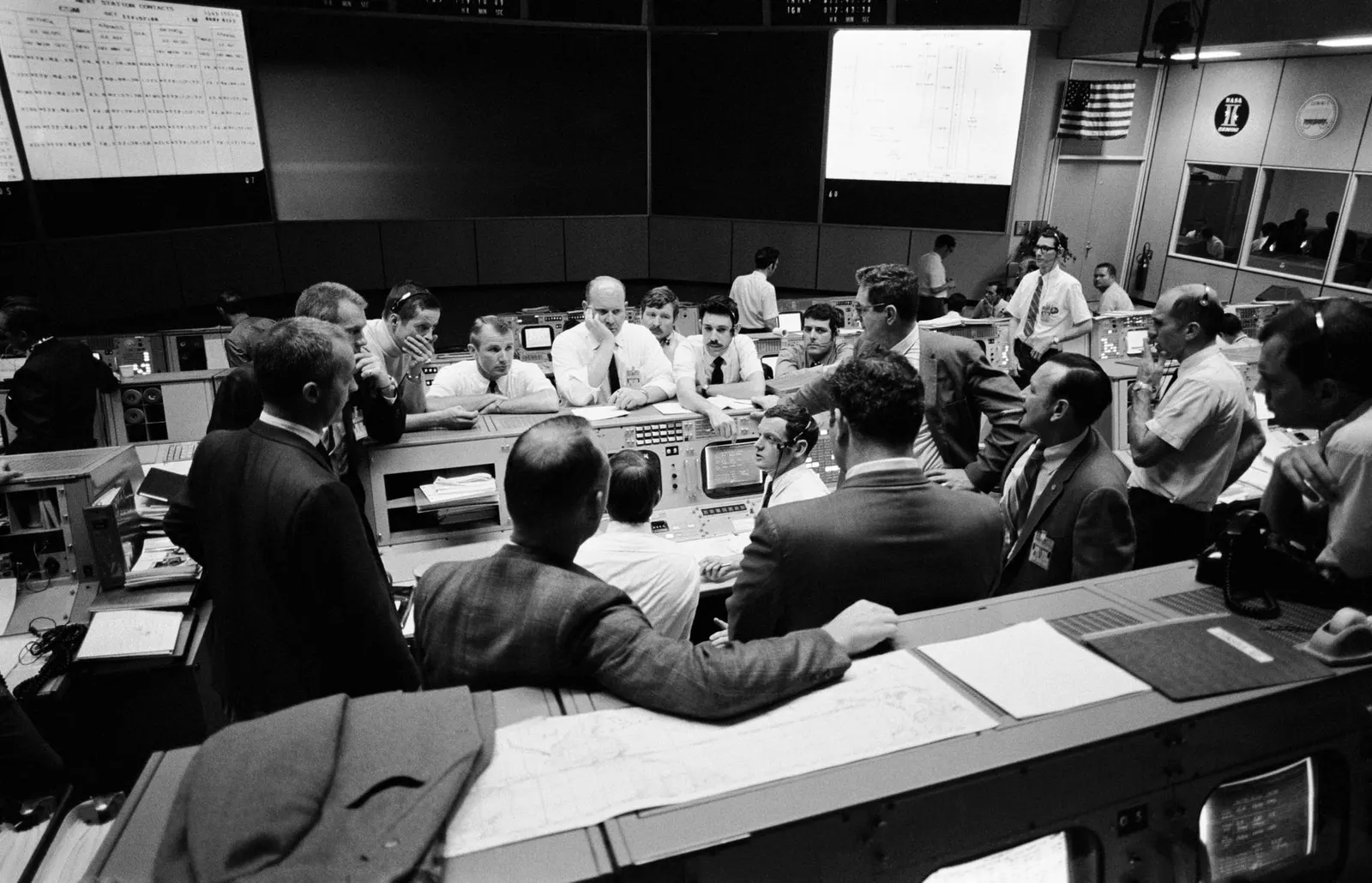
Apollo 13 returns safely after in-flight explosion
The moment in history
The mission file
Mission
Apollo 13
The mission file
From the same era
Experience
Apollo 11
From the same era
From the same era
Experience
Apollo 17
From the same era
From the same era
Experience
Apollo 8
From the same era
From the same era
Experience
Apollo–Soyuz
From the same era