Live · NASA SDO
The Sun Right Now
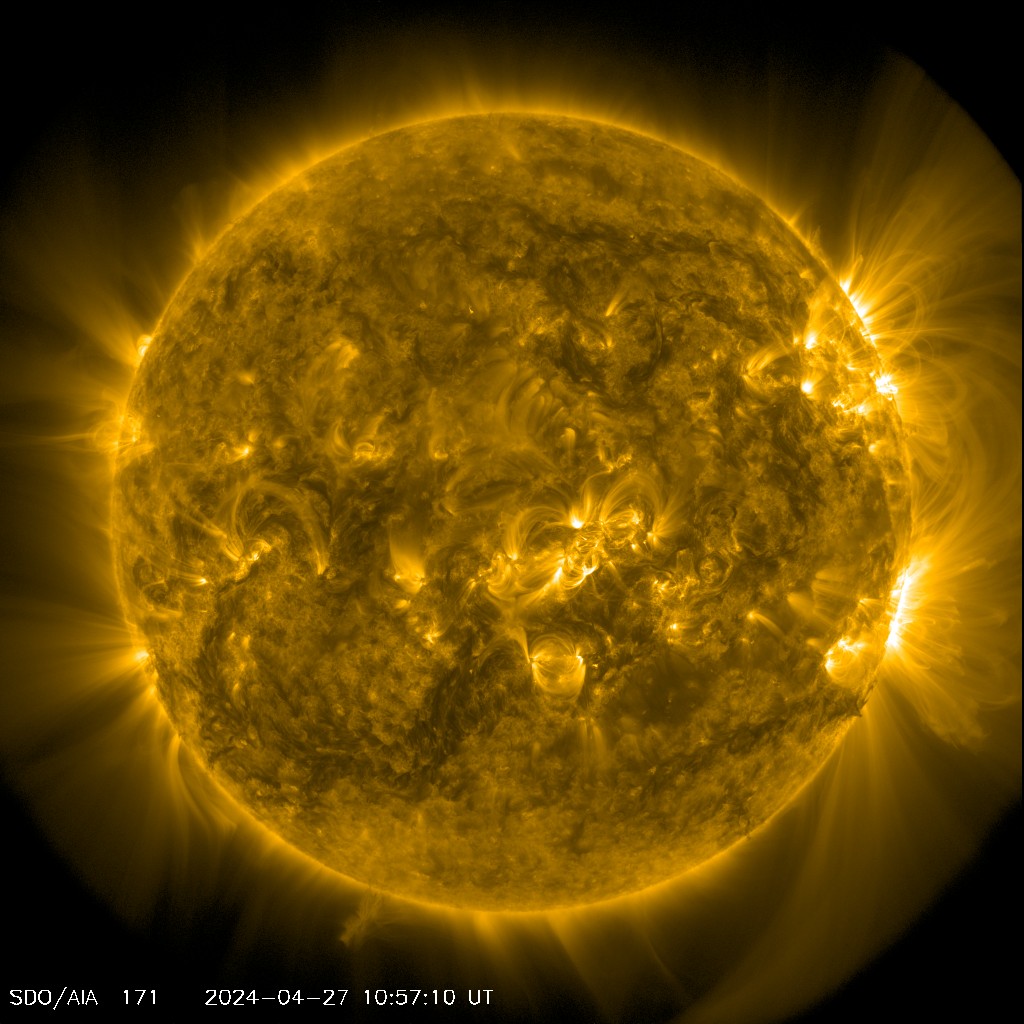
Our star, streamed live. NASA's Solar Dynamics Observatory stares at the Sun around the clock and sends back a fresh portrait every few minutes. Switch between wavelengths below — each one peels back a different layer, from the cool red chromosphere to ten-million-degree flare plasma, the dark freckle of a sunspot, and the raw magnetic field.
LIVE
Choose a wavelength
Quiet corona
~600,000 °CAIA 171 Å · extreme UV
The Sun's iconic golden filigree — magnetic loops of the quiet corona arching out of active regions.
Live from NASA's Solar Dynamics Observatory — refreshed every ~15 minutes. Public domain.
Our star, by the numbers
Diameter
1.39 million km
About 109 Earths across
Mass
333,000 Earths
99.86% of the entire solar system
Surface
~5,500 °C
The core reaches ~15 million °C
Age
~4.6 billion yrs
Roughly halfway through its life
Distance
150 million km
Its light reaches us in 8m 20s
Fuel burn
600 Mt/s
Hydrogen fused into helium each second
Why the Sun looks different in every light
The Sun doesn't have a single “true” colour. Each wavelength above is tuned to plasma at a particular temperature, so each one shows a different altitude in the solar atmosphere. Visible light reveals the photosphere and its sunspots; ultraviolet and extreme-ultraviolet light — invisible to the eye, false-coloured here — reveal the chromosphere and the million-degree coronaabove it. Stack them together and you can read the Sun's weather from the surface to the edge of space.
The 11-year heartbeat
The Sun's magnetic field tangles and untangles on a roughly 11-year rhythm called the solar cycle. At solar minimum the disc can be nearly spotless; at solar maximum it crawls with sunspots, flares and coronal mass ejections.
We are living through Solar Cycle 25, which began in December 2019 and reached its peak around 2024–2025 — a busier maximum than forecasters expected, which is why recent years have brought aurora to skies that rarely see them. Watch the active-region and flare wavelengths above on a stormy day and you can catch the cycle in the act.
When the Sun reaches Earth
Flares and coronal mass ejections fling radiation and plasma across 150 million kilometres. Days later they light up the aurora — and can rattle satellites, power grids and GPS. The live numbers behind that — the Kp index, solar wind speed and aurora forecast — live on the space-weather dashboard.
Keep exploring
Explore more of the universe
Universe ExplorerExplore the connected cosmos in 3DThe Cosmic LadderFly through 119,000 real starsWorldsLand on 16 real planets, moons & asteroidsThe PlanetsA tour of the solar system in real imagerySpace AcademyFly history's missions yourselfMission ReplaysRelive the great missions as they happenedStarsMeet the galaxy's brightest starsDeep-Sky Wonders39 galaxies, nebulae & clusters in real imageryThe Great CometsHalley, Hale-Bopp, NEOWISE & more in real photographyAsteroid WatchWatch real asteroids fly past Earth in 3DSpacecraftThe great robotic explorers in real imageryConstellationsThe figures of the night sky & how to find themMulti-WavelengthSee the cosmos in every kind of lightCosmic PerspectiveFrom your street to the edge of everythingSpace Time MachineTravel to any date in the Space Age