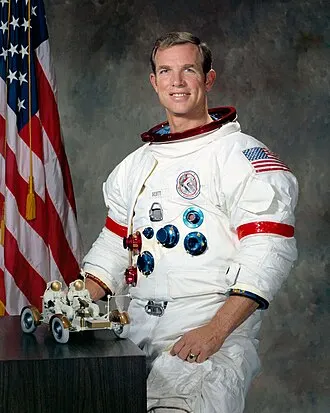
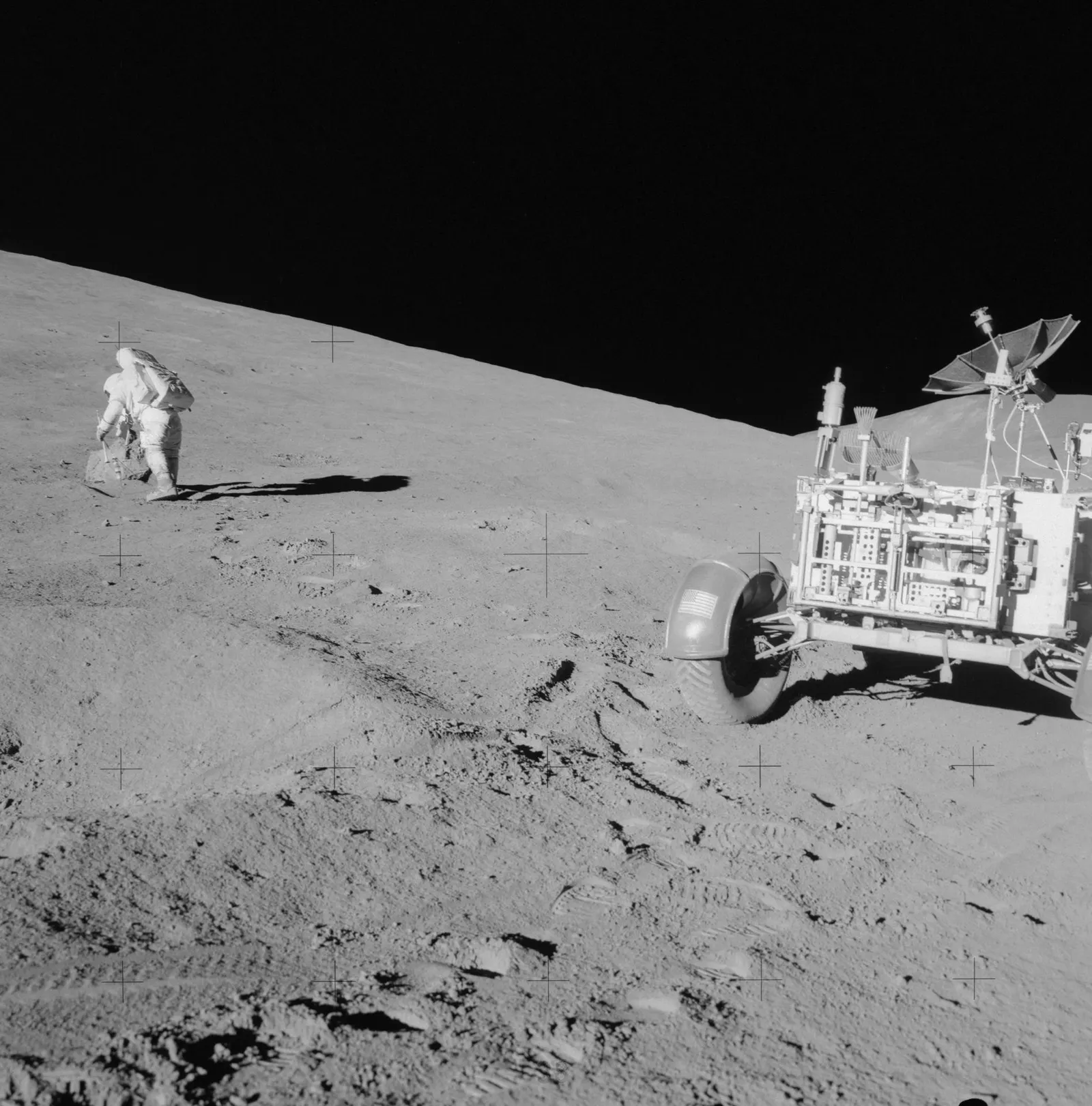
On the morning of 31 July 1971, Dave Scott and Jim Irwin stood on the Hadley plain with the Apennine mountains towering around them and pulled a series of lanyards on the side of the lunar module Falcon. A folded machine swung down from the descent stage and unfolded itself like a drawbridge: the first car on another world. When Scott took the driver's seat for a checkout spin, the front steering refused to respond. He drove anyway, steering with the rear wheels alone across a landscape no human had ever crossed at speed.
02 / 04
The Lunar Roving Vehicle was an improbable machine built on an impossible schedule. Boeing and General Motors' Delco division delivered it in just 17 months. Each wheel was woven from zinc-coated piano wire with titanium chevrons for tread, driven by its own small electric motor, and the whole vehicle folded flat against the lunar module's hull for the ride out. With no magnetic field to steer by, the crew navigated by a gyroscope-based dead-reckoning system that always knew the way home.
03 / 04
The rover transformed the mission. Scott and Irwin drove 27.9 kilometres in three hours and two minutes of total driving time, reaching the rim of Hadley Rille and the slopes of Mount Hadley Delta, places utterly beyond walking range. At Spur crater they picked up the Genesis Rock, a piece of ancient anorthosite crust roughly four billion years old. Across three moonwalks totalling 18 hours 35 minutes they collected 77 kilograms of samples, more than any previous crew.
04 / 04
The steering mystery resolved itself overnight; the front wheels worked perfectly on the second drive and no one ever fully explained why. Before leaving, Scott performed one last experiment for the television camera, dropping a hammer and a falcon feather together to prove Galileo right in the vacuum of the Moon. Rovers flew again on Apollo 16 and 17, and all three remain parked exactly where their crews left them.
“
As I stand out here in the wonders of the unknown at Hadley, I sort of realize there's a fundamental truth to our nature. Man must explore. And this is exploration at its greatest.
David R. Scott · Apollo 15 Commander, stepping onto the lunar surface, 31 July 1971
By the numbers
Launch
26 Jul 1971
First LRV drive
31 Jul 1971 (EVA-1)
Total LRV traverse
27.9 km (17.3 mi)
Driving time
3 h 2 min
EVA total
18 h 35 min over 3 moonwalks
Samples returned
77 kg (170 lb)
Why it mattered
The Lunar Roving Vehicle changed what a Moon mission could be. Apollo 11's crew never ventured more than about 60 metres from their lander; Scott and Irwin ranged across nearly 28 kilometres of mountain front and rille edge, and the geology haul grew accordingly. The rover turned the final three Apollo flights into true field expeditions, proved that surface mobility multiplies science return, and established the template every subsequent surface-mobility program has followed, from the Soviet Lunokhods' operations to Mars rovers to the lunar terrain vehicles being designed for Artemis crews today.
▸Boeing and GM's Delco division designed, built, and delivered the rover in just 17 months, and it worked on the Moon with no major anomalies.
▸The front steering was dead for the entire first drive on 31 July; the next morning it worked perfectly, and the cause was never fully explained.
▸Each wheel was hand-woven from zinc-coated piano wire with titanium chevron treads, because rubber tyres would not survive the lunar vacuum and temperature swings.
▸The rover's range led the crew to Spur crater, where they found the Genesis Rock, a fragment of the Moon's primordial crust roughly four billion years old.
▸At mission's end Scott dropped a hammer and a falcon feather on live television; they hit the dust together, confirming Galileo's prediction in lunar vacuum.