Space exploration is not safe. It has never been safe. But there is a difference between accepting inherent risk and failing to act on known dangers. The losses of Space Shuttle Challenger on January 28, 1986, and Space Shuttle Columbia on February 1, 2003, were not acts of God or unforeseeable accidents. They were the consequences of institutional failures -- of organizations that knew about problems and chose schedule, budget, and tradition over the lives of their people. These tragedies cost fourteen lives. They also transformed NASA and forced the entire aerospace industry to confront uncomfortable truths about safety culture. This is the story of what went wrong, who paid the price, and what changed because of their sacrifice.
Challenger: 73 Seconds
The morning of January 28, 1986, was bitterly cold at Kennedy Space Center -- 36 degrees Fahrenheit at launch time, far below the 53-degree minimum at which the Solid Rocket Booster O-rings had previously been tested. Engineers at Morton Thiokol, the contractor that built the boosters, had spent the previous evening in a desperate teleconference with NASA managers, arguing that the launch of STS-51-L should be delayed. They presented data showing that the rubber O-rings that sealed the joints between booster segments lost their resiliency in cold weather. At low temperatures, they warned, the rings might not seal properly, allowing superheated combustion gases to escape.
NASA managers pushed back. The launch had already been delayed multiple times. A teacher, Christa McAuliffe, was aboard as part of the Teacher in Space program, and the nation was watching. "My God, Thiokol," one NASA manager reportedly said, "when do you want me to launch -- next April?" Under intense pressure, Thiokol management overruled their own engineers and gave a launch recommendation.
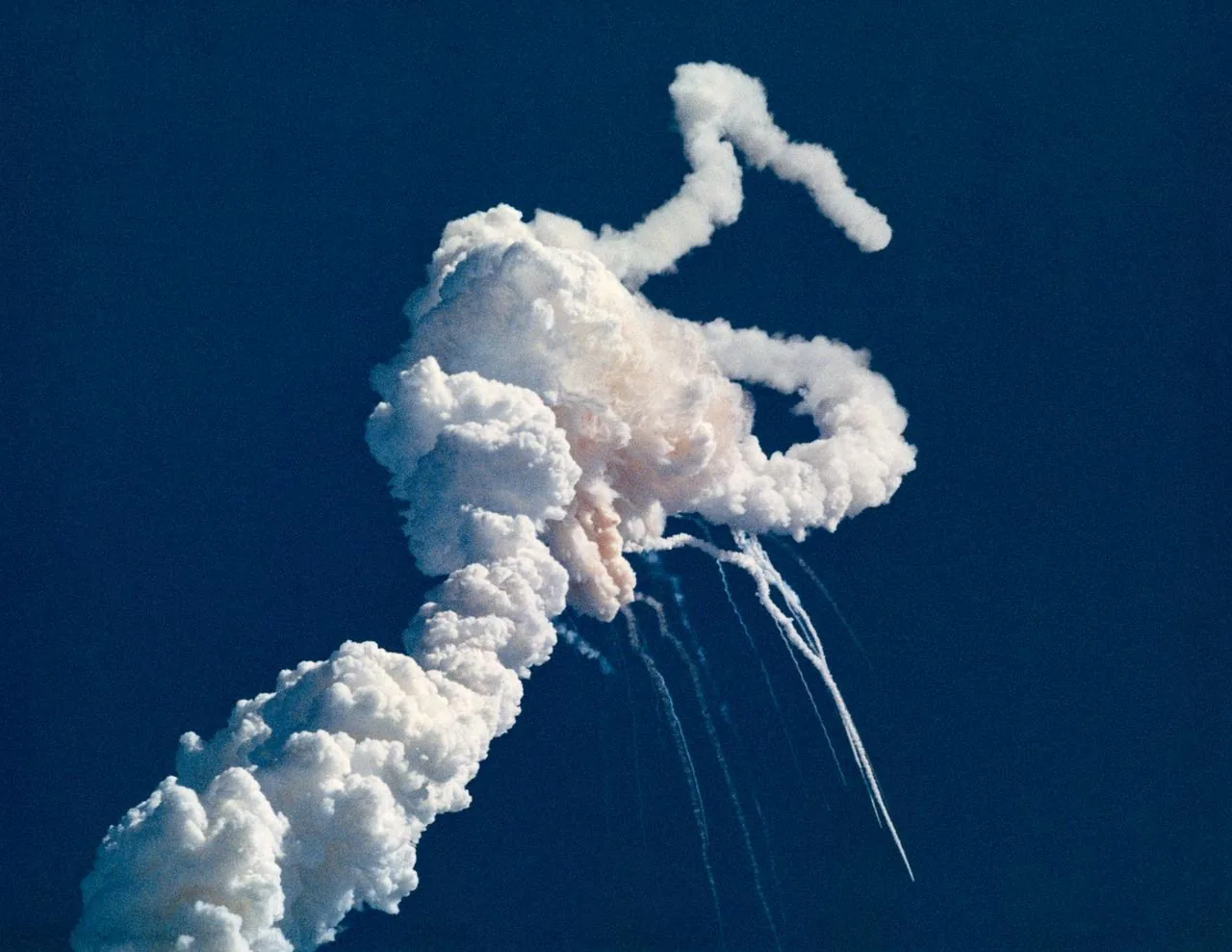
At 11:38 a.m. EST, Challenger lifted off. Within 0.678 seconds of ignition, puffs of black smoke appeared at the aft field joint of the right Solid Rocket Booster -- exactly where the engineers had predicted failure. The O-rings had failed to seal. Temporarily, aluminum oxide residue from the burning propellant plugged the gap. But at 58.788 seconds into flight, aerodynamic forces broke the temporary seal. A plume of flame erupted from the booster and quickly burned through the external tank's structure.
At 73 seconds after launch, the external tank disintegrated. The orbiter was torn apart by aerodynamic forces. The two Solid Rocket Boosters, still firing, spiraled away in opposite directions. The crew cabin, largely intact, continued on a ballistic arc, reaching an apogee of 65,000 feet before plunging into the Atlantic Ocean at roughly 200 miles per hour approximately two minutes and 45 seconds after breakup.
The seven crew members of STS-51-L were Commander Dick Scobee, Pilot Michael Smith, Mission Specialists Judith Resnik, Ellison Onizuka, and Ronald McNair, Payload Specialist Gregory Jarvis, and Teacher in Space participant Christa McAuliffe. At least some of them survived the initial breakup -- three Personal Egress Air Packs were found to have been activated. They were likely conscious for some portion of the fall. There was no escape system.
An estimated 17 percent of Americans watched the launch live on television, many of them schoolchildren who had tuned in to see McAuliffe teach from space.
The Rogers Commission
President Reagan appointed a presidential commission chaired by former Secretary of State William Rogers to investigate. The commission included physicist Richard Feynman, astronaut Sally Ride, and test pilot Chuck Yeager, among others. Their report, published in June 1986, was devastating.
The technical cause was straightforward: the O-ring failure. But the deeper findings were about culture. NASA had known about O-ring erosion problems since 1977. Engineers had flagged the issue repeatedly. The problems were documented, discussed, and rationalized away. The commission found that NASA's decision-making process was "flawed" and that the agency had developed a dangerous tolerance for deviation from design specifications -- a phenomenon later termed "normalization of deviance" by sociologist Diane Vaughan.
Feynman's appendix to the report contained a line that became famous: "For a successful technology, reality must take precedence over public relations, for nature cannot be fooled."
The Shuttle program was grounded for 32 months. The Solid Rocket Boosters were redesigned with a capture feature that prevented joint rotation. NASA restructured its management and created the Office of Safety, Reliability, and Quality Assurance, reporting directly to the NASA Administrator. A crew escape system was added for contingency abort scenarios.
Columbia: The Foam Strike
Seventeen years later, the pattern repeated itself -- different technical failure, same institutional blindness.
On January 16, 2003, Space Shuttle Columbia launched on STS-107, a 16-day science mission. During launch, 81.7 seconds after liftoff, a briefcase-sized piece of insulating foam broke away from the external tank's bipod ramp and struck the leading edge of the left wing at approximately 545 miles per hour. The impact punched a hole roughly six to ten inches in diameter in Reinforced Carbon-Carbon panel number eight.
Engineers at Boeing noticed the foam strike in film analysis within days of launch. A team led by engineer Rodney Rocha requested satellite imagery to assess potential damage to the wing. The request was denied by NASA management. In an email that would later become infamous, a NASA manager wrote that the foam was not a "safety of flight" issue -- despite the fact that foam had struck the orbiter on multiple previous missions and engineers had raised concerns for years.
For sixteen days, the crew of Columbia carried out their science mission, unaware of the damage to their spacecraft. On February 1, 2003, they began reentry. At approximately 8:44 a.m. EST, superheated atmospheric gases entered through the breach in the wing's leading edge. Over the next several minutes, the left wing's internal structure was destroyed. At 9:00 a.m. EST, at an altitude of approximately 207,135 feet over Texas, Columbia broke apart.
The seven crew members of STS-107 were Commander Rick Husband, Pilot William McCool, Mission Specialists Michael Anderson, David Brown, Kalpana Chawla, and Laurel Clark, and Payload Specialist Ilan Ramon -- the first Israeli astronaut. All seven perished.
Debris rained across East Texas and Louisiana along a corridor hundreds of miles long. More than 25,000 volunteers and searchers eventually recovered 84,000 pieces of debris, representing roughly 38 percent of the orbiter's dry weight. Remains of all seven crew members were recovered.
The Columbia Accident Investigation Board
The CAIB, chaired by retired Admiral Harold Gehman, produced a 248-page report in August 2003 that reached conclusions remarkably similar to those of the Rogers Commission seventeen years earlier. The physical cause was the foam strike. But the organizational causes ran far deeper.
The board found that NASA's safety culture had eroded once again. Schedule pressure, budget cuts, and a management structure that suppressed dissenting engineering opinions had created an environment where known risks were accepted without adequate analysis. The board wrote: "The organizational causes of this accident are rooted in the Space Shuttle Program's history and culture, including the original compromises that were required to gain approval for the Shuttle, subsequent years of resource constraints, fluctuating priorities, schedule pressures, mischaracterization of the Shuttle as operational rather than developmental, and lack of an agreed national vision for human space flight."
The parallels to Challenger were unmistakable. In both cases, engineers identified the problem before the disaster. In both cases, management overrode or ignored their concerns. In both cases, a known flaw was tolerated until it killed.
What Changed
The Columbia disaster led to sweeping changes. NASA implemented mandatory debris inspection protocols using the Orbiter Boom Sensor System on subsequent flights. The agency developed repair techniques for damaged thermal protection systems. Launch imaging was dramatically enhanced, with multiple high-resolution cameras tracking every ascent. A "safe haven" protocol was established whereby a damaged orbiter could dock at the International Space Station while a rescue shuttle was prepared.
More fundamentally, NASA restructured its safety reporting chain. The NASA Engineering and Safety Center was established in 2003 as an independent technical resource, free from programmatic pressure. Engineers were explicitly empowered to raise safety concerns without fear of retribution. The culture -- slowly, imperfectly, but genuinely -- began to shift.
President George W. Bush announced in January 2004 that the Space Shuttle would be retired after completion of the International Space Station. The final Shuttle mission, STS-135, flew in July 2011.
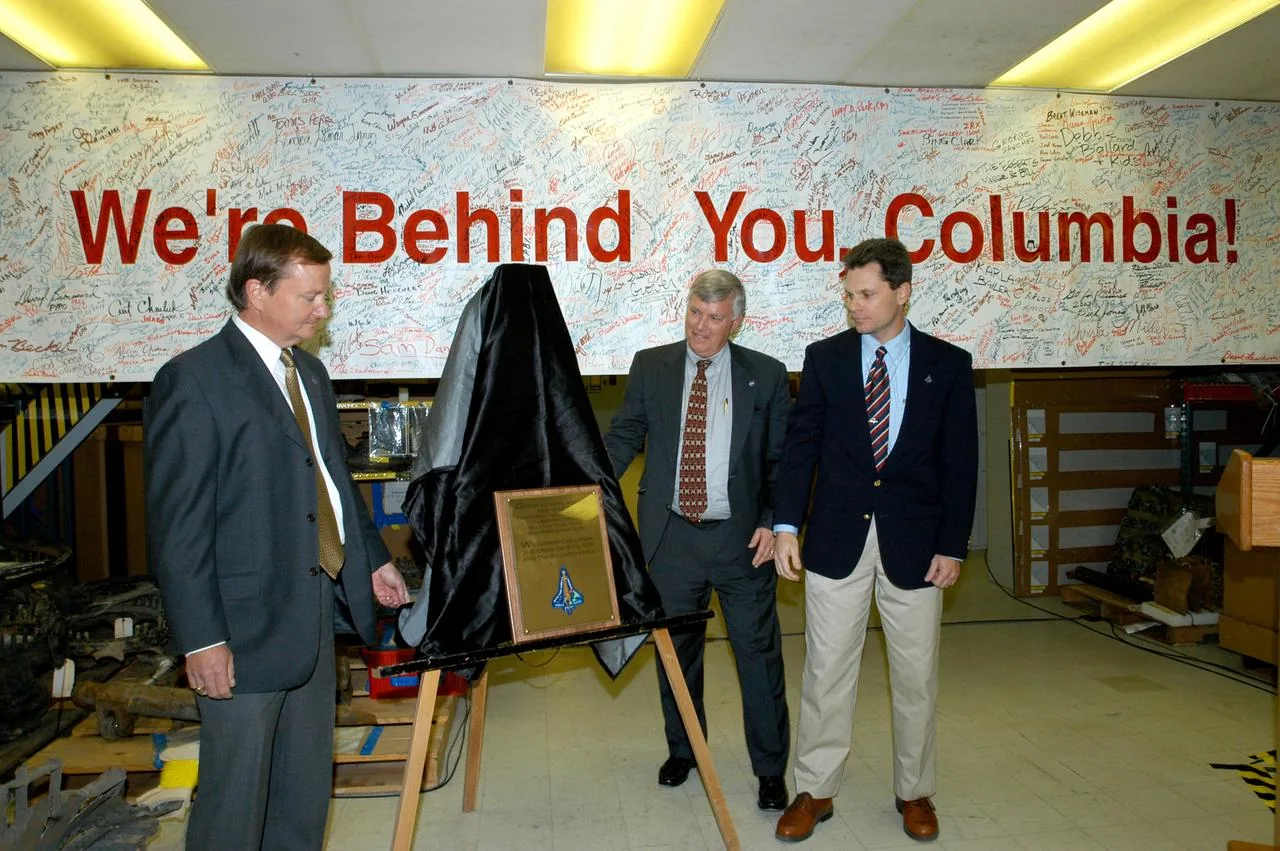
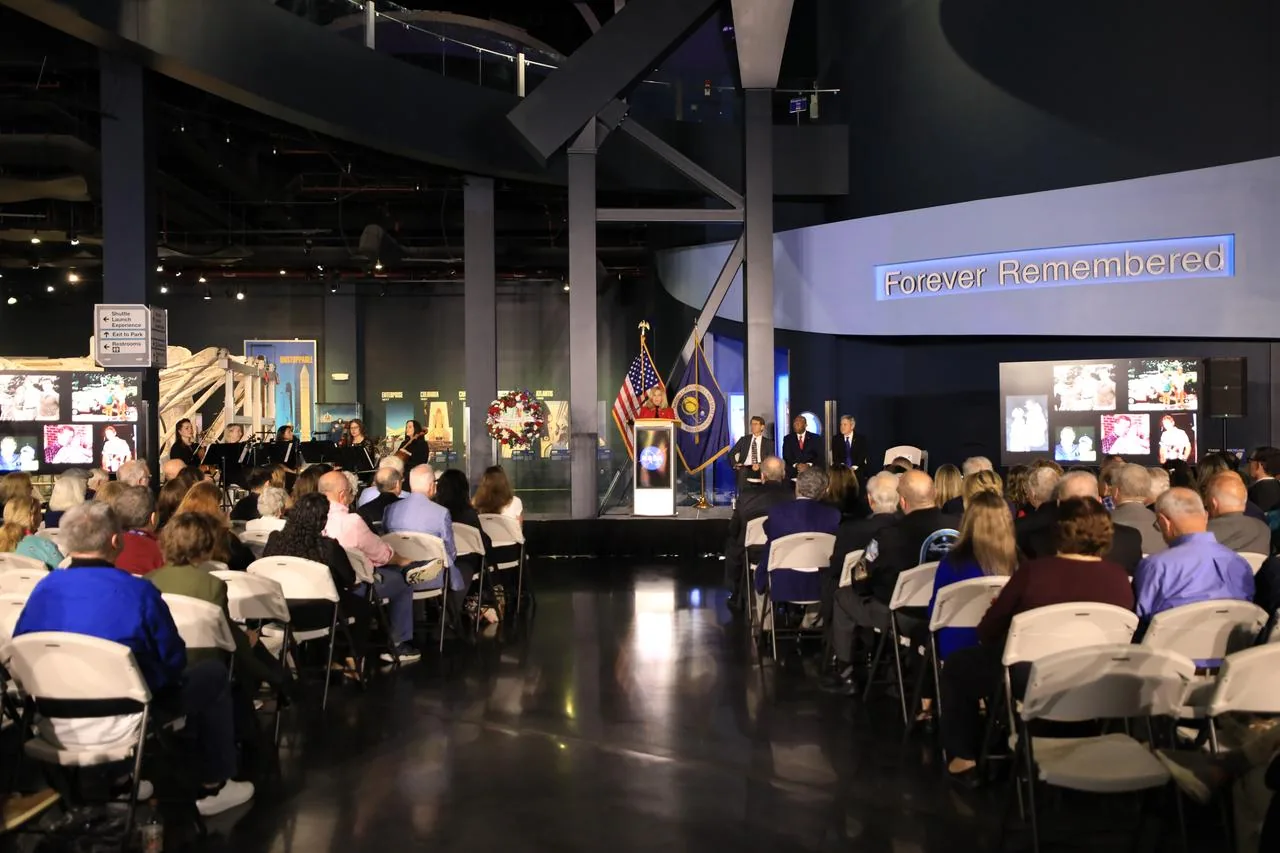
Remembering the Fourteen
The crews of Challenger and Columbia are remembered not as victims of institutional failure but as explorers who understood the risks they took. Rick Husband's wife, Evelyn, later said her husband knew the dangers and flew anyway, because he believed the work mattered. Christa McAuliffe's oft-quoted words -- "I touch the future. I teach." -- still resonate.
Their names are inscribed on the Space Mirror Memorial at Kennedy Space Center. Schools, buildings, and scholarships bear their names across the country. But the most meaningful memorial is the one you cannot see: a safety culture at NASA and across the aerospace industry that is fundamentally different -- more rigorous, more humble, more willing to listen to the quiet voice of the engineer who says, "I think we have a problem."
The fourteen men and women who died aboard Challenger and Columbia did not die in vain. They died because institutions failed them. And because of their loss, those institutions were forced to change. That is not comfort. But it is something.