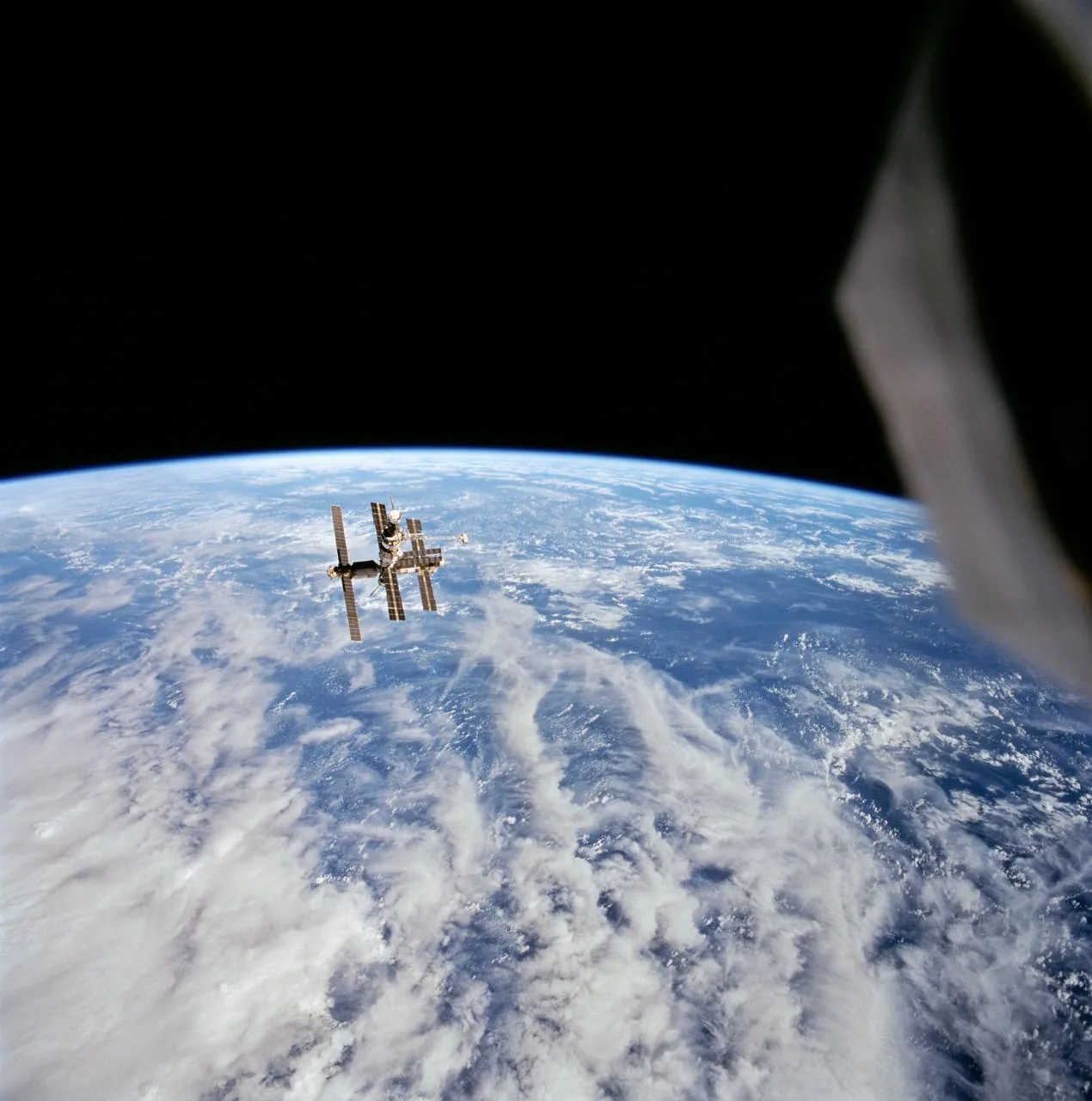
Before the International Space Station, before humans routinely lived and worked in orbit for six months at a stretch, there was Mir. The Russian word means both "peace" and "world," and for fifteen years the station was both -- a world unto itself, orbiting 250 miles above the Earth, where 104 people from twelve nations lived, worked, quarreled, nearly died, and proved that human beings could survive in space not for days or weeks, but for months and years. Mir was battered, patched, improvised, and sometimes terrifying. It was also one of the most important achievements in the history of spaceflight.
Building a Home in Orbit
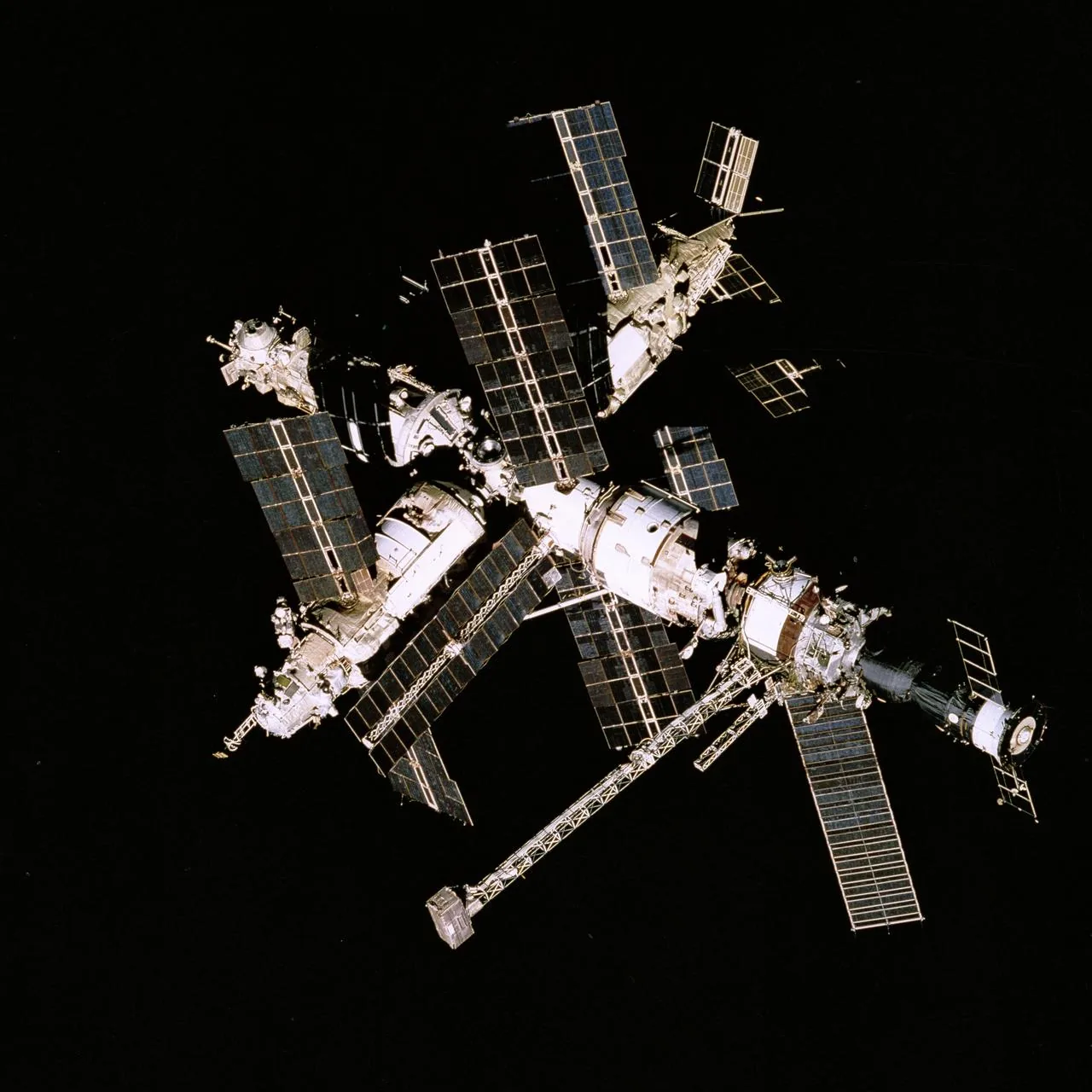
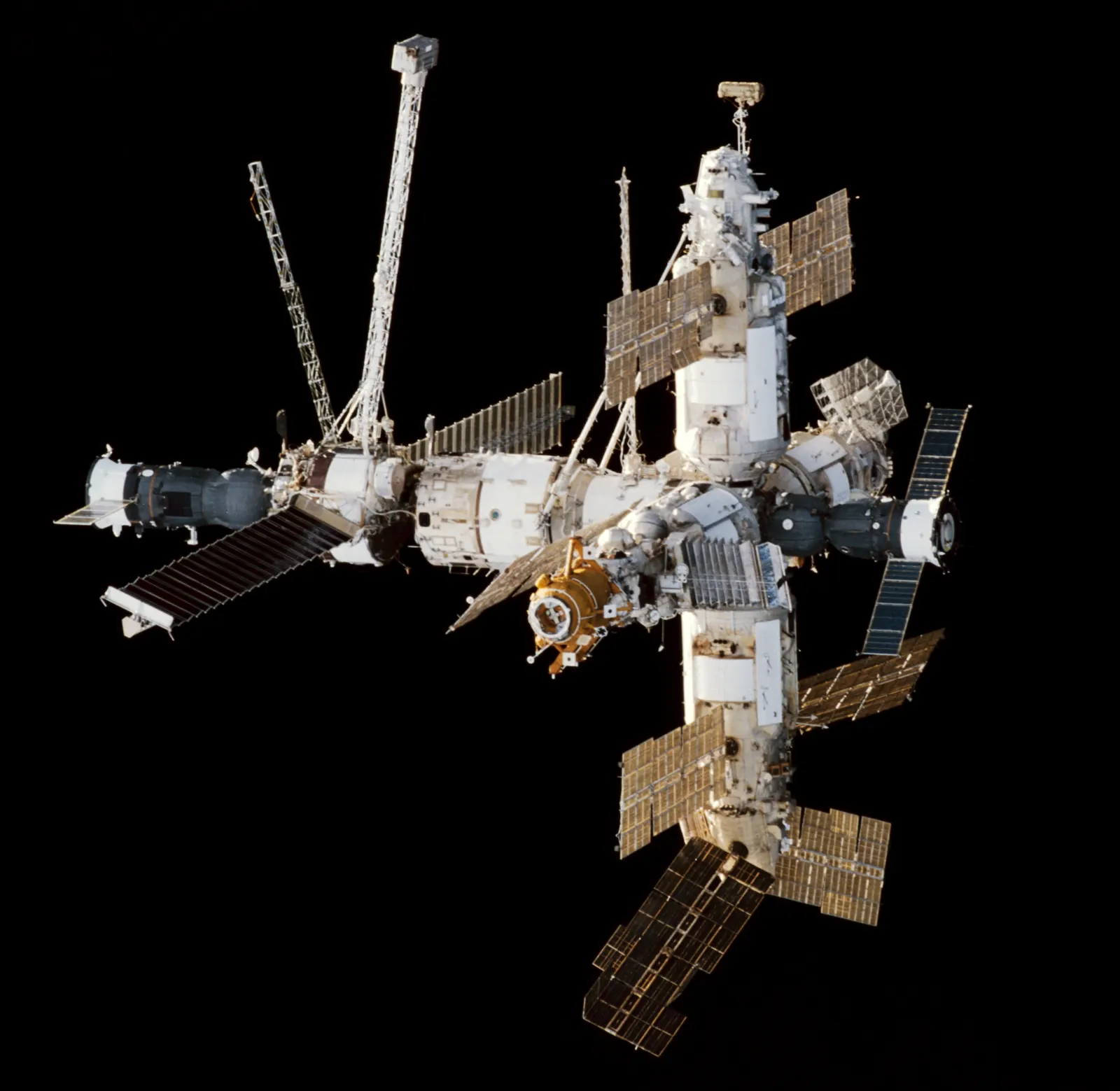
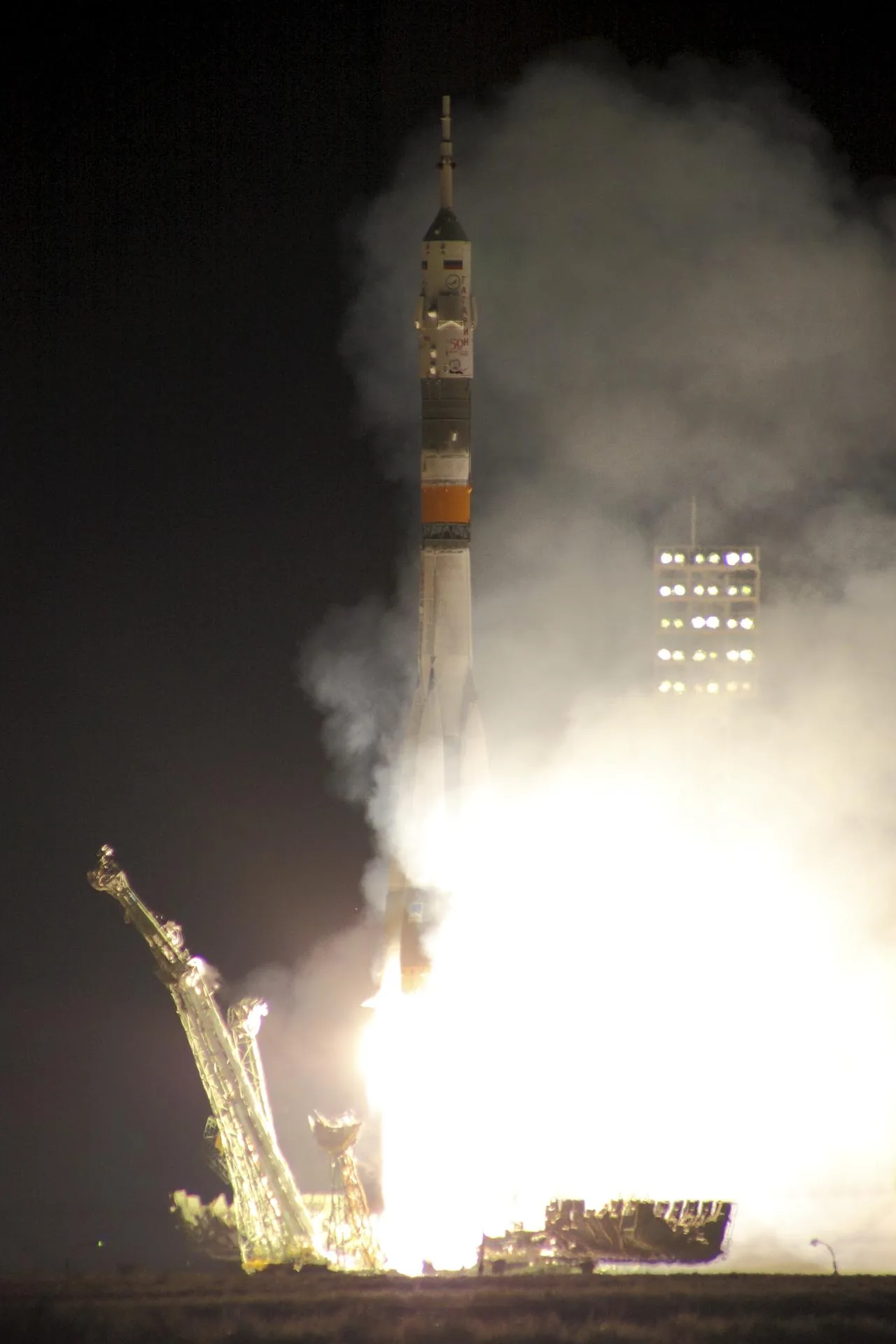
Mir's core module launched on February 20, 1986, atop a Proton rocket from the Baikonur Cosmodrome in Kazakhstan. It was the third generation of Soviet space stations, following the Salyut series, and it introduced a revolutionary concept: modular construction. The core module had six docking ports, allowing additional modules to be attached over time, growing the station like a technological organism.
The core itself was modest -- a cylinder roughly 43 feet long and 13.6 feet in diameter, with a pressurized volume of about 3,000 cubic feet. It contained the station's primary living quarters, life support systems, and control center. But it was designed from the start as a seed, not a finished product.
Over the next decade, six additional modules were launched and attached:
- Kvant-1 (March 1987): An astrophysics module carrying X-ray telescopes and other instruments. Its docking was nearly foiled by a trash bag that had become lodged in the docking mechanism -- cosmonauts had to perform an unplanned spacewalk to remove it.
- Kvant-2 (November 1989): Provided an EVA airlock, an additional life support system, and scientific equipment.
- Kristall (May 1990): A technology and materials science module that also carried a docking port for the Soviet Buran shuttle (which never flew to Mir).
- Spektr (May 1995): A remote-sensing module funded partly by NASA as part of the Shuttle-Mir program.
- Priroda (April 1996): The final module, focused on Earth observation.
When complete, Mir had a total pressurized volume of approximately 12,400 cubic feet -- roughly the interior space of a modest three-bedroom house, though organized in a way that no house on Earth would recognize.
Life Aboard Mir
Living on Mir was an exercise in adaptation. The station was perpetually cluttered; after years of habitation, equipment, personal items, and supplies accumulated in every available space. Cables snaked along walls. Storage bags filled corridors. The air smelled, according to multiple accounts, like a combination of a locker room and a machine shop -- sweat, hot metal, and the faint chemical tang of the life support system.
Crews typically consisted of two or three people. The daily routine was structured: eight and a half hours for work, eight hours for sleep, and the remainder for meals, exercise, and personal time. Exercise was mandatory -- roughly two hours per day on a treadmill and resistance machines -- to combat the bone density loss and muscle atrophy caused by microgravity. Despite this, long-duration crew members still returned to Earth significantly weakened.
The record for continuous habitation was set by Russian cosmonaut Valeri Polyakov, who lived aboard Mir for 437 days and 18 hours, from January 8, 1994, to March 22, 1995. It remains the longest single spaceflight in history. Polyakov, a physician, deliberately stayed as long as possible to demonstrate that humans could endure the duration of a Mars mission. When the recovery crew opened his capsule after landing, he insisted on walking away from it under his own power -- a deliberate, symbolic gesture, though he admitted later that he felt as though he weighed 500 pounds.
Shannon Lucid and the Shuttle-Mir Program
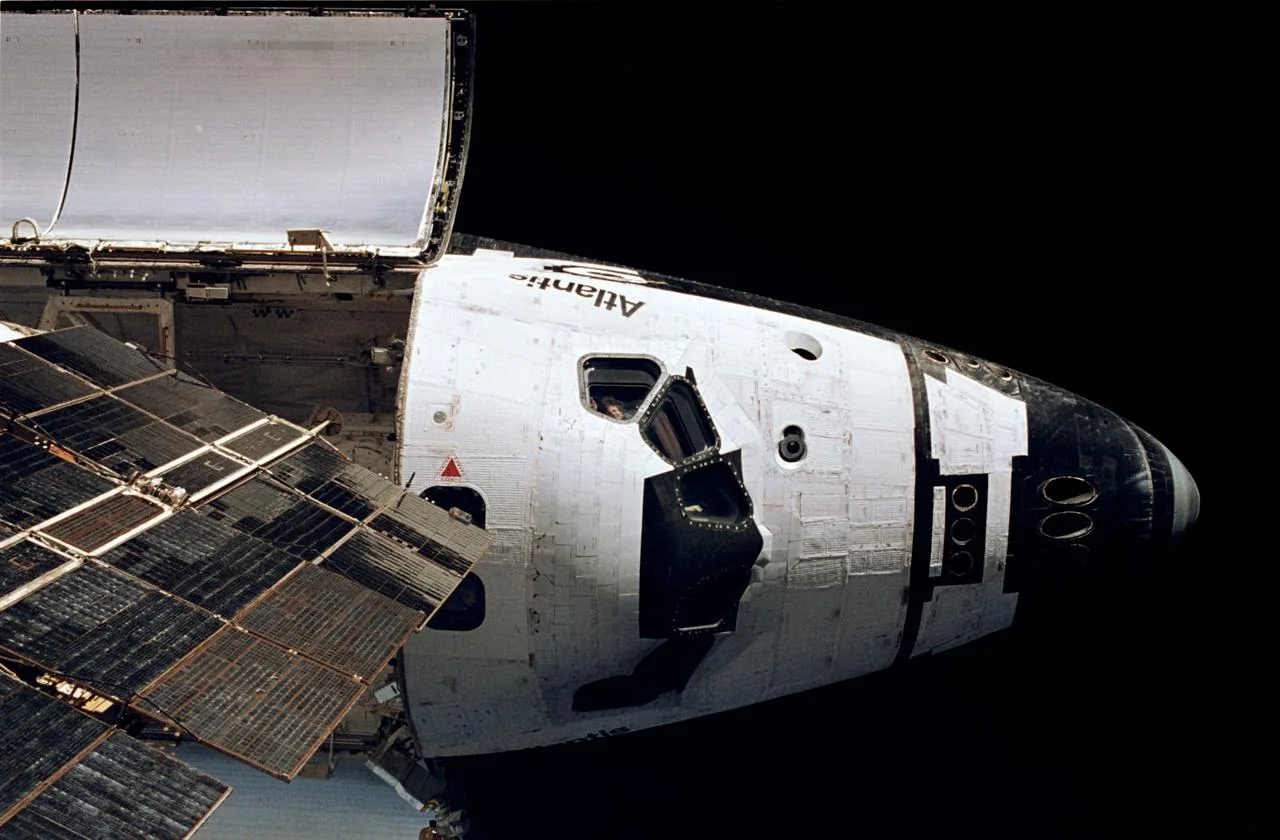
The Shuttle-Mir program (1995-1998) was a critical bridge between the Space Race era and the International Space Station. Seven American astronauts lived aboard Mir for extended stays, launching and returning on the Space Shuttle. The program was designed to give NASA experience with long-duration spaceflight operations and to build trust between the American and Russian space agencies.
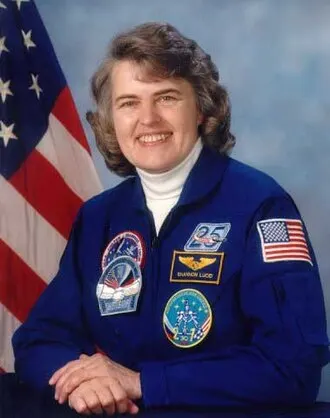
The most celebrated of the American residents was biochemist Shannon Lucid, who lived on Mir from March 22 to September 26, 1996 -- 188 days, a record for an American in space at the time and for any woman. Lucid, 53 years old during her stay, won the admiration of her Russian crewmates for her adaptability and good humor. She was famous for her love of reading -- she brought a personal supply of books -- and for making candy from the available food supplies. She was awarded the Congressional Space Medal of Honor upon her return.
But the Shuttle-Mir program was not always harmonious. NASA astronaut Jerry Linenger experienced one of the most dangerous events in station history during his stay in 1997, and his successor, Michael Foale, faced another. The program exposed deep cultural differences between the Russian and American approaches to spaceflight, and some within NASA questioned whether the aging station was safe enough for American crew members.
Fire and Collision: Mir's Darkest Hours
On February 23, 1997, a solid-fuel oxygen generator (a "candle" used to supplement the life support system) caught fire aboard Mir. The blaze, in the Kvant-1 module, produced thick, acrid smoke that filled the station. The fire burned for approximately 14 minutes, partially blocking the path to one of the two Soyuz escape capsules. Jerry Linenger, along with cosmonauts Vasily Tsibliev and Alexander Lazutkin, fought the fire using extinguishers and wet towels. The crew donned gas masks and struggled to see through the smoke. Had the fire burned through the hull, the station would have depressurized, killing everyone aboard.
The fire was eventually extinguished, but the incident was a wake-up call. It demonstrated that fire in a closed spacecraft environment is uniquely dangerous -- the smoke has nowhere to go, the crew has nowhere to flee, and the available firefighting resources are severely limited.
Four months later, on June 25, 1997, disaster struck again. During a manual docking test of an unmanned Progress supply vehicle, Tsibliev lost control. The 7-ton cargo ship struck the Spektr module at a speed estimated at roughly 10 feet per second. The collision punctured the module's hull, causing a rapid depressurization. Michael Foale, who had replaced Linenger, scrambled with Lazutkin to disconnect cables running through the hatch to Spektr so they could seal it off. They succeeded with seconds to spare. The station's pressure stabilized, but Spektr was permanently sealed and its solar arrays -- which provided a significant portion of Mir's electrical power -- were lost. The station limped on with reduced capability.
These incidents prompted serious debate within NASA about whether to continue sending American astronauts to Mir. Ultimately, the program continued, but with heightened safety oversight.
Lessons for the International Space Station
Mir's fifteen-year operational life provided an irreplaceable education in long-duration spaceflight. The station demonstrated that modular construction worked -- that you could build a complex in orbit piece by piece, using automated docking. It proved that international crews could live and work together, despite language barriers and cultural differences. It revealed the practical challenges of maintaining a spacecraft over many years: systems degradation, biological contamination (mold grew on interior surfaces), and the relentless accumulation of clutter and waste.
The emergencies aboard Mir -- the fire, the collision, numerous system failures -- taught lessons that were directly incorporated into ISS design and operations. The ISS has better fire detection and suppression systems, more robust emergency procedures, and redundant escape capability, all informed by Mir's hard experience. The Shuttle-Mir program also established the operational framework for international crew rotations that the ISS uses to this day.
Perhaps most importantly, Mir proved that human beings are psychologically resilient enough to live in confined, isolated environments for extended periods. The data gathered from Mir crews on bone density loss, muscle atrophy, cardiovascular deconditioning, immune system changes, and psychological stress formed the foundation of space medicine as practiced aboard the ISS.
The End of Mir
By the late 1990s, Mir was aging rapidly. Systems failed with increasing frequency. Russia, struggling economically after the collapse of the Soviet Union, could not afford to maintain both Mir and its commitments to the ISS. After a final crew departed in June 2000, Mir orbited empty, slowly losing altitude.
On March 23, 2001, Russian ground controllers fired the engines of a Progress cargo ship docked to Mir, performing three deorbit burns that lowered the station's orbit. At approximately 5:59 a.m. GMT, Mir entered the Earth's atmosphere over the South Pacific. The station broke apart and burned, its fragments splashing into the ocean in a debris field roughly 900 miles long and 120 miles wide, between New Zealand and Chile. A few observers in Fiji reported seeing bright streaks across the predawn sky.
Mir had been in orbit for 5,511 days. It had been continuously occupied for a total of 4,594 days. It had hosted 28 long-duration crews and 104 visitors. It had circled the Earth approximately 86,330 times, covering a distance of roughly 2.2 billion miles.
A Scrappy, Stubborn, Indispensable Pioneer
Mir was never glamorous. Compared to the sleek International Space Station, it looked like a jumble of tin cans held together with duct tape and optimism -- which, in some ways, it was. Its systems were old. Its interior was cluttered. It smelled bad. It caught fire. It got hit by a supply ship. Mold grew on the walls.
And yet, Mir did something no other spacecraft had done before: it proved that human beings could live in space. Not visit, not pass through, but live -- for weeks, months, more than a year. It demonstrated that the challenges of long-duration spaceflight, while serious, were solvable. It was the proof of concept upon which all subsequent human space habitation -- the ISS, future lunar stations, eventual Mars missions -- rests.
Mir was a scrappy, stubborn, occasionally terrifying masterpiece. It deserves to be remembered not for its failures, but for what it endured -- and what it made possible.