When we talk about exoplanets that might be Earth-like, the conversation eventually turns to distance. It is one thing to detect a potentially habitable world orbiting a star thousands of light-years away, cataloged in a survey of a hundred thousand stars. It is something else entirely to know that such a world exists next door, cosmically speaking, close enough that our descendants might one day visit it.
The nearest stars to our Sun are not just points of scientific interest. They are destinations, at least in the dreams of engineers and visionaries who are already sketching out the first interstellar missions. And remarkably, several of these nearby stars appear to have planets in or near their habitable zones. Here are our closest cosmic neighbors that might, under the right circumstances, harbor conditions friendly to life.
Nearest Earth-Like Exoplanets — Habitability Ranking (2026)
The table below ranks the most-studied nearby exoplanets by Earth Similarity Index (ESI, 0–1, where 1 is identical to Earth) and habitability prospect. ESI values are approximate and based on the PHL Habitable Exoplanets Catalog plus more recent characterization work.
| Rank | Planet | Distance | Min. Mass (Earth) | Orbital Period | Stellar Flux (vs Earth) | Star Type | ESI | Habitability Verdict |
|---|---|---|---|---|---|---|---|---|
| 1 | Proxima Centauri b | 4.24 ly | 1.17 | 11.2 days | ~0.65× | M5.5V red dwarf | ~0.87 | Possibly habitable; flare-star concern |
| 2 | Ross 128 b | 11.0 ly | 1.35 | 9.9 days | ~1.38× | M4V quiet red dwarf | ~0.86 | Best M-dwarf habitability candidate |
| 3 | Tau Ceti e | 11.9 ly | ~3.9 | 168 days | ~1.67× | G8V Sun-like | ~0.78 | Sun-like host; existence still debated |
| 4 | Wolf 1061 c | 13.8 ly | ~4.3 | 17.9 days | ~1.30× | M3.5V red dwarf | ~0.76 | Super-Earth at HZ inner edge |
| 5 | Tau Ceti f | 11.9 ly | ~3.9 | 642 days | ~0.30× | G8V Sun-like | ~0.71 | Outer HZ; cold without greenhouse |
| 6 | Proxima Centauri d | 4.24 ly | ~0.26 | 5.1 days | ~3.9× | M5.5V red dwarf | n/a | Sub-Earth; too hot for surface water |
| — | Barnard's Star b | 5.96 ly | ~0.37 (revised 2024) | 3.15 days | high | M4V red dwarf | n/a | Hot rocky world; not habitable |
Notes: "Min. Mass" refers to m sin i — the true mass is at least this value, possibly higher depending on orbital inclination. Stellar flux is the energy the planet receives compared to Earth (Earth = 1.0). HZ = habitable zone. The 2024 Barnard's Star characterization (ESPRESSO data) revised the planet to a hot sub-Earth in a tight orbit, replacing the disputed 2018 cold-Neptune candidate.
Proxima Centauri b: The Closest of Them All
Distance: 4.24 light-years
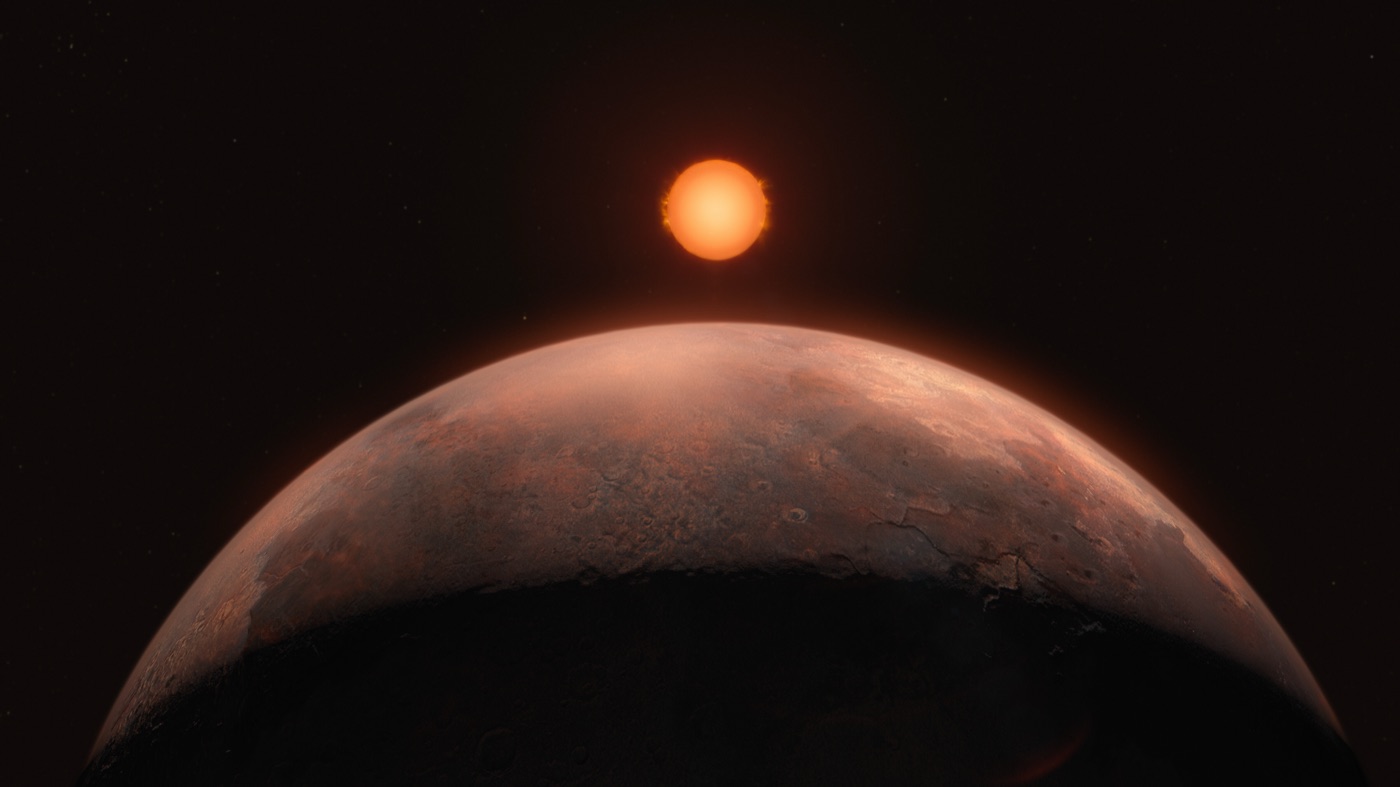
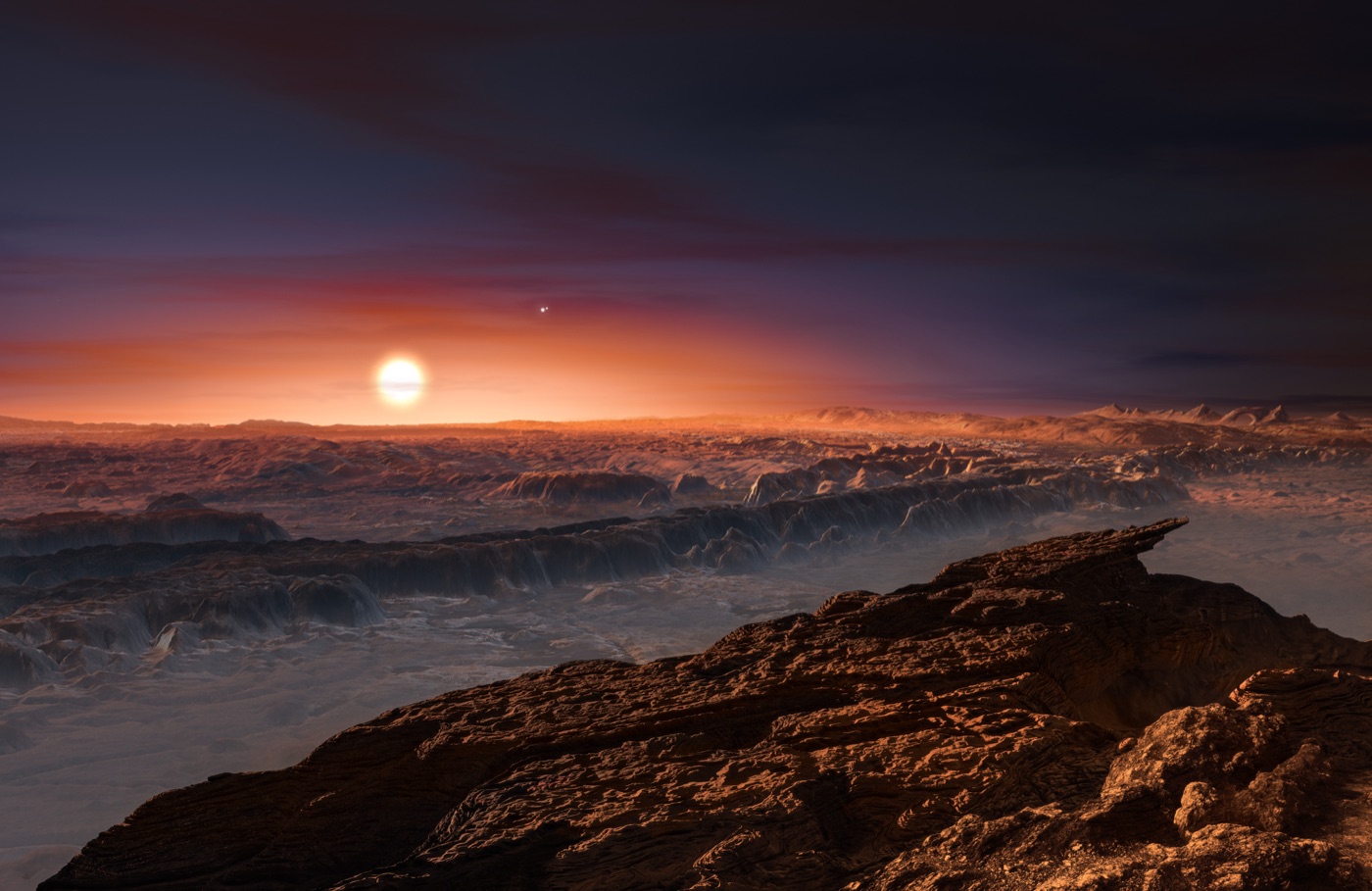
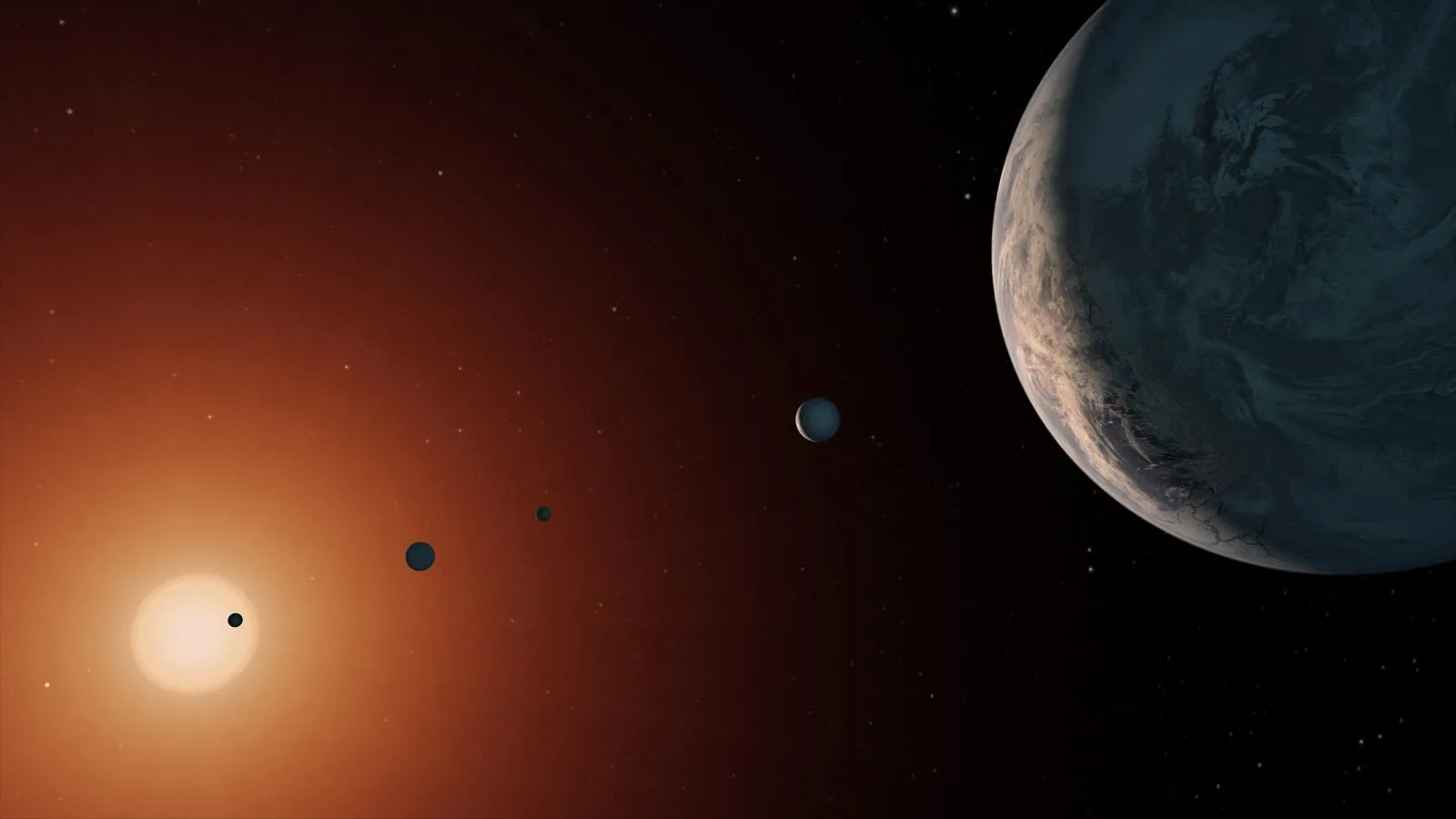
In August 2016, astronomers announced the discovery that sent a tremor through the space community: the nearest star to our Sun has a planet in its habitable zone. Proxima Centauri, a dim red dwarf that is part of the Alpha Centauri triple star system, hosts a world called Proxima Centauri b (often shortened to Proxima b) with a minimum mass of about 1.17 Earth masses and an orbital period of just 11.2 days.
Because Proxima Centauri is so much cooler and dimmer than the Sun (it has only about 0.15 percent of the Sun's luminosity), the habitable zone sits very close to the star. Proxima b's tight orbit places it squarely in this zone, where it receives roughly 65 percent of the energy Earth receives from the Sun. If the planet has an atmosphere with even a modest greenhouse effect, surface temperatures could permit liquid water.
The discovery was made using the radial velocity method, by the same team, led by Guillem Anglada-Escude, that had spent years painstakingly teasing the planetary signal out of decades of spectroscopic data. Subsequent observations, including tentative transit detections and additional radial velocity campaigns, have solidified the planet's existence, though some parameters remain uncertain.
The challenges for habitability are significant. Proxima Centauri is an active flare star, producing powerful stellar flares that could strip an unprotected atmosphere over time. The planet is likely tidally locked. And in 2017, a superflare was observed that temporarily increased the star's brightness by a factor of 1,000 in UV light, an event that would have been devastating to any surface biosphere without strong atmospheric or magnetic protection.
Despite these concerns, Proxima b remains the single most important exoplanet target for future study, simply because of its proximity. At 4.24 light-years, it is within theoretical reach of interstellar probes, and its nearness means that future telescopes may be able to directly image it or analyze its atmosphere. The Extremely Large Telescope, currently under construction, has Proxima b high on its target list.
A second planet, Proxima Centauri c, was reported in 2020 with a longer orbital period and a mass suggesting a mini-Neptune. A third candidate, Proxima d, was announced in 2022, a sub-Earth-mass planet in a very short orbit. The Proxima system is turning out to be richer than anyone anticipated.
Ross 128 b: A Quieter Neighbor
Distance: 11.0 light-years
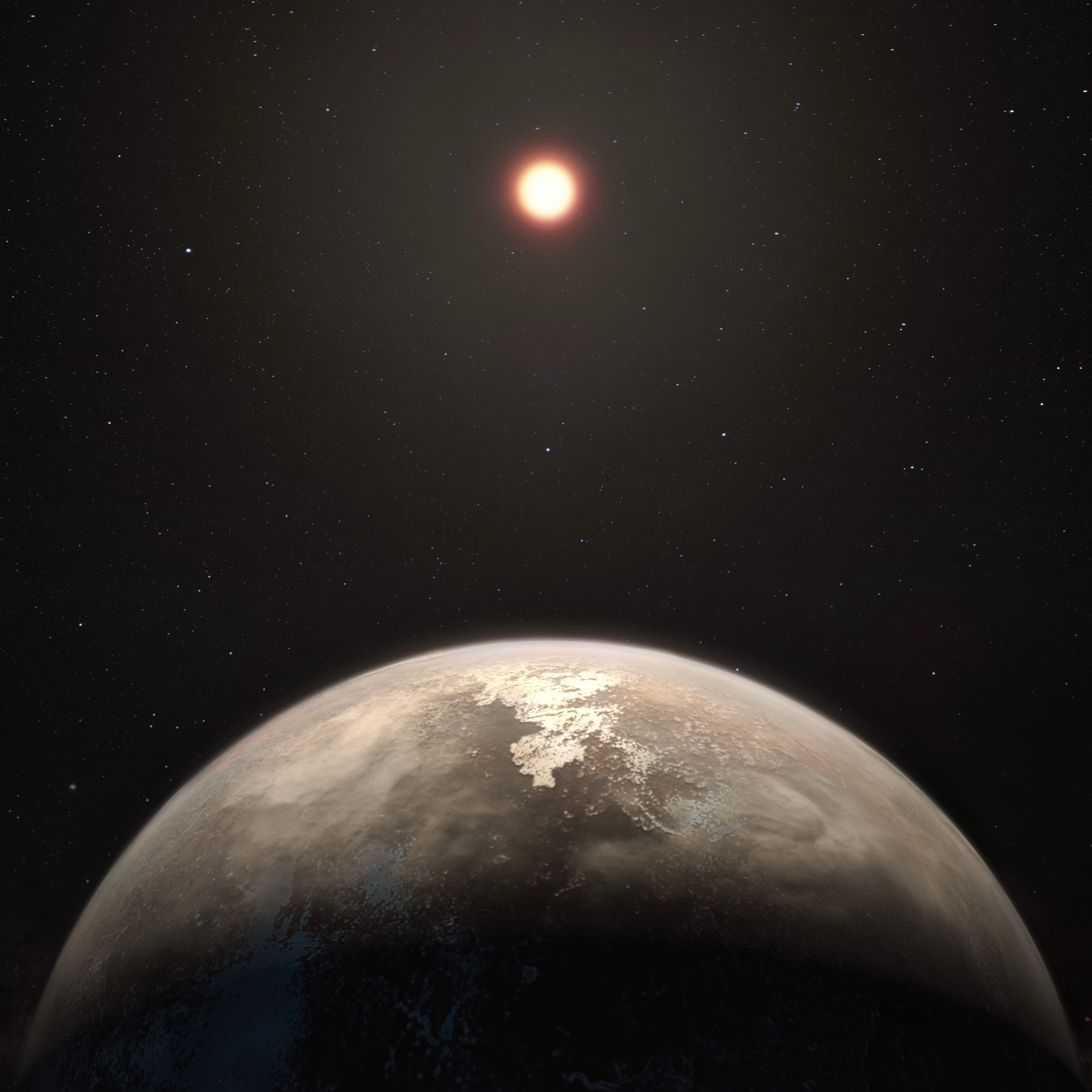
If Proxima b's main drawback is its hostile stellar environment, then Ross 128 b offers a calmer alternative. Discovered in 2017 using the HARPS spectrograph at the European Southern Observatory in Chile, Ross 128 b has a minimum mass of about 1.35 Earth masses and orbits its red dwarf host star every 9.9 days.
What makes Ross 128 special is that it is one of the quietest red dwarfs in the solar neighborhood. Unlike Proxima Centauri, Ross 128 is a relatively inactive star with a low flare rate. This dramatically improves the prospects for atmospheric retention. A planet orbiting Ross 128 is far less likely to have its atmosphere stripped away by stellar radiation, which means liquid water on the surface is a more plausible long-term proposition.
Ross 128 b receives about 38 percent more energy from its star than Earth receives from the Sun, placing it near the inner edge of the habitable zone. Whether it is too hot for liquid water depends entirely on its atmospheric properties. With little or no greenhouse effect, it could be temperate. With a thick Venus-like atmosphere, it could be an oven. We simply do not know yet.
At 11 light-years, Ross 128 b is close enough for detailed atmospheric study by next-generation telescopes and is frequently cited as one of the best targets for biosignature searches.
Wolf 1061 c: A Super-Earth in the Zone
Distance: 13.8 light-years
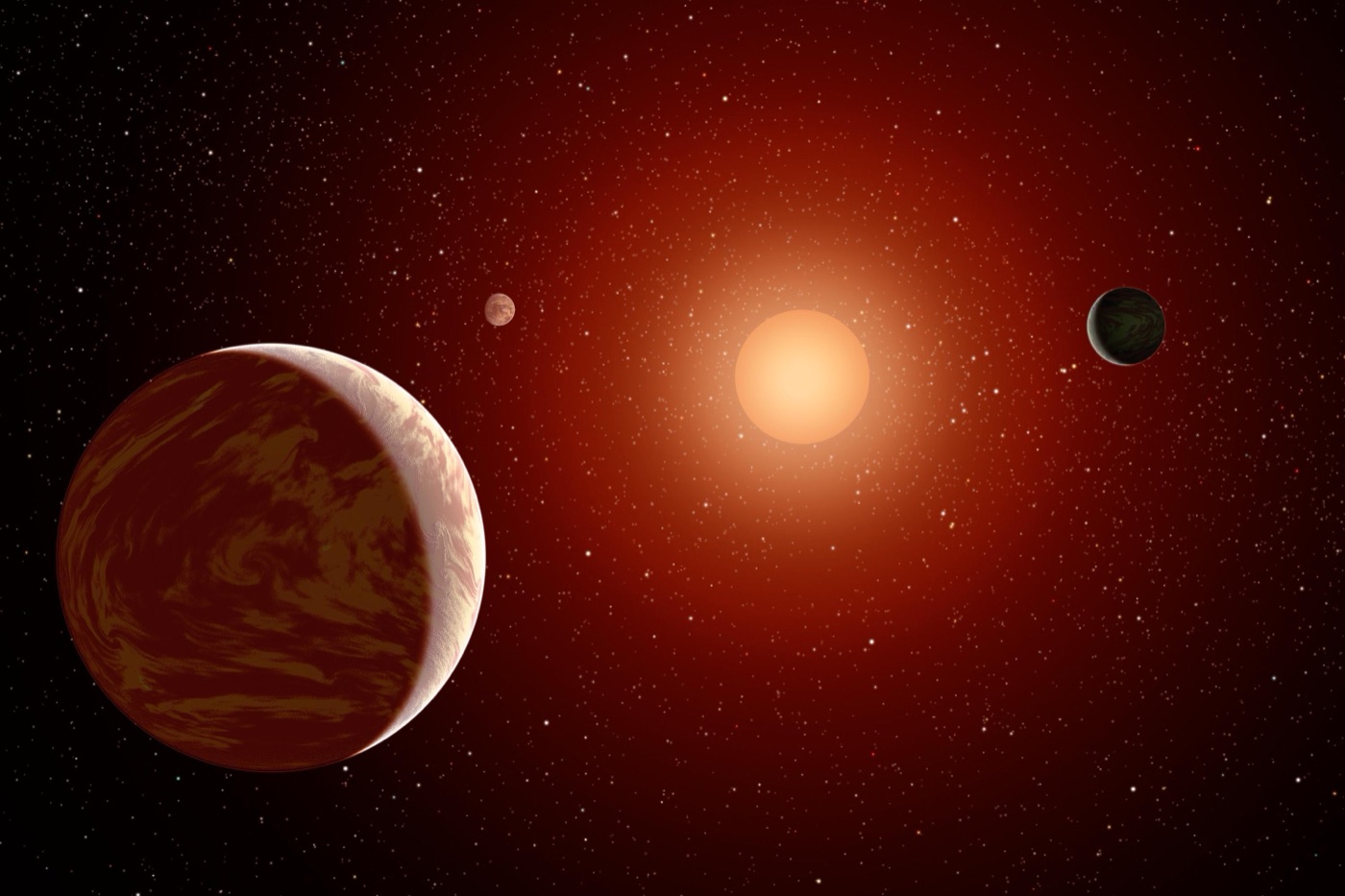
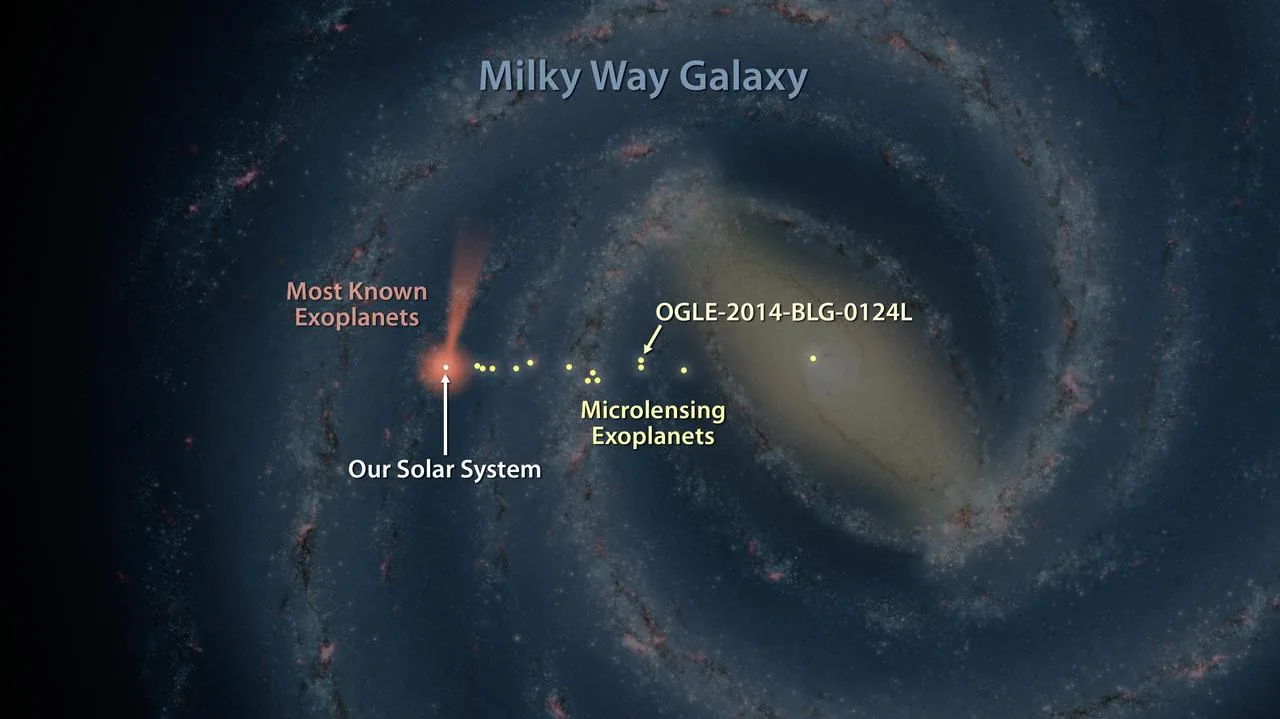
The Wolf 1061 system, discovered in 2015, contains three known planets orbiting a red dwarf star. The middle planet, Wolf 1061 c, has attracted the most attention. With a minimum mass of about 4.3 Earth masses and an orbital period of 17.9 days, it sits near the inner edge of its star's habitable zone.
Wolf 1061 c is a "super-Earth," a category that encompasses a wide range of possible compositions. It could be a rocky world with a thick atmosphere, a water world with a global ocean, or something else entirely. Its position near the inner edge of the habitable zone raises the possibility that it might experience a runaway greenhouse effect, as Venus did. Alternatively, if the planet has a strong reflective cloud cover or other cooling mechanisms, it could remain temperate.
The Wolf 1061 system is notable for being one of the closest known multi-planet systems. The three planets orbit in a compact configuration, with the innermost (Wolf 1061 b) well inside the habitable zone and the outermost (Wolf 1061 d) beyond it. Studying the system's architecture can provide insights into how planetary systems form and evolve around red dwarfs.
Tau Ceti: A Sun-Like Star with Candidates
Distance: 11.9 light-years
Tau Ceti holds a special place in the imagination of anyone who has ever dreamed of interstellar travel. It is a G-type star, the same class as our Sun, making it one of the nearest solar analogs. It is visible to the naked eye in the constellation Cetus, and for decades it has been a go-to target for SETI searches and science fiction stories.
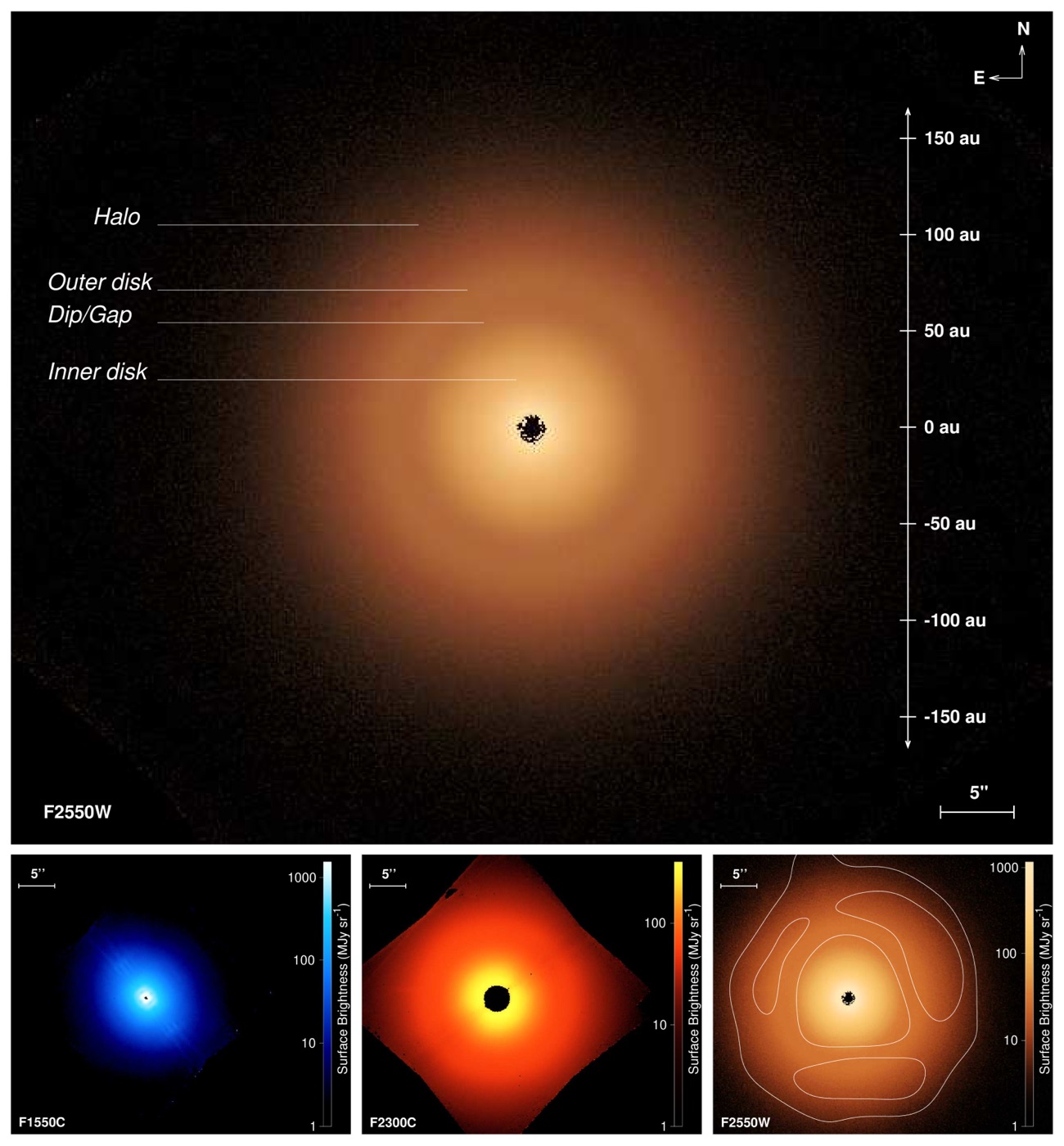
The planetary system around Tau Ceti has been the subject of intense study and significant debate. Multiple radial velocity campaigns have reported candidate planets, but the signals are at the limits of detection, tangled with stellar activity and the star's prominent debris disk (which suggests a much heavier asteroid belt than our own, potentially problematic for planet habitability due to frequent impacts).
The most commonly cited candidates are Tau Ceti e and Tau Ceti f, with estimated minimum masses of about 3.9 and 3.9 Earth masses respectively. Tau Ceti e orbits near the inner edge of the habitable zone, while Tau Ceti f orbits near the outer edge. If both are rocky and have suitable atmospheres, one or both could potentially support liquid water.
However, the existence of these planets is not as firmly established as some of the other entries on this list. Different analysis techniques applied to the radial velocity data have produced different results, and some researchers argue that some of the planetary signals may be artifacts of stellar noise. Future observations with more sensitive instruments should resolve the debate.
If the planets are real, Tau Ceti would be enormously significant: a nearby Sun-like star with potentially habitable worlds. It would immediately become a top-priority target for direct imaging missions designed to characterize Earth-like planets around Sun-like stars.
Barnard's Star b: A Cold World, Maybe
Distance: 5.96 light-years
Barnard's Star is the second-closest star system to the Sun (after the Alpha Centauri system) and the nearest single star. In 2018, a team announced the detection of a super-Earth candidate, Barnard's Star b, with a minimum mass of about 3.2 Earth masses and an orbital period of 233 days.
At that orbital distance, the planet would receive only about two percent of the energy Earth receives from the Sun, placing it well beyond the traditional habitable zone. Surface temperatures, without a substantial greenhouse effect, would be around minus 170 degrees Celsius. This is not a world where you would expect surface liquid water.
However, the planet's discovery generated interest for several reasons. If it has a thick hydrogen atmosphere, the greenhouse effect could potentially warm the surface significantly. And if the planet has internal heat sources (from residual formation heat or radioactive decay), subsurface liquid water is not out of the question.
It must be noted that Barnard's Star b's existence has been debated. A 2021 study argued that the signal could be an artifact of the star's activity cycle rather than a planet. The matter remains unresolved, and further observations are needed. If confirmed, it would be one of the closest known exoplanets, even if not classically habitable.
Could We Ever Visit?
The distances involved are humbling. Proxima Centauri, the nearest of these targets, is 4.24 light-years away. That is about 40 trillion kilometers. Our fastest spacecraft, the Parker Solar Probe at peak velocity, would take roughly 6,000 years to cover that distance. Clearly, conventional propulsion will not get us to the stars.
This is where Breakthrough Starshot enters the picture. Funded by billionaire Yuri Milner and backed by a board that included the late Stephen Hawking, Breakthrough Starshot is a research program investigating the feasibility of sending gram-scale spacecraft to Alpha Centauri at up to 20 percent the speed of light. At that velocity, the journey would take about 20 years, with the data taking another 4.24 years to return to Earth at the speed of light.
The concept relies on a ground-based laser array that would focus an intense beam of light on a light sail attached to a tiny probe. The momentum of the photons would accelerate the sail to relativistic speeds in a matter of minutes. The engineering challenges are formidable: building a sufficiently powerful laser array, creating a sail that can withstand the intense beam without disintegrating, miniaturizing useful scientific instruments to gram-scale mass, and ensuring the probe can survive the interstellar medium and communicate data across light-years.
None of these problems have been solved. But none have been shown to be impossible, either. The Breakthrough Starshot team estimates that the technology could be ready within a generation, with a launch potentially feasible by the 2040s or 2050s.
If it works, the first close-up images of an exoplanet would arrive at Earth around the 2070s. The target would almost certainly be Proxima Centauri b.
A Neighborhood Worth Knowing
The nearest potentially Earth-like exoplanets are not abstractions. They orbit stars that you can see (or almost see) with your own eyes on a clear night. They are close enough that the light reaching us from their host stars left just a few years ago, not centuries or millennia. In astronomical terms, they are right here.
We do not yet know if any of these worlds are truly habitable. We do not know if any of them harbor life. But we are building the telescopes that will characterize their atmospheres and the technologies that might one day send probes to visit them. For the first time in human history, the question "could we go there?" has an answer that is not "absolutely not" but rather "maybe, with enough ingenuity and determination."
The nearest Earth-like exoplanets are more than scientific targets. They are the first pages of a story that could define our species for centuries to come: the story of reaching beyond our solar system, and perhaps, finding that we are not alone in the dark.