Chemical rockets are magnificent. They are loud, dramatic, and powerful enough to hurl payloads off the surface of the Earth against the relentless pull of gravity. But they have a fundamental limitation that no amount of engineering cleverness can overcome: the energy density of chemical propellants has a ceiling, and we are already very close to it. The best chemical rockets achieve a specific impulse of around 450 seconds. To go farther, faster, and with more payload, we need to break through that ceiling.
Nuclear propulsion is how we break through.
The physics are compelling. Nuclear reactions release roughly a million times more energy per unit mass than chemical reactions. Even if we only capture a small fraction of that energy to heat propellant and expel it from a nozzle, the performance gains over chemical propulsion are transformative. We are talking about cutting the transit time to Mars from six to nine months down to as little as 45 days. For crewed missions, that difference is not just a convenience -- it is potentially the difference between a feasible mission and an unacceptable one, because every additional day in transit is another day of radiation exposure, muscle atrophy, and risk.
The DRACO Program: NASA and DARPA Make It Real
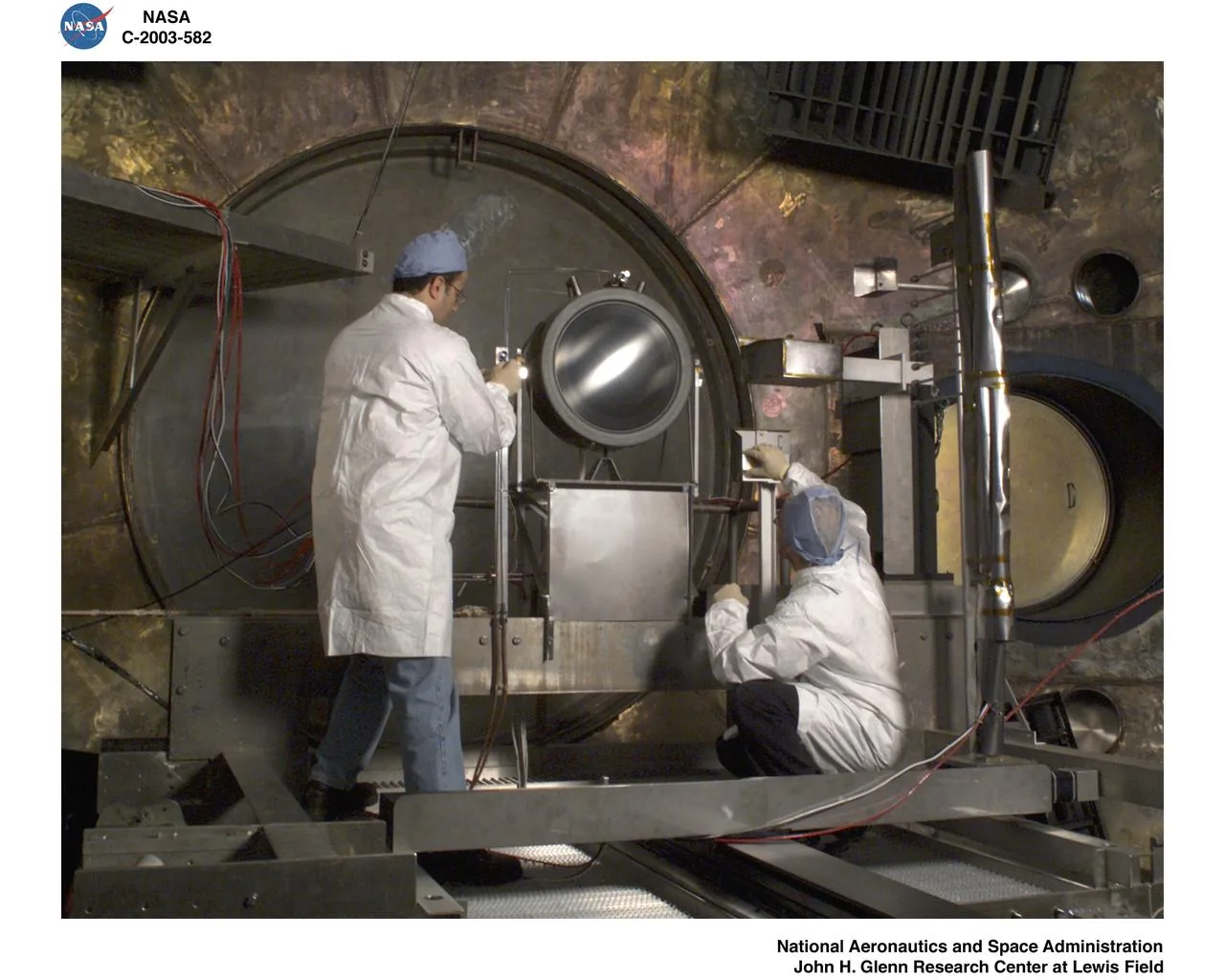
In January 2023, NASA and DARPA announced a partnership that sent a jolt of excitement through the propulsion community: the Demonstration Rocket for Agile Cislunar Operations, or DRACO. The program aims to flight-demonstrate a nuclear thermal propulsion (NTP) engine in space, with a target date in the late 2020s. This is not a paper study or a conceptual design exercise. This is hardware development, funded and scheduled, with Lockheed Martin selected to build the experimental spacecraft and BWX Technologies developing the nuclear reactor.
DRACO represents the most serious commitment to nuclear propulsion by the U.S. government in over 50 years. The engine will use a compact nuclear reactor to heat hydrogen propellant to extreme temperatures and expel it through a nozzle, producing roughly twice the specific impulse of the best chemical engines. The flight demonstration will validate the technology in the space environment, prove that the reactor can be safely started up and controlled in orbit, and pave the way for operational NTP systems on future missions.
If DRACO succeeds, it will fundamentally alter the trajectory of deep space exploration. Every mission architecture for Mars, the outer planets, and beyond would need to be reconsidered in light of what NTP makes possible.
Nuclear Thermal vs. Nuclear Electric: Two Paths, One Atom
There are two main approaches to nuclear propulsion, and they are different enough that they are essentially separate technologies sharing a common energy source.
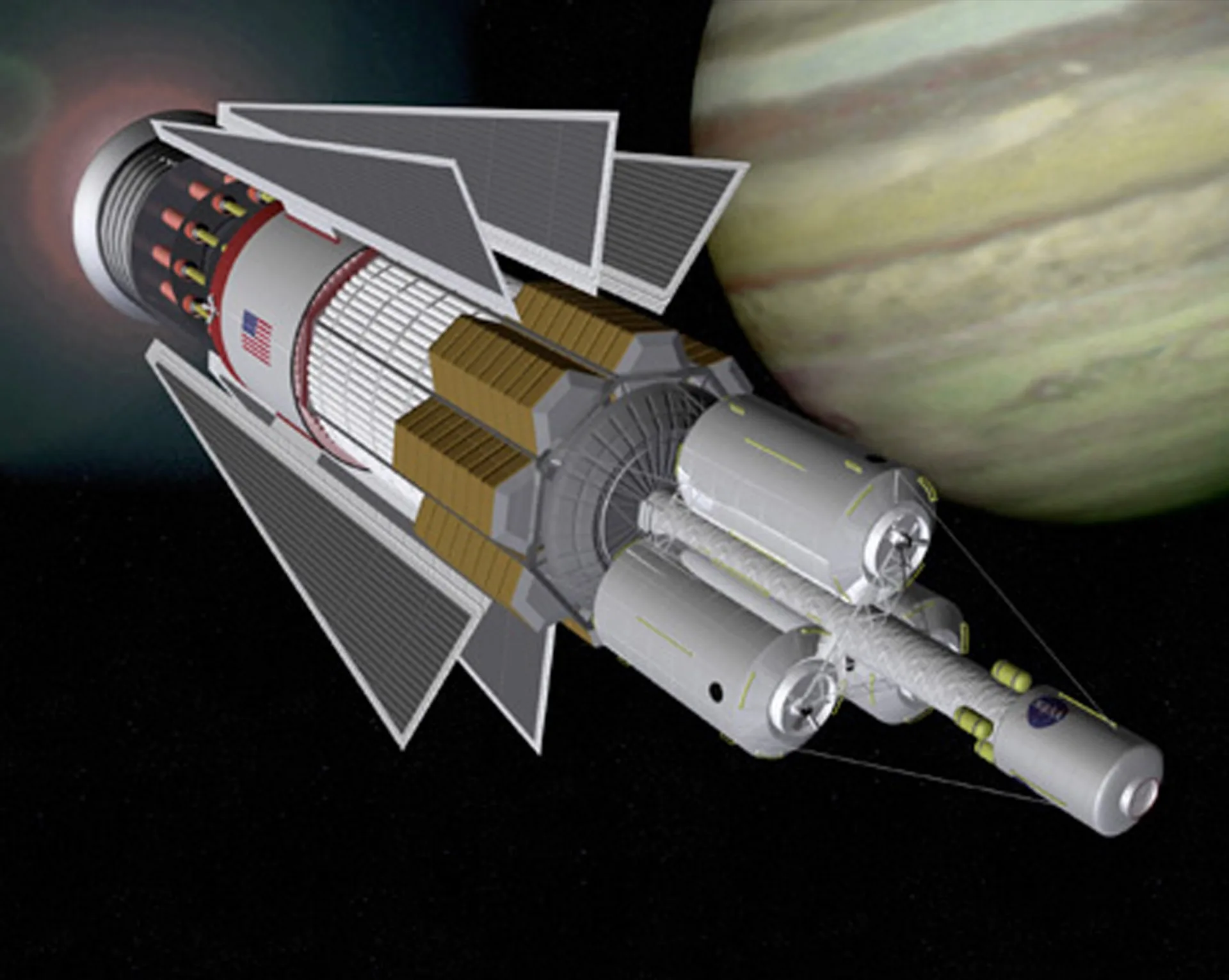
Nuclear Thermal Propulsion (NTP) is the more intuitive concept. A nuclear fission reactor heats a propellant -- typically liquid hydrogen -- to very high temperatures (around 2,500 to 3,000 Kelvin). The superheated hydrogen expands and is expelled through a rocket nozzle, producing thrust. The specific impulse is roughly 900 seconds -- about twice that of the best chemical engines. The thrust levels are high, comparable to chemical engines, which means NTP can perform the short, powerful burns needed for orbit changes and planetary departures.
Nuclear Electric Propulsion (NEP) takes a different approach. The nuclear reactor generates electricity, which powers electric thrusters -- ion engines, Hall thrusters, or other advanced electric propulsion systems. The specific impulse is much higher (3,000 to 10,000+ seconds), but the thrust is very low. NEP excels on long-duration missions where the total velocity change is enormous but time is available to accumulate it gradually.
The tradeoff is clear: NTP gives you high thrust and moderate efficiency, while NEP gives you low thrust and very high efficiency. For crewed Mars missions, where minimizing transit time is critical, NTP is generally favored. For robotic cargo missions, where time is less important and propellant mass is the constraint, NEP may be the better choice. Some mission architectures use both -- NTP for the crewed vehicle and NEP for pre-positioning cargo.
How Nuclear Thermal Propulsion Works
The heart of an NTP engine is a nuclear fission reactor. Uranium-235 fuel elements are arranged in a core geometry that sustains a controlled chain reaction. Neutron moderators and control drums regulate the reaction rate. Liquid hydrogen is pumped from storage tanks through the reactor core, where it flows through channels in the fuel elements and absorbs the heat from fission.
The hydrogen does not become radioactive in any meaningful way -- it is simply heated. By the time it exits the reactor core, the hydrogen has reached temperatures far beyond what any chemical combustion can achieve. It expands through a converging-diverging nozzle, accelerating to very high exhaust velocities and producing thrust.
The elegance of NTP is that it uses the lightest element in the universe -- hydrogen -- as its propellant. Because thrust and specific impulse both benefit from low molecular weight exhaust, hydrogen is the ideal working fluid. This is the same principle that makes hydrogen-oxygen the highest-performing chemical propellant combination, but NTP takes the temperature (and therefore the exhaust velocity) much higher because the energy source is not limited by chemistry.
NERVA: The Program We Already Built and Abandoned
Here is the part of the story that makes propulsion engineers wince. The United States already built and tested nuclear thermal rocket engines -- successfully -- over 50 years ago. The Nuclear Engine for Rocket Vehicle Application (NERVA) program, which ran from 1963 to 1973, developed and ground-tested a series of NTP engines at the Nevada Test Site.
The NERVA engines worked. The NRX (Nuclear Rocket Experimental) series demonstrated sustained operation at full power, restart capability, and the kind of specific impulse that the physics promised. The most advanced engine in the program, the Pewee, achieved a specific impulse of about 901 seconds and ran for over 40 minutes at full power. The program was on track to produce a flight-ready engine.
And then it was cancelled, a casualty of shifting national priorities after the Apollo program wound down and budgets were cut. The Nixon administration decided that the country did not need a nuclear rocket because there was no longer a mandate for human Mars exploration. Half a century of potential progress was shelved.
DRACO, in many ways, is the spiritual successor to NERVA. The core physics have not changed. What has changed is the reactor technology -- modern high-assay low-enriched uranium (HALEU) fuels, advanced materials, and computational modeling tools that were unavailable in the 1960s. The modern NTP engine will be smaller, lighter, and safer than NERVA, while delivering comparable or superior performance.
Cutting Mars Transit to 45 Days
The headline number that gets everyone's attention is transit time. A conventional chemical propulsion trajectory to Mars, using a minimum-energy Hohmann transfer orbit, takes approximately six to nine months depending on the alignment of Earth and Mars. An NTP-powered spacecraft, with its higher specific impulse and ability to carry more propellant for a given mass, could cut that to approximately three to four months on a standard trajectory.
But if you are willing to push the envelope -- using higher-energy trajectories that spend more propellant -- NTP could potentially reduce the one-way transit to as little as 45 days. That would require a significantly larger propellant fraction and a spacecraft architecture optimized for speed, but it is within the physics. Some advanced concepts, combining nuclear thermal propulsion with nuclear electric systems in a "bimodal" configuration, push the numbers even further.
For crew health and safety, shorter transit times are enormously important. Galactic cosmic radiation exposure is roughly proportional to time spent outside Earth's magnetosphere. Reducing a nine-month trip to a three-month trip cuts radiation exposure by two-thirds. It also reduces the psychological burden on the crew and the amount of consumables (food, water, air) that must be carried.
Safety: The Elephant in the Room
Any discussion of nuclear propulsion must address safety, because public perception of nuclear technology in space is, understandably, cautious. The key points are worth stating clearly.
First, an NTP reactor is not a nuclear bomb. The fuel enrichment, geometry, and operating conditions are entirely different. A reactor cannot detonate like a weapon -- it is physically impossible.
Second, the reactor is launched in a "cold" (non-critical) state. The fission reaction is not started until the spacecraft is safely in orbit, well above the atmosphere. If the launch vehicle fails and the reactor falls back to Earth, the uranium fuel remains in a subcritical state and poses a radiological risk comparable to a medical or industrial radiation source -- not a catastrophic hazard.
Third, the hydrogen propellant is not made radioactive by passing through the reactor. The exhaust is essentially hot hydrogen gas. There are trace activation products, but they are negligible compared to the natural space radiation environment.
Fourth, modern reactor designs incorporate multiple layers of safety -- passive safety features that shut the reactor down automatically in off-normal conditions, containment systems, and control mechanisms that require deliberate action to achieve criticality.
The safety case for NTP is strong, and it has only gotten stronger with five decades of advances in nuclear engineering. The challenge is communicating that case clearly to a public that has legitimate but often misplaced fears about nuclear technology.
The Road Ahead
Nuclear propulsion is not science fiction. It was demonstrated on the ground in the 1960s. It is being developed for flight in the 2020s. And it may be the technology that finally makes crewed Mars missions practical, safe, and sustainable.
DRACO will be the first step. If the flight demonstration succeeds, operational NTP systems could follow within a decade. Combined with advances in nuclear electric propulsion, space nuclear power, and in-space refueling, we are looking at a propulsion architecture that could open the entire inner solar system to human exploration.
The atom has been waiting patiently for us to use it wisely in space. It is about time we did.