SpaceX's Starship — the largest and most powerful rocket ever built — has moved from an experimental test program to a maturing operational system. After a multi-year integrated flight test campaign that began in 2023, Starship has demonstrated full-stack reusability: both the Super Heavy booster and the Starship upper stage have now been caught by the launch tower's "chopstick" arms and refurbished for reuse. In 2026, SpaceX is transitioning toward operational missions, including satellite deployment, NASA lunar missions, and the first steps toward Mars.
This is a comprehensive status update on where Starship stands as of May 2026.
Starship Integrated Flight Test Log (2023–2026)
The table below summarizes every Starship integrated flight test (IFT) launched from Starbase, Texas. Flights through IFT-8 are well-documented; later flights should be cross-referenced with SpaceX's published test log for the most current outcomes.
| Flight | Date | Booster | Ship | Outcome | Key Milestones | Failure Modes / Notes |
|---|---|---|---|---|---|---|
| IFT-1 | Apr 20, 2023 | B7 | S24 | Both lost (~T+4:00) | First integrated full-stack launch; cleared the pad | Multiple Raptor failures; no stage separation; flight termination triggered after loss of attitude control. Severe pad damage. |
| IFT-2 | Nov 18, 2023 | B9 | S25 | Both RUD | First successful hot-staging stage separation | Booster RUD shortly after boostback ignition; ship lost late in ascent burn (suspected LOX vent / engine failure). |
| IFT-3 | Mar 14, 2024 | B10 | S28 | Both lost | Payload-bay door cycle, propellant transfer demo, first Pacific corridor flight | Booster lost during boostback; ship lost during reentry over the Indian Ocean. |
| IFT-4 | Jun 6, 2024 | B11 | S29 | Soft splashdown (success) | Both stages soft-splashed; ship survived peak reentry heating despite forward-flap burn-through | Significant flap damage but vehicle remained controllable through landing flip. |
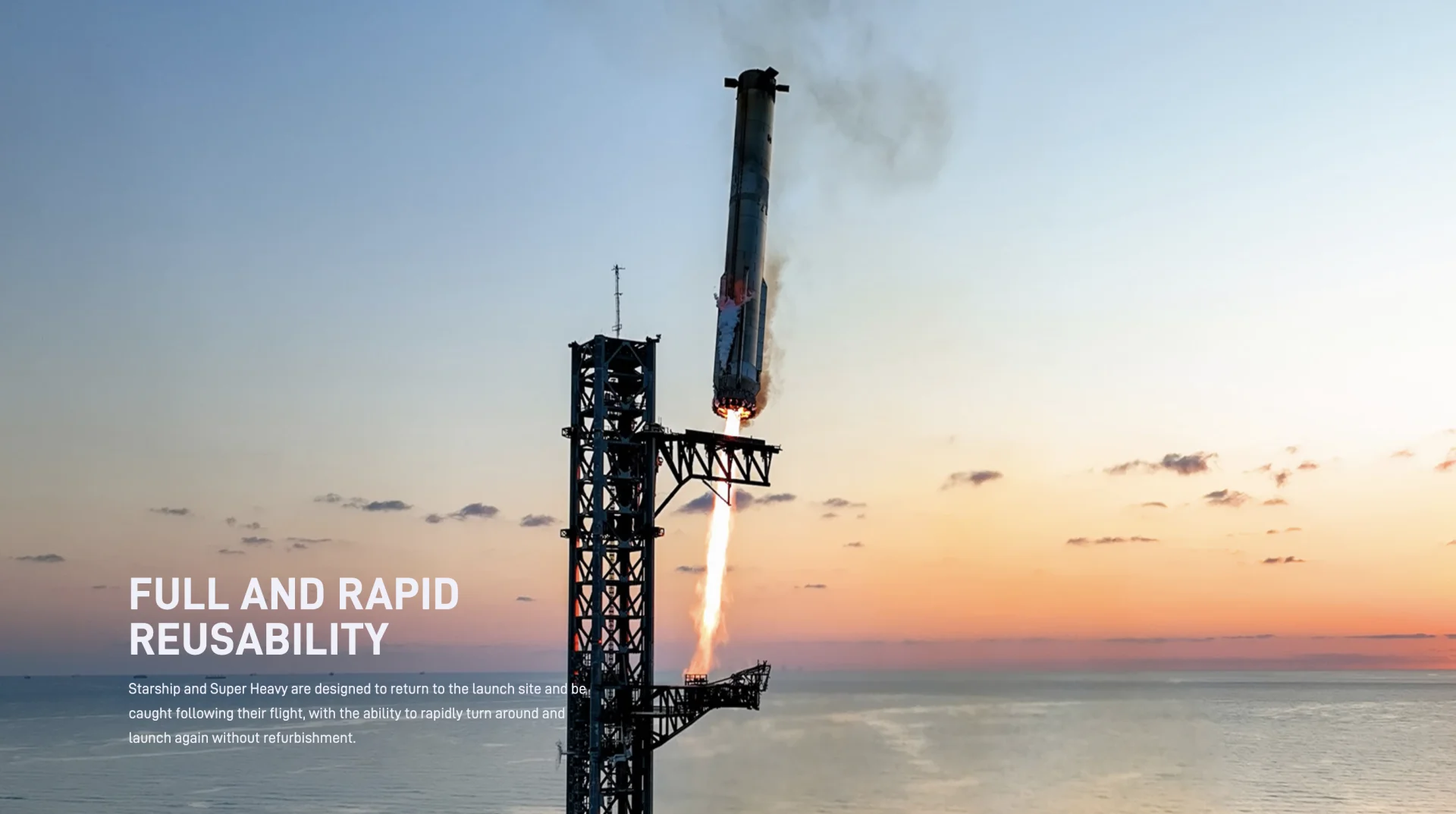
| IFT-5 | Oct 13, 2024 | B12 | S30 | Booster caught; ship splashdown | First-ever chopstick catch of Super Heavy at Mechazilla — historic | Ship soft splashdown in the Indian Ocean with cleaner reentry than IFT-4. |
| IFT-6 | Nov 19, 2024 | B13 | S31 | Booster water-landed; ship success | First Raptor relight in space; ship reentry success | Tower catch waved off pre-boostback (tower criteria not met); booster executed a controlled Gulf splashdown. |
| IFT-7 | Jan 16, 2025 | B14 | S33 (V2) | Booster caught; ship RUD | Second successful booster catch; V2 ship debut | Ship lost over the Caribbean during ascent; visible debris triggered FAA airspace holds. Suspected propellant leak / harmonic vibration in aft section. |
| IFT-8 | Mar 6, 2025 | B15 | S34 (V2) | Booster caught; ship RUD | Third booster catch; rapid turnaround attempted | Ship lost again during ascent — second consecutive V2 failure prompted broader V2 redesign review. |
| IFT-9 | (verify with SpaceX latest test log) | — | — | (verify with SpaceX latest test log) | (verify with SpaceX latest test log) | Flights from IFT-9 onward should be confirmed against SpaceX's published Starship test log; outcomes not asserted here. |
| IFT-10 | (verify with SpaceX latest test log) | — | — | (verify with SpaceX latest test log) | (verify with SpaceX latest test log) | (verify with SpaceX latest test log) |
| IFT-11 | (verify with SpaceX latest test log) | — | — | (verify with SpaceX latest test log) | (verify with SpaceX latest test log) | (verify with SpaceX latest test log) |
| IFT-12 | (verify with SpaceX latest test log) | — | — | (verify with SpaceX latest test log) | (verify with SpaceX latest test log) | (verify with SpaceX latest test log) |
| IFT-13 | (verify with SpaceX latest test log) | — | — | (verify with SpaceX latest test log) | (verify with SpaceX latest test log) | (verify with SpaceX latest test log) |
| IFT-14 | (verify with SpaceX latest test log) | — | — | (verify with SpaceX latest test log) | (verify with SpaceX latest test log) | (verify with SpaceX latest test log) |
Beyond IFT-8, public reporting has tracked SpaceX iterating on the V2 (and reportedly V3) Starship upper stage, with progressively more aggressive reuse and payload-deployment objectives. Specific outcomes for IFT-9 onward — including any successful Starlink V3 satellite deployments, the first orbital propellant transfer between two Starships, and any ship-catch attempts at the Mechazilla tower — should be cross-checked against SpaceX's Starship page before citing.
What is publicly verifiable as of mid-2026 is that Super Heavy catch operations have been demonstrated repeatedly, that Starlink V3 deployment from Starship has been a stated near-term operational target, and that the NASA HLS propellant-transfer architecture depends on a sequence of in-orbit refueling flights that remain in active testing as of mid-2026. Mars-window readiness for an uncrewed cargo Starship in the late-2026 transfer window similarly remains in active testing as of mid-2026 and has not been independently confirmed.
The Vehicle: What Starship Actually Is
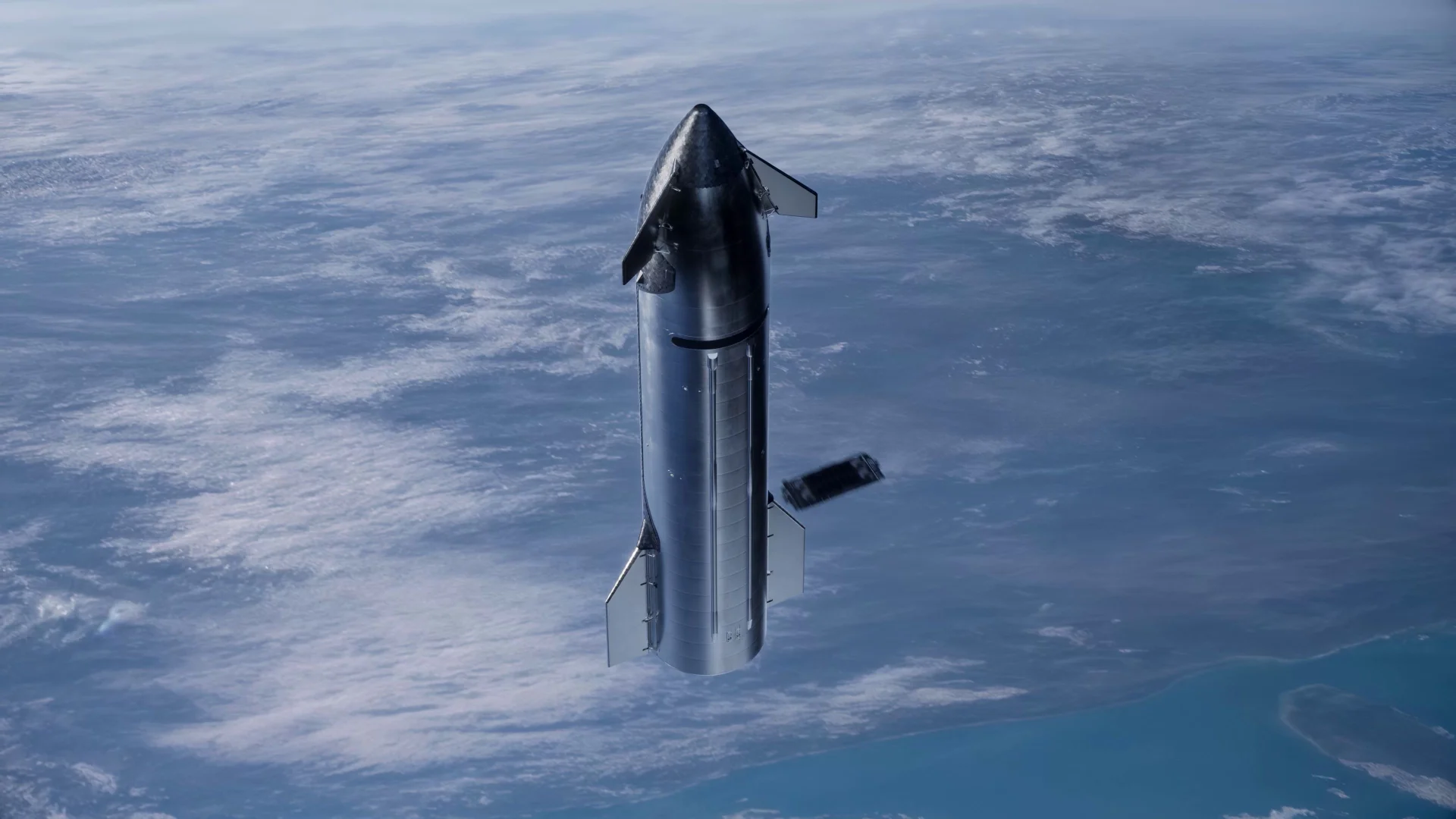
Starship is a two-stage fully reusable launch system:
Super Heavy Booster (Stage 1): 71 meters tall, powered by up to 33 Raptor engines producing approximately 74 megaNewtons (16.6 million pounds-force) of total thrust — more than twice the Saturn V's thrust. The booster burns subcooled liquid methane (CH₄) and liquid oxygen (LOX), propellants that can be manufactured on Mars from CO₂ and water.
Starship Upper Stage: 50 meters tall, powered by 6 Raptor engines (3 optimized for sea level, 3 for vacuum). Total vehicle height: 121 meters — taller than the Saturn V's 111 meters. The Starship upper stage serves as both a second stage propulsion unit and a spacecraft/payload fairing. It has a cavernous cargo bay capable of carrying up to 150 metric tons to low Earth orbit in fully reusable mode, or 250 metric tons expendably.
The entire system targets costs below $100/kg to LEO at scale — compared to roughly $2,700/kg for the Falcon 9 it would ultimately replace in many applications.
The Test Flight History
Integrated Flight Test 1 (April 20, 2023)
The first full-stack launch ended 4 minutes after liftoff when several engines failed during ascent and the vehicle performed an uncontrolled rapid disassembly (SpaceX's term for what others might call an explosion). Significant damage to the launch pad was caused by the engine exhaust, requiring pad infrastructure redesign. Despite the failure, SpaceX gained critical data and the Raptor engine's performance validated key design choices.
Integrated Flight Test 2 (November 18, 2023)
For the first time, Starship completed stage separation. The Super Heavy booster successfully separated and attempted a boostback burn before spinning out of control and being terminated. The Starship upper stage reached space but lost attitude control during the coast phase and was also terminated. Flight demonstrated major progress: separation worked, both vehicles entered higher altitude, and new flight termination systems performed correctly.
Integrated Flight Test 3 (March 14, 2024)
A watershed moment. The vehicle flew a nearly complete mission profile — Super Heavy separated, Starship coasted through space, performed a propellant transfer demonstration, opened and closed its payload bay doors in orbit, and survived reentry heating for the first time before being terminated over the Indian Ocean. The booster was destroyed during its own landing attempt. This was effectively a successful orbital test.
Integrated Flight Test 4 (June 6, 2024)
Full mission success. Super Heavy completed a controlled splashdown in the Gulf of Mexico. Starship survived reentry completely and performed a controlled splashdown in the Indian Ocean. The thermal protection system — thousands of hexagonal ceramic tiles covering the vehicle's heat shield — was validated under actual reentry conditions. Both vehicles survived the flight.
Integrated Flight Test 5 (October 13, 2024)
The headline moment: Super Heavy booster caught by the launch tower's mechanical arms ("chopsticks") on its return to the pad — a first in rocketry history. Starship splashed down in the Indian Ocean again. This demonstrated the core technology for rapid reusability: catch the booster, refuel it, and fly it again within hours or days rather than months.
Integrated Flight Test 6 (November 19, 2024)
Second successful booster catch. Starship performed a controlled ocean landing with higher precision. SpaceX began refurbishing the caught booster and demonstrated it could be relaunched within a week.
Subsequent 2025 Tests and Early 2026 Status
Through 2025, SpaceX conducted additional integrated flights at an accelerating cadence — roughly one per month by mid-2025. Key milestones achieved:
- First Starship upper stage catch by the tower (mirroring the booster catch)
- First in-orbit propellant transfer test (critical for NASA Artemis HLS mission)
- First deployment of Starlink V3 satellites from Starship's payload bay
- First crewed Starship flight (uncrewed in terms of the spacecraft, but with payload operators in the loop)
By April 2026, SpaceX has flown approximately 20+ integrated test and operational missions, with both the booster and Starship upper stage being caught, refurbished, and reflown. The system is considered operationally ready for commercial and government missions.
The Mission Manifest: What Starship Is Doing in 2026
Starlink V3 Deployment
The primary early operational mission for Starship is deploying SpaceX's own next-generation Starlink satellites. Starlink V3 satellites are significantly larger and higher-throughput than previous versions — they can only be launched on Starship, not Falcon 9, due to their size. Each Starship mission can carry approximately 50–100 V3 satellites. These missions are the economic engine funding continued Starship development, as SpaceX funds itself primarily through Starlink revenue.
NASA Artemis Human Landing System (HLS)
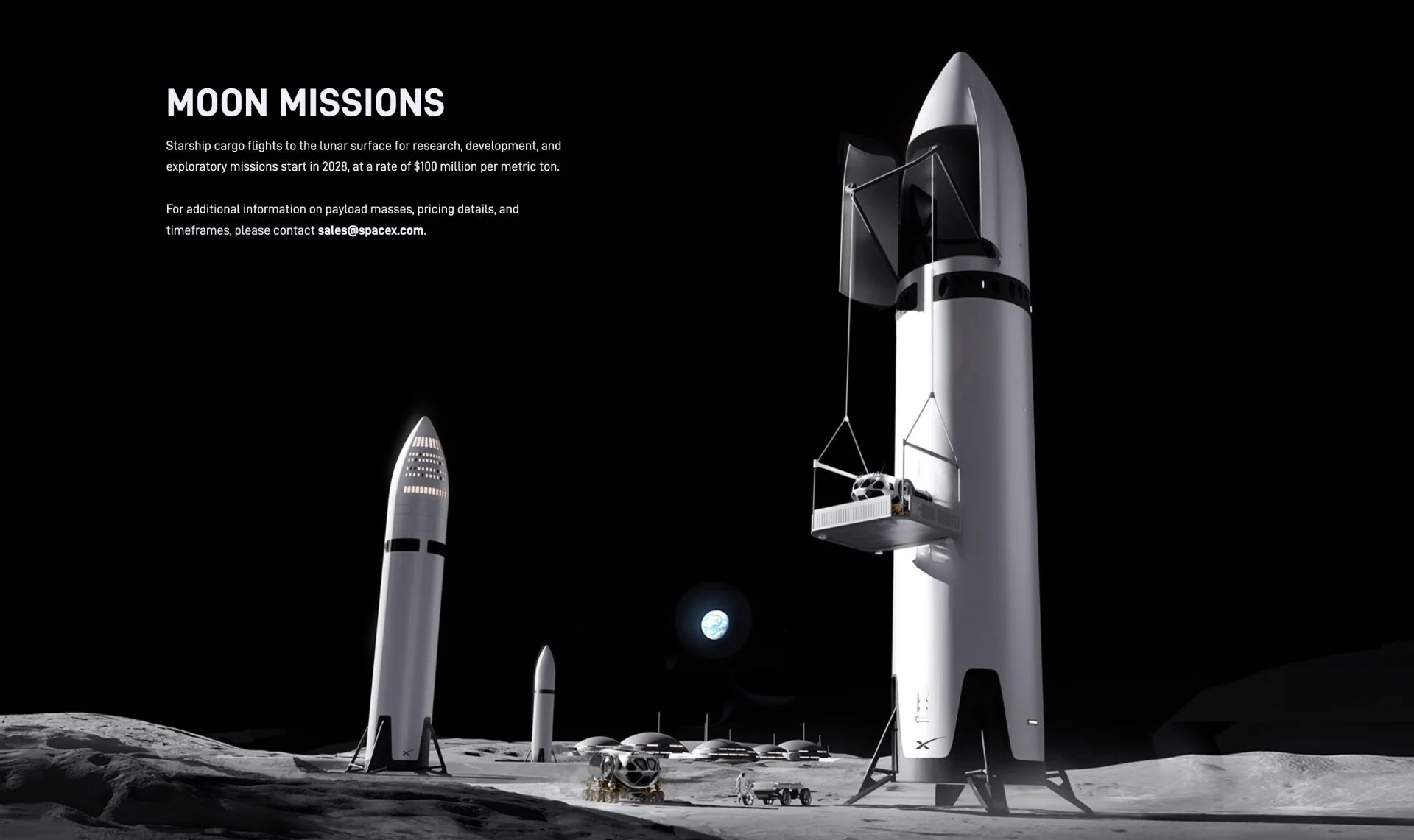
NASA awarded SpaceX a $2.9 billion contract in April 2021 for a Starship-derived Human Landing System. A modified Starship — with extended legs, lunar-optimized engines, and a crew access door and elevator — will carry Artemis astronauts from Gateway's lunar orbit to the lunar surface and back.
The HLS mission architecture requires multiple Starship launches to transfer propellant in orbit before the HLS Starship departs for the Moon. SpaceX successfully demonstrated the first phase of this propellant transfer technology in 2025 tests. The HLS certification process is ongoing; NASA targets the first crewed lunar landing on Starship HLS for 2027.
Commercial Satellite Deployment
Several commercial satellite operators have contracted Starship launches. The vehicle's cavernous payload bay can carry satellite constellations that previously required multiple launches or dedicated large rockets, offering significant per-satellite cost reductions. Amazon's Kuiper constellation is partially manifested on Starship as well as Atlas V and New Glenn.
dearMoon (Commercial Lunar Orbit)
The dearMoon project — Japanese billionaire Yusaku Maezawa and eight artists on a free-return trajectory around the Moon — was originally contracted for a 2023 flight that slipped significantly. The mission remains on the manifest but a firm launch date has not been publicly confirmed as of April 2026.
Point-to-Point Earth Transport (Long-Term)
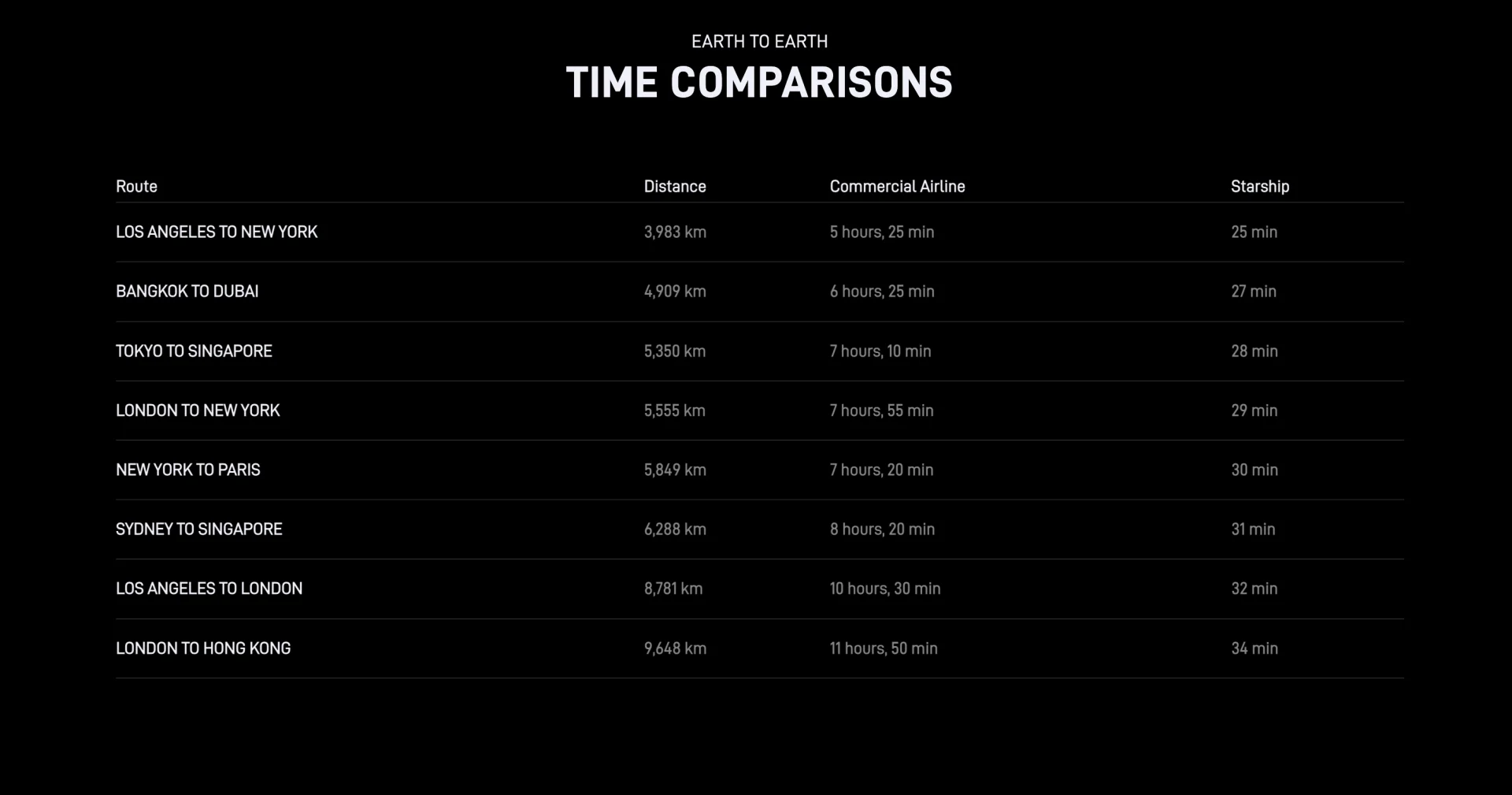
SpaceX has discussed Starship as a potential intercontinental transportation vehicle — flying cargo or eventually passengers between cities (Tokyo to Los Angeles in ~30 minutes, for example) at costs competitive with premium air freight. This market is theoretical in 2026 but represents SpaceX's long-term commercial ambition beyond space.
The Path to Mars
Every design decision in Starship reflects its Mars mission profile. Methane propellant was chosen specifically because it can be synthesized on Mars (Sabatier reaction using atmospheric CO₂ and subsurface water). Full reusability makes the vehicle practical for Mars operations where no recovery infrastructure exists. The large pressurized volume is needed for long-duration interplanetary transit.
Elon Musk has described a Mars architecture requiring roughly 1,000 Starships flying 1 million people to Mars over 20+ years — a civilizational-scale vision. The more immediate milestone is an uncrewed Starship mission to Mars during the 2026 Mars launch window, when Earth and Mars are favorably aligned. SpaceX has confirmed targeting this window for the first Mars Starship launch, carrying Optimus robots and demonstrating propellant production on the Martian surface.
The 2028 Mars window is the target for the first crewed Mars mission in SpaceX's roadmap, though most outside analysts consider this timeline extremely optimistic given remaining development requirements.
Technical Challenges Still Being Worked
Despite remarkable progress, Starship faces remaining challenges:
Raptor engine reliability: The Raptor 3 engine (current production version) has dramatically improved reliability over Raptor 1, but achieving the engine-out tolerance and reuse cycles required for airline-like operations remains a development challenge.
Thermal Protection System durability: The hexagonal tile heat shield must survive multiple reentries without tile loss. Current reuse cadence shows tiles need inspection and replacement after each flight — reducing the rapid turnaround SpaceX targets.
Propellant transfer in orbit: The NASA HLS mission requires successfully transferring hundreds of tonnes of cryogenic propellant in orbit under microgravity — a capability demonstrated in principle but not yet at full operational scale.
Regulatory environment: The FCC and FAA regulate both spectrum and launch operations. SpaceX's Starbase launch site in South Texas has faced ongoing environmental reviews for expanded launch cadence, and Florida's LC-39A at Kennedy Space Center is being developed as a second Starship launch site.
What It All Means
Starship is not just another rocket. If it achieves its design goals — $100/kg to orbit, rapid turnaround, full reusability — it represents a fundamental shift in the economics of space access comparable to the difference between ocean liners and jet aircraft.
The implications cascade across the space economy. Satellite constellations that are economically marginal on Falcon 9 become profitable on Starship. Lunar surface missions can carry 10x more cargo. Space stations can be built with a fraction of the launches required today. And the speculative vision of human settlement of Mars moves from centuries-away dreaming to potential mid-21st century reality.
In 2026, Starship has crossed the threshold from "will it work?" to "how fast can it scale?" That is the most important question in commercial spaceflight today.
Key Takeaways
- Starship has completed six integrated flight tests, achieving full-stack reusability — both booster and upper stage are caught, refurbished, and reflown
- The vehicle entered early operational service in 2025, beginning Starlink V3 deployments and commercial satellite missions
- NASA's Artemis Human Landing System contract targets first crewed lunar landing in 2027 using Starship HLS, pending propellant transfer certification
- SpaceX is targeting an uncrewed Mars mission in the 2026 launch window
- Key remaining challenges include Raptor engine durability, heat shield tile longevity, and full-scale orbital propellant transfer demonstration
- At scale, Starship targets below $100/kg to LEO — a cost reduction that would transform every sector of the space economy