Every serious plan to send humans to Mars eventually confronts the same brutal math: you need to move an enormous amount of mass across interplanetary space, land it safely on a planet with a thin atmosphere, keep people alive on the surface, and then launch them back home. For decades, that math produced mission architectures so expensive and complex that Mars remained perpetually "20 years away."
SpaceX's Starship is an attempt to break that cycle -- not by making the problem smaller, but by making the vehicle big enough to swallow the problem whole. And whether you are a die-hard SpaceX fan or a cautious skeptic, there is no denying that Starship is the most ambitious launch vehicle ever built, and the one most explicitly designed for Mars.
Let me walk you through the engineering, the strategy, and the challenges.
The Hardware: A Two-Stage Fully Reusable Giant
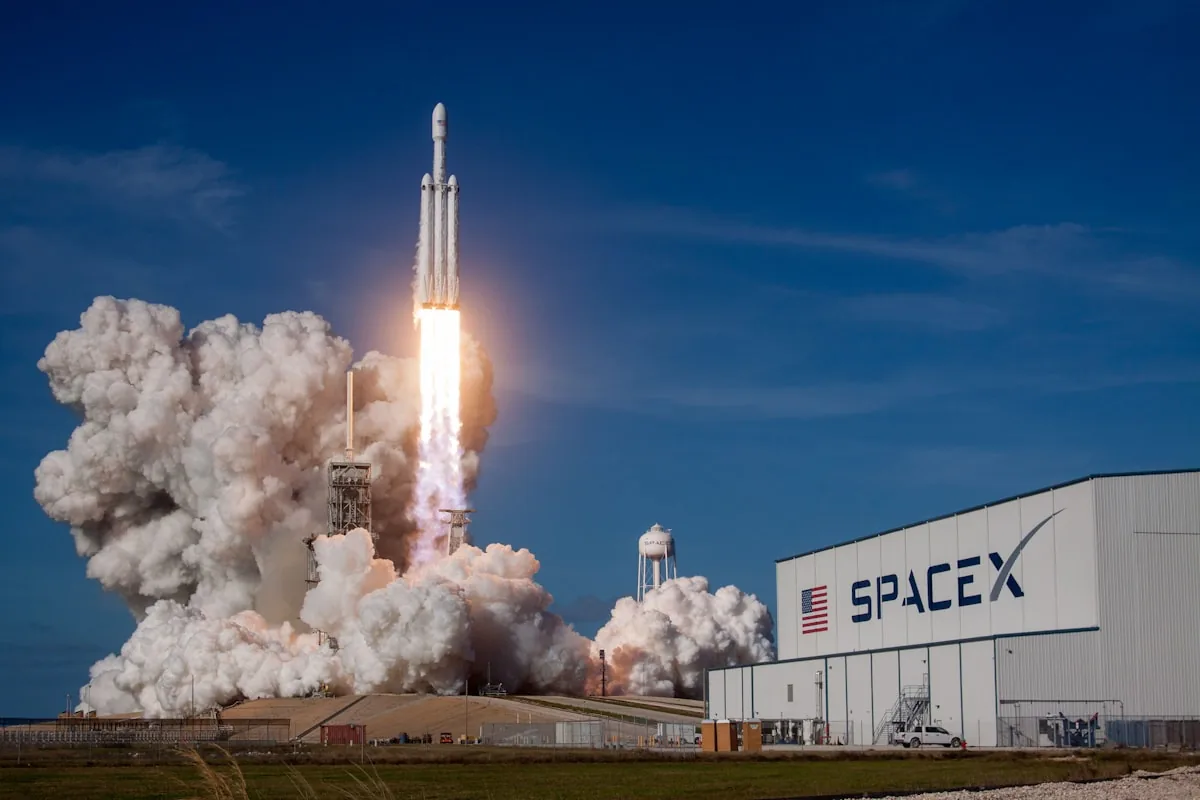
Starship is a fully reusable two-stage launch system consisting of the Super Heavy booster (first stage) and the Starship spacecraft (upper stage). The numbers are staggering:
Super Heavy Booster: Standing approximately 71 meters tall and 9 meters in diameter, the booster is powered by 33 Raptor engines generating a combined thrust of approximately 74 meganewtons (about 16.7 million pounds-force) at full throttle. That makes it the most powerful rocket stage ever built -- roughly twice the thrust of the Saturn V's first stage. The booster is designed to return to the launch site after separation and be caught by mechanical arms on the launch tower, enabling rapid turnaround for reuse.
SpaceX achieved a milestone in October 2024 when the "chopstick" catch system on the launch tower at Starbase, Boca Chica, Texas, successfully caught a returning Super Heavy booster for the first time during the fifth integrated flight test (IFT-5). It was one of the most jaw-dropping moments in spaceflight history -- a 71-meter rocket stage descending on its engines and being gently grabbed by a pair of mechanical arms.
Starship Spacecraft: The upper stage, also called Starship, is roughly 50 meters tall and powered by six Raptor engines -- three optimized for sea-level operation and three with extended nozzles optimized for vacuum. It has a payload volume of approximately 1,000 cubic meters -- larger than the cargo hold of a Boeing 747. In its cargo configuration, it can deliver over 100 metric tons to low Earth orbit and potentially over 100 metric tons to the Martian surface.
The total stack height is approximately 121 meters -- taller than the Statue of Liberty.
Raptor Engines: The Methane Advantage
The Raptor engine is fundamental to the Mars strategy, and its fuel choice is not accidental. Raptor burns liquid methane (CH4) and liquid oxygen (LOX) in a full-flow staged combustion cycle -- the most efficient engine cycle ever flown. Each Raptor produces roughly 230 tons of thrust at sea level, with a specific impulse of about 350 seconds (sea level) to 380 seconds (vacuum).
Why methane? Because methane can be manufactured on Mars.
This is the critical insight that makes Starship's Mars architecture viable. Using the Sabatier reaction, carbon dioxide from the Martian atmosphere (which is 96% CO2) can be combined with hydrogen (extracted from Martian water ice via electrolysis) to produce methane and oxygen:
CO2 + 4H2 --> CH4 + 2H2O
Both products -- methane and oxygen -- are exactly what Raptor engines burn. A Starship that lands on Mars with empty propellant tanks could, in principle, refuel itself using local resources and fly home. This in-situ resource utilization (ISRU) approach eliminates the need to carry return-trip propellant from Earth, which would otherwise require an impossibly large vehicle or multiple pre-positioned fuel depots launched from Earth.
Elon Musk has described this as the single most important design decision in the entire Starship program. It transforms Mars from a destination into a place you can leave.
Orbital Refueling: The Key to Interplanetary Range

Here is the fundamental challenge of getting to Mars: a vehicle large enough to carry a useful payload to the Martian surface cannot carry enough propellant to get there in a single launch from Earth. Starship's solution is orbital refueling.
The concept works like this: a Starship intended for Mars is launched into low Earth orbit with its payload but with mostly depleted propellant tanks. Then, a series of tanker Starships -- perhaps 6 to 12, depending on the mission profile -- launch in quick succession, rendezvous with the Mars-bound ship, and transfer propellant in orbit. Once the Mars Starship's tanks are full (approximately 1,200 metric tons of propellant), it fires its engines for the trans-Mars injection burn.
SpaceX has been developing propellant transfer technology, and NASA awarded SpaceX a contract worth up to $53 million in 2023 specifically to demonstrate orbital propellant transfer. This technology is not just important for Mars -- it is also critical for NASA's Artemis program, which selected a Starship variant as the Human Landing System (HLS) for returning astronauts to the lunar surface.
Orbital refueling has never been done at this scale. The closest precedent is the routine propellant transfer between Progress cargo ships and the ISS, but that involves relatively small quantities. Transferring over a thousand metric tons of cryogenic propellant in microgravity, preventing boil-off, and maintaining precise orbital alignment during the process is a formidable engineering challenge. But if SpaceX can crack it, it unlocks not just Mars but the entire solar system.
The Mars Mission Profile
SpaceX's stated Mars mission architecture, as described by Elon Musk at various presentations since the original 2016 International Astronautical Congress talk, follows this general sequence:
Step 1: Cargo missions. During the first available launch window, multiple uncrewed Starships land on Mars carrying equipment: power systems (likely solar arrays and possibly nuclear), ISRU propellant production plants, habitats, life support systems, and supplies. These ships would also begin producing propellant for future return flights.
Step 2: Confirm systems. Over the next 26 months (one Mars synodic period), the pre-positioned equipment is verified to be operational. Propellant production is confirmed. The landing zone is characterized.
Step 3: Crewed missions. During the next launch window, Starships carrying crew and additional cargo depart for Mars. The transit time, depending on the trajectory, is roughly 6 to 9 months. Upon arrival, the ships perform an aerodynamic entry through the Martian atmosphere (using Starship's heat shield and the thin Martian atmosphere for deceleration) followed by a propulsive landing.
Step 4: Surface operations and return. Crew members conduct science, expand the base, and produce propellant for the return trip. When sufficient propellant has been manufactured, a Starship launches from Mars and returns to Earth.
Timeline: Aspirational Versus Realistic
SpaceX's timelines have always been aggressive. Elon Musk initially suggested uncrewed Starship landings on Mars as early as 2024, a date that has clearly come and gone. As of early 2025, SpaceX is still working through the Earth-orbital test flight program, with increasingly successful flights but significant work remaining on heat shield durability, orbital refueling demonstrations, and regulatory approvals.
A more realistic assessment, shared by many industry analysts, puts the first uncrewed Starship Mars landing attempt in the late 2020s -- perhaps the 2028 or 2030 transfer window. Crewed missions would follow no earlier than the early 2030s, assuming the ISRU and life support technologies mature on schedule.
NASA's current planning for human Mars missions targets the late 2030s to 2040s, and the agency's approach may incorporate Starship as a cargo vehicle even if the crewed mission uses a different architecture.
The Challenges That Remain
Starship's Mars ambitions still face major unresolved challenges:
Heat shield reliability. Starship's heat shield, composed of thousands of hexagonal ceramic tiles, must survive both Earth reentry (at roughly 7.8 km/s) and Mars entry (at 6 to 7 km/s). The tiles have shown vulnerability to damage during test flights, and achieving airline-like reliability will require extensive iteration.
Landing on Mars. Mars's thin atmosphere provides some aerodynamic braking but not enough for a vehicle of Starship's mass. The final landing sequence requires precise propulsive control. Starship has never landed on Mars, and the 4-to-24-minute communication delay means the landing must be fully autonomous.
Long-duration life support. A 6-to-9-month transit with a crew requires reliable closed-loop life support systems that SpaceX has not yet demonstrated. This is a domain where NASA has decades of ISS experience that will be essential.
ISRU at scale. Manufacturing hundreds of tons of propellant on Mars requires industrial-scale chemical processing, reliable power (megawatts, not kilowatts), and water extraction infrastructure. No one has demonstrated ISRU at anything approaching this scale.
Despite these challenges, Starship represents the most credible near-term path to Mars. No other vehicle in development -- not NASA's Space Launch System, not China's Long March 9, not any other concept on the drawing board -- combines the payload capacity, reusability, and Mars-specific design features that Starship offers.
The vehicle is real. It is flying. And with every test flight, the gap between aspiration and reality narrows.
Mars is the destination. Starship is the ship. The only question left is when.