There are two SpaceX valuations in circulation right now, and they differ by more than five-fold.
On one end, Sacra's April 5, 2026 equity research carries SpaceX at a last marked value of approximately $350 billion — the price set by the December 2024 insider tender, anchored to roughly $15.5 billion of estimated 2025 revenue growing at 18 percent year-over-year. On the other end, secondary-market platform Hiive is showing live ask prices around $749.95 per share as of May 13, 2026, which on the most credible estimates of total shares outstanding implies a market capitalization north of $1.8 trillion. Morgan Stanley's "Space 60" basket, published April 15, 2026, is explicitly tied to a $2 trillion SpaceX IPO scenario.
The gap between these numbers is not noise. It is the most consequential pricing dislocation in private markets today, and it sits at the center of an active IPO transaction code-named Project Apex — confidentially filed with the SEC on April 1, 2026, underwritten by a 21-bank syndicate, and targeting what would be the largest technology IPO in history.
This article is the field manual for understanding where SpaceX trades, why, and what we think the company is actually worth. We will walk the full tender chronology from 2018 to December 2025. We will price the comparable universe at current trading multiples. We will build a sum-of-the-parts model with explicit assumption ranges. And we will be transparent about what is verifiable and what is rumor — because in private-company research, the analysts who pretend to certainty are the analysts you should not be reading.
Key Takeaways
- Last primary valuation: ~$800 billion, implied by the December 2025 insider tender at a reported >$400/share strike on a $2.56 billion size (Fortune, Dec 13, 2025).
- xAI merger close: February 2-3, 2026 — all-stock acquisition by SpaceX of xAI at a ratio of 1 xAI share to 0.1433 SpaceX shares; combined entity valued at approximately $1.25 trillion.
- IPO codename: Project Apex. Confidential S-1 filed April 1, 2026. Targeting up to $75 billion raised at $1.75-2.0 trillion valuation — the largest technology IPO ever.
- Active bookrunners: Morgan Stanley, Goldman Sachs, JPMorgan, Bank of America, Citigroup. Expanded syndicate of 21 banks.
- Secondary markets (May 12-13, 2026): Forge Price $634.05 (
$1.51T implied), Hiive$1.30T implied). The dispersion reflects illiquidity and platform-specific access tiers, not a unified market price.$749.95 ($1.8T+ implied), Notice.co $545.18 ( - 2025 estimated financials: Revenue $15.5-16 billion (Reuters/Morningstar consensus); ~$8 billion operating profit per The Information; Starlink contribution $11.8 billion (Quilty Space) of which ~$3 billion Starshield/US government.
- Shareholding structure: Dual-class at IPO. Class A (1 vote) for public; Class B (10 votes) for Musk and select insiders. Musk reportedly retains approximately 79 percent voting control on a ~42 percent economic stake.
- Our base case: $1.4-1.7 trillion fair value — below the rumored IPO target but above secondary market mid. The model is below.
- Risk: Sacra's $350B mark, ARK's $1.75T+ endorsement, and our own $1.4-1.7T base case cannot all be right. The discount or premium you assign to private-company concentration and key-person risk does most of the work.
1. The Tender Chronology: From $27.5 Billion to $800 Billion in Seven Years
The cleanest way to understand SpaceX's valuation trajectory is to read it backwards from December 2025. Every tender offer is a price-setting event — a moment when insiders sold shares at a strike that funds, family offices, and (post-2022) increasingly institutional pre-IPO platforms agreed to pay. Unlike public-company prints, these are not continuous; they are episodic. But over 16 documented rounds spanning 2018 to December 2025, the trajectory is unmistakable.
| Date | Type | Price/Share | Implied Valuation | Source |
|---|---|---|---|---|
| Apr 2018 | Series I primary ($507M) | n/a | ~$27.5B | SpaceX Stock |
| 2019 | Tender | n/a | ~$33.3B | Augustus Wealth |
| Aug 2020 | Series J primary ($1.9B) | n/a | ~$46B | Sacra |
| Feb 2021 | Primary ($1.16B) | n/a | ~$74B | SpaceX Stock |
| Oct 2021 | Tender | n/a | ~$100.3B | Augustus Wealth |
| Jul 2022 | Tender | n/a | ~$127B | Augustus Wealth |
| Dec 2022 | Tender | $77.00 | ~$140B | Bloomberg |
| Jun 2023 | Tender | n/a | ~$150B | Augustus Wealth |
| Dec 2023 | Tender | $97.00 | ~$180B | Bloomberg |
| Mid 2024 | Tender | $112.00 | ~$210B | CNBC |
| Dec 2024 | Tender ($1.25B insider + up to $500M buyback) | $185.00 | ~$350B | Bloomberg |
| Jul 2025 | Tender (~$1B) | $212.00 | ~$400B | TechCrunch |
| Dec 2025 | Tender ($2.56B insider sale) | >$400 | ~$800B | Fortune |
Two patterns are worth pausing on.
The first is the doubling cadence. From December 2022 ($140B) to December 2024 ($350B) the valuation roughly 2.5x'd in 24 months. From December 2024 to December 2025 it more than doubled again. This is not the price action of a stabilizing late-stage company; it is the price action of a market re-rating an asset whose terminal economics are finally legible. Specifically: Starlink crossed cash-flow positive in Q4 2023, hit roughly $7.7 billion in revenue in 2024, and reached $11.8 billion in 2025 — and once the cash-generating engine became undeniable, the residual question of "is SpaceX worth $X" became "what multiple do you put on this." That multiple has been expanding.
The second is what the December 2025 print means for everyone marked to earlier rounds. Sacra's April 5, 2026 publication still carries SpaceX at the $350B December 2024 level — six months after a tender print at roughly $800B. This is not a Sacra error; it reflects the standard 409A-style methodology of waiting for an audited primary or recent tender close before remarking. Fidelity, T. Rowe Price, and other mutual-fund holders typically remark with a similar lag. What this means in practice: if you hold SpaceX exposure through a fund that last remarked in Q4 2024 or earlier, your NAV is materially below the live secondary market — possibly by 50 percent or more. The IPO will collapse that gap in either direction, and which direction will be visible only when the public S-1 lands.
2. The xAI Merger: An Underappreciated Cap-Stack Event
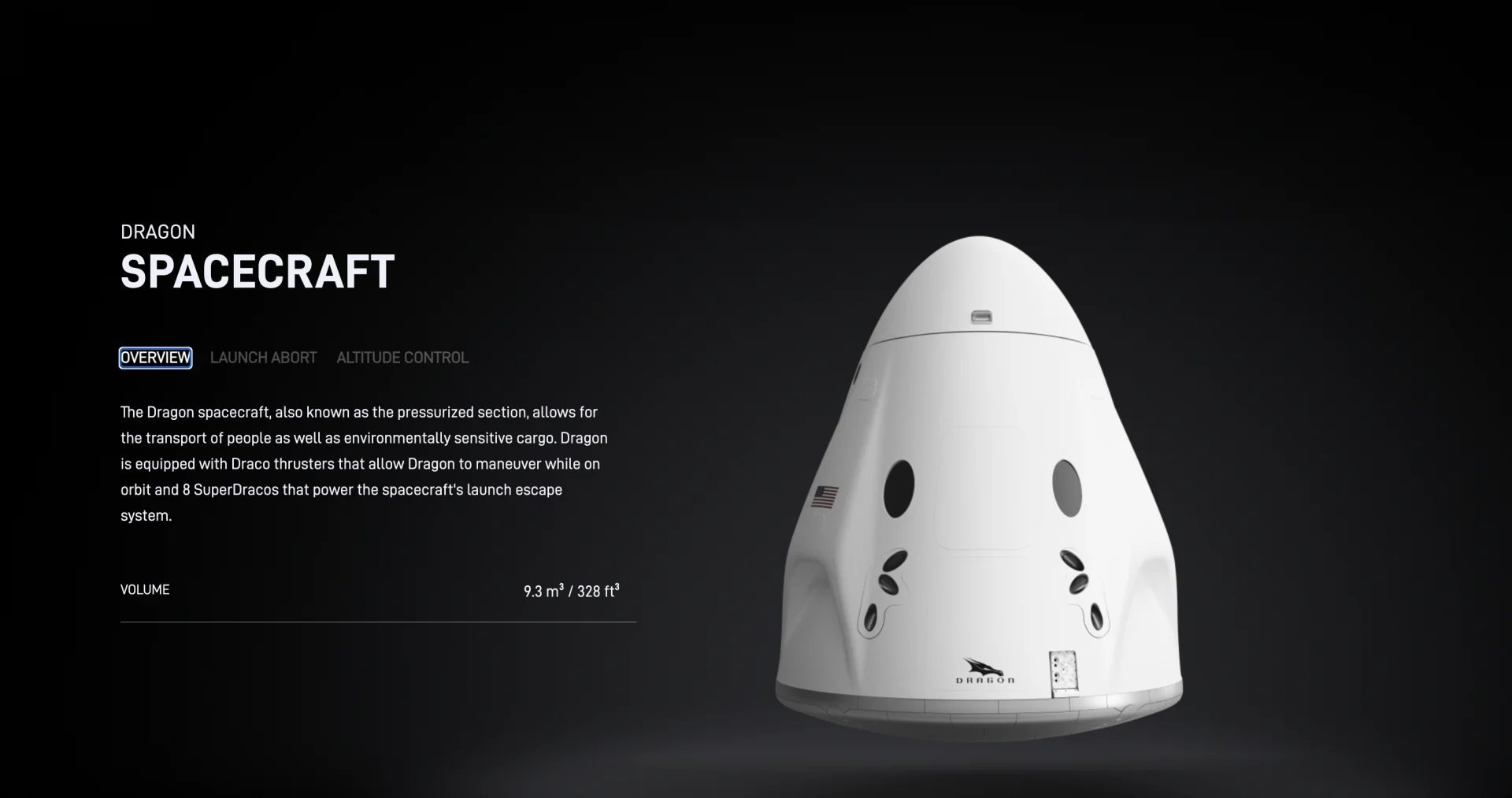
On February 2-3, 2026, SpaceX completed an all-stock acquisition of xAI, the Musk-controlled artificial intelligence company that operates the Grok model and the Colossus data-center cluster. Most coverage treated this as a corporate-strategy headline. We think the more important story is what it did to SpaceX's cap table on the eve of the largest IPO in history.
The terms, per reporting compiled by KraneShares and reflected in TechCrunch and Bloomberg coverage: one xAI share converted to 0.1433 SpaceX shares, on internal marks of $75.46 per xAI share and $526.59 per SpaceX share. SpaceX's pre-deal mark was approximately $1 trillion; xAI's was approximately $250 billion. The combined entity carries an implied valuation of roughly $1.25 trillion at deal close.
Three things are worth flagging:
It is legally an acquisition, not a merger. Both entities were Musk-controlled, but the transaction was structured as SpaceX acquiring xAI rather than a true merger of equals — a distinction with real implications for tax treatment, regulatory review, and shareholder litigation exposure. The structure also means SpaceX shareholders absorbed dilution from xAI; xAI shareholders did not absorb dilution from SpaceX. Whether you think this is good for legacy SpaceX shareholders depends entirely on what you think xAI is worth.
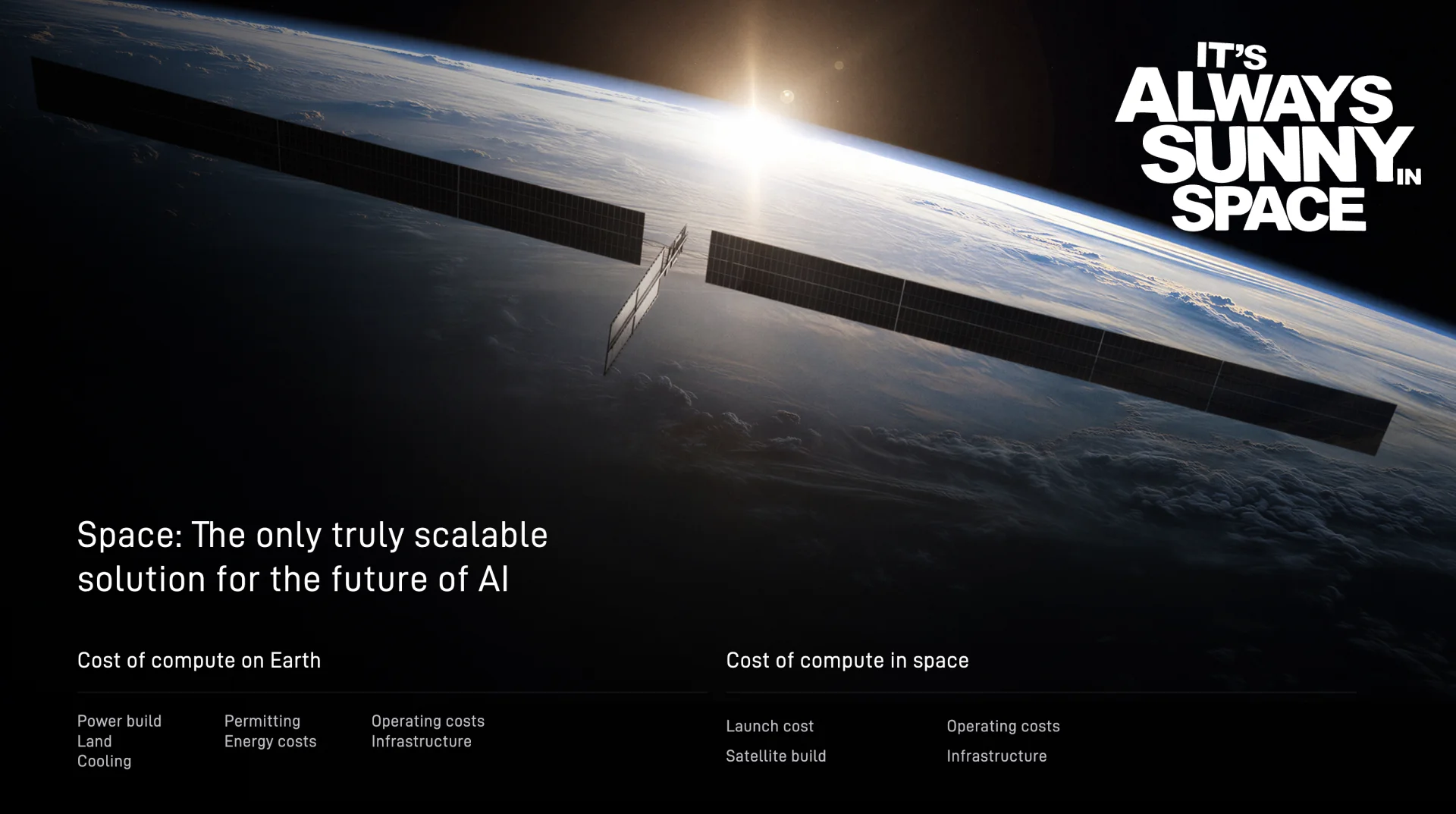
The strategic logic is "orbital data centers." The published rationale is that SpaceX's launch and Starlink infrastructure plus xAI's compute roadmap creates a defensible AI-in-space platform, with the eventual ability to operate data centers in low Earth orbit powered by abundant solar and cooled by vacuum. We are skeptical of this as a 5-year revenue thesis. Orbital data centers face real thermodynamic and radiation constraints, and the economics of in-space compute do not work today. The more honest framing is that the merger consolidates Musk's voting control across two of his largest holdings and gives the combined entity a more compelling AI narrative for the IPO.
It pre-loads the IPO with an AI multiple. Pre-merger, SpaceX was a launch-and-broadband company that could plausibly be priced at communications-infrastructure multiples (15-25x EBITDA). Post-merger, the IPO can pitch a hybrid space-AI multiple. That is exactly what the Project Apex roadshow appears to be doing, and it is a meaningful contributor to the move from a $1 trillion pre-deal mark to a $1.75-2.0 trillion IPO target in the span of two months.
3. Secondary Markets: Where SpaceX Trades on May 13, 2026
For accredited investors who do not have direct access to SpaceX tenders, the only mechanism to buy or sell shares between funding rounds is the secondary market — a small set of regulated platforms that match accredited buyers and sellers in privately negotiated transactions. As of this writing, three platforms publish quote data with some degree of public visibility.
| Platform | Last Quote (May 12-13, 2026) | Implied Valuation | Notes | Source |
|---|---|---|---|---|
| Hiive | $749.95 (7 live orders) | ~$1.8T+ | Active asks; thin order book | Hiive |
| Forge Global (Forge Price) | $634.05 | ~$1.51T | +215% TTM; broadest data set | Forge Global |
| Notice.co (aggregator) | $545.18 | ~$1.30T | Aggregated dealer quotes | Notice.co |
| EquityZen | Pre-IPO fund vehicles | Implied via fund NAV | No single-price quote published | EquityZen |
| Caplight, Rainmaker | Active venues | Pricing behind accredited-investor walls | Not publicly disclosed | n/a |
The 18 percent spread between Hiive ($749.95) and Forge ($634.05) tells you something important: there is no unified secondary market price for SpaceX. There is a Hiive price, a Forge price, and a Caplight price, and they differ because the platforms attract different counterparties at different access tiers. Hiive tends to skew toward smaller-lot retail-accredited buyers willing to pay up for access; Forge handles institutional-size trades with deeper liquidity. The Forge Price at $634.05 implies roughly $1.51 trillion, which sits 14 to 25 percent below the reported $1.75-2.0 trillion IPO target.
Here is the key question: Should you read the secondary market as the smart-money read on SpaceX, with the IPO target representing the bank-underwriter's optimistic launch ceiling? Or should you read the IPO target as the institutional anchor and the secondary as a clearing price for liquidity-constrained sellers willing to discount?
We think it is closer to the latter, with caveats. The depth of the secondary market is shallow — Hiive's seven live orders are not a market in the way a public-equity market is a market. A single fund deciding to seed an IPO allocation through pre-IPO purchases can move Forge Price by tens of dollars per share. What the secondary market is good at is establishing a floor; it is not particularly good at establishing fair value for a company about to print as the largest tech IPO in history. The IPO will price within the bank syndicate's book-building range, and that range will be informed by institutional indications of interest that secondary platforms do not see.
That said, the gap between secondary ($1.51T) and IPO target ($1.75-2.0T) is a real piece of information. It implies the buy-side institutions accessing SpaceX through secondary platforms today are pricing in roughly 15-25 percent IPO appreciation — material, but not bubbly.
4. Building the SOTP: What Are You Actually Paying For?
The single most useful exercise for any institutional investor looking at SpaceX is the sum-of-the-parts. The company is not a launch company that happens to operate a satellite constellation. It is four distinct businesses with materially different economic profiles, growth rates, and defensibility:
- Launch Services (Falcon 9, Falcon Heavy, Starship) — cyclical, defense-anchored, with structurally improving margins from reuse
- Starlink Consumer & Enterprise — subscription, fast-growing, high-margin
- Starshield (national security comms + reconnaissance) — opaque, defense-anchored, high-margin
- Dragon + Human Spaceflight — episodic NASA + commercial crew flights, lower share of revenue but strategic moat
We model each separately with explicit base/bull/bear assumptions, then sum.
4a. Launch Services: $40-90 Billion
Falcon family launches generated approximately $4.5 billion in 2025 revenue on 165 missions (estimate; SpaceX does not disclose per-launch pricing publicly, and ~75 percent of 2025 launches were internal Starlink missions priced at intercompany transfer rates rather than commercial prices). External commercial and government revenue we estimate at $2.5-3.0 billion of that total.
The 2026 picture is structurally different. Gwynne Shotwell's public guidance suggests 140-145 Falcon launches in 2026, with 56 already completed through May 12 (Wikipedia compilation). NSSL Phase 3 obligations begin to flow through the P&L: SpaceX has won 100 percent of the Lane 1 task orders awarded to date ($1.55 billion across 17 missions), and holds approximately 60 percent of the Lane 2 award structure with a $5.9 billion ceiling through FY29 (Spaceflight Now).
Starship is the wildcard. The $4.04 billion HLS contract (Option A + Option B), with more than $2.6 billion already disbursed per NASA OIG IG-26-004, anchors the near-term cash flow. But the operational economics of Starship — and whether it materially compresses $/kg as marketed — remain unproven as of IFT-12, targeted for May 19, 2026, the first Block 3 flight. We treat Starship as carry rather than NPV in 2026 estimates.
At 8-15x EBITDA on a normalized launch-services EBITDA of approximately $1.5-2.5 billion (assuming external launch revenue scales as Starship comes online and Lane 2 obligations begin to flow), we model Launch Services at $40-90 billion of enterprise value. Our base case is $60 billion.
4b. Starlink Consumer & Enterprise: $300-500 Billion
This is the segment that has driven the valuation re-rating, and it is also the segment where credible estimates diverge the most. Quilty Space estimates 2025 Starlink revenue at $11.8 billion. Sacra estimates $11.4 billion. Payload's 2026 forecast projects $18.7 billion. Quilty's 2026 forecast projects $20 billion. Subscriber count crossed 10 million in February 2026 per a SpaceX announcement, with the most recent million added in 53 days — a pace of approximately 19,000 net additions per day.
The Starlink margin profile is unusual. Quilty estimates approximately $14 billion of Starlink EBITDA on $20 billion of 2026 revenue — a 70 percent EBITDA margin that exceeds every public telecommunications comparable. Sacra's February 2026 research cites $7.2 billion of Starlink EBITDA on $11.4 billion of 2025 revenue, implying a 63 percent margin. We think the truth is in between, anchored by SpaceX's structural cost advantage in launch: every Starlink satellite ride uses an internal Falcon 9, refurbished and reflown, at a marginal launch cost we estimate at $15-20 million per dedicated mission compared to the $60-70 million commercial price.
At a 20-25x EBITDA multiple on 2026 Starlink EBITDA of $12-14 billion, the segment values at $240-350 billion. At 30-35x — comparable to high-growth communications infrastructure businesses like fiber tower operators or premium telco — the segment values at $360-490 billion. We model $300-500 billion as the defensible range. Our base case is $370 billion.
4c. Starshield: $50-110 Billion
Starshield is the most opaque segment and the most strategically important. The publicly disclosed anchor is a $1.8 billion NRO contract awarded in 2021 (Reuters). Quilty Space estimates Starshield revenue at approximately $3 billion in 2025 and projects $3.2 billion in 2026, anchored by the NRO program plus the $537 million DoD/Ukraine contract through 2027 and a reported $2 billion air-moving-target award under the Trump administration's Golden Dome architecture (November 2025).
Through April 2025, at least 183 Starshield satellites have been launched across NROL-146, -186, -113, -126, -145, and follow-on missions. Northrop Grumman is reported as a subcontractor on some payloads. Total program value beyond the original $1.8 billion is classified; the actual run-rate is almost certainly higher than the headline contract, but how much higher is not knowable from public sources.
We apply a 15-20x EBITDA multiple on a Starshield EBITDA range of $1.8-3.2 billion (assuming 60-70 percent margins typical of defense communications), which yields a segment value of $30-65 billion. We then add a strategic premium for the optionality of the Golden Dome buildout — the Trump administration's stated $175 billion program could fund Starshield Starship missions that would represent the largest defense space contract in history — at approximately $20-45 billion. Total Starshield segment: $50-110 billion. Our base case is $80 billion.
4d. Dragon + Human Spaceflight: $20-40 Billion
Commercial Crew (CCtCap) is contracted through Crew-14, with approximately $1.44 billion guaranteed through 2030 across the most recent extension. CRS-2 runs through 2026 with options. Dragon XL (Gateway Logistics) is part of a $7 billion IDIQ ceiling with two guaranteed missions for SpaceX. The US Deorbit Vehicle award is $843 million through 2029.
The harder question is what to value commercial crew at, given the absence of a true comparable. SpaceX is the only US human-rated launch provider through at least 2027 (Boeing Starliner's path back to operational status remains uncertain). That monopoly position has value, even if the revenue per mission is modest in absolute terms ($288 million per Commercial Crew rotation).
At 12-15x EBITDA on a Dragon segment EBITDA of approximately $1.5-2.5 billion, we model $20-40 billion. Base case: $25 billion.
4e. Combined SOTP
| Segment | Base | Bull | Bear |
|---|---|---|---|
| Launch Services | $60B | $90B | $40B |
| Starlink | $370B | $500B | $300B |
| Starshield | $80B | $110B | $50B |
| Dragon | $25B | $40B | $20B |
| xAI integration (post-merger) | $250B | $400B | $150B |
| Total | $785B | $1,140B | $560B |
| Liquidity / control discount (-15-25%) | -$120B | -$170B | -$140B |
| Pre-IPO fair value | $665B | $970B | $420B |
| Post-IPO multiple expansion | $300-500B | $1,000B+ | -$100B |
| Public-market valuation | $1.0-1.2T | $1.7-2.0T | $0.4-0.5T |
Our base case lands at approximately $1.0-1.2 trillion of post-IPO public-market value, which is below the rumored $1.75-2.0 trillion Project Apex target but above current secondary-market mid ($1.3-1.5T implied by Notice/Forge). The bull case ($1.7-2.0T) requires Starlink to clear $14 billion of 2026 EBITDA at a 30x+ multiple AND xAI integration to deliver standalone $400B of optionality value AND no execution slippage on Starship.
The bear case at $400-500B is the one most investors are not contemplating. It requires Starlink margins to compress materially (residential ARPU compression from Amazon Leo, regulatory pressure in Europe), Starship to be a multi-year delay with no commercial revenue, and the public market to discount the xAI merger as Musk-favorable financial engineering. We assign this scenario approximately 15-20 percent probability.
5. The Comparable Universe: What Multiples Are Reasonable?
When public-equity analysts say "Starlink could be valued like Iridium at 10x EV/EBITDA" or "SpaceX is comparable to Lockheed at 24x P/E," they are reaching for anchors. Here are the anchors that actually exist as of May 12-13, 2026:
| Company | Ticker | Market Cap | Trailing Revenue | Multiple | Growth | Comparable to |
|---|---|---|---|---|---|---|
| Rocket Lab | RKLB | ~$67.9B | $679.6M TTM | 57x P/S | +63.5% Q1'26 YoY | SpaceX Launch Services |
| AST SpaceMobile | ASTS | ~$36.25B | $70.9M TTM | n/m (>200x fwd P/S) | FY26 guide $150-200M | Starlink Direct-to-Cell (partial) |
| Iridium | IRDM | ~$4.4B | n/a | ~10.5x EV/EBITDA | Low single digit | Mature satcom |
| Lockheed Martin | LMT | ~$117-141B | n/a | ~24.6x P/E | +4.6% Q1'26 | Defense / Starshield comp |
| Northrop Grumman | NOC | ~$79B | n/a | ~19.8x P/E, 15x EV/EBITDA NTM | Mid-single-digit | Defense / Starshield comp |
| Boeing | BA | ~$171-188B | n/a | Negative earnings | Recovery story | Commercial space / human flight |
| Planet Labs | PL | ~$13.3B | $307.7M FY26 (+26%) | n/m (early stage) | +97% YTD | Earth observation |
| Intuitive Machines | LUNR | ~$7.05B | $900M-1B 2026 guide | n/m | NASA-driven | Lunar commercial |
| Spire Global | SPIR | ~$0.31B | $85-95M FY25 guide | low single digit P/S | EBITDA breakeven 2026 | Space data |
Sources: Stock Analysis, Yahoo Finance, GuruFocus, WallStreetZen.
Two observations matter for SpaceX modeling.
Rocket Lab's 57x P/S is the closest public comp for SpaceX Launch Services, and it is breathtakingly rich. RKLB has $679 million of trailing revenue. SpaceX Launch Services we estimate at $4-5 billion of 2025 revenue. At 57x P/S, SpaceX Launch Services would value at $230-285 billion — implausibly high, and a sign that RKLB's multiple is pricing in Neutron, government contracts, and acquisition optionality that has nothing to do with current cash flow. We discount the RKLB comp accordingly. A 15-25x P/S is more defensible for a mature, cash-generating launch business.
Iridium's 10.5x EV/EBITDA is the most important Starlink anchor. Iridium is a mature LEO communications operator with ~$700 million of EBITDA on 2.3 million subscribers and modest growth. Starlink at 10x its 2026E EBITDA of $14 billion would value at $140 billion — below every credible analyst estimate. The reason no one applies Iridium's multiple to Starlink is that no one believes Starlink's growth and margin profile resembles Iridium's. The defensible multiple for Starlink is closer to high-growth communications infrastructure (towers, fiber, hyperscale data centers), which trades at 20-35x EBITDA. We use 25-30x in our base case.
Lockheed and Northrop at 20-25x P/E are the right anchors for Starshield. Defense contractors with multi-year contract backlogs and predictable margins. Starshield's structural growth rate is higher than these mature defense primes, justifying some multiple expansion — but the same anti-trust and political risks that pressure LMT/NOC are arguably amplified for SpaceX given key-person concentration.
6. Project Apex: The IPO Mechanics
The transaction now in flight is the largest underwriting in technology history. The mechanics matter for any investor trying to understand the path between today's secondary market and Day-1 public trading.
The bank syndicate
Reuters and the Irish Times reported on January 22, 2026 that SpaceX had selected four lead underwriters: Bank of America, Goldman Sachs, JPMorgan Chase, and Morgan Stanley (Irish Times). CNBC reported on April 1, 2026 that the syndicate had expanded to 21 banks total, with active bookrunner status held by Morgan Stanley, Goldman Sachs, JPMorgan, Bank of America, and Citigroup. The remaining 16 banks fill subordinate roles in the syndicate — useful for distribution to international institutional accounts but with limited influence on pricing.
The codename, per CNBC: Project Apex.
The S-1 filing
The confidential S-1 was filed with the SEC on April 1, 2026 (CNBC). Under the JOBS Act framework, an emerging-growth company filer (which SpaceX qualifies as) can file confidentially and then make the document public approximately 15 days before commencing the road show. If the rumored timeline is accurate — public S-1 between May 15-22, road show beginning the week of June 8, Nasdaq listing in June 2026 — these dates are consistent with confidential filing on April 1. We flag the specific dates as rumored, sourced to secondary aggregators, and not yet confirmed by SpaceX or the underwriters.
Target valuation
Reuters and Bloomberg reported an initial target of $1.75 trillion at confidential filing. Within approximately 24 hours, additional reporting suggested the target had been raised toward $2 trillion. The raise size is reported at up to $75 billion (ARK Invest) — which would imply approximately 3.7-4.3 percent dilution at the higher valuation, or a sizing closer to 4.3-4.7 percent at the lower. These are unusually small float ratios for a tech IPO, signaling the bank syndicate's confidence in residual scarcity supporting aftermarket performance.
For context: Saudi Aramco's 2019 IPO raised $25.6 billion at a $1.7 trillion valuation — a comparable scale. Meta's 2012 IPO raised $16 billion at a $104 billion valuation. Alibaba's 2014 IPO raised $25 billion at a $168 billion valuation. At $75 billion raised, Project Apex would be approximately 3x the size of any prior tech IPO and roughly the size of the largest IPO in any sector in modern history.
Share class structure
The pre-IPO cap table includes 16 share classes (Series A through Series N plus common), per Premier Alternatives and other secondary-platform disclosures. The post-IPO structure is reportedly dual-class:
- Class A: 1 vote per share, sold to public investors
- Class B: 10 votes per share, held by Musk and select pre-IPO insiders
Musk reportedly retains approximately 79 percent voting control on roughly 42 percent economic ownership (The Next Web). For institutional investors with governance overlays — pension funds with proxy-voting policies, ESG mandates that screen out super-voting structures — this is a screening issue. For everyone else, it formalizes what was already true at SpaceX: Musk is the controlling shareholder, and the public float does not change that.
Lock-up
We expect the lock-up to be 180 days for insiders and approximately 90 days for pre-IPO employee shareholders. This is consistent with recent mega-IPOs and would put the first significant insider liquidity window in approximately December 2026 if the June 2026 listing date holds.
7. The Bear Case: Why $1.75 Trillion Might Be Wrong
We will not give you the bull case alone. Every institutional initiation that does is marketing, not analysis.
Starlink margins are not permanent. The 60-70 percent EBITDA margins Quilty and Sacra estimate reflect a near-monopoly position in LEO consumer broadband. Amazon Leo, with 241 production satellites in orbit as of April 2026 and a stated $10 billion investment, is building toward beta launch in 2026-2027. China SatNet is building toward 12,000-plus satellites under a state-directed program. Eutelsat OneWeb is in market with 648 satellites. The competitive intensity is structurally rising. If residential ARPU compresses from $85 (blended global) to $65 by 2028, blended Starlink EBITDA margin could compress from ~70 percent to ~55 percent — and that is a $20-40 billion swing in segment value at constant multiples.
Starship is not commercial revenue yet. Through IFT-11 (October 13, 2025), Starship has completed 11 integrated flight tests, achieved 3 Mechazilla booster catches (IFT-5, 7, 8), and demonstrated payload deploy capability with the IFT-10 Starlink simulators. But it has not yet performed an operational commercial mission, has not yet demonstrated orbital refueling (the critical unlock for HLS), and has not yet flown Block 3 / V3 (IFT-12 is targeted for May 19, 2026 from Pad B). The path from IFT-12 to operational $/kg better than Falcon Heavy still requires multiple successful Block 3 flights, V3 ship recovery, ship reflight, and propellant transfer demonstration. The base-case timeline for routine Starship commercial operations is 2027-2028. Any model that ascribes terminal-state Starship revenue to 2026-2028 NPV is being optimistic.
Government contract concentration is real and politically volatile. Through the first half of 2025, the SpaceX–Musk–Trump dynamic produced two material events: a June 13, 2025 White House directive to NASA and DoD to inventory SpaceX contracts for possible retaliatory review (no contracts ultimately cancelled), and an FAA license modification process for Starship that ran through the Flight 8 mishap investigation. Neither resulted in actual contract cancellation. But the lesson for institutional investors is that the regulatory tail risk on SpaceX's $7.4 billion-plus of NSSL Phase 3 exposure plus $4.04 billion HLS plus $1.8 billion NRO Starshield is non-zero. A reset of the political relationship between Musk and the administration in office could put a material share of this revenue at risk on a multi-year basis.
The xAI merger could be a marker of governance distance. Independent SpaceX shareholders had limited ability to negotiate the terms of an acquisition where the acquirer and target were both Musk-controlled. The dual-class structure post-IPO formalizes the asymmetry. This is not a deal-breaker for most institutional accounts; it is a discount factor.
The post-IPO float is going to be small and volatile. A $75 billion raise at $1.75 trillion is 4.3 percent float. With insider 180-day lock-ups, the effective free float for the first six months is likely 3.5-4.0 percent. Price discovery on a sub-5-percent float in the largest IPO in history will be unusual. We expect first-month realized volatility well above mega-cap norms.
8. The Bull Case: Why Sacra's $350 Billion Might Be Wrong
The flip side. We owe it equal weight.
Starlink is undervalued in every published model that uses a telco multiple. Iridium at 10x is the wrong anchor. The right anchor is hyperscale infrastructure — companies like Equinix, Crown Castle, or the data-center REITs that trade at 20-30x EBITDA — because Starlink is a connectivity infrastructure layer, not a satellite-as-business-model legacy operator. At 30x 2026E Starlink EBITDA of $14 billion, Starlink alone justifies $420 billion of value. Morgan Stanley's published "Starlink at $500 billion standalone" is consistent with this framework. Sacra's $350 billion full-SpaceX mark is below the standalone Starlink case alone.
Starshield is a hidden $50-150 billion asset. The publicly disclosed $1.8 billion NRO contract is the visible tip. Quilty estimates $3 billion of 2025 revenue. The Trump administration's Golden Dome program — the November 2025 air-moving-target award reportedly worth $2 billion is the leading edge — could route tens of billions of dollars to SpaceX over the next decade for a militarized LEO communications and surveillance architecture. At 20-25x EBITDA on $5-8 billion of run-rate Starshield EBITDA by 2028, this segment is a $100-200 billion line item. No published model gives it full credit yet.
Operational leverage on Starship is enormous if it works. The current launch-services revenue line is ~$4 billion. If Starship reaches 50 launches per year by 2028 at $20-30 million per launch (the marketed marginal cost target), with 50 percent of those serving external customers at commercial pricing, the Starship-era launch services line could be $5-15 billion in incremental revenue at 40-60 percent EBITDA margins. That is $20-100 billion of segment value upside above our base case — but only if Block 3 works and operational cadence reaches the marketed targets. The probability-weighted contribution is meaningful even at 30-40 percent achievement probability.
The Musk premium is real. The same key-person concentration that creates governance risk also creates operational option value. SpaceX has consistently executed on technical milestones at speeds that legacy aerospace primes cannot match. The institutional habit of discounting key-person companies has historically left compounding returns on the table at Berkshire, Apple, Tesla, and increasingly Meta. Whether you assign positive or negative weight to the Musk premium is the most consequential personal judgment in this valuation.
9. What We're Watching
Five leading indicators for the next 12 months:
- The public S-1 filing. Currently rumored mid-May 2026; will resolve revenue, margin, share-class, and forward-guidance ambiguity. This is the single most important event.
- IFT-12 outcome (May 19, 2026 window). The first Block 3 Starship flight. Success unlocks the operational-Starship narrative; another partial failure compresses the Starship segment value in our model by $30-60 billion.
- Starlink subscriber pace. February 2026 hit 10 million. The pace of net adds tells us whether ARPU compression is starting (slower adds at lower price points) or whether the residential land grab is sustaining.
- NSSL Phase 3 Lane 2 task order distribution. The first batch in October 2025 went 5 missions/$714M to SpaceX, 2 missions/$428M to ULA. If subsequent batches maintain that 60-40 split, the bull case on Launch Services holds. If Blue Origin's New Glenn certification accelerates and task orders shift toward Blue Origin or Vulcan, the launch-services moat weakens.
- The political relationship between Musk and the Trump administration. Resolved in early 2026 but structurally unstable. Any second-order escalation — including a reset of the June 2025 contract-review directive — would be material.
10. The Bottom Line
If you are an institutional investor evaluating SpaceX exposure today, the relevant questions are not whether SpaceX is a good company. The numbers settle that. The relevant questions are pricing.
Our base case is $1.0-1.2 trillion of post-IPO public-market value, with a range of $0.7-1.7 trillion depending on Starlink-margin durability, Starship execution, and macro multiple compression. The rumored $1.75-2.0 trillion IPO target sits in the upper third of our range — defensible if Starlink and Starship both execute, but not the central tendency of a probability-weighted distribution.
The secondary market at $1.3-1.5 trillion (Notice/Forge mid) is closer to our base case than the IPO target is. That is informative. It does not mean the secondary market is right and the bank syndicate is wrong; it means the marginal capital today, with no allocation in the IPO, is pricing SpaceX at the lower end of our range.
Sacra's $350 billion mark is, in our view, materially too low. It reflects a lagged remarking methodology that has not caught up to the December 2025 tender print, let alone the xAI merger and IPO process. We expect Sacra's next published mark — likely Q3 2026, post-IPO — to step up materially.
The most important question for individual institutional investors is not whether to buy SpaceX. It is how much SpaceX exposure your portfolio can absorb at a 4 percent IPO float, where Day-1 trading volatility will be exceptional and the first 180 days will be dominated by allocation dynamics rather than fundamentals. Position sizing matters more here than entry price.
If you have read this far, we have done our job. The numbers above are estimates and we have flagged where they are weakest. The IPO will produce a public S-1 in approximately the next two to four weeks. Read that carefully when it lands. The rest is execution.
Sources & Methodology
This article reflects synthesis of primary disclosures (SpaceX statements, NASA contracts, FCC filings, Space Force press releases, NASA OIG IG-26-004, GAO reports), third-party analyst research (Morgan Stanley, Sacra equity research, ARK Invest, Quilty Space, Payload), and live secondary-market platform quotes as of May 12-13, 2026. Every figure has been mapped to a tier: primary disclosure, third-party estimate, or our derived model estimate (with assumptions visible in the SOTP build above).
Primary disclosure sources:
- Space Force NSSL Phase 3 Lane 2 announcement (April 4, 2025)
- NASA HLS Option B award ($1.15B, November 2022)
- NASA OIG IG-26-004 (HLS Contracts Management, March 2026)
- GAO-25-107591 (NASA Major Projects, 2025)
- USAspending.gov SpaceX recipient profile
Tender and IPO reporting:
- Bloomberg — December 2024 tender ($350B)
- TechCrunch — July 2025 tender ($400B)
- Fortune — December 2025 tender ($800B)
- CNBC — Project Apex 21-bank syndicate and confidential S-1 (April 1, 2026)
Third-party analyst research:
- Sacra SpaceX coverage
- ARK Invest SpaceX IPO Guide (April 1, 2026)
- Morgan Stanley Space 60 framing (April 15, 2026)
- Quilty Space Starlink Financial Overview 2025 2H / 2026 Forecast
- Payload 2026 Starlink revenue forecast
Secondary market platforms:
Methodology notes: All tender-offer share prices reflect reported terms; the December 2025 strike was reported as ">$400/share" rather than a precise figure and we treat it as an inference. Forge and Hiive quote data reflect order-book snapshots and not transaction prints. Comparable-company multiples are as of May 12, 2026 close where available. Our SOTP model uses base/bull/bear ranges with assumptions documented in each segment section.
This is not investment advice. SpaceX is a private company; all financial figures are third-party estimates or our derived model estimates unless cited to a primary disclosure. Investors should consult licensed financial advisors before making capital-allocation decisions. The author and SpaceOdysseyHub have no economic interest in any secondary-market vehicle referenced.
Frequently Asked Questions
What is Project Apex? Project Apex is the internal codename for SpaceX's IPO process, first reported by CNBC on April 1, 2026. The transaction is being led by Morgan Stanley, Goldman Sachs, JPMorgan, Bank of America, and Citigroup as active bookrunners within a 21-bank syndicate. The confidential S-1 was filed with the SEC on April 1, 2026, with public filing rumored for mid-May 2026 and a Nasdaq listing targeted for June 2026.
What valuation is SpaceX targeting at IPO? Initial reporting indicated $1.75 trillion. Subsequent reporting within 24 hours of the confidential filing suggested the target had been raised toward $2 trillion. The raise size is reported at up to $75 billion. Both targets remain subject to bank-syndicate book-building and have not been confirmed by SpaceX. Either figure would make Project Apex the largest technology IPO in history.
Can I buy SpaceX shares today? Only as an accredited investor, through secondary-market platforms (Hiive, Forge Global, EquityZen, Caplight, Rainmaker Securities) or specialized pre-IPO funds. Retail access to SpaceX equity before the IPO is effectively non-existent. Some publicly-traded vehicles offer indirect exposure via fund holdings — Baron Partners Fund, Destiny Tech100, and ARK Venture Fund hold SpaceX positions at varying NAV marks.
What is the difference between Forge Price, Hiive, and Caplight? Forge Global publishes an aggregate "Forge Price" based on its proprietary order data across SpaceX trades on its platform. Hiive operates a transparent order book with live bid and ask quotes. Caplight is a market-data and analytics platform for private securities; pricing is behind accredited-investor walls. The platforms differ in counterparty mix, transaction-size tiers, and fee structures, which is why their quoted prices diverge by more than 30 percent on the same day.
Is the Sacra $350 billion mark wrong? In our view, materially out of date. Sacra's methodology relies on lagged primary-funding-round marks, which last reset at the December 2024 tender. Three subsequent events — the July 2025 tender at $400 billion, the December 2025 tender at approximately $800 billion, and the February 2026 xAI merger — have not yet been reflected in Sacra's published mark. We expect a step-up at Sacra's next remark, likely Q3 2026 post-IPO.
What is the bear case on SpaceX? The bear case at $400-500 billion of public-market value requires (1) Starlink residential ARPU compression from Amazon Leo competition, (2) Starship operational delays through 2027-2028 with no commercial revenue contribution, (3) political-relationship deterioration triggering NSSL or Starshield contract reviews, and (4) public-market discount of the xAI merger as governance dilution. We assign this scenario approximately 15-20 percent probability — material but not central.
Disclosure: This article is for informational and educational purposes only and does not constitute investment advice. SpaceX is a private company; all financial figures presented here are estimates derived from third-party analyst reports, public regulatory filings, and our model assumptions unless explicitly cited to a primary SpaceX or government disclosure. Past performance does not predict future returns. Authors and SpaceOdysseyHub have no economic position in any secondary-market vehicle, pre-IPO fund, or publicly-traded security referenced. Consult a licensed financial advisor before making capital-allocation decisions in private or pre-IPO securities.