Image: NASA / Chris Gunn
Don't just read it — experience it
Relive James Webb Space Telescope, chapter by chapter
30 days to L2 · 7 chapters · Unfolding the Universe
James Webb Space Telescope
Mission Profile
| Launch date | 2021-12-25 |
|---|---|
| Launch vehicle | Ariane 5 ECA |
| Spacecraft | James Webb Space Telescope |
| Target | Earth-Sun L2 |
| Type | Robotic |
| Cost | $10.0B life-cycle (NASA portion); ~$1.4B ESA + ~$200M CSA |
| Mass | 6,200 kg at launch |
| Duration | 10-year primary; 20+ years projected with extra propellant |
| Partners | NASA Goddard (lead), ESA (NIRSpec, MIRI optics, launch), CSA (FGS/NIRISS), Northrop Grumman (prime), STScI (operations) |
| Instruments | NIRCam, NIRSpec, MIRI, FGS/NIRISS |
Prime Contractors
Companies that built, launched, or operate this mission. Tickers link to their investor profile.
- Northrop Grumman
- BAE Systems (Ball Aerospace)
- Airbus Defence & Space
- Arianespace
- L3Harris
Overview
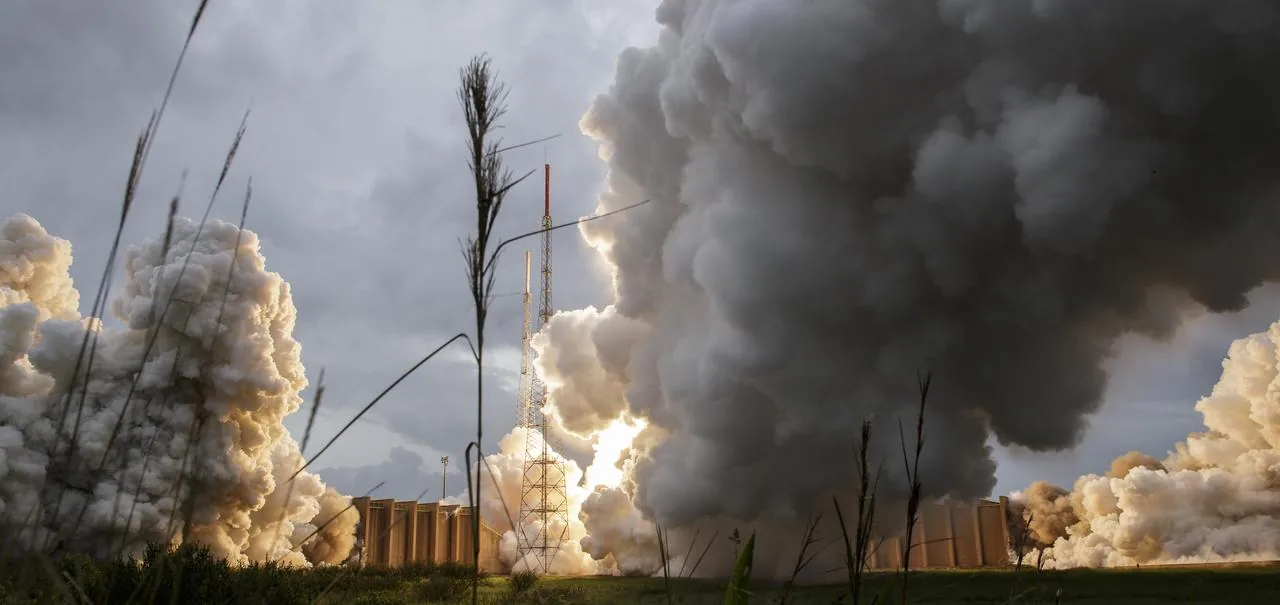
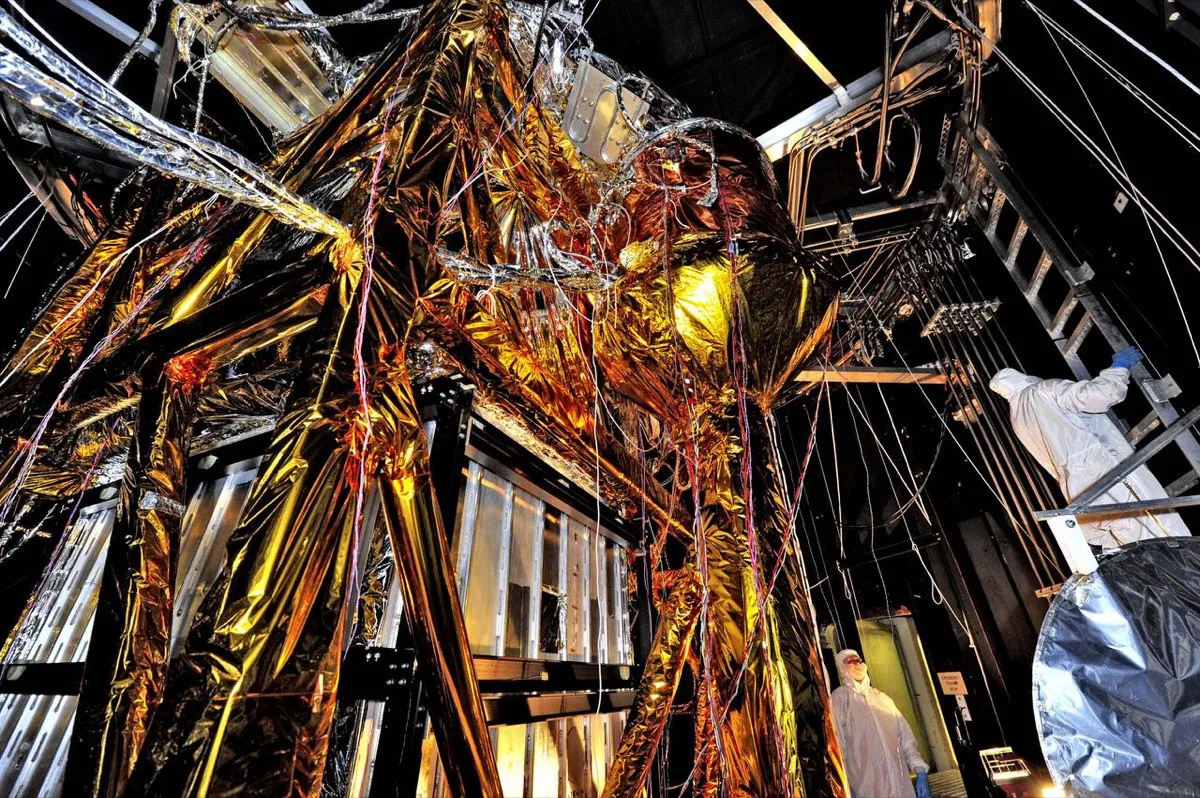
The James Webb Space Telescope (JWST) is the most powerful astronomical observatory ever launched and the scientific successor to Hubble. A joint NASA-ESA-CSA project more than 25 years in development, JWST launched on 25 December 2021 on the most precise Ariane 5 launch in that vehicle's history — accurate enough that ESA's planned trajectory correction maneuvers were only minimally needed, effectively doubling the propellant available for science operations. Over the following month JWST executed the most complex spacecraft deployment ever attempted, unfolding a tennis-court-sized five-layer sunshield and a 6.5-m segmented gold-coated primary mirror — both too large to fit folded behind any rocket fairing in their final shape. After arrival at the second Earth-Sun Lagrange point and six months of commissioning, JWST began science operations on 12 July 2022 with iconic images including the deepest infrared view of the universe ever taken. JWST's four instruments (NIRCam, NIRSpec, MIRI, and FGS/NIRISS) span 0.6-28 μm, allowing it to see through dust into star-forming regions, characterize exoplanet atmospheres, and probe galaxies from the very first cosmic dawn. JWST has already detected the most distant galaxies ever confirmed — the current record-holder being MoM-z14 at z≈14.4, spectroscopically confirmed in a 2026 paper (seen as it was just ~280 million years after the Big Bang), which superseded the prior holder JADES-GS-z14-0 (z=14.32) — identified water vapor in exoplanet atmospheres, and reshaped our understanding of early-universe galaxy assembly. The mission's nominal lifetime is 10 years but the propellant savings from the Ariane launch extend that to 20+ years.
Key Milestones
2021-12-25
Launch on Ariane 5 from Kourou, French Guiana
2022-01-08
Sunshield fully deployed
2022-01-24
Arrival at Earth-Sun L2
2022-07-12
First science images released; full operations begin
2024-12-04
Confirms then-most-distant galaxy (JADES-GS-z14-0, z=14.32)
2026-01
Confirms new most-distant galaxy MoM-z14 (z≈14.4), superseding JADES-GS-z14-0