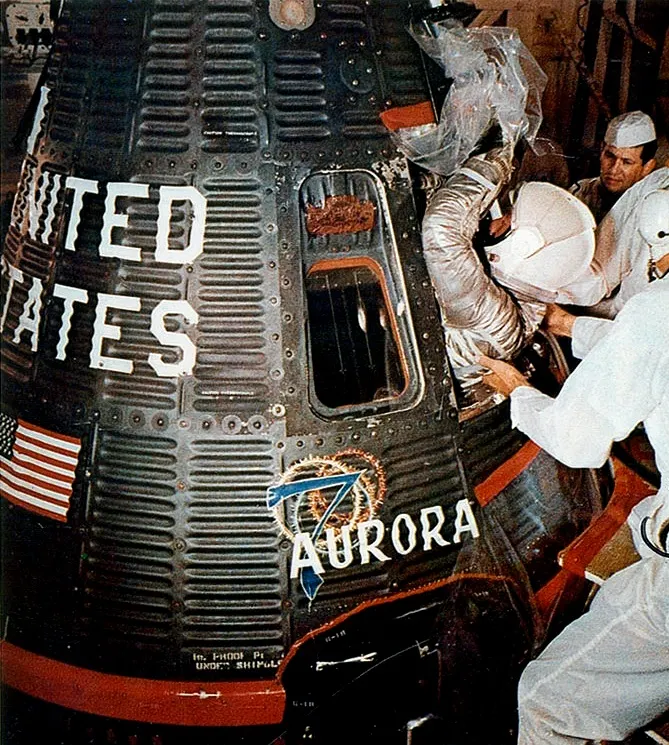
Image: NASA
Mercury-Atlas 7 (Aurora 7)
Mission Profile
| Launch date | 1962-05-24 |
|---|---|
| Launch site | Cape Canaveral Air Force Station Launch Complex 14 (LC-14), Florida |
| Launch vehicle | Atlas LV-3B (107-D) |
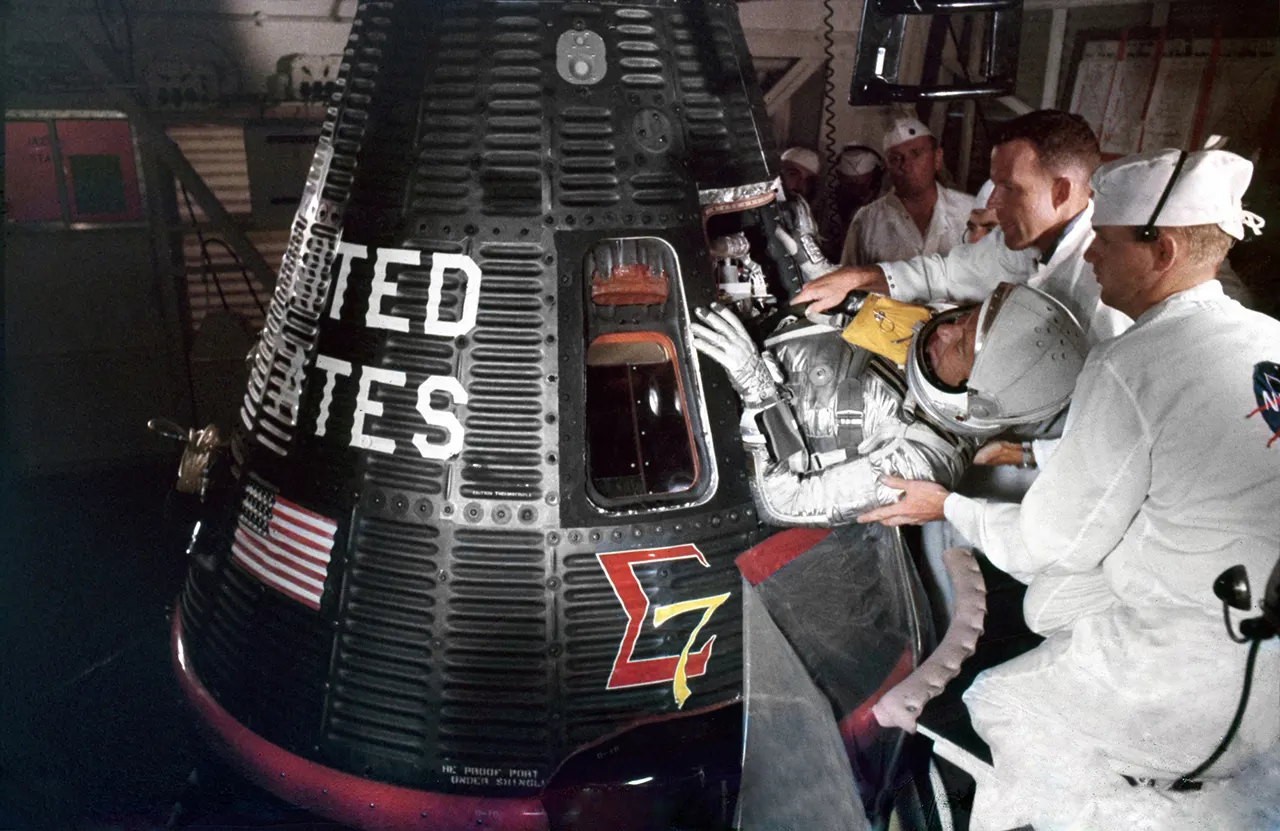
| Spacecraft | Mercury capsule No. 18 (Aurora 7) |
| Target | Low Earth Orbit |
| Type | Crewed |
| End date | 1962-05-24 |
| Recovery | USS Intrepid (CVS-11) — Carpenter recovered by helicopter; capsule retrieved by USS John R. Pierce (DD-753) |
| Mass | 1,350 kg (2,976 lb) |
| Duration | 4 hours, 56 minutes, 5 seconds |
Overview
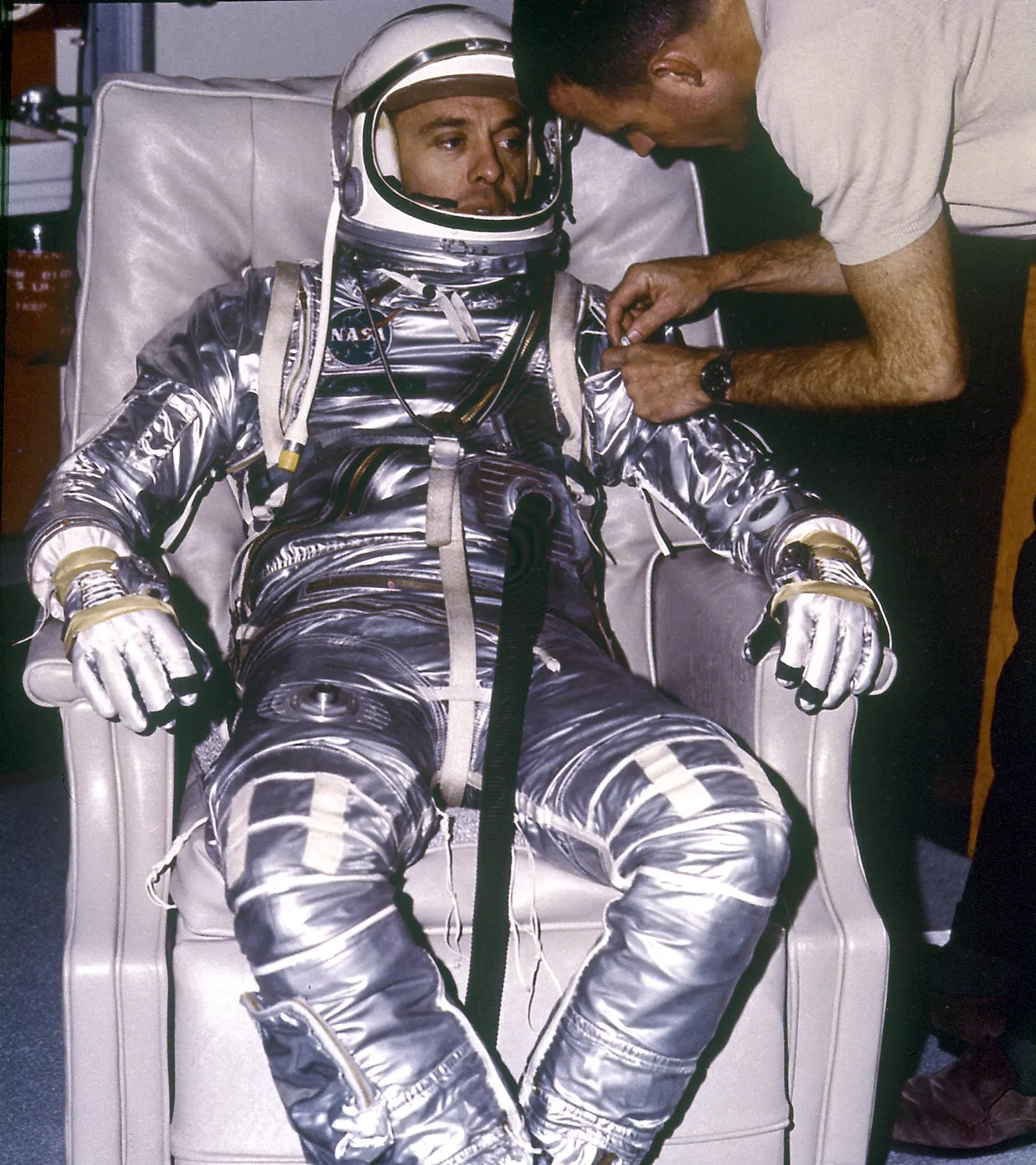
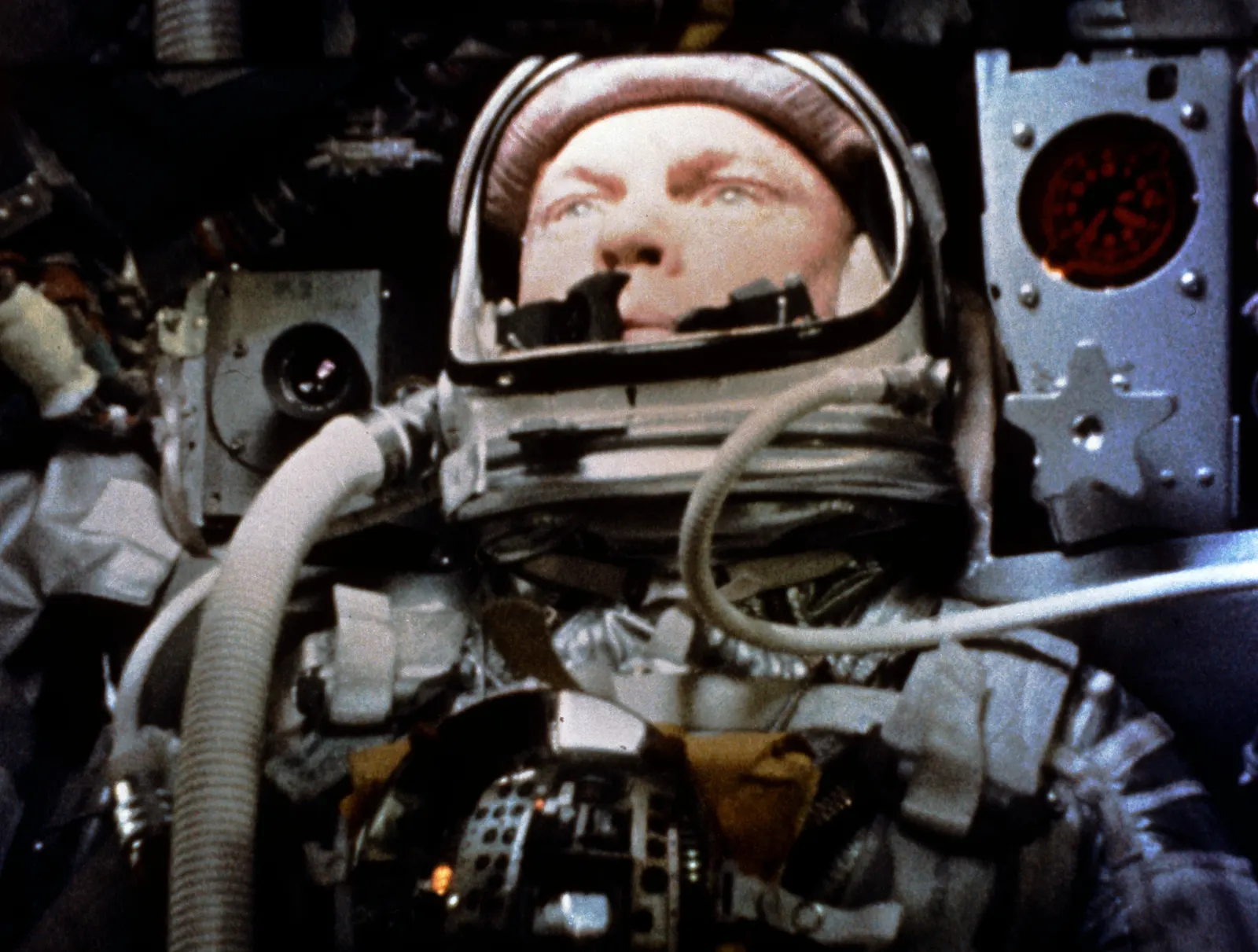
Scott Carpenter, who inherited the second American orbital flight after Deke Slayton was grounded with a heart irregularity, lifted off aboard Aurora 7 at 12:45:16 UTC on May 24, 1962. His three-orbit, 4-hour, 56-minute, 5-second mission was deliberately weighted toward science: Carpenter photographed the Earth and airglow layer, tracked a towed multicolored balloon to study drag and visibility, and solved one of Friendship 7's mysteries when he rapped on the capsule wall and watched John Glenn's 'fireflies' shake loose — ice particles clinging to the spacecraft's skin. The busy flight plan and a malfunctioning pitch horizon scanner took a toll on attitude-control fuel, and the reentry sequence turned tense. Retrofire came roughly three seconds late with the spacecraft slightly misaligned, and the combined errors pushed the landing point about 400 kilometers (250 miles) beyond the planned recovery zone. For nearly forty minutes, the world waited without word of the astronaut. Search aircraft found Carpenter floating calmly beside his capsule in a life raft, where he remained for almost three hours before helicopters from USS Intrepid lifted him to safety; the destroyer USS John R. Pierce later retrieved Aurora 7 itself. It was Carpenter's only spaceflight — he later turned to the ocean floor as a Navy SEALAB aquanaut.
Crew
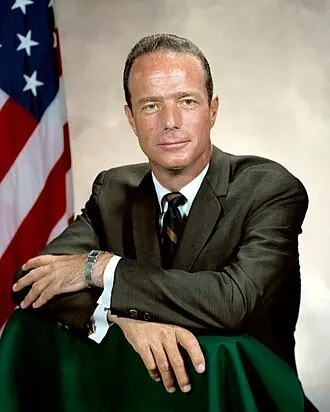
Scott Carpenter
Pilot
Second American to orbit the Earth, replacing the grounded Deke Slayton. Flew only once; later lived on the seafloor as a SEALAB II aquanaut.
Key Milestones
1962-05-24
Liftoff from Cape Canaveral LC-14 at 12:45:16 UTC atop Atlas 107-D
1962-05-24
Carpenter identifies Glenn's orbital 'fireflies' as ice particles shed from the spacecraft
1962-05-24
Conducts science program including Earth photography and the towed-balloon drag experiment
1962-05-24
Late, misaligned retrofire causes a roughly 400 km (250-mile) landing overshoot
1962-05-24
Splashdown at 17:41 UTC; Carpenter recovered by helicopter to USS Intrepid after nearly three hours in a life raft
Key Achievements
Completed the second American orbital spaceflight, matching Friendship 7's three orbits
Carried the most science-intensive flight plan of Project Mercury to that date
Resolved the 'fireflies' mystery from John Glenn's flight as ice particles from the spacecraft
Demonstrated astronaut survival and recovery procedures after a 400 km landing overshoot
Provided hard lessons on fuel management and reentry precision applied to later Mercury flights
Legacy & Significance
Aurora 7 showed both the promise and the limits of packing science into a tiny single-seat capsule: Carpenter returned with genuinely useful observations, but the overloaded flight plan, fuel exhaustion, and 250-mile overshoot triggered a lasting debate about pilot workload versus automation. The anxious wait for news of the astronaut — broadcast live to millions — also hardened NASA's resolve on tracking and recovery coverage. Subsequent missions flew leaner, more disciplined profiles, and the mission's cautionary lessons echoed in crew procedures well into Gemini. Carpenter himself became the only person of his era to explore both space and the deep ocean.