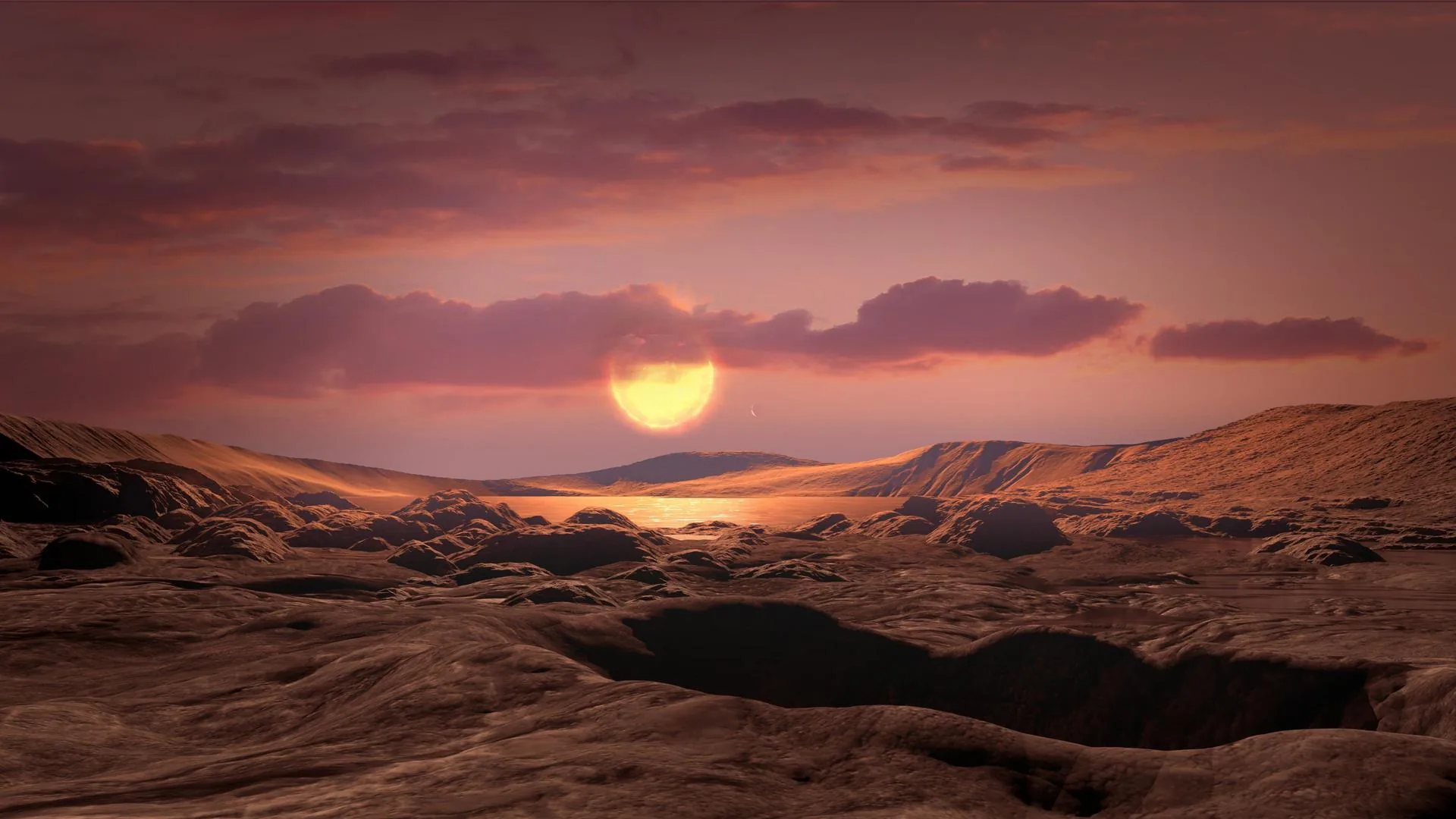
Forty light-years is, by cosmic standards, right next door. And in that neighboring stretch of space, orbiting a dim red star in the constellation Aquarius, lies what may be the most promising world we have yet found in our search for habitable planets beyond our own. TRAPPIST-1e has captivated astronomers since its discovery, and thanks to the James Webb Space Telescope, we are finally beginning to learn whether this distant rocky world lives up to its extraordinary promise.
A System That Stunned the World
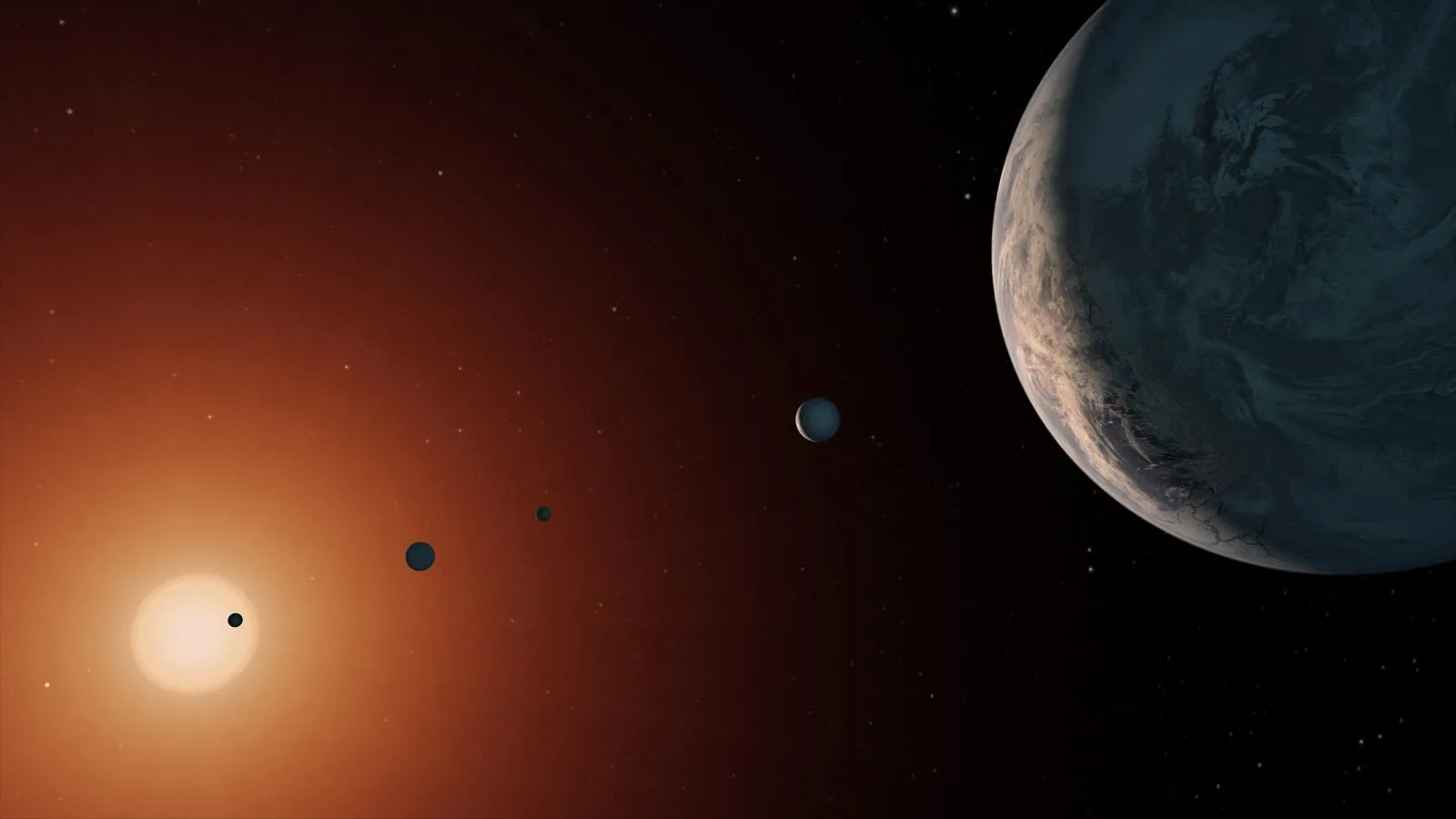
When the TRAPPIST-1 system was announced in 2017, it was unlike anything we had seen before: seven Earth-sized, rocky planets orbiting a single ultracool dwarf star, with three of them -- planets d, e, and f -- sitting within or near the star's habitable zone. The star itself is tiny, just slightly larger than Jupiter, and radiates most of its energy in the infrared. The planets orbit remarkably close to it, with TRAPPIST-1e completing a full orbit in just 6.1 Earth days.
What makes this system so scientifically precious is the combination of proximity (40 light-years away), the Earth-like sizes of the planets, and the fact that they regularly transit their star from our vantage point. That last detail is crucial. Every time a TRAPPIST-1 planet passes in front of its star, a sliver of starlight filters through whatever atmosphere the planet may possess. By analyzing which wavelengths of light are absorbed, astronomers can determine the chemical composition of that atmosphere -- a technique called transmission spectroscopy.
The TRAPPIST-1 system was always going to be one of JWST's highest-priority targets. And in 2023 and 2024, those observations began delivering results that are reshaping our understanding of rocky exoplanets.
JWST Turns Its Gaze on TRAPPIST-1
The first TRAPPIST-1 planet to receive detailed JWST scrutiny was TRAPPIST-1b, the innermost world. Results published in 2023 from thermal emission observations using JWST's MIRI instrument indicated that TRAPPIST-1b likely has little to no atmosphere. The planet's dayside temperature was consistent with a bare rock surface directly absorbing and re-radiating stellar energy, with minimal heat redistribution -- a strong sign that no substantial atmosphere is present to circulate warmth.
TRAPPIST-1c, the second planet, told a similar story. MIRI observations published in mid-2023 showed that TRAPPIST-1c also appears to lack a thick atmosphere, at least ruling out a dense carbon dioxide atmosphere like that of Venus. This was a sobering finding, but not entirely unexpected. Both planets orbit extremely close to their star and are subject to intense ultraviolet and X-ray radiation that could strip away lighter atmospheric gases over billions of years.
These results set the stage for the planets that matter most for habitability: TRAPPIST-1d, e, and f, which orbit farther out in the zone where liquid water could potentially persist on the surface.
TRAPPIST-1e: The Crown Jewel
TRAPPIST-1e remains the standout candidate in the system, and arguably one of the most compelling potentially habitable worlds known anywhere. Here is what makes it special:
Size and density. TRAPPIST-1e is remarkably Earth-like in its physical properties. It has approximately 0.92 Earth radii and about 0.69 Earth masses, giving it a density consistent with a rocky, iron-core composition very similar to our own planet. Of all known exoplanets, few match Earth's bulk properties as closely as TRAPPIST-1e does.
Habitable zone location. The planet receives about 60% of the stellar flux that Earth receives from the Sun, placing it squarely within the conservative habitable zone of its star. Surface temperatures could, in principle, allow liquid water if a suitable atmosphere is present.
Potential for an atmosphere. Unlike its inner siblings, TRAPPIST-1e orbits far enough from the star that atmospheric retention becomes more plausible. The reduced stellar radiation at its orbital distance means that atmospheric stripping processes are less severe, and models suggest that a planet of TRAPPIST-1e's mass could potentially hold onto a secondary atmosphere -- one generated by volcanic outgassing, for example -- even around an active M-dwarf star.
As of early 2025, direct atmospheric characterization of TRAPPIST-1e with JWST is still underway. Transmission spectroscopy observations require multiple transits to build up sufficient signal, and the atmospheric signatures of a true Earth-like atmosphere (thin, nitrogen-dominated) are extremely subtle. The JWST teams studying this system have been methodical, accumulating transit data across multiple observation cycles. Preliminary indications have not yet produced a definitive atmospheric detection for TRAPPIST-1e, but nor have they ruled one out -- and that ambiguity itself is noteworthy, because it means we cannot yet say the atmosphere has been stripped away as it was for the inner planets.
What We Are Learning About Rocky Exoplanet Atmospheres
The TRAPPIST-1 observations are part of a broader revolution in our understanding of rocky exoplanet atmospheres, and the emerging picture is more nuanced than many had hoped.
One key lesson from 2023-2024 is that atmospheres on rocky planets orbiting M-dwarf stars are not guaranteed. The intense stellar activity of these small, cool stars -- frequent flares, strong stellar winds, and sustained high-energy radiation -- can erode planetary atmospheres over time. The results from TRAPPIST-1b and 1c, along with similar findings for other rocky worlds like GJ 486b and LHS 3844b, suggest that many rocky planets in close orbits around M-dwarfs may indeed be airless.
But this does not close the book. Atmospheric retention depends on many factors: planetary mass, magnetic field strength, volcanic activity, orbital distance, and the history of stellar activity. Larger rocky planets, planets with strong magnetic fields, or planets that orbit farther from their star may fare better. TRAPPIST-1e checks several of these boxes.
Furthermore, JWST observations have shown that even when atmospheres are present, characterizing them is extraordinarily challenging. The signals are small -- we are talking about changes of tens of parts per million in the starlight during a transit. Stellar contamination, where features on the star's surface mimic or obscure atmospheric signals, has emerged as a significant complication. TRAPPIST-1 is an active star with starspots, and disentangling the planet's atmospheric signal from the star's own variability requires careful, repeated observations and sophisticated modeling.
Revised Habitability Assessments
The cumulative JWST findings have prompted a recalibration of how we assess habitability around M-dwarf stars. Some researchers now argue that the habitable zone for these stars should be narrower than previously assumed, accounting for the atmospheric erosion effects observed on the inner TRAPPIST-1 planets. Others point out that the outer habitable zone planets have not yet been ruled out and that we should be patient.
What has become clear is that "habitable zone" is a necessary but far from sufficient condition. A planet needs the right size, the right composition, the right orbital distance, the right stellar environment, and the right geological history to maintain the conditions for liquid water and, potentially, life. TRAPPIST-1e appears to satisfy many of these criteria on paper. The question is whether reality matches the models.
Climate modeling studies conducted in 2024 continue to suggest that TRAPPIST-1e could maintain habitable surface conditions under a range of atmospheric scenarios, including thin atmospheres with modest greenhouse warming. The tidal locking of the planet -- one hemisphere permanently facing the star, the other in permanent darkness -- creates unique atmospheric dynamics, but models show that even moderate atmospheres can transport heat from the dayside to the nightside effectively enough to prevent atmospheric collapse.
The Road Ahead
TRAPPIST-1e represents a defining test case for the question of whether Earth-sized, rocky planets can retain atmospheres and sustain habitable conditions around the most common type of star in our galaxy. M-dwarfs make up roughly 70% of all stars in the Milky Way. If planets like TRAPPIST-1e can be habitable, the implications for the frequency of life in the universe are enormous.
JWST will continue observing the TRAPPIST-1 system through its upcoming observation cycles. Each additional transit of TRAPPIST-1e builds the signal needed to either detect or definitively rule out an atmosphere. Ground-based extremely large telescopes, currently under construction in Chile and Hawaii, will provide complementary data in the late 2020s with even greater spectroscopic precision.
We are at the edge of an answer -- not yet there, but closer than humanity has ever been. Forty light-years away, a small rocky world orbits a dim red star, and we are straining every instrument we have to learn its secrets. Whether TRAPPIST-1e turns out to be a barren rock or a world wrapped in a thin, protective veil of atmosphere, what we learn will fundamentally shape our understanding of where life can take root in the cosmos. That is worth every photon of light we can collect.