α Orionis
Betelgeuse
The Red Giant of Orion · Red supergiant semi-regular variable
At a glance
- Distance
- 497.9 ly
- Constellation
- Orion
- Type
- M1-2Ia-Iab
- Apparent magnitude
- 0.45
- Mass
- 16 M☉
- Luminosity
- 126,000 L☉
- Surface temp
- 3,600 K
- Age
- 0.009 billion yrs
The story
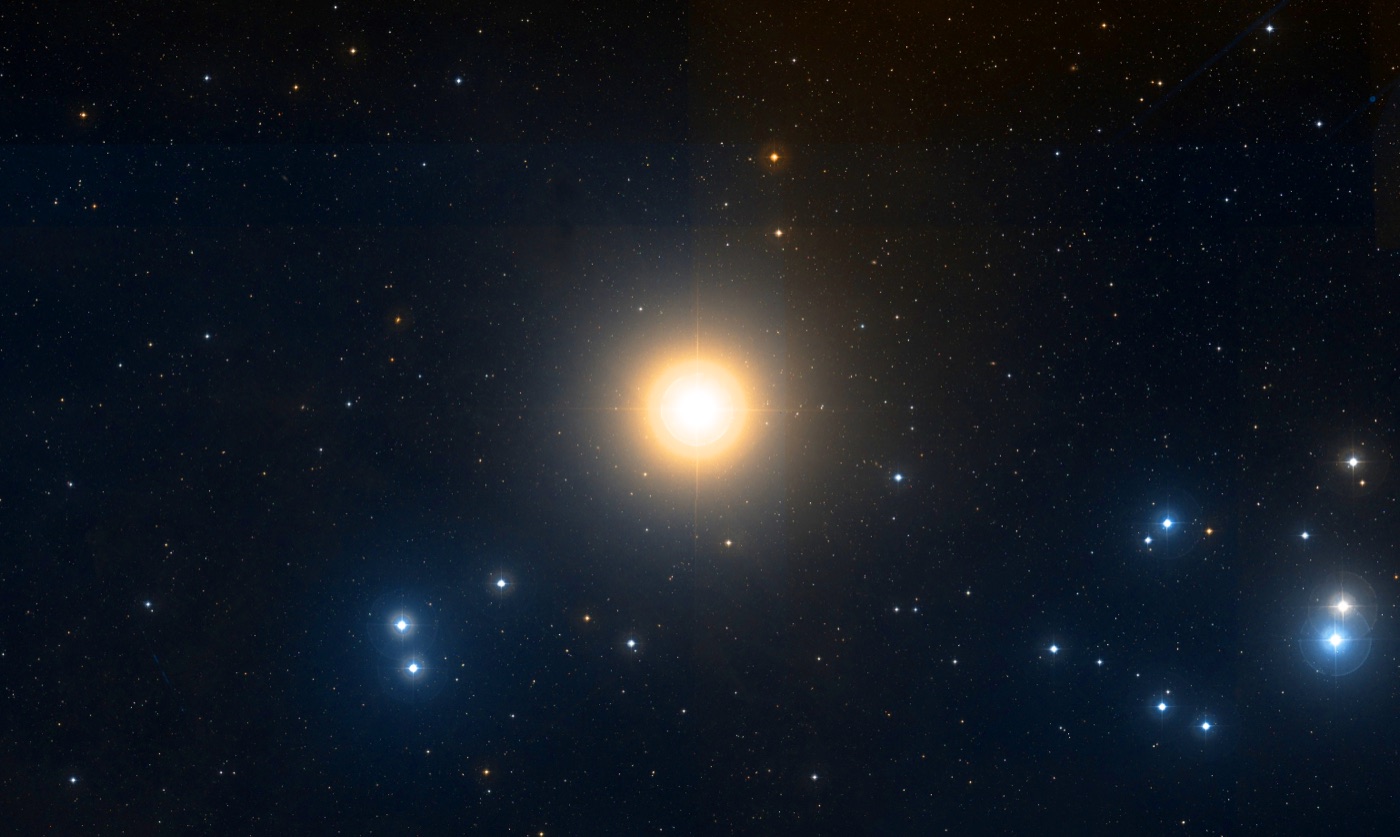
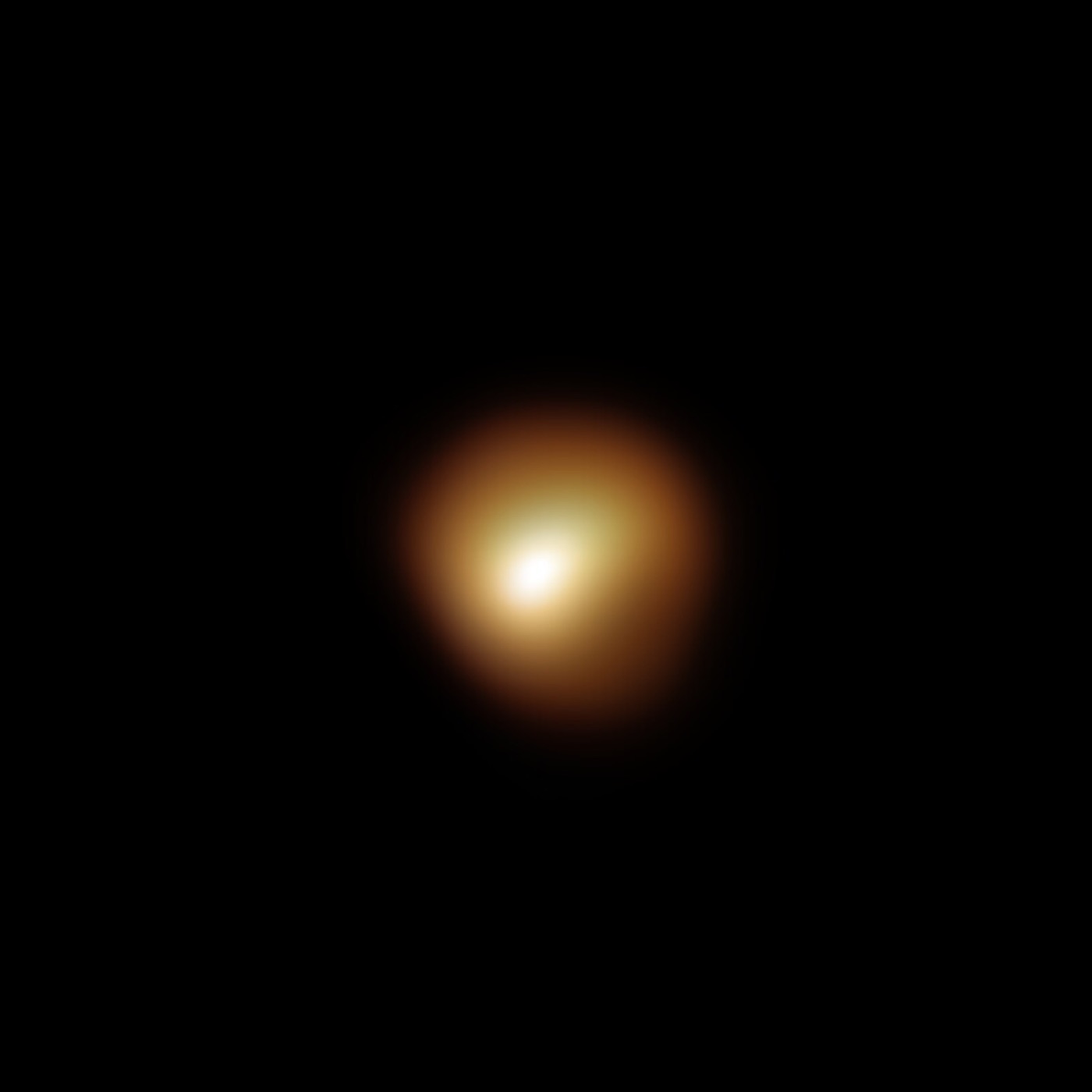
Betelgeuse glows rust-orange at Orion's left shoulder — one of the most recognisable stars in the winter sky. Its apparent magnitude fluctuates between about 0.0 and 1.3, and a dramatic dimming in late 2019 briefly sent the internet into supernova watch. Follow-up VLT/SPHERE imaging revealed the culprit: a plume of ejected gas that cooled into dust, temporarily veiling the star's southern hemisphere.
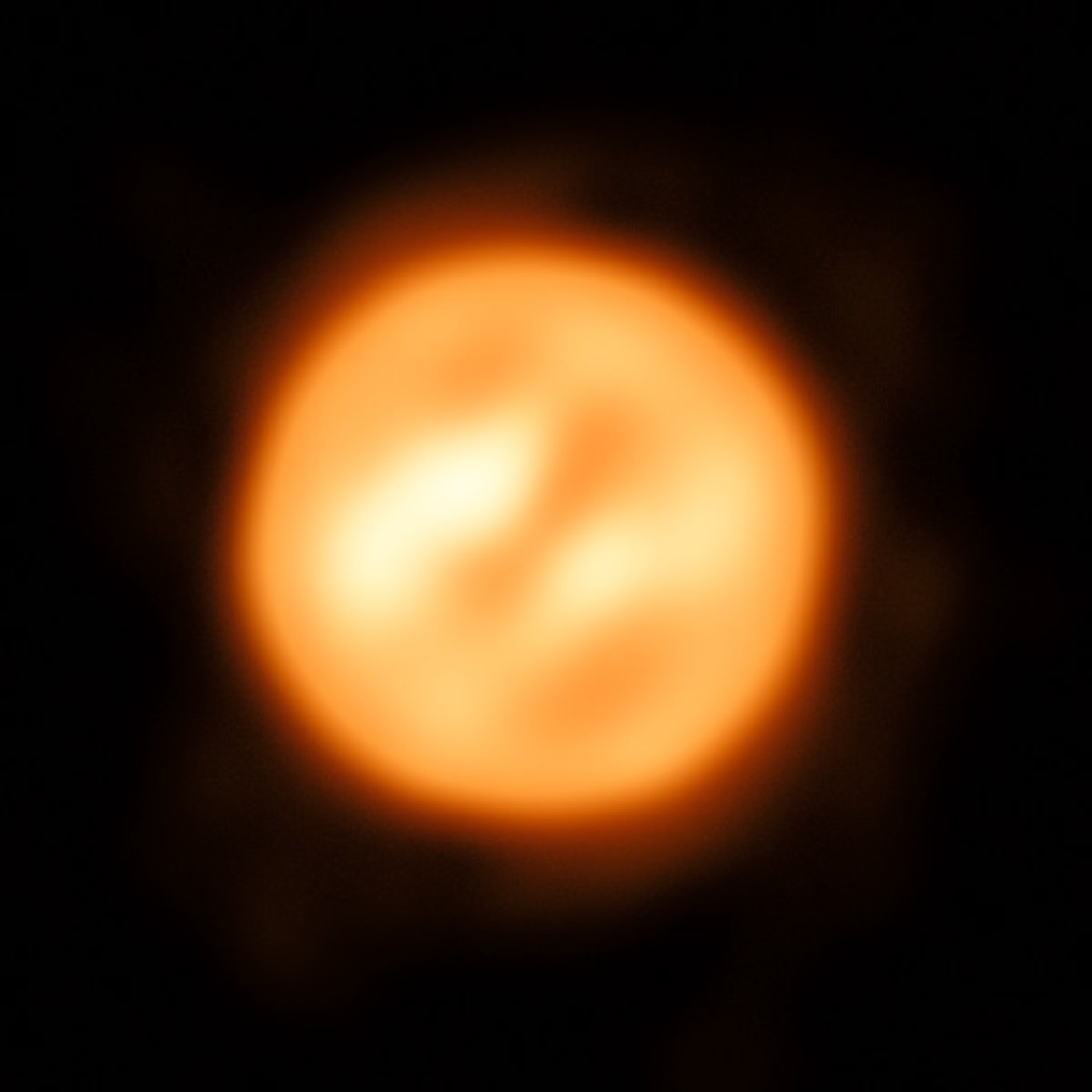
This red supergiant spans roughly 900–1,200 times the Sun's diameter — placed at our solar system's centre its surface would swallow every planet out to at least Jupiter. Combined evolutionary, asteroseismic, and hydrodynamical modelling (Joyce et al. 2020; updated 2023 studies) converge on a current mass of roughly 16–20 M☉, after the star has shed enormous quantities of material throughout its brief ~8–10 million-year life. VLTI interferometry has directly resolved its disk and tracked convective plumes crawling across its surface.
Ancient observers recorded Betelgeuse by name in Arabic as Ibt al-Jauzā' — 'the armpit of the central one'. In Chinese astronomy it was one of the Three Stars mansions. Modern cultures from Polynesia to the Inca incorporated this conspicuous red point into navigation and seasonal calendars. Its possible unseen companion, hinted at in decades of radial-velocity data and recently glimpsed in early direct imaging, could reshape our understanding of how massive stars evolve.
Its fate
Betelgeuse is near the end of its life — estimates suggest it will explode as a core-collapse supernova within roughly 100,000 years, briefly outshining the crescent Moon and visible in daylight. The resulting remnant will be a neutron star or black hole, and the expanding nebula will enrich the surrounding interstellar medium with heavy elements.
Find it in the sky
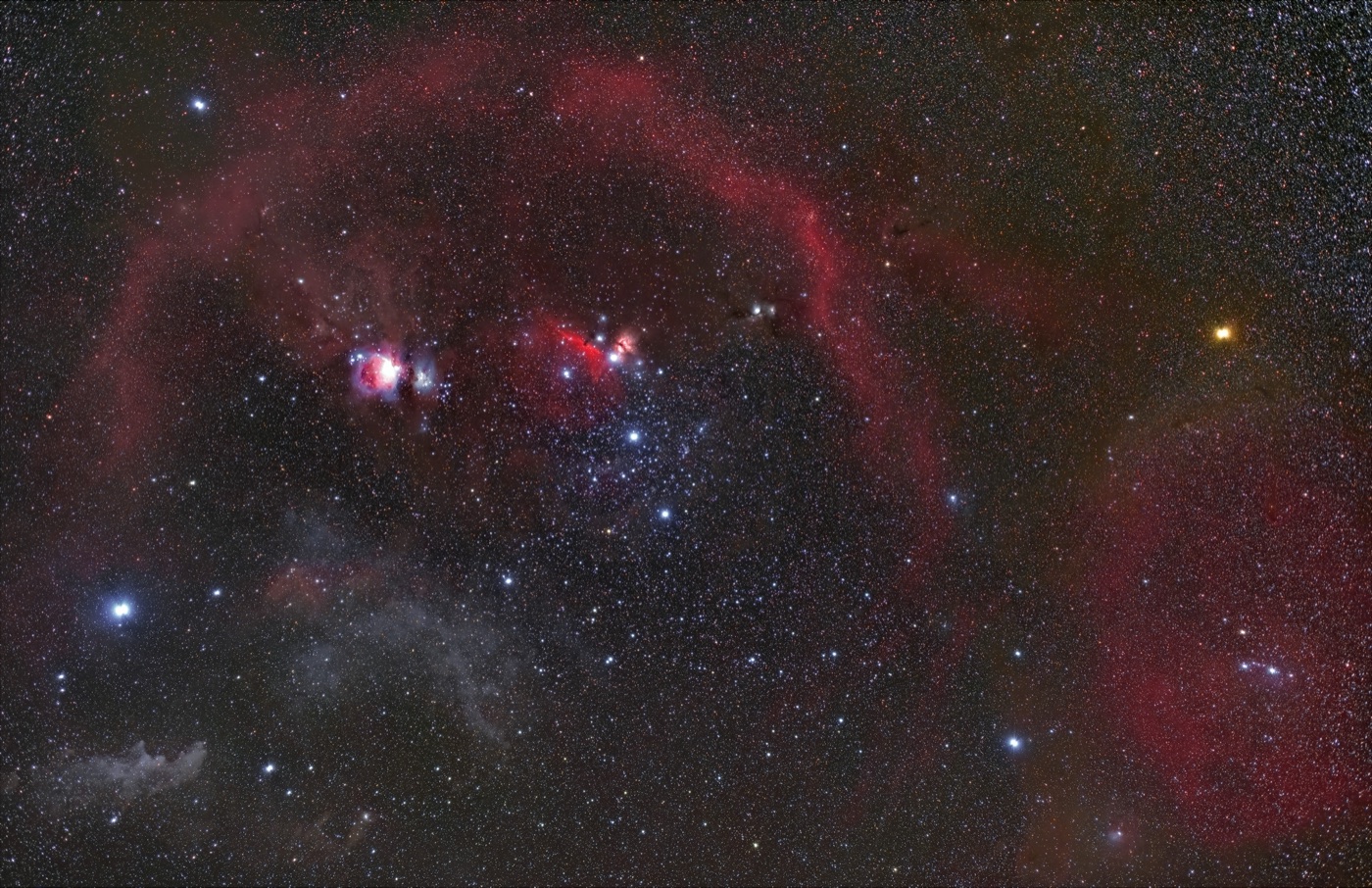
Betelgeuse is unmistakable: the ruddy star at Orion's upper-left shoulder, visible worldwide from late autumn through early spring (northern hemisphere). Follow Orion's Belt upward to the left to reach it. Its colour contrast with blue-white Rigel at the opposite corner of Orion is striking even to the naked eye.