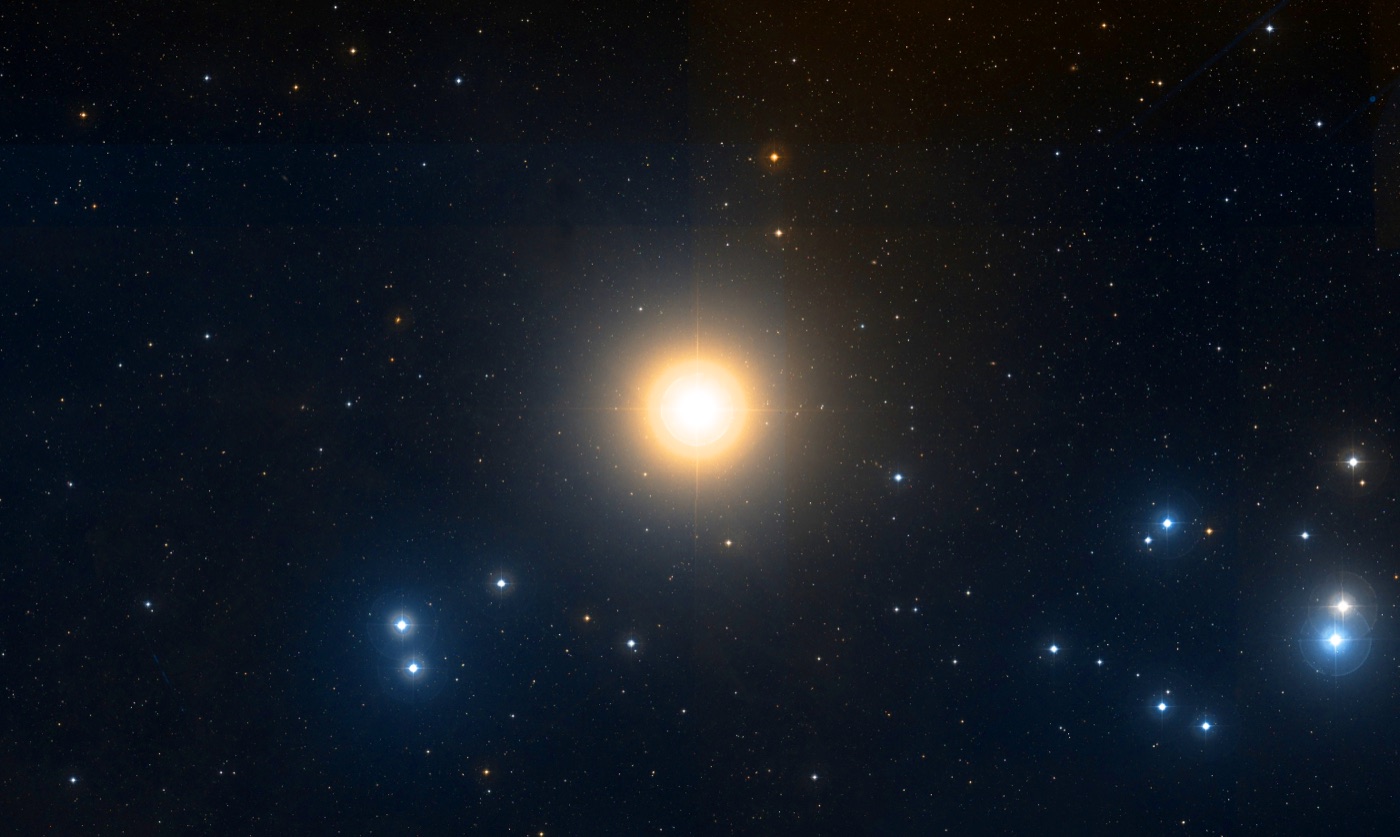
α Tauri
Aldebaran
The Eye of the Bull · Orange giant variable
At a glance
- Distance
- 66.6 ly
- Constellation
- Taurus
- Type
- K5III
- Apparent magnitude
- 0.87
- Mass
- 1.7 M☉
- Radius
- 44.2 R☉
- Luminosity
- 518 L☉
- Surface temp
- 4,010 K
The story
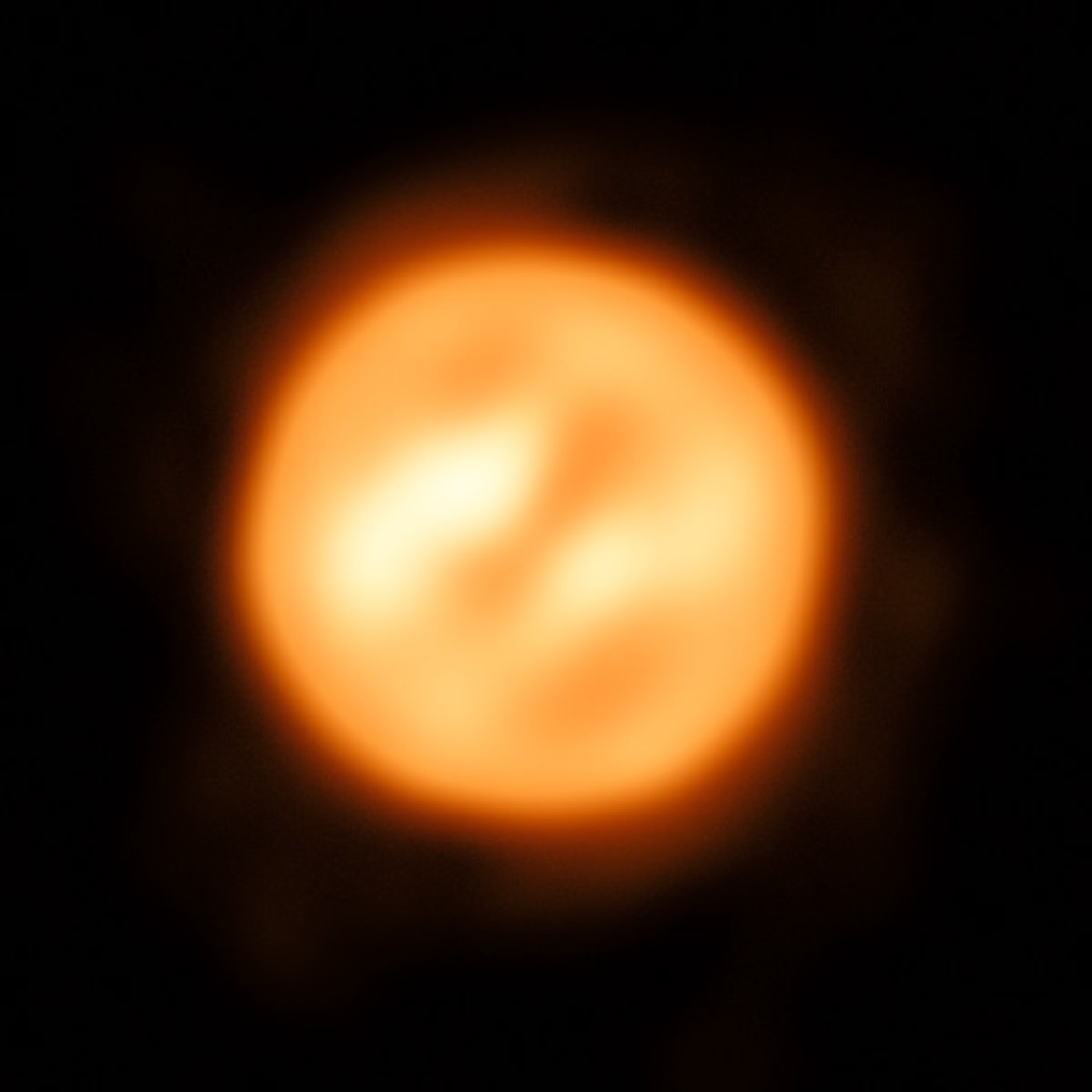
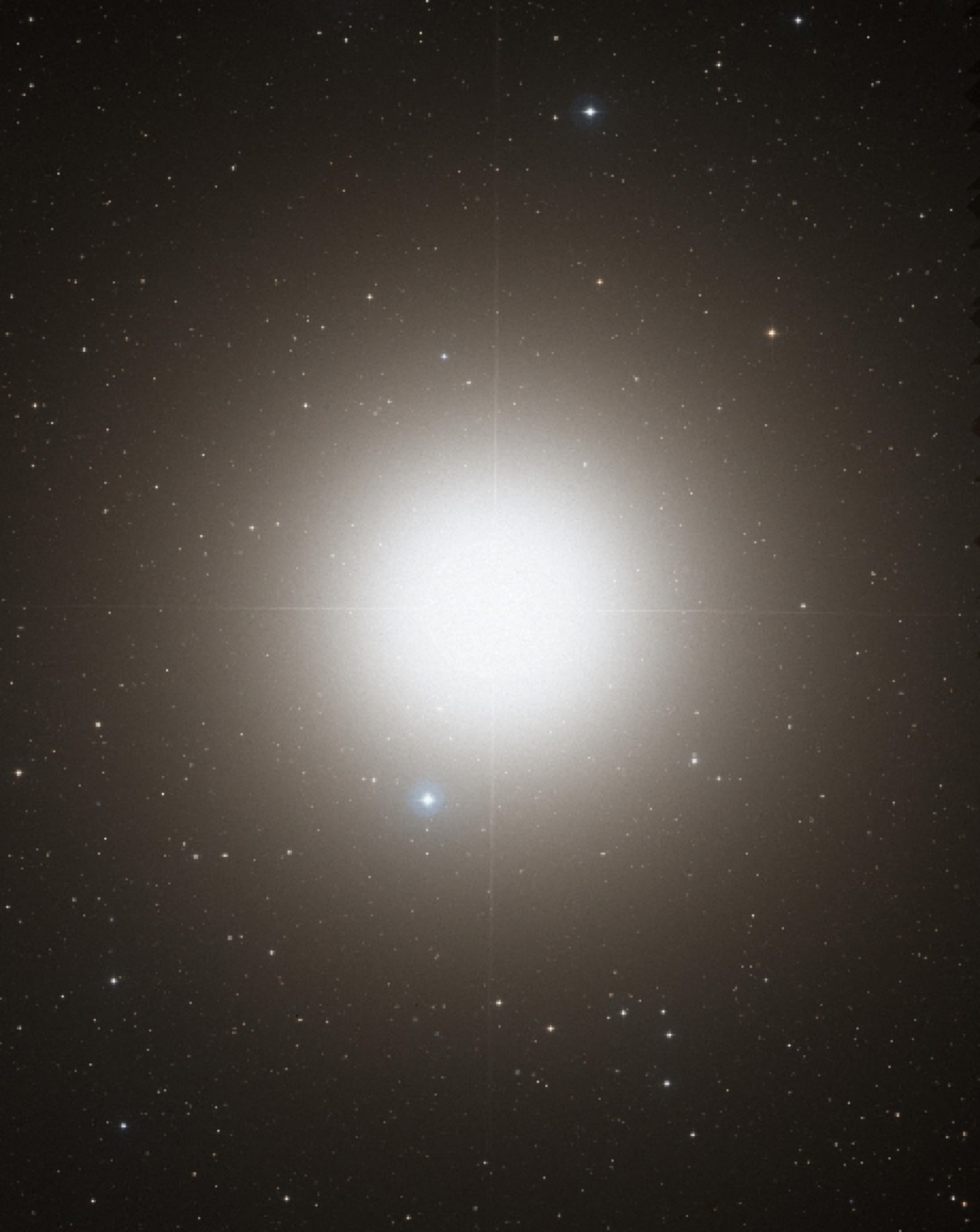
Aldebaran glows a warm orange-red at the eye of Taurus the Bull, magnitude 0.87, making it the fourteenth-brightest star in the sky. It lies 66.6 light-years away and presents an apparent disk large enough that VLTI interferometry has mapped the motions of carbon-monoxide gas in its atmosphere. Its very name comes from Arabic al-dabarān, 'the follower', because it follows the Pleiades across the sky.
After burning through its core hydrogen, Aldebaran has expanded to 44 times the diameter of the Sun — large enough to swallow all of the inner planets were it placed at the Sun's position. Although it sits in the same line of sight as the Hyades star cluster, Aldebaran is not a member: the Hyades lie about 150 light-years away while Aldebaran is only 66 light-years distant. It has one confirmed exoplanet candidate, Aldebaran b (also designated α Tau b), a super-Jupiter in a 629-day orbit, though some studies question its planetary nature.
Pioneer 10 and 11, launched in 1972–1973, are travelling roughly in the direction of Aldebaran and will make their closest approach — still a vast gulf — in about two million years. The star has been used since antiquity as a seasonal marker; it was one of the four 'royal stars' of Persia alongside Regulus, Antares, and Fomalhaut, appointed to guard the four cardinal directions of the sky.
Compared to the Sun
Sun
This star · 44.2× radius
It shines about 518 times as bright as the Sun.
Its fate
Aldebaran has already exhausted its core hydrogen and is fusing hydrogen in a shell. On stellar timescales it will continue to expand as an asymptotic giant branch star, eventually expelling its outer layers as a planetary nebula and leaving behind a white dwarf roughly half the Sun's mass.
Find it in the sky
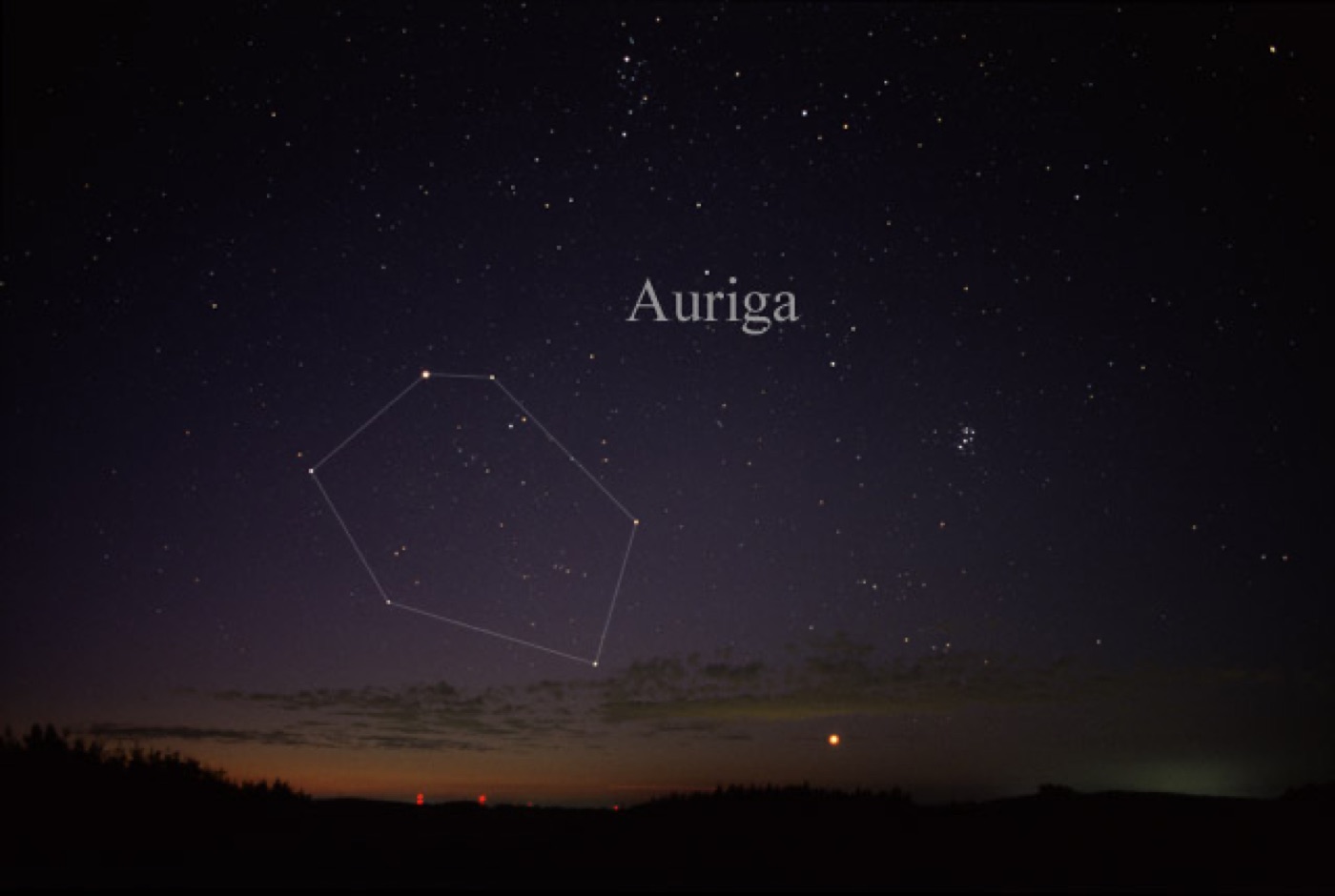
Aldebaran is easy to locate: follow Orion's Belt to the upper right (or in the southern hemisphere, upper left) until you meet the bright orange star in the V-shaped Hyades. It is well placed for viewing in the northern sky from October through February, and the Moon regularly occults it, providing dramatic sightings through binoculars.