3D printing in space — also called in-space additive manufacturing — has been operational on the International Space Station since 2014, when Made In Space (now Redwire) installed the first microgravity FDM printer. Today the technology spans three frontiers: Redwire's ISS printers fabricating tools and parts on demand, Relativity Space 3D-printing 85% of its Terran R rocket structures on Earth, and ICON's NASA-funded Project Olympus developing autonomous lunar-regolith construction systems for Moon bases. This article covers the active programs, the launch-cost economics ($10,000+ per kg to LEO) driving the shift, and the timeline for orbital factories and printed lunar habitats.
The ISS: Where Space Manufacturing Began
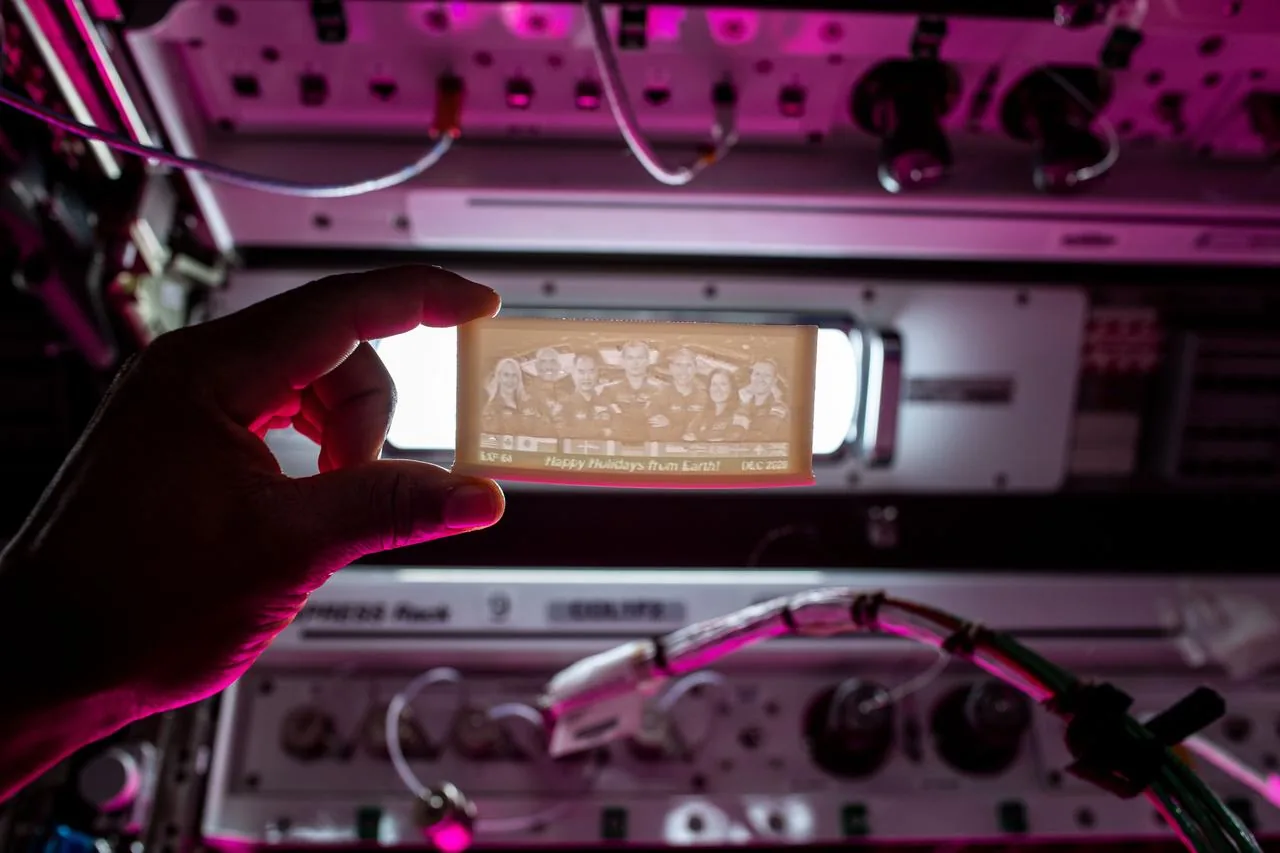
The International Space Station has been the proving ground for 3D printing in space since 2014, when Made In Space (now Redwire) installed the first 3D printer in microgravity. That initial printer was a fused deposition modeling (FDM) system -- essentially the same technology as consumer desktop 3D printers, adapted for the unique challenges of the space environment.
The first object printed in space was a replacement part for the printer itself -- a faceplate for the extruder head. It was a small, simple object, but it represented something profound: the first time a manufacturing tool had been used to fabricate a functional part off Earth. Since then, the ISS has hosted increasingly capable printers that have produced tools, medical devices, radiation shields, and experimental components.
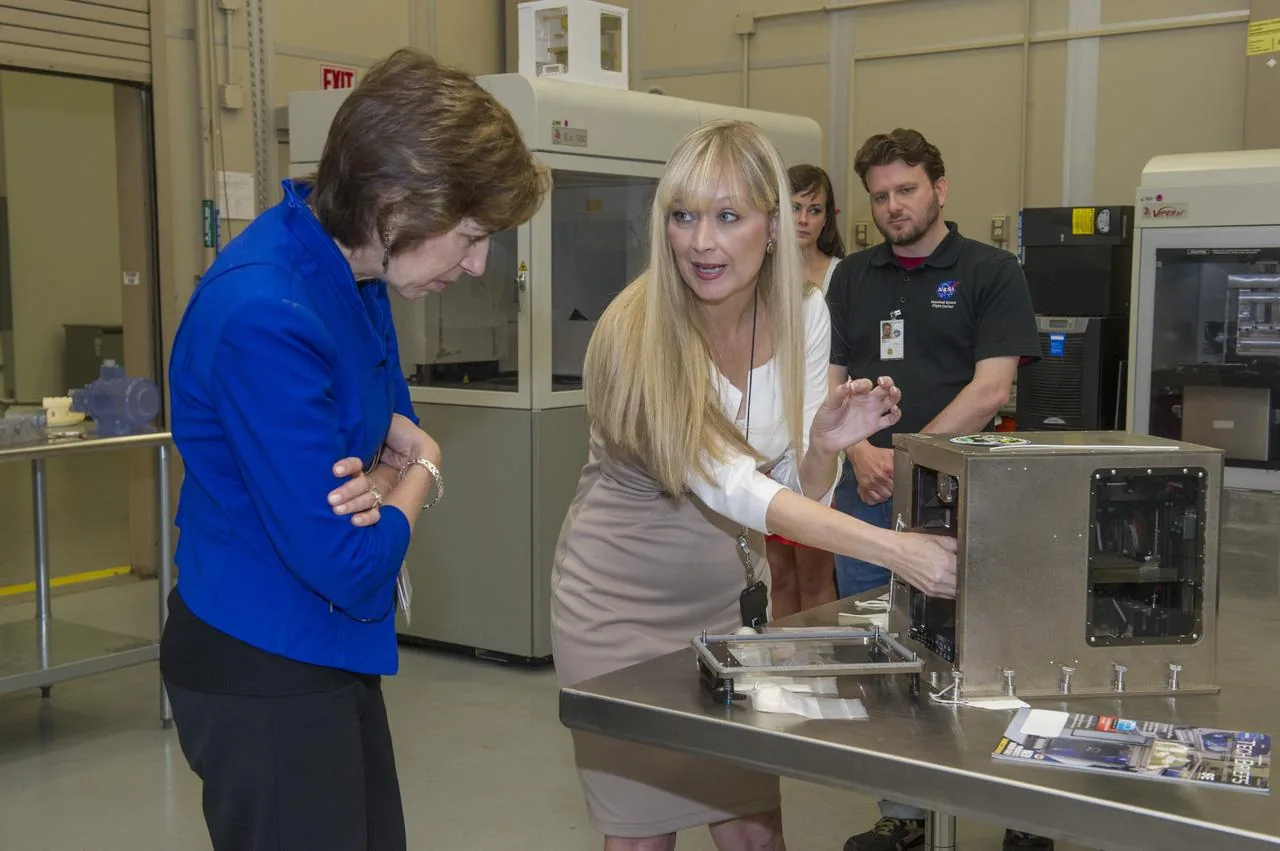
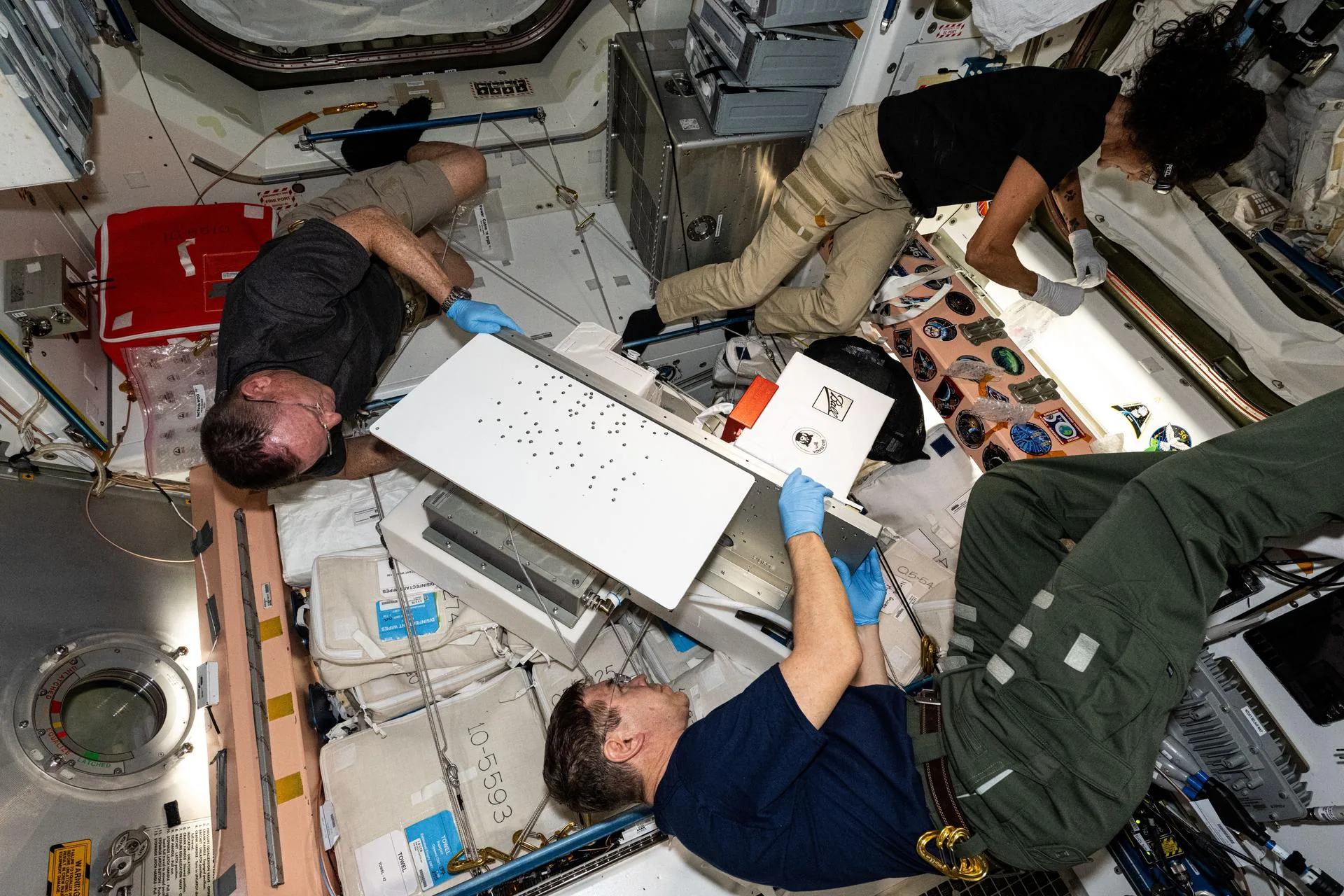
The Additive Manufacturing Facility (AMF), also built by Redwire, has been operating on the station since 2016 and can print in multiple materials, including engineered polymers with enhanced strength and temperature resistance. Astronauts have used it to print custom tools and experiment hardware, avoiding the weeks or months of delay that would be required to send a replacement part from Earth.
But the most intriguing ISS experiments involve printing materials that are actually better when made in microgravity. ZBLAN optical fiber, for example, is a fluoride glass that can transmit light with far lower losses than conventional silica fiber -- but only if it is manufactured in an environment free of the gravity-driven crystallization defects that plague terrestrial production. Several companies, including Flawless Photonics and FOMS (Fiber Optic Manufacturing in Space), have conducted experiments on the ISS demonstrating that microgravity-produced ZBLAN fiber is dramatically superior to its Earth-made counterpart. If this can be scaled up, it could become one of the first commercially viable products manufactured in space and sold on Earth.
Relativity Space: Printing the Entire Rocket
If 3D printing small parts on the ISS is a proof of concept, Relativity Space is the proof of ambition. The Long Beach, California-based company set out to 3D-print an entire rocket, and they have come remarkably close to that goal.
Relativity's approach centers on its Stargate printer, one of the largest metal 3D printers in the world. Stargate uses wire-fed directed energy deposition -- robotic arms feed metal wire into a melt pool created by electric arcs or lasers, building up structures layer by layer. The system can produce large-scale rocket components -- tanks, engine chambers, structural elements -- with dramatically fewer individual parts than traditionally manufactured rockets.
The company's first vehicle, Terran 1, made history in March 2023 as the first 3D-printed rocket to attempt an orbital launch. While the mission did not reach orbit (the upper stage experienced an anomaly), the first stage -- which was approximately 85% 3D-printed by mass -- performed nominally. The flight demonstrated that large-scale additively manufactured structures could withstand the extreme loads and vibrations of launch.
Relativity has since shifted its focus to Terran R, a much larger, fully reusable rocket designed to compete with Falcon 9. Terran R is being designed as the largest 3D-printed rocket ever built, with even more of its structure produced through additive manufacturing. The company's thesis is that 3D printing radically reduces the parts count (from tens of thousands to hundreds), shortens the manufacturing timeline, and enables rapid design iteration -- you can update the design in software and print a new version without retooling a factory.
The reduction in parts count is not just an efficiency gain; it is a reliability gain. Fewer parts means fewer joints, fewer welds, fewer potential failure points. Every interface between two components is a place where something can go wrong, and 3D printing eliminates many of those interfaces entirely.
Lunar Regolith Printing: Building with Moon Dirt
The most transformative application of 3D printing in space may be using local materials to build structures on the Moon. Lunar regolith -- the layer of loose, fragmented rock and dust covering the Moon's surface -- is an abundant construction material if you can figure out how to work with it.
Several approaches are under development. One method uses concentrated solar energy or lasers to sinter or melt regolith into solid building blocks. Another mixes regolith with a binding agent (similar to how concrete uses cement to bind aggregate) and extrudes it through a large-scale 3D printer. A third approach, being explored by ESA and others, uses microwave sintering to fuse regolith particles into dense ceramic-like structures.
The appeal is obvious: instead of launching millions of kilograms of building materials from Earth at enormous cost, you use what is already there. Lunar regolith is available in essentially unlimited quantities, and initial studies suggest it can be processed into materials with sufficient strength for habitat walls, landing pads, roads, and radiation shielding.
Radiation shielding is particularly important. The Moon has no atmosphere and no magnetic field, so the surface is exposed to the full force of solar particle events and galactic cosmic radiation. A regolith-printed structure with walls several meters thick could reduce radiation exposure to safe levels for long-duration habitation -- something that would be prohibitively expensive to achieve with launched materials.
The European Space Agency has been actively researching regolith-based construction through its partnership with architecture firm Foster + Partners and various research institutions. Prototype structures have been printed on Earth using simulated lunar regolith, demonstrating the feasibility of the approach. The next step is robotic demonstration missions on the lunar surface itself.
ICON's Project Olympus: From Austin to the Moon
ICON, the Austin, Texas-based construction technology company that pioneered large-scale 3D-printed homes on Earth, has set its sights on something considerably more ambitious: building structures on the Moon. Project Olympus, developed in partnership with NASA, aims to create a construction system capable of printing habitats, landing pads, and other infrastructure on the lunar surface using processed regolith.
ICON's terrestrial experience is directly relevant. The company has printed full-scale houses, barracks for the U.S. military, and community housing developments using its Vulcan printer system, which extrudes a specialized concrete mixture called Lavacrete. The houses are structurally sound, weather-resistant, and can be printed in days rather than the months required for conventional construction.
Adapting this technology for the Moon requires solving several additional problems. The printer must operate autonomously (or with minimal teleoperation from Earth), in vacuum, in extreme temperatures, and in one-sixth gravity. The "ink" must be derived from local regolith rather than specially formulated concrete. And the structures must provide radiation shielding, thermal insulation, and micrometeorite protection.
NASA awarded ICON a contract under the Artemis program to develop the lunar construction system, recognizing that sustainable human presence on the Moon will require the ability to build infrastructure in place rather than launching it from Earth. The timeline is ambitious -- ICON aims to demonstrate the technology within the decade -- but the terrestrial track record gives confidence that the fundamental approach is sound.
The Advantages of In-Space Manufacturing
Beyond the obvious benefit of reducing launch mass, 3D printing in space offers several advantages that are less immediately intuitive.
Design freedom. Components manufactured in space do not need to survive the violence of launch. They can be designed for their operational environment alone, without the structural margins required to withstand launch loads and vibrations. This means lighter, more efficient structures optimized for their actual purpose.
On-demand production. Instead of predicting every possible failure mode and launching a comprehensive set of spare parts, crews can carry raw material and print what they need when they need it. This is a paradigm shift for mission planning -- it transforms the supply chain from a rigid, pre-planned inventory to a flexible, responsive manufacturing capability.
Structures impossible to build on Earth. Microgravity enables the fabrication of geometries that would collapse under their own weight on Earth. Large, thin-walled structures, complex internal lattices, and other forms that are impossible or impractical in 1g become feasible in orbit. This could lead to entirely new categories of space hardware.
Reduced waste. Additive manufacturing builds objects by adding material only where it is needed, in contrast to subtractive manufacturing (machining), which starts with a block of material and removes everything that is not the final part. In a resource-constrained environment like space, this efficiency matters enormously.
The Road Ahead
3D printing in space is still in its early chapters. The ISS experiments have proven that the technology works in microgravity. Relativity Space has demonstrated that you can print a rocket and fly it. Regolith-based construction research has shown that building with lunar materials is feasible. ICON's Project Olympus is translating terrestrial 3D printing expertise into lunar construction capability.
The next decade will bring flight demonstrations of lunar surface printing, expanded in-orbit manufacturing capabilities on commercial space stations, and continued maturation of large-scale metal printing for rocket production. The long-term vision is a space economy where most of what we need in space is made in space -- using local resources, local energy, and manufacturing systems that we designed on Earth but operate autonomously off it.
It is a future that is being built, quite literally, one layer at a time.