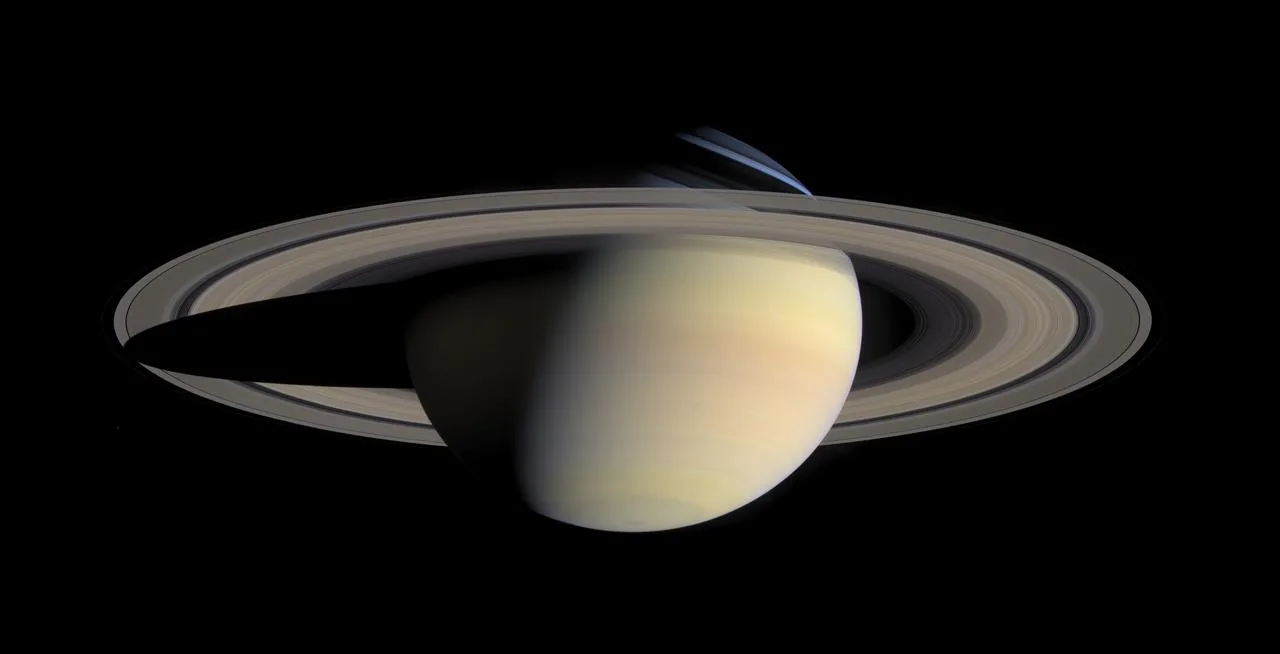
Sometimes the most extraordinary discoveries come from the most unassuming places. Enceladus is a tiny moon, just 504 kilometers across, small enough to fit comfortably inside the borders of France. Before the Cassini spacecraft arrived at Saturn in 2004, it was considered an interesting but unremarkable ball of ice. Twenty years later, Enceladus stands alongside Europa as one of the two most promising places to search for extraterrestrial life in our solar system. Its story is a reminder that the universe hides its greatest secrets in unexpected corners.
The Cassini Revelation
Cassini's first close flyby of Enceladus in February 2005 was not originally designed to study the moon in detail. It was, in a sense, a routine pass during the spacecraft's grand tour of the Saturn system. But the data that came back stopped scientists in their tracks.
The spacecraft's magnetometer detected something strange: Saturn's magnetic field was being distorted near Enceladus in a way that suggested the moon was producing a significant amount of ionized gas. Something was actively venting material into space from this tiny, supposedly geologically dead world.
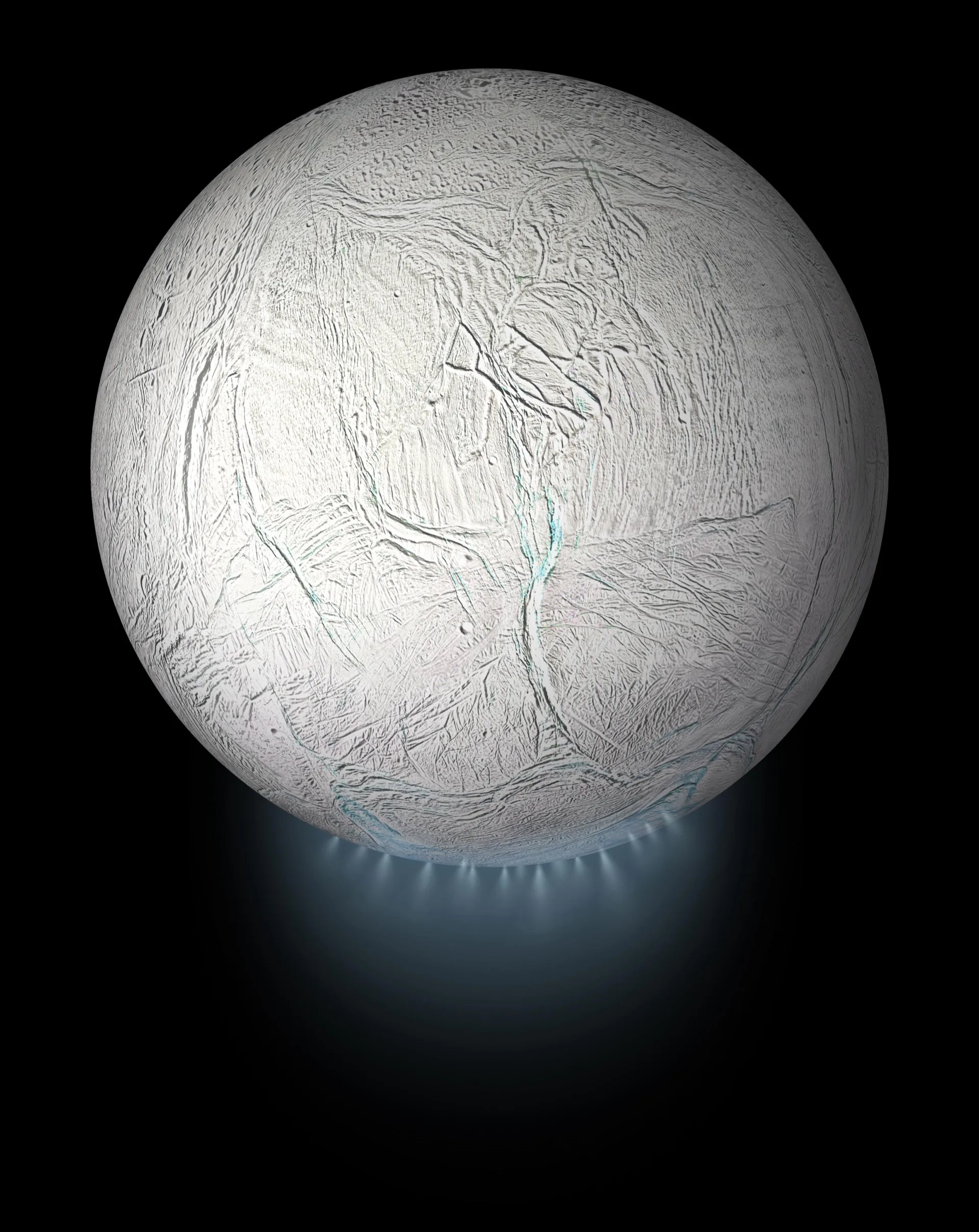
Subsequent flybys confirmed the discovery beyond any doubt. Cassini's cameras captured one of the most stunning images in the history of space exploration: brilliant jets of water ice and vapor erupting from fractures near Enceladus's south pole, backlit by the distant Sun, spraying material hundreds of kilometers into space. These fractures, nicknamed "tiger stripes," are roughly 130 kilometers long and spaced about 35 kilometers apart, and they are warm, far warmer than the surrounding ice, indicating a subsurface heat source.
The plumes of Enceladus are not a minor curiosity. They are so voluminous that the ejected material forms Saturn's E ring, one of the planet's outermost rings. This tiny moon is literally feeding a planetary ring with material from its interior.
An Ocean Revealed
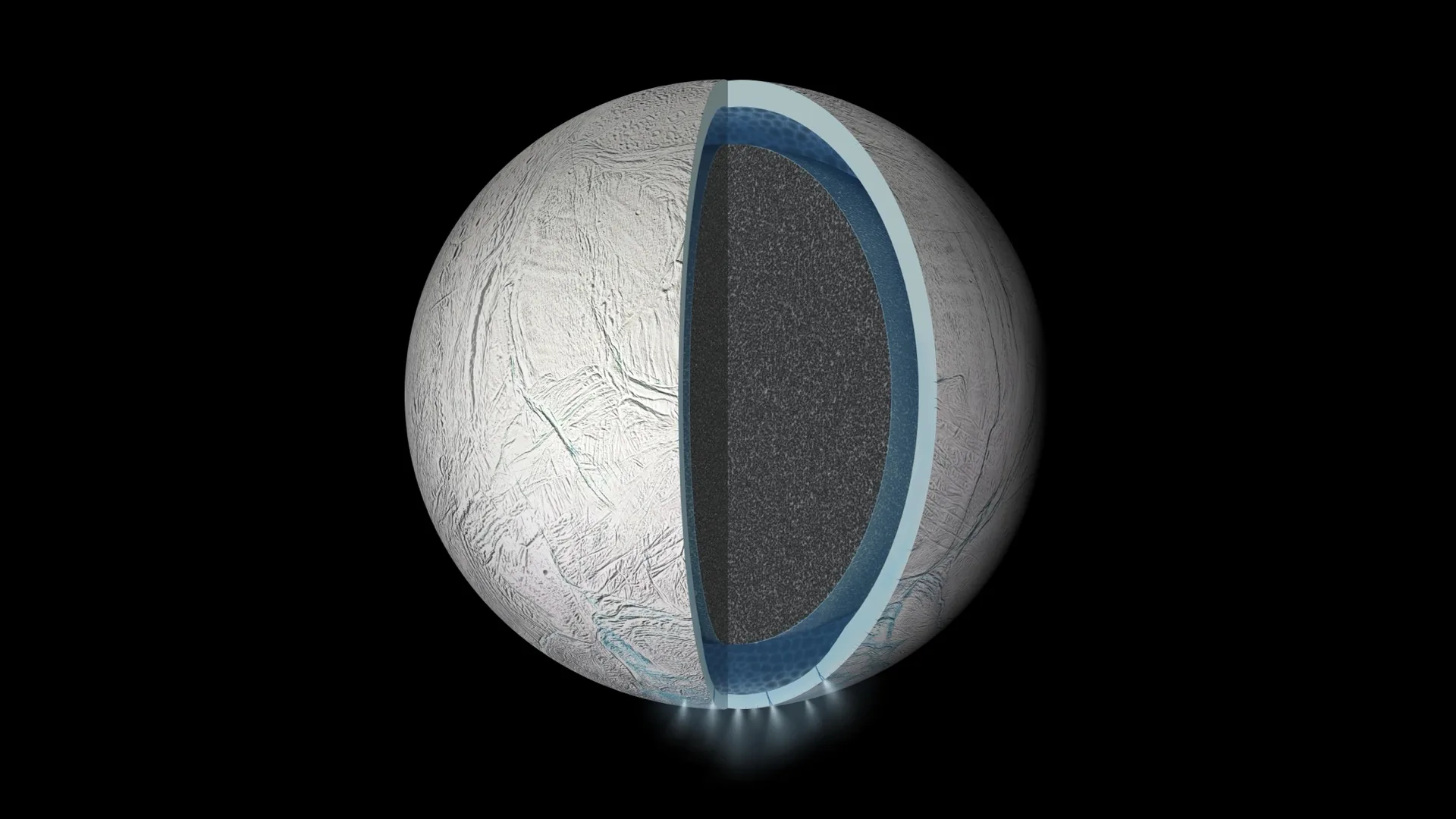
The plumes raised an immediate question: where is the water coming from? Over years of flybys and measurements, the answer emerged. Enceladus has a global subsurface ocean of liquid water, sandwiched between the rocky core and the icy outer shell.
The evidence came from multiple lines of investigation. Gravity measurements revealed that Enceladus's interior mass distribution was inconsistent with a solid ice body; a layer of liquid water about 26 to 31 kilometers deep was needed to explain the data. Measurements of the moon's slight wobble (called libration) as it orbits Saturn showed that the icy shell is not rigidly connected to the rocky core, confirming that a liquid ocean decouples them. The ice shell is estimated to be only about 1 to 5 kilometers thick at the south pole, which explains why the plumes can punch through.
The heat source driving all of this is tidal dissipation. Enceladus's orbit around Saturn is slightly elliptical, maintained by a gravitational resonance with the neighboring moon Dione. As Enceladus moves closer to and farther from Saturn on each orbit, tidal forces flex its interior, generating frictional heat. This heat is concentrated at the south pole by mechanisms that are still being studied, but the result is clear: enough energy to maintain a liquid ocean and power geological activity on a moon that should, by all rights, be a frozen snowball.
What Is in the Water?
Cassini was not designed to search for life on Enceladus. It was designed before anyone knew the plumes existed. But in a stroke of extraordinary luck, the spacecraft was able to fly directly through the plume material and analyze it with its onboard instruments. What it found was remarkable.
The plumes contain water vapor, water ice, salts (sodium chloride and sodium bicarbonate, essentially salty soda water), and a suite of organic molecules, including both simple compounds like methane and more complex molecules with masses up to roughly 200 atomic mass units. The salt content indicates that the ocean water has been in prolonged contact with a rocky core, dissolving minerals over geological time.
In 2015, Cassini's Cosmic Dust Analyzer detected nanoscale silica particles in the plume material. On Earth, silica nanoparticles of this specific size form in one known environment: hydrothermal vents, where hot water interacts with rock at temperatures above about 90 degrees Celsius. This was strong circumstantial evidence that Enceladus has active hydrothermal systems on its ocean floor.
Then, in 2017, Cassini's mass spectrometer detected molecular hydrogen (H2) in the plumes. On Earth, molecular hydrogen is produced in significant quantities by serpentinization, a chemical reaction between water and iron-rich minerals in ocean-floor rock at hydrothermal vents. This reaction is a key energy source for chemosynthetic microorganisms that form the base of deep-sea vent ecosystems on Earth, life that exists entirely without sunlight.
The implication was staggering. Enceladus appears to have everything that hydrothermal vent ecosystems on Earth require: liquid water, a rocky seafloor, chemical energy from water-rock reactions, and organic molecules. The pieces for habitability were falling into place one by one.
Phosphorus: The Final Piece
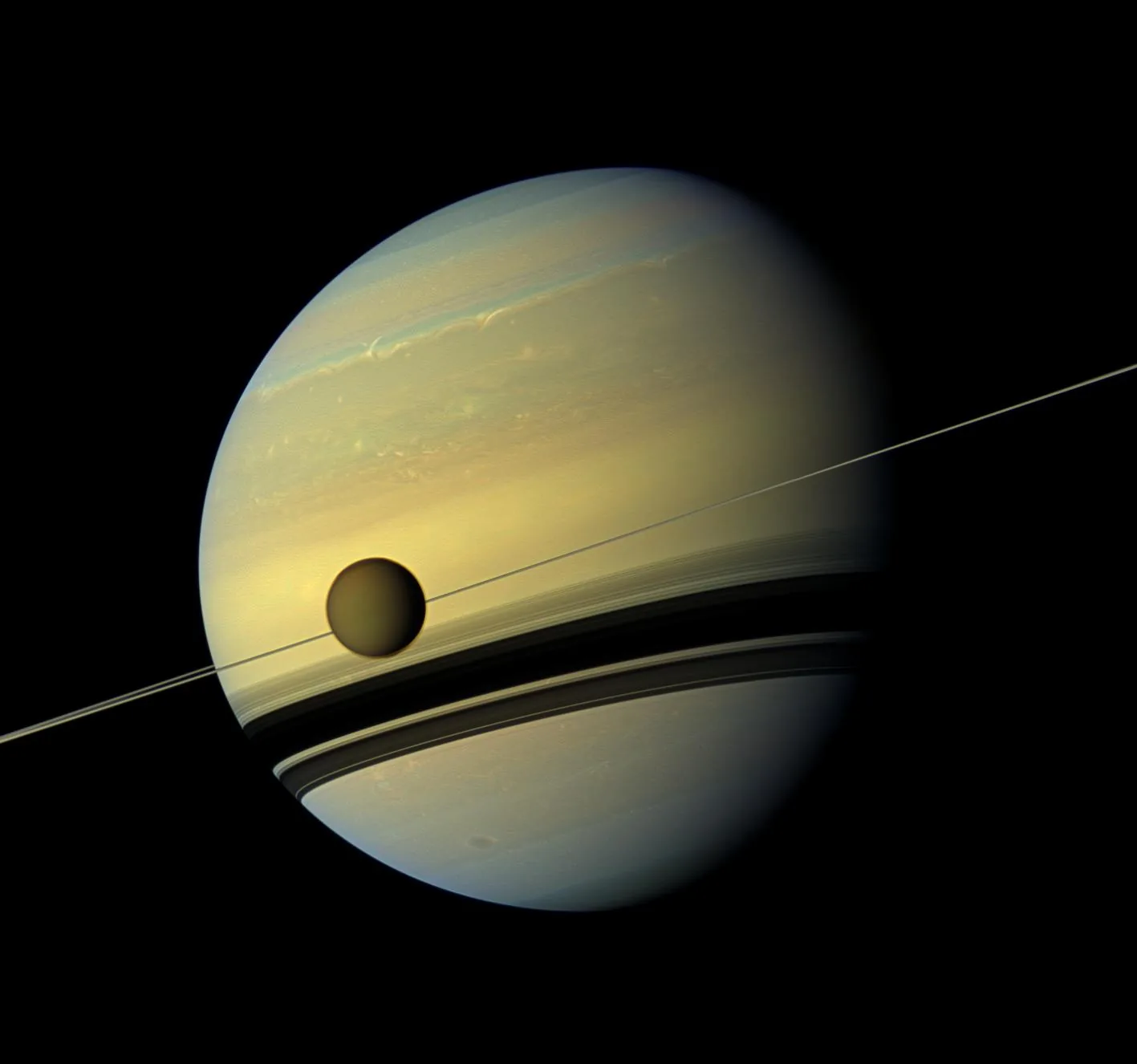
For years, there was one notable gap in the habitability argument for Enceladus. Life as we know it requires six key elements: carbon, hydrogen, nitrogen, oxygen, phosphorus, and sulfur (CHNOPS). Cassini had found evidence for all of them except phosphorus. And phosphorus is critical; it forms the backbone of DNA and RNA and is essential for cellular energy metabolism (ATP).
In 2023, that gap was closed. A team led by Frank Postberg at the Free University of Berlin reanalyzed Cassini data from Saturn's E ring (which is fed by Enceladus's plumes) and found clear signatures of sodium phosphates, phosphorus-bearing salts dissolved in the ocean water. The concentrations were at least 100 times higher than in Earth's oceans.
This discovery was a watershed moment. All six elements essential for life had now been detected in a single extraterrestrial ocean. The geochemical modeling suggested that Enceladus's ocean chemistry, specifically the interaction between carbonate-rich water and the rocky core, naturally produces elevated phosphorus levels. Enceladus was not just potentially habitable in an abstract sense; it had the complete chemical toolkit.
Hydrothermal Vents: The Deep-Sea Analog
To understand why Enceladus excites astrobiologists so deeply, consider what we have learned about life in Earth's deep oceans. In 1977, scientists exploring the Galapagos Rift in the submarine Alvin discovered thriving ecosystems around hydrothermal vents at the bottom of the ocean, in complete darkness, at crushing pressures, in water heated to hundreds of degrees Celsius.
These ecosystems are powered not by sunlight but by chemical energy. Microorganisms called chemolithoautotrophs harvest energy from the chemical reactions between vent fluids and seawater, particularly the oxidation of hydrogen, hydrogen sulfide, and methane. These microbes form the base of a food web that includes tube worms, shrimp, crabs, and fish, all thriving in conditions that were once considered impossible for life.
If similar hydrothermal systems exist on Enceladus's ocean floor, and the evidence strongly suggests they do, then the same type of chemosynthetic life could theoretically exist. The conditions are not identical to Earth's vents (Enceladus's ocean is likely cooler overall, and the specific chemistry differs in detail), but the fundamental principle of using chemical energy from water-rock reactions to power metabolism applies.
It is worth emphasizing that "could theoretically exist" is very different from "does exist." The presence of habitable conditions does not guarantee that life has arisen. Life's origin is still poorly understood, and we do not know how common or rare it is for chemistry to make the leap to biology. But Enceladus has met every prerequisite we know to check.
Future Mission Concepts
The scientific community is eager to go back to Enceladus with instruments specifically designed to search for signs of life. Several mission concepts have been proposed.
The most developed is the Enceladus Orbilander, a flagship-class mission concept studied by the Johns Hopkins Applied Physics Laboratory. As its name suggests, it would first orbit Enceladus, mapping the surface and flying through the plumes with advanced mass spectrometers and other instruments far more sensitive than Cassini's. After the orbital phase, it would land near the south pole, directly in the zone where plume material falls back to the surface, and analyze fresh ocean material that has been deposited on the ice.
The Orbilander would carry life-detection instruments, including mass spectrometers capable of identifying amino acids and measuring their chirality (the molecular "handedness" that is a hallmark of biological origin), as well as microscopes and chemical analysis tools. It could determine whether Enceladus's ocean contains the complex organic chemistry associated with life, or perhaps even life itself.
Other concepts include simpler flythrough missions that would pass through the plumes at low velocity, collecting and analyzing material with state-of-the-art instruments. These would be less expensive than the Orbilander but would still represent a massive leap in capability over what Cassini could do.
The 2023 Planetary Science Decadal Survey, which sets priorities for NASA's planetary exploration program, identified Enceladus as a high-priority target and recommended that a dedicated Enceladus mission be studied for the coming decade. The scientific case is overwhelming; the question is one of budget and programmatic timing.
The Geysers of Hope
There is something poetic about the plumes of Enceladus. Here is a world that is actively offering us samples of its ocean, spraying them into space as if inviting us to come and take a closer look. We do not need to drill through kilometers of ice, as we would on Europa. We do not need to land on a hostile surface and deploy complex sampling machinery. We can fly through the plumes, scoop up ocean material, and analyze it.
This accessibility is what makes Enceladus such a compelling target. The ocean is literally coming to us. Every second, the tiger stripes vent about 200 kilograms of water vapor and ice into space, along with the salts, organic molecules, and dissolved gases that tell the story of what is happening in the ocean below.
If life exists in Enceladus's ocean, traces of it may already be in that plume material: fragments of organic molecules, cellular debris, or chemical signatures that are difficult to explain without biology. A mission with the right instruments, flying through the plumes at the right velocity, could potentially detect those traces.
The Question That Drives Us
Enceladus embodies the central question of astrobiology with an almost unfair clarity. We have a world with liquid water, chemical energy, all the essential elements, and organic molecules. We have an analog on Earth, deep-sea hydrothermal vents, where life thrives. We have a delivery mechanism, the plumes, that makes sampling feasible. The only thing missing is the answer.
Does chemistry become biology easily, given the right conditions? Or is the origin of life a staggeringly improbable event that happened once on Earth and perhaps never again? Enceladus might be able to tell us. A positive detection of life would mean that biology arises readily wherever conditions permit, and the universe would likely be teeming with it. A negative result, finding all the ingredients but no life, would be almost equally profound, suggesting that the origin of life requires something beyond mere chemistry, something rare and precious.
Either way, we need to go. The geysers are calling. The ocean is waiting. And this tiny moon, small enough to drive across in a few hours, may hold the answer to one of the biggest questions humanity has ever asked.