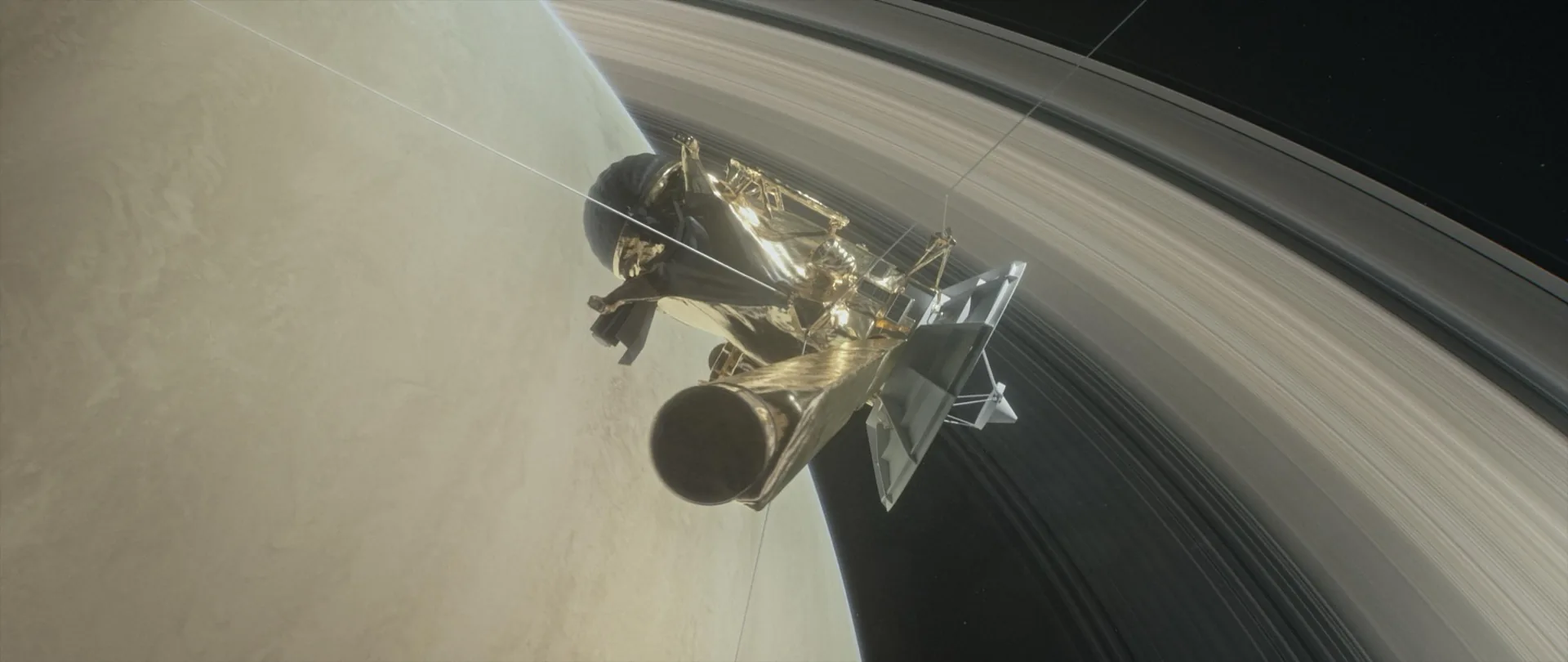
On September 15, 2017, a spacecraft the size of a school bus plunged into the atmosphere of Saturn at 76,000 miles per hour and burned to ash. It had been in space for nearly twenty years. It had traveled 4.9 billion miles. It had orbited Saturn 293 times, discovered new moons, revealed oceans hidden beneath icy crusts, and fundamentally rewritten our understanding of the outer solar system. The Cassini-Huygens mission was, by almost any measure, the greatest planetary exploration mission ever flown. And its deliberate destruction was its final, most poignant act of science.
A Mission Born in Ambition
Cassini-Huygens was a joint endeavor of NASA, the European Space Agency (ESA), and the Italian Space Agency (ASI). Named after Giovanni Cassini, the 17th-century astronomer who discovered four of Saturn's moons and the division in its rings that bears his name, and Christiaan Huygens, the Dutch scientist who discovered Titan, the mission was designed to be the definitive study of the Saturnian system.
The spacecraft consisted of two elements: the Cassini orbiter, built by NASA's Jet Propulsion Laboratory, and the Huygens probe, built by ESA, designed to parachute through the atmosphere of Titan and land on its surface. Together, they weighed 12,593 pounds fully fueled -- one of the largest and most complex interplanetary spacecraft ever built. Cassini carried twelve scientific instruments; Huygens carried six.
The mission launched on October 15, 1997, atop a Titan IVB/Centaur rocket from Cape Canaveral. But Saturn is so distant that even with one of the most powerful rockets available, Cassini could not fly there directly. Instead, it executed an intricate series of gravity assist maneuvers: two flybys of Venus (April 1998 and June 1999), one of Earth (August 1999), and one of Jupiter (December 2000). Each flyby stole a tiny fraction of the planet's orbital energy, adding speed to the spacecraft. The journey to Saturn took six years and 261 days.
Arrival at the Ringed World
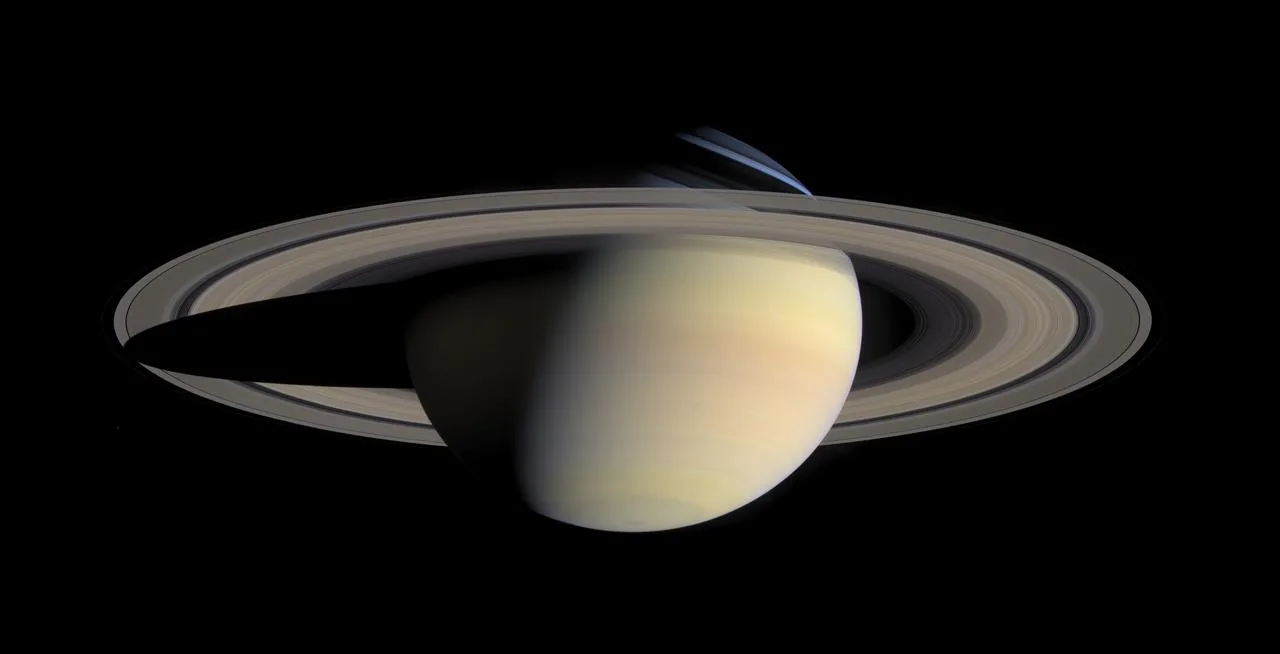
On July 1, 2004, Cassini fired its main engine for 96 minutes to slow down enough to be captured by Saturn's gravity. The orbital insertion burn was a nail-biting event -- the spacecraft was out of contact with Earth during the critical maneuver, passing through the gap between Saturn's F and G rings on the way in. When the signal was reacquired, mission controllers at JPL erupted in celebration.
The views that immediately followed were staggering. Saturn's rings, seen up close for the first time since the Voyager flybys of 1980 and 1981, revealed a complexity no one had anticipated. What appeared from Earth as a few broad bands resolved into thousands of individual ringlets, waves, gaps, and structures. The rings contained embedded moonlets -- tiny satellites just hundreds of meters across that created propeller-shaped disturbances in the ring material. Cassini's cameras revealed spokes, braids, and clumps that shifted and evolved, showing the rings to be a dynamic, living system rather than a static structure.
Huygens: Landing on Another World
On December 25, 2004 -- Christmas Day -- Cassini released the Huygens probe on a three-week coast toward Titan, Saturn's largest moon. Titan had long fascinated scientists because it is the only moon in the solar system with a thick atmosphere -- one and a half times the surface pressure of Earth's. Its opaque orange haze had prevented any previous spacecraft from seeing its surface.
On January 14, 2005, Huygens entered Titan's atmosphere at 12,400 miles per hour. Over the next two hours and 27 minutes, it descended by parachute through the smoggy sky, sampling the atmosphere and transmitting data and images the entire way. The probe's cameras revealed a landscape eerily reminiscent of Earth: drainage channels carved by flowing liquid, dark flat areas that appeared to be lakebeds, rounded pebbles that suggested fluvial erosion. But nothing was made of water. The liquid on Titan is methane and ethane; the "rocks" are made of water ice frozen as hard as granite in the minus-290-degree-Fahrenheit cold.
Huygens touched down on a relatively soft surface -- likely a thin crust over a damp substrate of hydrocarbon sludge -- and continued transmitting for 72 minutes after landing. It was the most distant landing ever achieved by a human-made spacecraft, and it remains so today. The images from Titan's surface showed a flat, pebble-strewn plain under an orange sky. It looked like a beach at sunset. On an alien moon. A billion miles from home.
Enceladus: An Ocean World
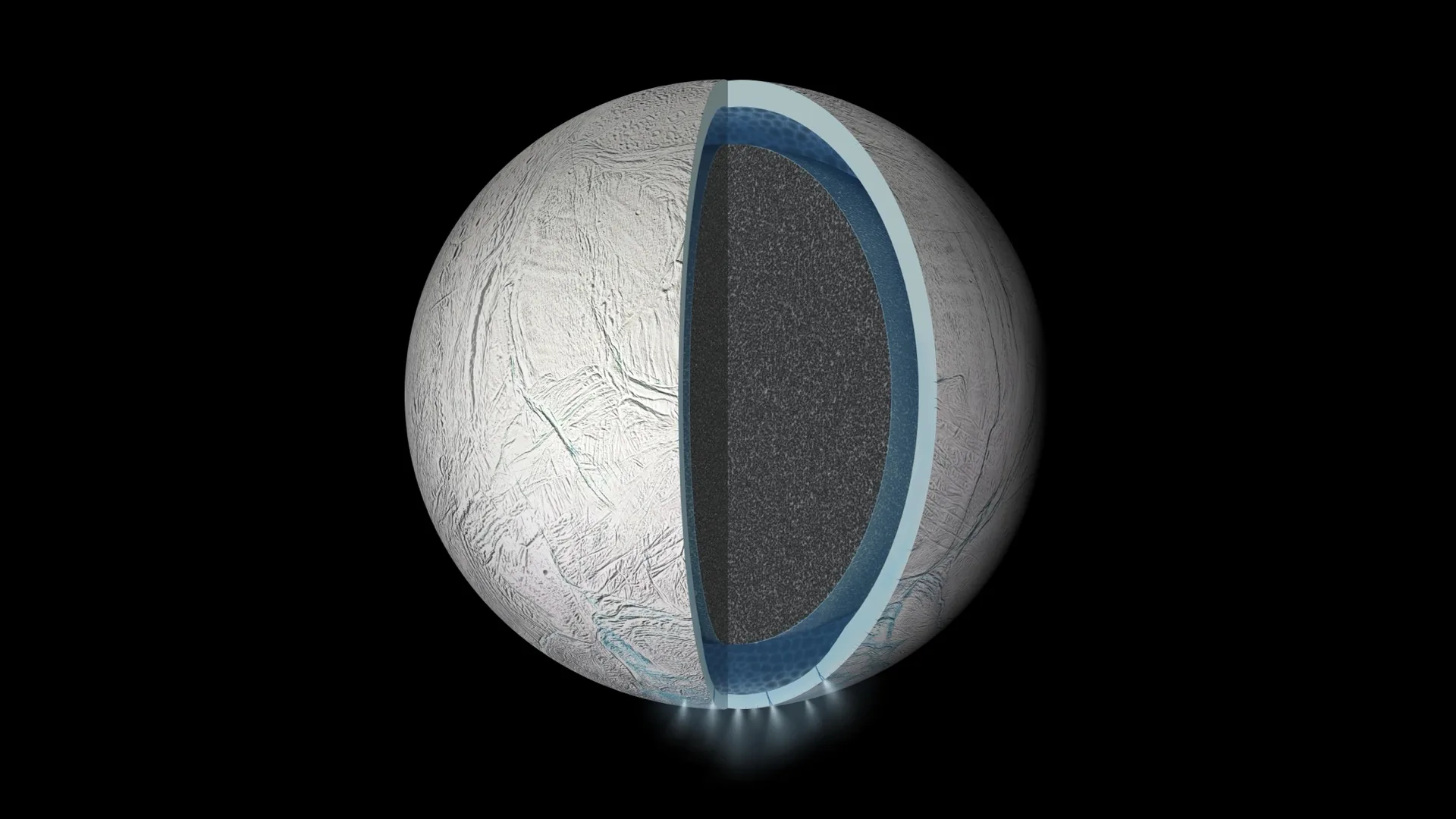
If Huygens' landing was the mission's most dramatic moment, the discovery at Enceladus was its most profound. Enceladus is a small moon, just 313 miles in diameter, entirely covered in brilliant white ice. It was expected to be a frozen, geologically dead world. It was anything but.
During a close flyby on July 14, 2005, Cassini's cameras captured something astonishing: towering plumes of water vapor and ice particles erupting from fissures near Enceladus' south pole. These "tiger stripe" fractures, four parallel cracks each roughly 80 miles long, were venting material from the moon's interior into space at speeds of up to 800 miles per hour. The plumes were so prolific that they were feeding Saturn's E ring.
Subsequent flybys revealed even more. Cassini flew directly through the plumes, and its instruments detected water, salts, silica nanoparticles, and organic molecules -- including molecular hydrogen, a potential chemical energy source for microbial life. The evidence pointed inexorably to one conclusion: beneath its icy shell, Enceladus harbors a global subsurface ocean of liquid water, kept warm by tidal heating from Saturn's gravity. The ocean is in contact with the moon's rocky core, creating hydrothermal conditions similar to those found at deep-sea vents on Earth -- places where life thrives in the absence of sunlight.
Enceladus went from an overlooked iceball to one of the most promising places to search for extraterrestrial life in the solar system. It was a discovery that no one predicted and that Cassini was not specifically designed to make. It happened because the mission was there, and the scientists were paying attention.
Thirteen Years of Discovery
Over its 13 years at Saturn, Cassini rewrote textbooks. It discovered seven new moons, bringing Saturn's total to 62 at the time (subsequent ground-based surveys have found more). It observed a massive storm on Saturn in 2010-2011 that encircled the entire planet -- a "Great White Spot" event that occurs roughly once every 30 Earth years. Its radar mapped the methane lakes and seas of Titan, revealing that Kraken Mare, Titan's largest sea, covers approximately 154,000 square miles -- larger than the Caspian Sea.
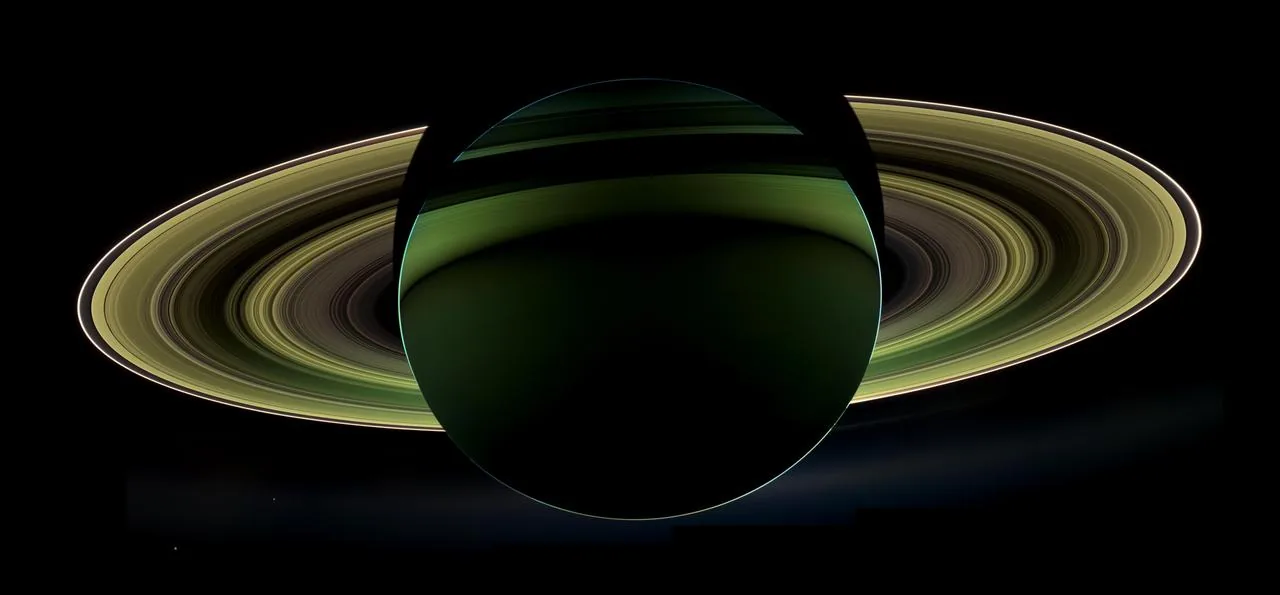
Cassini observed seasonal changes on Saturn and Titan as the system moved from northern winter toward northern summer. It captured a stunning natural-color mosaic of Saturn backlit by the Sun, with Earth visible as a pale blue dot beyond the rings -- an image deliberately evocative of Carl Sagan's famous reflection on the original "Pale Blue Dot" photograph taken by Voyager 1.
The spacecraft performed 127 close flybys of Titan, using the moon's gravity to reshape its orbit and access different regions of the Saturnian system. It flew past Enceladus 23 times, each pass bringing new data about the plumes and the ocean below.
The Grand Finale
By 2017, Cassini was running low on propellant. Rather than risk the spacecraft eventually losing control and crashing into Enceladus or Titan -- potentially contaminating those worlds with Earth microbes -- mission planners devised an audacious end: the Grand Finale.
Beginning in April 2017, Cassini executed 22 daring orbits that threaded the gap between Saturn's innermost ring and the planet's cloud tops -- a space only 1,200 miles wide that no spacecraft had ever entered. These final orbits produced the highest-resolution observations ever obtained of Saturn's rings and atmosphere. They revealed that the rings are remarkably young -- perhaps only 100 to 200 million years old, meaning they did not exist when dinosaurs roamed the Earth. They also measured Saturn's magnetic field and internal rotation rate with unprecedented precision.
On September 15, 2017, Cassini made its final plunge. The spacecraft entered Saturn's atmosphere at roughly 76,000 miles per hour, transmitting data to Earth until the very last second. The signal was lost at 7:55 a.m. EDT. At JPL, mission controllers, many of whom had spent their entire careers on the project, wept openly. Project manager Earl Maize called it "the end of an incredible, incredible mission."
A Legacy Still Growing
Even years after its destruction, Cassini's data continues to produce discoveries. The mission returned 635 gigabytes of science data, nearly half a million images, and enabled more than 4,000 scientific papers. Its findings about Enceladus and Titan have shaped the priorities of planetary science for decades to come. Future missions -- including NASA's Dragonfly rotorcraft, scheduled to arrive at Titan in the 2030s -- are direct descendants of Cassini's discoveries.
Cassini-Huygens was a monument to what international cooperation and long-term scientific commitment can achieve. It cost approximately $3.9 billion over its full lifecycle -- roughly $12 per American, or the price of a movie ticket, spread over two decades. In return, it revealed Saturn and its moons as a system of astonishing complexity and beauty, harboring environments where life might, just possibly, have found a foothold.
In the end, Cassini became part of the world it had spent thirteen years studying -- its atoms scattered through the atmosphere of the ringed planet. It was a fitting end. No museum could have been grand enough.