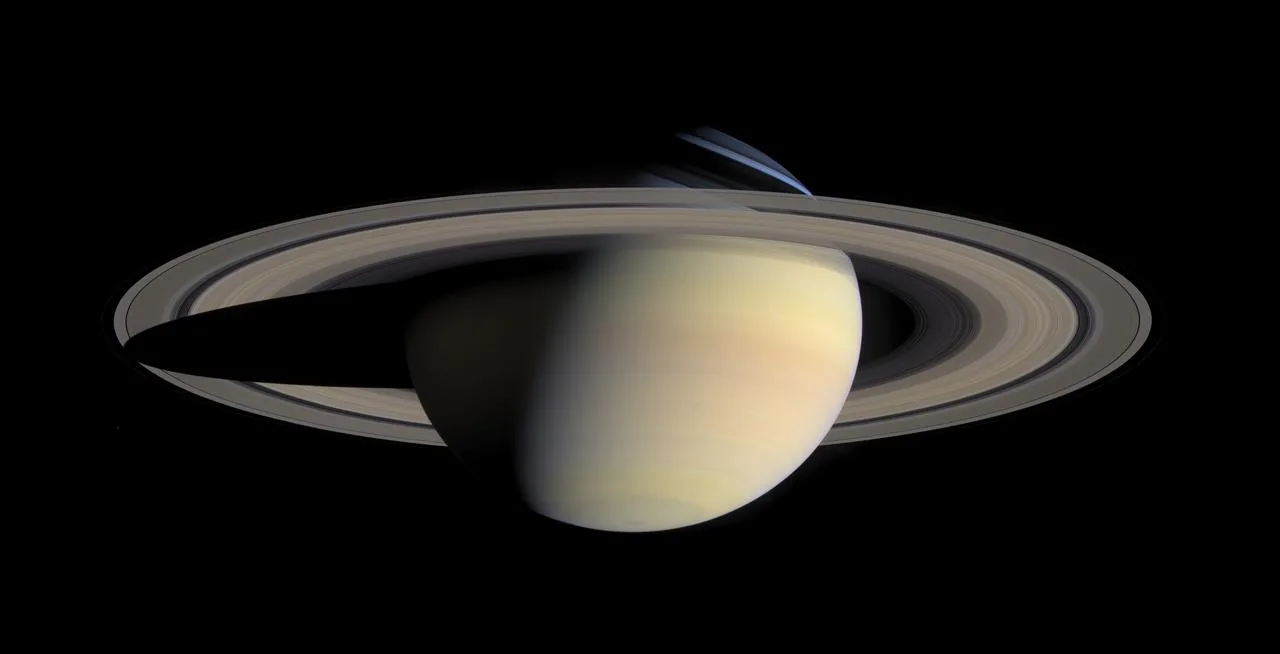
Imagine a world with a thick, hazy atmosphere, vast dune fields of organic sand, lakes and rivers of liquid methane and ethane, and a landscape shaped by a hydrological cycle eerily similar to Earth's, except that the "water" is hydrocarbon and the "rocks" are water ice as hard as granite in the minus-179-degree-Celsius cold. Now imagine sending a nuclear-powered drone helicopter to fly across that world, landing at site after site, sampling the exotic chemistry, and searching for the building blocks of life.
This is not science fiction. This is Dragonfly, one of the most audacious missions NASA has ever approved. Scheduled to launch in 2028 and arrive at Saturn's moon Titan in 2034, Dragonfly will be the first vehicle to fly in an atmosphere on another world in the outer solar system. It represents a completely new approach to planetary exploration, and its target is one of the most fascinating and astrobiologically significant places in the solar system.
Why Titan?
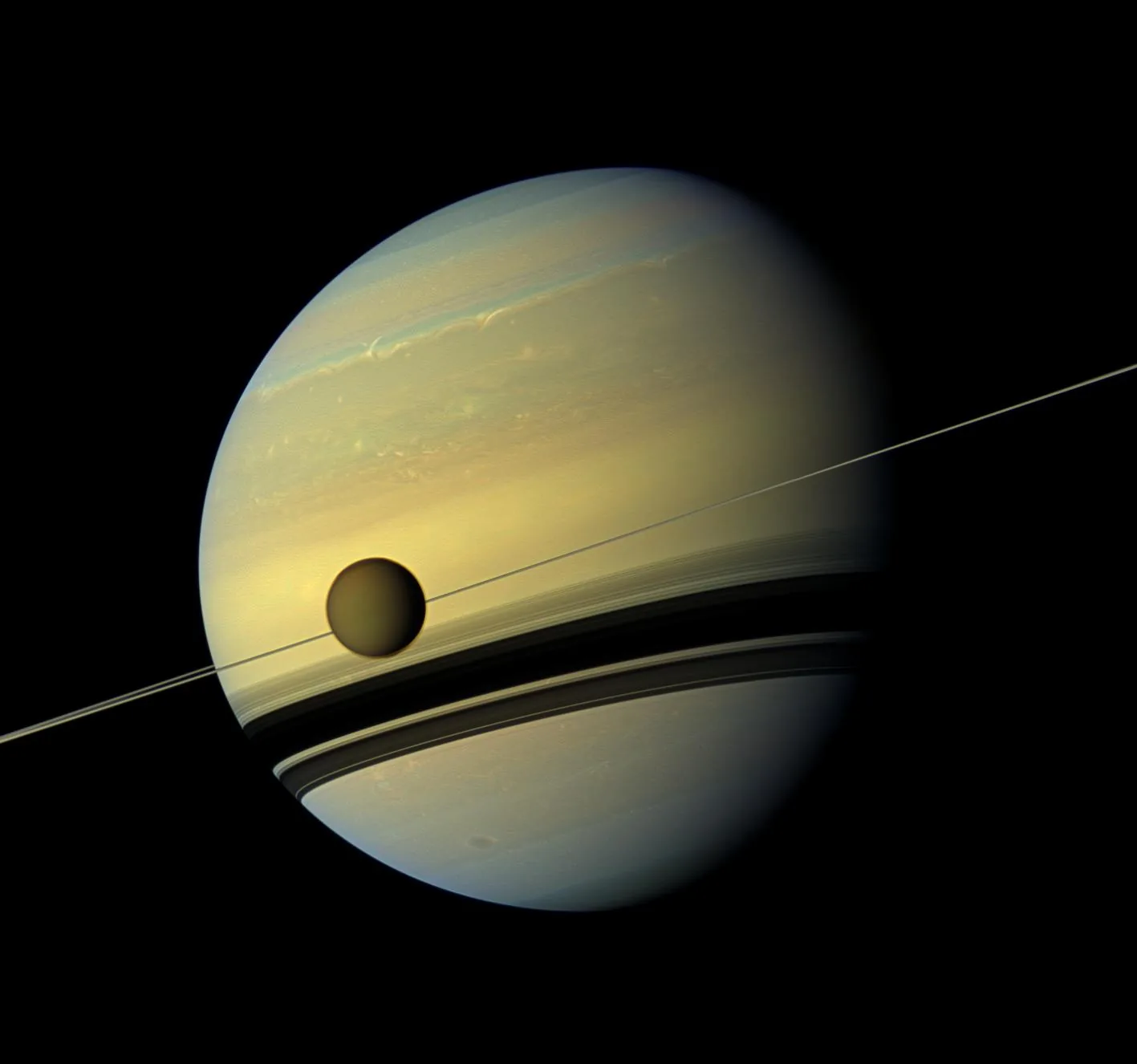
Titan has been captivating scientists since the Voyager flybys of the early 1980s revealed it to be the only moon in the solar system with a substantial atmosphere. That atmosphere is roughly 1.5 times denser than Earth's at the surface and composed primarily of nitrogen (about 95 percent) with methane (about 5 percent) and traces of other organic molecules. The nitrogen-methane atmosphere, energized by solar ultraviolet radiation and charged particles from Saturn's magnetosphere, undergoes complex photochemistry that produces a zoo of organic compounds: hydrocarbons, nitriles, and other molecules that settle to the surface as an orange haze.
When the Cassini-Huygens mission arrived at Saturn in 2004, it transformed our understanding of Titan. The Huygens probe descended through Titan's atmosphere in January 2005, returning images and data from the surface for about 72 minutes after landing. Cassini's radar, meanwhile, spent thirteen years mapping Titan's surface through the impenetrable haze, revealing a world of startling complexity.
Cassini discovered hydrocarbon lakes and seas concentrated near Titan's north pole, with the largest, Kraken Mare, roughly the size of the Caspian Sea. It found vast equatorial dune fields composed of organic particles. It observed evidence of cryovolcanism, where "magma" might be water-ammonia slurries instead of molten rock. And intriguingly, gravity and rotational data suggested that Titan, like Europa and Enceladus, harbors a subsurface liquid water ocean beneath its icy crust.
This combination makes Titan uniquely interesting for astrobiology. The surface is covered in organic molecules, the raw ingredients of life. The subsurface ocean provides a potential environment for water-based life. And the surface itself, with its methane cycle and exotic chemistry, raises the wild card question: could life exist using liquid methane as a solvent instead of water? On Titan, we can investigate both conventional and truly alien biochemistry.
The Machine
Dragonfly is a rotorcraft lander, essentially an eight-rotor drone (a quadcopter with coaxial rotors, giving it eight rotors total on four arms) roughly the size of a large car. It weighs about 450 kilograms and is designed to fly through Titan's atmosphere from one landing site to another, covering distances of up to 8 kilometers per flight, with the potential to travel over 175 kilometers during its baseline mission.
Flying on Titan is, remarkably, much easier than flying on Earth. The combination of Titan's thick atmosphere (four times denser than Earth's at the surface) and low gravity (about one-seventh of Earth's) means that generating lift requires far less power than on our planet. A drone that would struggle to get off the ground on Earth can soar on Titan. The Dragonfly team has calculated that the power required for flight on Titan is roughly equivalent to a large consumer drone on Earth.
Power comes from a Multi-Mission Radioisotope Thermoelectric Generator (MMRTG), the same type of nuclear power source that has been keeping the Curiosity rover running on Mars since 2012. Solar power is not viable at Saturn's distance from the Sun (sunlight there is roughly one percent of what reaches Earth), so the plutonium-238 in the MMRTG provides a steady supply of electrical and thermal energy.
Dragonfly cannot fly continuously; the MMRTG produces enough electricity to charge the drone's batteries over the course of a Titan day (about 16 Earth days), with flight operations occurring during shorter windows. Between flights, the lander sits on the surface, running its science instruments and charging up for the next hop. This pattern, land, study, charge, fly, mirrors no previous planetary mission.
The Science
Dragonfly carries a suite of instruments designed to characterize Titan's chemistry and assess its prebiotic potential.
DraMS (Dragonfly Mass Spectrometer) is the core chemistry instrument. It will analyze surface samples ingested through a drill, identifying organic molecules and their structures. DraMS is a descendant of the SAM instrument on Curiosity and can detect amino acids, nucleotide bases, and other molecules relevant to the origin of life. The central question it will address: how far has Titan's chemistry progressed along the path toward biology?
DraGNS (Dragonfly Gamma-Ray and Neutron Spectrometer) will measure the elemental composition of the surface material directly beneath the lander, determining the abundance of carbon, nitrogen, hydrogen, and other elements.
DraGMet (Dragonfly Geophysics and Meteorology package) will characterize atmospheric conditions including wind, pressure, temperature, and humidity (of methane, in this case), building a comprehensive picture of Titan's weather.
DragonCam is a suite of cameras providing panoramic surface imaging and close-up views of the terrain and surface material. These images will help scientists understand the geological context of each landing site.
Dragonfly will also carry seismometers to probe Titan's interior structure, potentially constraining the depth and properties of the subsurface ocean.
The Landing Site
Dragonfly's initial landing site is Shangri-La, a large equatorial dune field named after the mythical Himalayan paradise. The dunes are composed of organic material that has settled from the atmosphere over millions of years, essentially the accumulated residue of Titan's atmospheric chemistry. Sampling this material will provide a comprehensive survey of what Titan's atmosphere produces.
From Shangri-La, Dragonfly will progressively hop toward the Selk impact crater, roughly 175 kilometers away. Selk is a particularly exciting target because impact craters on Titan are places where liquid water temporarily existed on the surface. When an asteroid slams into Titan's ice crust, it melts the ice, creating a transient pool of liquid water that can persist for hundreds or thousands of years before freezing. During that time, Titan's abundant surface organics would be mixed with liquid water, creating conditions that mimic the kind of prebiotic chemistry that may have led to life on early Earth.
If complex prebiotic molecules have formed anywhere on Titan's surface, the floor of Selk crater is one of the best places to look.
Prebiotic Chemistry and the Origin of Life
One of Dragonfly's most profound scientific goals connects directly to the question of how life began on Earth. The Miller-Urey experiment of 1953 showed that electrical discharges in a mixture of gases thought to resemble Earth's early atmosphere could produce amino acids and other organic molecules. Titan's atmosphere is essentially running a planet-scale version of this experiment continuously, with ultraviolet light and charged particles driving chemistry in a nitrogen-methane mixture.
But Titan's experiment has been running for over four billion years, far longer than any laboratory simulation. And on Titan, the products are not confined to a flask; they rain down onto a surface with diverse environments, including locations where liquid water has existed. By studying Titan's surface chemistry in detail, Dragonfly can help us understand the steps between simple organic molecules and the complex chemistry of life.
This does not mean that Dragonfly expects to find life on Titan's surface. Surface temperatures of minus 179 degrees Celsius are far too cold for any biochemistry we understand. But finding that prebiotic chemistry has progressed further on Titan than we expected, that amino acids or nucleotide bases have formed naturally in this alien environment, would have enormous implications for how easily the chemistry of life arises in the universe.
The Journey
Dragonfly is scheduled to launch in July 2028 aboard a heavy-lift rocket. The cruise to Saturn takes approximately six years, with arrival at Titan expected in 2034. The spacecraft will enter Titan's atmosphere directly, using an aeroshell and parachutes to slow down, much as Huygens did in 2005. Once the parachute has slowed the descent sufficiently, Dragonfly will detach, power up its rotors, and fly to its first landing site.
The baseline mission is 2.7 years on Titan's surface, but like so many NASA missions before it, Dragonfly could potentially operate far longer if the hardware remains healthy. The MMRTG will continue producing power for years, and the Titan environment, though exotic, is not as mechanically harsh as the dust storms and extreme temperature swings of Mars.
A New Way to Explore
Dragonfly represents a paradigm shift in how we explore other worlds. Rovers like Curiosity and Perseverance have been transformative on Mars, but they are slow, covering at most tens of kilometers over their entire missions. Dragonfly will cover more distance in a single flight than most rovers manage in a year. It can hop over obstacles, survey the landscape from the air, and access a diversity of geological environments that a surface-bound rover never could.
If Dragonfly succeeds, it could open a new era of aerial exploration. Titan is uniquely suited for flight, but the concept could be adapted for other destinations: the thick atmosphere of Venus, the thin but flight-capable atmosphere of Mars (as the Ingenuity helicopter has already demonstrated), or even the atmospheres of gas giant planets.
Waiting with Wonder
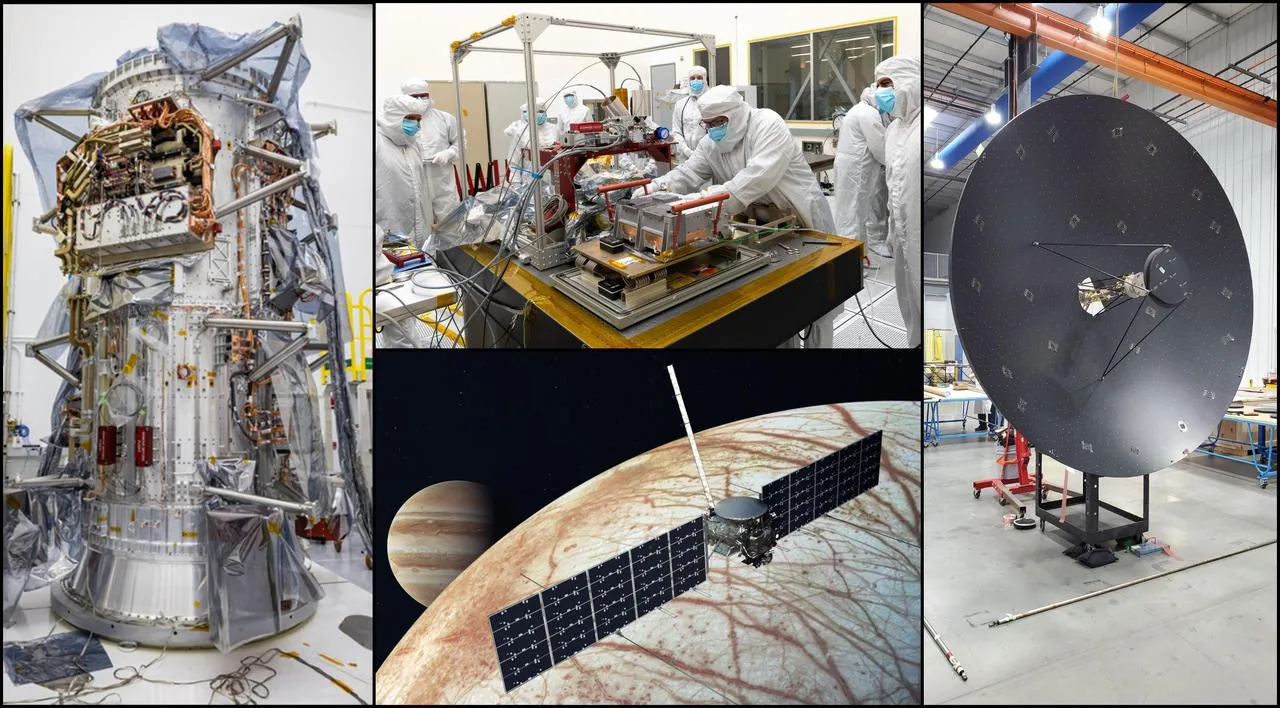
As of 2025, Dragonfly is deep in its assembly and testing phase. Hardware is being built, instruments are being calibrated, and the mission team is refining the flight plans that will guide the drone across Titan's alien terrain. The launch window is years away, and the arrival is further still.
But for those of us who have spent our lives wondering about the chemistry of distant worlds and the origins of life, the wait is filled with anticipation rather than impatience. A nuclear-powered helicopter is going to fly through the haze of an orange moon, land in alien sand dunes, and taste the chemistry of a world where it rains methane and the beaches are made of organic molecules.
Some missions explore. Dragonfly seeks to answer one of the deepest questions we can ask: how easily does the universe produce the chemistry of life? The answer begins on Titan.