Company / Organization Overview
The Indian Space Research Organisation (ISRO) is one of the world's most capable and cost-efficient space agencies, operating under the Department of Space within the Government of India. Founded in 1969 by visionary scientist Dr. Vikram Sarabhai — who famously articulated his goal of using space technology for India's development rather than competing in a space race — ISRO has grown from a fledgling program to a globally respected institution delivering missions that routinely do more with less.
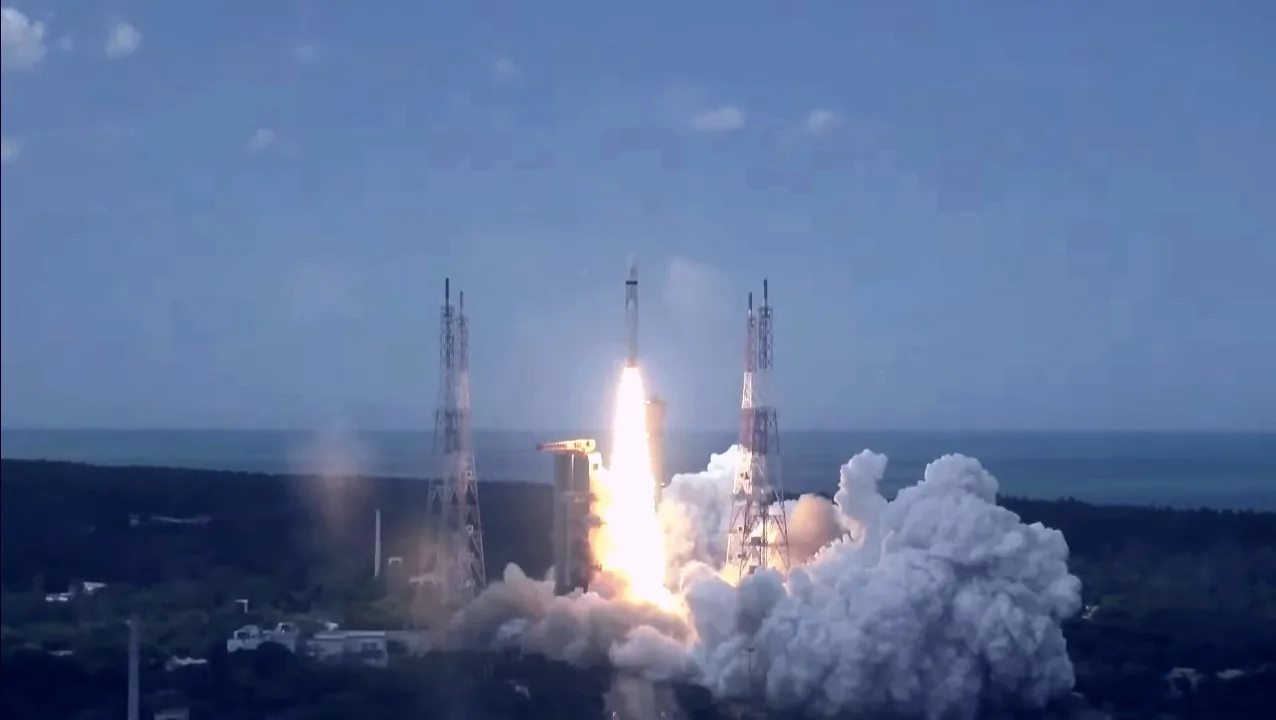
Headquartered in Bengaluru (Bangalore), Karnataka, ISRO employs approximately 17,000 people and operates a nationwide infrastructure including the Satish Dhawan Space Centre (SDSC) at Sriharikota on India's southeastern coast — its primary launch facility. The agency maintains dedicated centers for satellite development (ISAC/UR Rao Satellite Centre, Bengaluru), liquid propulsion (LPSC, Thiruvananthapuram and Mahendragiri), space applications (SAC, Ahmedabad), and mission control.
ISRO's annual budget has grown steadily but remains modest by international standards — ₹13,706 crore (~$1.6 billion USD) in FY2026-27 (Union Budget allocation), a fraction of NASA's $25 billion but delivering a program whose breadth and scientific impact rival agencies with far greater resources.
Alongside ISRO, two critical institutions have emerged to commercialize and reform India's space sector: NewSpace India Limited (NSIL), the government-owned commercial arm of ISRO established in 2019, and IN-SPACe (Indian National Space Promotion and Authorisation Centre), a regulatory and promotional body created in 2020 to open India's space sector to private players.
Key Takeaways
- Revenue/Budget: ₹13,706 crore (~$1.6B USD) FY2026-27 government appropriation; NSIL commercial revenues climbing past $300M/year on the back of LVM3 contracts including AST SpaceMobile BlueBird Block-2 (Dec 2025)
- Key Achievement: NASA-ISRO NISAR Earth-observation flagship launched on GSLV-F16 (July 30, 2025); 100% LVM3 success rate sustained through M5 (Nov 2025) and M6 (Dec 2025); Chandrayaan-3's south-pole landing (Aug 2023) still defining
- Key Program: Gaganyaan crewed mission targeted early 2027 after the May 2025 final abort test and August 2025 first integrated air-drop test; Bharatiya Antariksh Station phased through 2035
- Key Risk: PSLV-C62 EOS-N1 third-stage failure (January 2026) prompted a return-to-flight investigation; budget strain across simultaneous Gaganyaan, NGLV, lunar, and station programs
- Outlook: Indian space economy targeted at $44B by 2033 (IN-SPACe), with private players Skyroot, Agnikul, Pixxel, and others scaling fast
Notable Quotes
"Chandrayaan-3 was not just a mission — it was a statement. India has demonstrated that it can do what no other nation has done, at a cost no other nation has matched. The south pole of the Moon now carries India's footprint."
— S. Somanath, Chairman, ISRO, on Chandrayaan-3's historic landing
"Gaganyaan will mark the dawn of a new era for India. When our Gagannauts fly, they will carry with them the dreams of 1.4 billion people and prove that India's capabilities extend beyond Earth's atmosphere."
— S. Somanath, ISRO Chairman, on the Gaganyaan human spaceflight program
Mission & Strategic Position
ISRO's core mandate has always been development-oriented: using remote sensing, communications satellites, and navigation systems to serve India's 1.4 billion citizens in agriculture, disaster management, weather forecasting, urban planning, and connectivity. This dual-use civilian-developmental model distinguishes ISRO from agencies primarily driven by prestige or military imperatives.
Strategically, ISRO occupies a unique global position as a low-cost, high-reliability space agency that demonstrated commercial launch services long before it was fashionable. ISRO's PSLV has launched payloads for over 30 countries, establishing India's reputation as a reliable and affordable launch partner — a reputation that serves both commercial and soft-power objectives.
The 2023 Chandrayaan-3 success transformed ISRO's strategic standing. By becoming the first country to land near the lunar south pole — a region of enormous scientific and resource interest — India signaled its arrival as a genuine deep-space power. The mission, accomplished for approximately $75 million (a fraction of comparable NASA missions), generated global attention and reinforced the "Jugaad innovation" (frugal engineering) narrative that ISRO has mastered.
India's 2020 space sector reforms, opening commercial launch, satellite manufacturing, and ground segment operations to private companies, are the most significant structural change in Indian space since ISRO's founding. The goal: create a domestic commercial space ecosystem that can compete globally and reduce India's dependence on foreign launch providers.
Key Products & Services
PSLV (Polar Satellite Launch Vehicle)
ISRO's most dependable workhorse — a four-stage rocket alternating solid and liquid propulsion stages:
- Configurations: Standard, Core Alone (CA), XL, and DL variants
- Payload to SSO: Up to 1,750 kg
- Payload to LEO: Up to 3,800 kg
- Flight record: 60+ flights with exceptional success rate
- Notable achievement: 2017 mission deploying 104 satellites simultaneously — world record at the time
- Commercialization: PSLV transfers to NSIL; L&T and HAL consortium awarded first private manufacture contract
GSLV Mk II
India's medium-lift rocket with an indigenous cryogenic upper stage:
- Payload to GTO: 2,250 kg
- Upper stage: Indigenous cryogenic technology — developed domestically after Soviet technology transfer was denied under US pressure in the early 1990s
- Status: Achieved greater reliability in recent years after a checkered history
LVM3 (Launch Vehicle Mark-3 / GSLV Mk III)
India's heavy-lift rocket and most capable operational launch vehicle:
- Payload to GTO: 4,000 kg
- Payload to LEO: 8,000 kg
- Stages: L110 liquid core stage + S200 solid strap-on boosters + cryogenic C25 upper stage
- Key missions: Chandrayaan-2, Chandrayaan-3, OneWeb/Eutelsat constellation deployment
- Human spaceflight: Baseline launch vehicle for Gaganyaan
The LVM3's selection by OneWeb (now Eutelsat OneWeb) for commercial constellation deployment was a landmark commercial contract demonstrating global market credibility.
NavIC (Navigation with Indian Constellation)
India's regional navigation satellite system:
- Coverage: India and ~1,500 km beyond its borders
- Accuracy: Better than 5 meters positional accuracy
- Constellation: Seven operational satellites
- Applications: Navigation, precision agriculture, disaster management, smartphone integration
- Next step: Expanded global NavIC-2 constellation under development
RISAT / Cartosat / Resourcesat Series
ISRO's comprehensive Earth observation fleet:
- Cartosat series: Sub-meter resolution optical imagery
- RISAT series: All-weather synthetic aperture radar (SAR) imagery
- Users: Government agencies, agriculture departments, military planners, scientific researchers
Revenue & Financials
- ISRO annual budget: ₹13,706 crore (~$1.6B USD) FY2026-27 — almost entirely government appropriation
- NSIL commercial revenues: ~$300–400 million/year (LVM3 missions including AST SpaceMobile BlueBird Block-2, OneWeb constellation deployments, transponder leasing, ground-station services)
- Indian space startup investment: Cumulative private investment crossed $400 million through 2025 across ~190 funded NewSpace startups
- Projected market growth: ~$13B in 2025 to $44 billion by 2033 per IN-SPACe estimates
NSIL's commercial launch business is growing but modest relative to ISRO's overall scale. The agency's true economic value is indirect — NavIC, remote sensing data services, and communications satellite capacity generate economic value orders of magnitude larger than ISRO's budget.
Major Programs & Contracts
OneWeb / Eutelsat OneWeb Launches: NSIL and ISRO's LVM3 selected to launch 36 OneWeb LEO broadband satellites per mission. Multiple successful launches completed, delivering commercial revenue and demonstrating LVM3 reliability.
Gaganyaan (Human Spaceflight):
- India's first crewed spaceflight program
- Four Indian Air Force pilots selected as astronauts; training completed in Russia and India
- May 2025: Final crew-escape system abort test completed
- August 2025: First integrated air-drop test of crew module parachute system completed
- Uncrewed orbital test flights G1/G2 sequenced ahead of crewed mission
- Inaugural crewed mission targeted for early 2027
Chandrayaan-4 (Lunar Sample Return):
- Building on Chandrayaan-3's success
- Will collect rocks from the lunar surface and return them to Earth
- Would make India only the fourth country to achieve lunar sample return
- Targeted for 2028
Aditya-L1 (Solar Observatory):
- Launched September 2023; placed at Sun-Earth Lagrange Point 1
- India's first solar observation mission
- Carries seven instruments studying the solar corona, solar wind, and space weather
- Entered L1 halo orbit January 2024
NISAR (NASA-ISRO Synthetic Aperture Radar):
- First-ever hardware collaboration between NASA and ISRO
- L-band (NASA) and S-band (ISRO) radar for monitoring Earth's surface changes
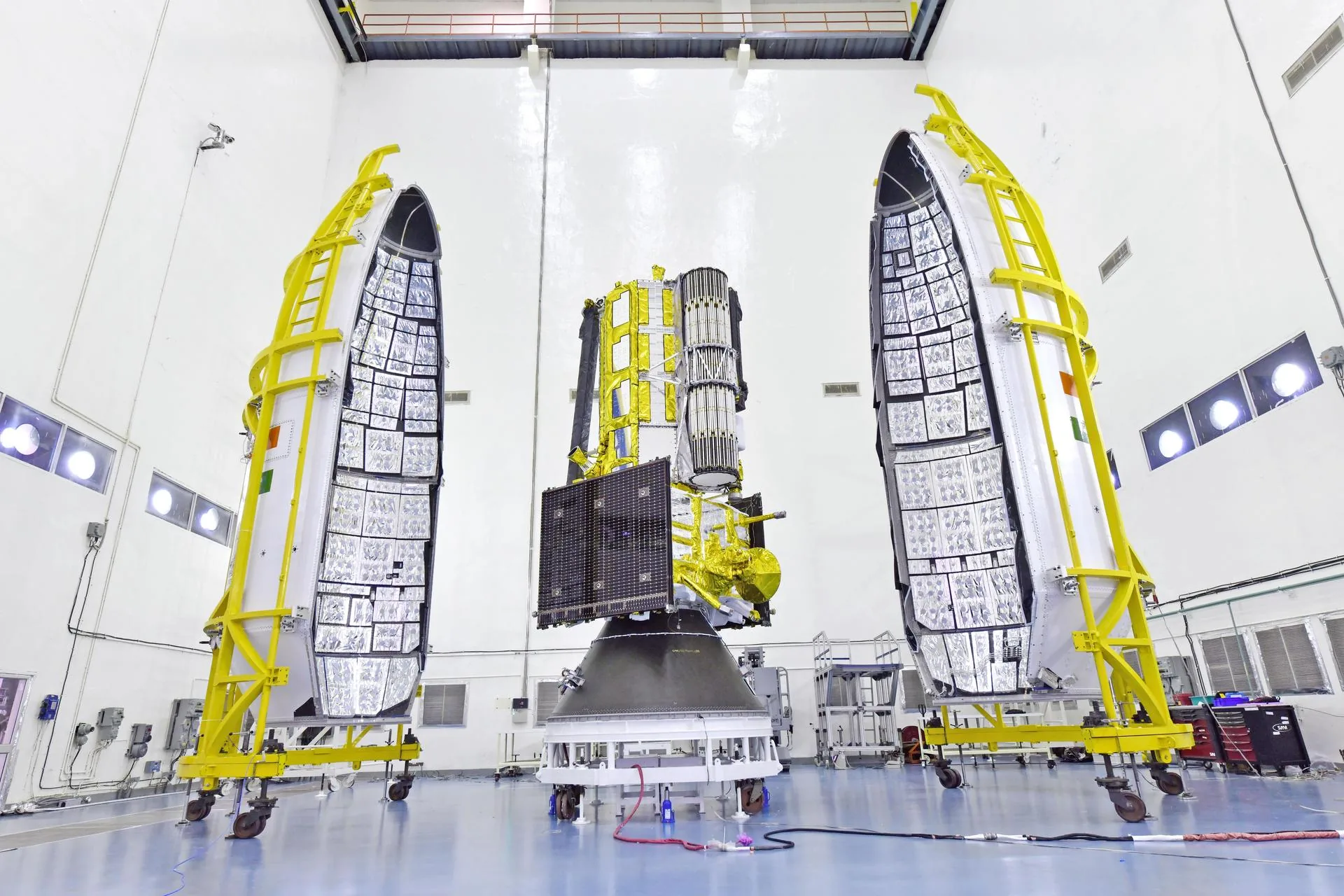
- Launched on GSLV-F16 from Sriharikota on July 30, 2025; first GSLV mission to a sun-synchronous polar orbit; ground controllers confirmed nominal operation 18 minutes after liftoff
Venus Orbiter Mission / Shukrayaan:
- Advanced study phase; potential launch window 2028
Recent Milestones (2024–2026)
LVM3-M5 / CMS-03 (November 2025):
- LVM3 lofted India's heaviest indigenous communications satellite, CMS-03
- All eight LVM3 missions to date now successful
LVM3-M6 / AST SpaceMobile BlueBird Block-2 (December 2025):
- 6,100 kg payload — the heaviest foreign satellite ever launched from Indian soil
NISAR Launch on GSLV-F16 (July 30, 2025):
- First-of-its-kind dual-band (L+S) Earth-observation radar mission
- First GSLV launch to sun-synchronous polar orbit
Gaganyaan Final Abort Test (May 2025) and Integrated Air-Drop Test (August 2025):
- Both critical milestones achieved on schedule
- Crewed mission now targeted early 2027
PSLV-C62 / EOS-N1 (January 2026):
- Third-stage anomaly resulted in mission failure — first PSLV failure since 2017
- ISRO investigation under way as of April 2026
Chandrayaan-3 (August 23, 2023):
- Vikram lander and Pragyan rover touched down at 69.37°S latitude — lunar south pole
- Historic first for any nation
- Rover operated for one lunar day (~14 Earth days)
- Confirmed presence of: sulfur, iron, oxygen, other elements in south polar regolith
- Detected plasma near the surface
- Mission cost: ~$75 million
Aditya-L1 L1 Orbit Insertion (January 2024):
- Successfully entered halo orbit around L1 Lagrange point
- Began continuous solar observation
PSLV-C58 / XPoSat (January 2024):
- India's first dedicated X-ray polarimetry mission
- Studying X-ray emissions from black holes and neutron stars
- Only the second such mission globally after NASA's IXPE
RLV Technology Demonstrator Tests (2023–2024):
- Multiple autonomous runway landing experiments at Aeronautical Test Range, Chitradurga, Karnataka
- Demonstrates India's progress toward a future reusable spaceplane
GSLV-F14 / INSAT-3DS (February 2024):
- Successful GSLV mission deploying INSAT-3DS meteorological satellite
- Enhancing India's weather forecasting and disaster warning capabilities
Competitive Landscape
China / CNSA: India's most direct strategic comparison. China's space budget is 8–10x larger; it has a crewed space station and the world's fastest-growing commercial space sector. Competition for leadership in Asian and Global South space is intertwined with broader geopolitical rivalry.
SpaceX: In commercial launch, SpaceX's pricing and cadence make direct competition challenging. However, ISRO's PSLV and LVM3 compete effectively where customers value cost, politics, or prefer non-US providers. India's ITAR-free satellite manufacturing is a growing advantage.
Arianespace / ESA: More complementary than competitive; growing cooperation interests. ESA has explored collaboration on multiple missions.
India's Emerging Private Players:
- Skyroot Aerospace: First private Indian rocket to reach space (Vikram-S, November 2022); Vikram-1 maiden orbital launch slipping past mid-2025; Infinity Campus opened by PM Modi in November 2025 with monthly orbital-rocket production capacity; ₹500 crore Telangana facility agreement signed January 2025
- Agnikul Cosmos: Agnibaan SOrTeD suborbital test successful May 30, 2024 (world's first single-piece 3D-printed engine flight); Agnite booster test-fire March 2026; clustered three-engine test February 2026; valuation reportedly above $500M; Tamil Nadu government acquired ₹25 crore equity stake in early 2026 — first government equity in an Indian space startup
- Pixxel: Three Firefly hyperspectral satellites launched on Falcon 9 January 14, 2025; further Fireflies and Honeybees planned through 2026; cumulative funding ~$95M through Series B
- Bellatrix Aerospace: Electric propulsion and orbital transfer vehicles
Future Roadmap (2025–2030)
- Gaganyaan crewed flight (2026–2027): India joins China, the US, and Russia as nations that have independently launched humans to space
- Indian Space Station (Bharatiya Antariksh Station): Approved; first 20-tonne module early 2030s, operational by 2035
- Next-Generation Launch Vehicle (NGLV): Semi-reusable, medium-heavy launcher with ~3x LVM3's LEO capacity; early development phase
- Chandrayaan-4: Lunar sample return mission targeted 2028
- Mars Mission 2 (MOM-2): Follow-on to 2014 Mars Orbiter Mission with more sophisticated instruments
- Private Sector Scale-Up: India's commercial space market projected at $44 billion by 2033
Key Risks & Challenges
Funding Constraints: ISRO's budget, while growing, remains tight relative to its ambitions. Simultaneous scaling of Gaganyaan, NGLV, the space station, and multiple planetary missions creates resource strain.
Private Sector Maturity: India's NewSpace ecosystem is promising but nascent. Regulatory frameworks, access to ISRO infrastructure, technology transfer policies, and export controls are still being refined.
Brain Drain: India's technically talented engineers have historically emigrated to NASA, SpaceX, and global tech companies. Retaining talent within the domestic space sector is an ongoing challenge, though the exploding private ecosystem is helping.
Launch Reliability Under Scale: As ISRO transfers more launches to NSIL and private manufacturers, maintaining the quality control standards that have defined ISRO's reputation will require careful oversight.
Geopolitical Dependencies: India's space ambitions intersect with complex relationships with the US (ITAR, technology transfer), Russia (Gaganyaan training), and China (competition). Navigation of these dependencies requires careful diplomacy.
Sources
- ISRO Official Website — Mission Archives and Program Documentation
- NewSpace India Limited (NSIL) — Commercial Launch Contracts
- IN-SPACe — India Commercial Space Market Study, 2023
- Department of Space, Government of India — Annual Reports FY2023-24
- NASA-ISRO NISAR Mission Documentation
- Nature — Chandrayaan-3 Scientific Results, 2023–2024
- SpaceNews — "ISRO's Chandrayaan-3 becomes first mission to land near lunar south pole," August 2023
- BryceTech — Global Space Activity Overview 2024
- Deloitte / IN-SPACe — Indian Space Economy: Opportunities and Roadmap