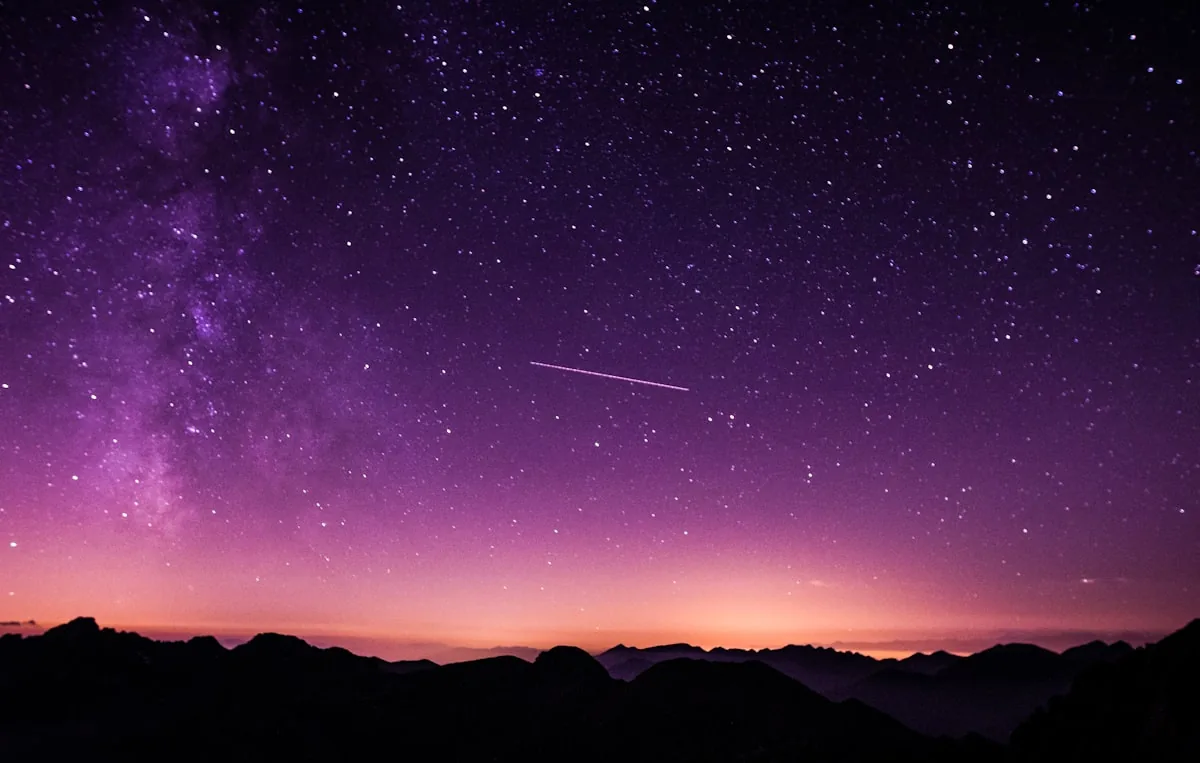
I remember the first time I saw the aurora. I was standing on a frozen lake in northern Norway, and the sky above me was on fire. Curtains of green and violet light rippled across the stars, moving with a slow, liquid grace that no photograph or video had prepared me for. My hands were shaking -- partly from the cold, mostly from the sheer overwhelming beauty of it.
The Northern Lights are one of nature's most breathtaking phenomena. But what makes them even more extraordinary is the story behind them -- a tale of nuclear fusion, supersonic plasma, magnetic field lines, and quantum physics, all combining to paint the sky with light. Let me tell you that story.
How the Aurora Works: From Sun to Sky
It Starts With the Sun
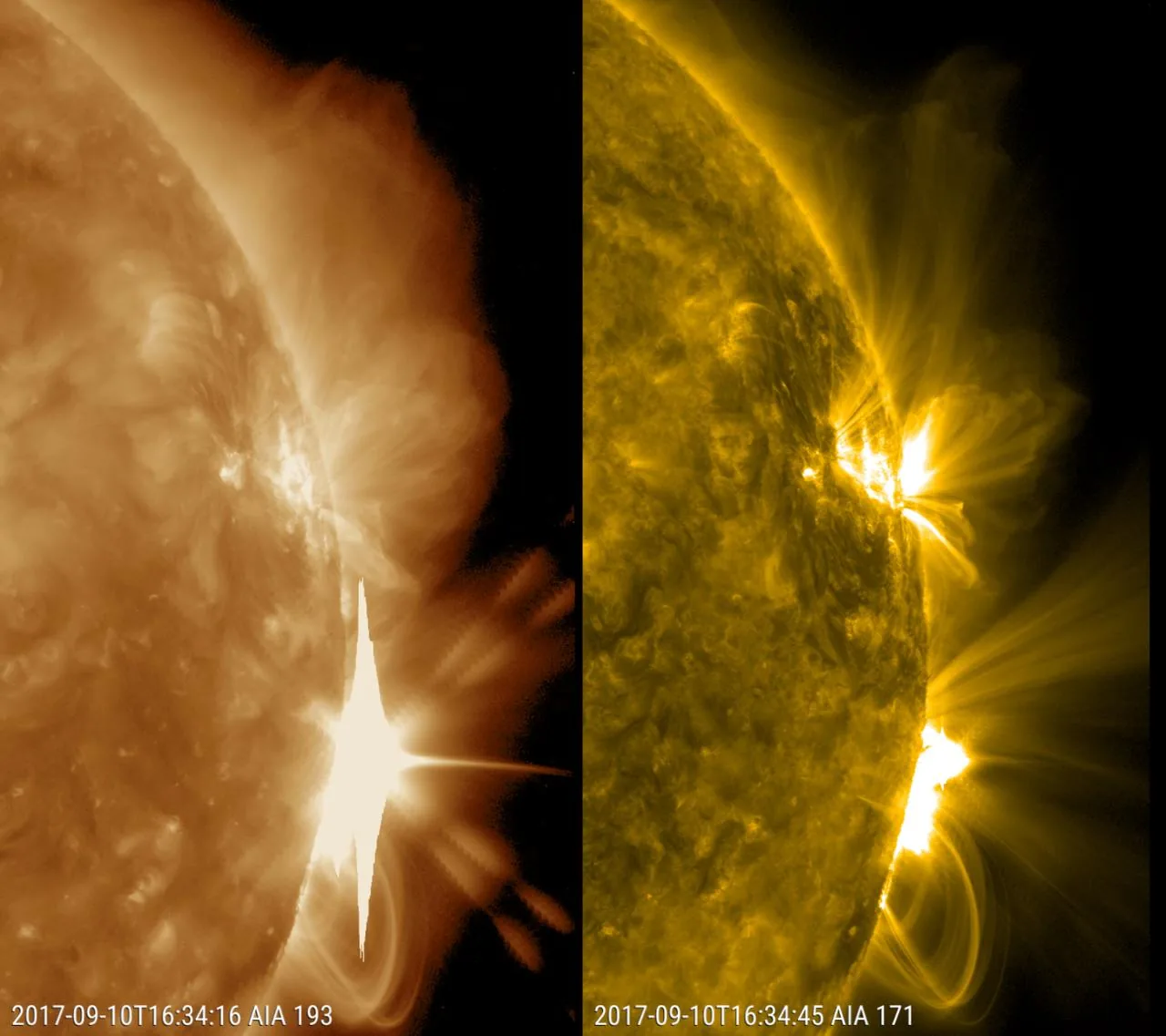
The Sun is not the calm, steady yellow ball it appears to be. It is a seething, violent furnace of hydrogen plasma, and it is constantly hurling material into space. This outflow is called the solar wind -- a stream of charged particles (mostly electrons and protons) racing outward at 400 to 800 kilometers per second.
During periods of high solar activity, the Sun also releases coronal mass ejections (CMEs) -- enormous clouds of magnetized plasma weighing billions of tons, launched into space by eruptions in the Sun's magnetic field. When a CME is aimed at Earth, things get interesting.
Earth's Magnetic Shield
Our planet is surrounded by a magnetosphere -- a vast magnetic bubble generated by the churning of molten iron in Earth's outer core. This magnetosphere deflects most of the solar wind, shielding us from radiation that would otherwise strip away our atmosphere and make the surface uninhabitable.
But the magnetosphere is not a perfect shield. At the poles, magnetic field lines converge and dip down toward Earth's surface, creating funnel-like openings. When solar wind particles find these openings, they spiral down along the field lines and plunge into the upper atmosphere at speeds exceeding 1,000 kilometers per second.
The Light Show
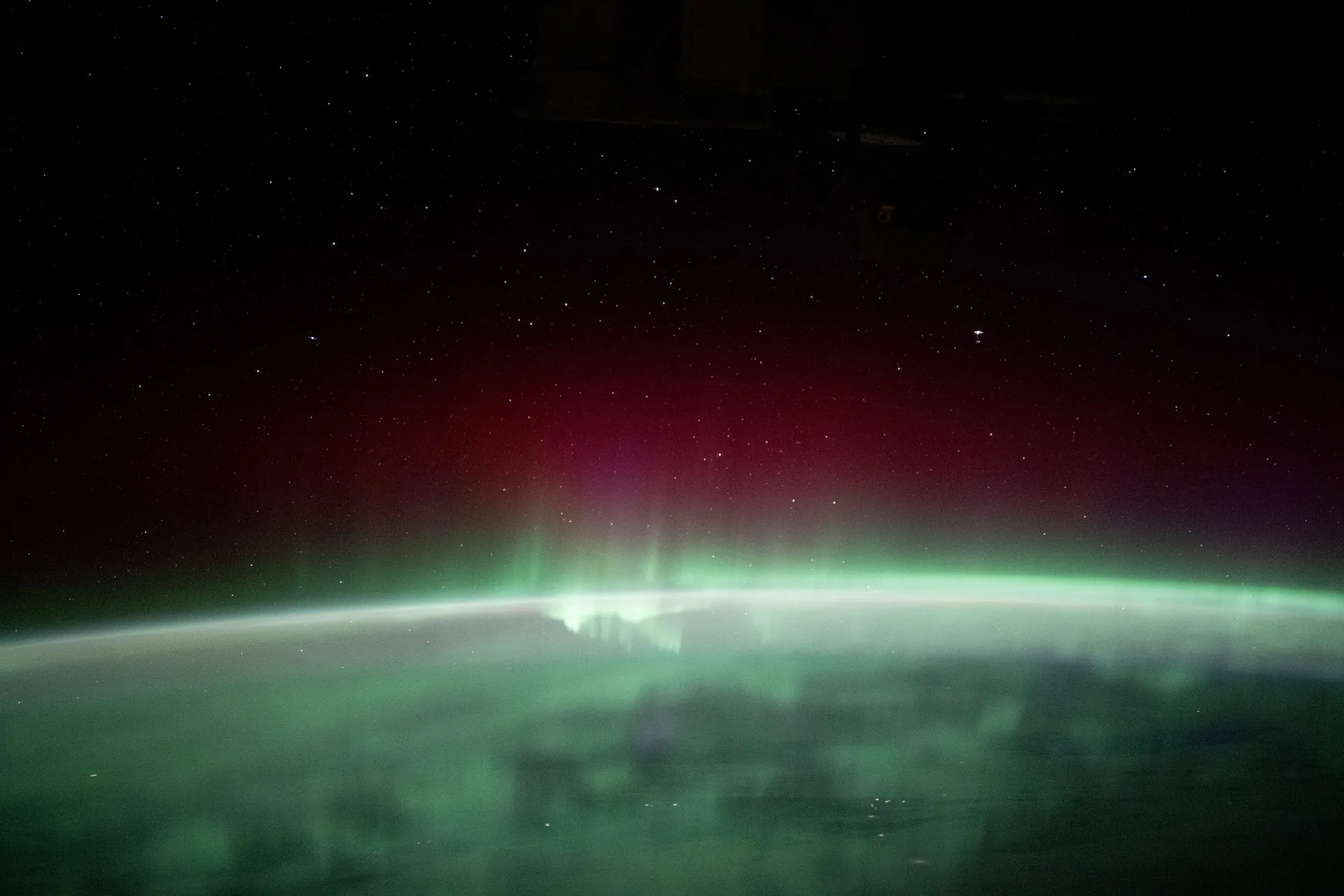
Here is where the magic happens. Those high-energy particles slam into gas molecules in the upper atmosphere -- primarily oxygen and nitrogen -- at altitudes between 80 and 300 kilometers. The collisions excite the electrons in these gas molecules, temporarily kicking them to higher energy levels. When the electrons drop back down to their normal state, they release photons -- tiny packets of light.
Billions upon billions of these collisions happening simultaneously produce the shimmering curtains of light we call the aurora.
Kp Index → Aurora Visibility (Northern Hemisphere)
The Kp index is the planetary geomagnetic activity scale used by NOAA's Space Weather Prediction Center. It runs 0–9 and tells you how far the auroral oval has expanded from the magnetic pole on a given night. The higher the Kp, the further south the aurora becomes visible.
| Kp Index | Storm Level | Auroral Oval Reaches | Example Cities (Visible) | Frequency |
|---|---|---|---|---|
| Kp 0–1 | Quiet | ~67° geomagnetic | Tromsø, Fairbanks, Yellowknife, Reykjavik | Most nights when dark |
| Kp 2 | Quiet–unsettled | ~65° | Northern Norway, Iceland (interior), Fairbanks | ~50% of nights |
| Kp 3 | Unsettled | ~63° | Iceland (south), northern Sweden/Finland, Anchorage | ~30% of nights |
| Kp 4 | Active | ~60° | Trondheim, central Sweden/Finland, southern Alaska | ~10–15% of nights |
| Kp 5 (G1) | Minor storm | ~58° | Stockholm, Edinburgh, Oslo, Calgary, northern US tier | ~5% of nights |
| Kp 6 (G2) | Moderate storm | ~56° | Glasgow, Hamburg, Moscow, Vancouver, Seattle | ~1–2% of nights |
| Kp 7 (G3) | Strong storm | ~54° | London, Berlin, Warsaw, US Midwest, Boston | ~0.5% of nights |
| Kp 8 (G4) | Severe storm | ~52° | Paris, US Plains states, San Francisco | ~0.1% of nights — major events |
| Kp 9 (G5) | Extreme storm | ~47° | Madrid, Rome, Texas, Mexico, southern California | <0.05% — historic events (May 2024 Gannon storm) |
Caveat — geographic vs. geomagnetic latitude: Geomagnetic latitude differs from geographic latitude. North America's geomagnetic pole is offset by roughly 10° from the geographic pole, which is why aurora is visible at notably lower geographic latitudes in Canada and the northern United States than at equivalent latitudes in Europe. Calgary (51°N geographic) routinely sees aurora at Kp levels that would barely brush the Scottish Highlands.
Solar Cycle 25 status (2026): Solar Cycle 25 peaked in late 2024–early 2025, but elevated activity continues through 2026, with G1+ geomagnetic storms still occurring roughly weekly. Forecasters expect strong displays to remain plausible into 2027 before activity tails off toward the next minimum.
Why Different Colors?
The color of auroral light depends on which gas is being excited and at what altitude:
- Green (557.7 nm): The most common aurora color. Produced by oxygen atoms at altitudes of 100 to 300 kilometers. This is the color most often seen in photographs and with the naked eye.
- Red (630.0 nm): Also produced by oxygen, but at higher altitudes (above 300 km) where the atmosphere is thinner. Red auroras are rarer and often appear during intense geomagnetic storms. The oxygen atoms at these altitudes have more time to emit the red photon before being disturbed by another collision.
- Blue and violet (391.4 nm and 427.8 nm): Produced by nitrogen molecules. These colors appear at lower altitudes (below 100 km) during strong events, often forming the lower edges of auroral curtains.
- Pink: A mix of red and blue, sometimes visible at the very lowest edges of particularly dynamic displays.
The interplay of these colors, shifting and blending in real time, is what gives the aurora its otherworldly character. During powerful storms, all of these colors can appear simultaneously.
Solar Maximum: Why 2024–2026 Has Been Spectacular
The Sun follows an approximately 11-year cycle of activity, swinging between solar minimum (quiet) and solar maximum (active). Solar Cycle 25 peaked in late 2024 and early 2025, and it turned out to be more powerful than most forecasters predicted.
The result? The aurora has put on some of the most spectacular shows in over two decades. In May 2024, the historic Gannon storm — driven by multiple CMEs arriving in rapid succession — reached G5 (Kp 9) and produced aurora visible as far south as Florida, Mexico, and the Canary Islands. People who had never seen the Northern Lights in their lives were photographing them from their backyards.
Even now in 2026, on the descending side of the cycle, elevated activity continues. G1–G3 storms are still common, and G4+ events remain plausible into 2027 before the cycle tails off. In other words: this is still an exceptional window to plan an aurora trip.
Where to See the Northern Lights
The aurora occurs in an oval-shaped band centered on the magnetic poles, called the auroral oval. Under normal conditions, it sits at latitudes between 65 and 72 degrees north. During strong storms, it expands dramatically southward.
Best Locations
- Northern Norway (Tromso, Lofoten Islands): Perhaps the most popular aurora destination in the world, and for good reason. The Gulf Stream keeps temperatures surprisingly mild for the latitude, and the fjord-dotted landscape provides stunning foregrounds.
- Iceland: The entire country lies under the auroral oval. Combine aurora with volcanoes, glaciers, and hot springs for an unforgettable trip. Cloud cover is the main challenge.
- Swedish Lapland (Abisko): Abisko sits in a "rain shadow" that gives it some of the clearest skies in Scandinavia. The Aurora Sky Station at Abisko National Park is legendary.
- Finnish Lapland: Glass-roofed igloos that let you watch the aurora from a warm bed. Need I say more?
- Fairbanks, Alaska: Interior Alaska has cold, dry air and clear skies in winter. Fairbanks is one of the most reliable spots in North America.
- Yellowknife, Canada: Located directly under the auroral oval with predominantly clear winter skies. Statistically one of the best places on Earth for aurora viewing.
- Southern tip of New Zealand and Tasmania: For the aurora australis (Southern Lights). Less accessible and less reliable, but the southern aurora has been putting on remarkable shows during this solar maximum.
Timing
- Season: September through March offers the longest dark hours at high latitudes. The equinox months (September/October and February/March) are statistically slightly more active due to the orientation of Earth's magnetic field relative to the solar wind.
- Time of night: The aurora can appear at any time after dark, but activity often peaks between 10 PM and 2 AM local time.
- Moon phase: A full Moon does not prevent you from seeing the aurora, but a dark sky makes fainter structures more visible.
Forecasting and Apps
You do not need to rely on luck. Space weather forecasting has become remarkably sophisticated:
- NOAA Space Weather Prediction Center (swpc.noaa.gov): The gold standard. Their 30-minute forecast and Kp index (a measure of geomagnetic activity from 0-9) tell you the likelihood and expected reach of auroral activity.
- My Aurora Forecast (app): Clean, simple interface with Kp forecasts, cloud cover maps, and push notifications when activity is high at your location.
- SpaceWeatherLive (app and website): More detailed data including real-time solar wind measurements, CME tracking, and historical statistics.
- Aurora Alerts (app): Customizable notifications based on your location and desired Kp threshold.
A Kp index of 3-4 means aurora is likely visible at high latitudes. Kp 5-6 brings it south to places like Edinburgh, Oslo, and Anchorage. Kp 7+ means aurora visible across much of the northern United States and central Europe -- these events happen a few times a year during solar maximum.
Photographing the Aurora
The aurora is one of the most photogenic phenomena in nature, and even smartphones can capture it during strong displays.
Camera Settings
- Tripod: Absolutely essential.
- Wide-angle lens: 14-24mm is ideal to capture the full sweep of the sky.
- Aperture: As wide as your lens allows (f/2.8 or faster is ideal).
- ISO: 1600-6400 depending on aurora brightness.
- Shutter speed: 5-15 seconds. Shorter exposures (2-5 seconds) preserve the dynamic structure of fast-moving aurora; longer exposures capture fainter detail but can blur rapid movement.
- Focus: Manual focus set to infinity on a bright star.
Composition Tips
- Include foreground interest: a frozen lake, mountain silhouette, church steeple, or lone tree.
- Leave room in the frame for the aurora to "breathe."
- Shoot in RAW for maximum processing flexibility.
- Take video clips too -- the movement of the aurora is part of the experience.
The Science Keeps Getting Deeper
Scientists are still making new discoveries about the aurora. In recent years, citizen scientists helped identify STEVE (Strong Thermal Emission Velocity Enhancement) -- a narrow, mauve-colored ribbon of light that appears at lower latitudes than the classical aurora and is driven by a different physical mechanism involving a fast-moving river of hot plasma in the magnetosphere.
There are also pulsating auroras -- diffuse patches that blink on and off every few seconds, driven by a different wave-particle interaction in the magnetosphere. And we now know that auroras exist on other planets too: Jupiter, Saturn, Uranus, and Neptune all have auroral displays driven by the solar wind interacting with their own magnetic fields. Jupiter's aurora is powered partly by volcanic material from its moon Io.
Go See Them
There are experiences in life that change your sense of scale, that recalibrate your understanding of where you are in the universe. Watching the Northern Lights is one of them. The physics is beautiful. The visual is overwhelming. And right now, during this solar maximum, the show is as good as it gets.
Start watching the forecasts. Book a trip to high latitudes. Step outside on the next clear night and look north. The Sun is putting on a performance, and Earth's atmosphere is the stage.