Rocket Lab: From Electron to Neutron
Peter Beck started Rocket Lab in New Zealand with a mission so straightforward it sounded naive: build a small rocket that launches small satellites on a dedicated schedule, not a rideshare schedule. Two decades later, Electron has crossed 75 cumulative missions and is the second-most-launched American orbital rocket after Falcon 9. Rocket Lab has done something that eluded dozens of well-funded startups: it actually works. And now it's reaching for something much bigger — Neutron, the medium-lift reusable rocket whose first flight has now slipped to late 2026.
Key Takeaways
- Stock: NASDAQ: RKLB
- 2025 Revenue: $602 million; operating loss of $229M and net loss of $198M reflect heavy Neutron spend
- Electron Launches: 75+ cumulative missions as of January 2026
- Recent contracts: $190M HASTE hypersonic test deal with the Pentagon (March 2026); $515M Space Force MILNET-class award; multi-launch iQPS extension (April 2026)
- Neutron: First flight now targeting late 2026 (delay announced February 2026); LC-3 at Wallops officially opened August 28, 2025
- Key Risk: Neutron schedule slip; financial runway with ongoing cash burn
- Outlook: Only proven small-launch company at scale; Neutron is the strategic bet that transforms the company into a medium-lift competitor
Company Overview
Founded: 2006 Founder: Peter Beck Headquarters: Long Beach, California Launch sites: Launch Complex 1 (Mahia Peninsula, New Zealand); Launch Complex 2 (Wallops Island, Virginia, USA); Launch Complex 3 (Wallops, opened August 28, 2025) — Neutron's home pad Employees: 2,600+ (as of May 2025) Stock listing: Public since August 2021 via SPAC merger with Vector Acquisition Corporation (NASDAQ: RKLB)
Rocket Lab was founded in Auckland, New Zealand, which makes it a genuinely unusual story in the American-dominated world of commercial space. Beck — a self-taught engineer who reportedly built a backpack-sized jet engine as a teenager — convinced himself and then investors that the small satellite revolution needed its own dedicated infrastructure. He was right. The company went public in 2021 and has consistently been one of the most-watched names in the public space stock universe, not because of hype but because of actual launch frequency and operational results.
Mission & Vision
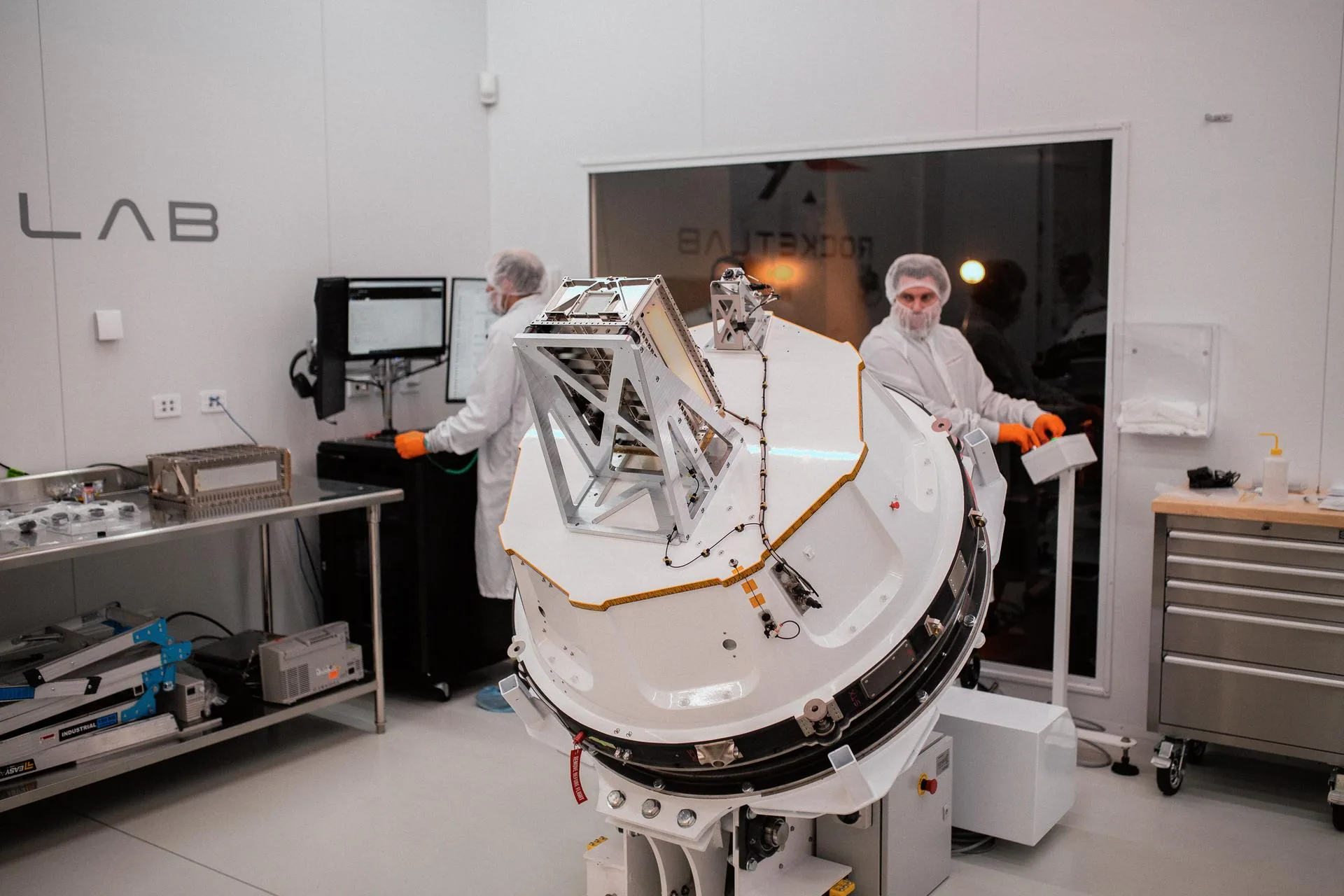
Rocket Lab's mission is "to open access to space to improve life on Earth." In practice, this has meant building reliable, affordable, dedicated launch for small satellites — and then systematically expanding into spacecraft manufacturing, mission operations, and now medium-lift launch.
"We're not building a rocket company, we're building a space company. The rocket is just the first step." — Peter Beck, Rocket Lab CEO and founder
What makes Rocket Lab's strategy intellectually interesting is its deliberate vertical integration. Beck's bet was never just about rockets. It was about owning the entire mission — from launch to spacecraft to orbit-raising. The company's Photon spacecraft platform takes this to its logical conclusion: a customer can buy a "complete mission" from Rocket Lab rather than assembling components from multiple vendors.
Key Products & Services
Electron
The rocket that made Rocket Lab famous and financially viable.
| Specification | Value |
|---|---|
| Type | Two-stage, partially reusable small orbital launch vehicle |
| Height | 18 meters |
| Payload to LEO | 300 kg (standard); ~200 kg to SSO |
| Launch cost | ~$7.5–8 million per dedicated launch |
| First stage engines | 9 Rutherford (electric pump-fed — world first for an orbital rocket) |
| Fuel | RP-1 / liquid oxygen |
| 2024 launches | 16 |
| Cumulative launches | 75+ as of January 2026 |
Electron's Rutherford engine is a genuine engineering innovation. By replacing traditional turbopumps with electric motor-driven pumps (powered by lithium polymer batteries), Rocket Lab eliminated one of the most mechanically complex parts of a rocket engine. The design trades some performance for dramatically reduced engine complexity and cost.
Reusability: Rocket Lab achieved mid-air helicopter booster catch in May 2022 and is refining the process. Full operational reusability is on the near-term roadmap and would meaningfully reduce per-launch costs.
Photon
The spacecraft platform that extends Rocket Lab's addressable market beyond launch.
- Type: Small satellite / spacecraft bus
- Mass: 65–170+ kg (configurable)
- Power: Up to 200W
- Notable missions:
- NASA CAPSTONE: CubeSat sent to lunar orbit to validate the Near-Rectilinear Halo Orbit for Gateway
- ESCAPADE Mars mission: Photon serves as the spacecraft bus for NASA's Mars mission
Photon transforms Rocket Lab from a launch company into a mission services company. The margins on spacecraft are potentially higher than on launch, and the customer relationship is stickier.
Space Systems (Component Manufacturing)
Through acquisitions, Rocket Lab has assembled a vertically integrated space systems business:
- SolAero (acquired 2022): Solar cells and panels for satellites — over 1,000 satellites have flown SolAero power products, including the James Webb Space Telescope
- Planetary Systems Corporation (acquired 2021): Separation systems, including the Canisterized Satellite Dispenser (CSD) used on dozens of missions
- Advanced Solutions Inc. (acquired 2021): Flight software and mission simulation
- Sinclair Interplanetary (acquired 2020): Reaction wheels and attitude control components
This portfolio means Rocket Lab is not just launching satellites — it is manufacturing core subsystems that go into satellites launched by everyone, including competitors.
Neutron (In Development)
The medium-lift rocket that will define Rocket Lab's next decade.
- Type: Two-stage, fully reusable medium-lift launch vehicle
- Height: ~40 meters
- Payload to LEO: 13,000 kg (reusable)
- Propulsion: 7 Archimedes engines on first stage (liquid natural gas / liquid oxygen)
- Key design feature: "Hungry hippo" fairing — the payload fairing is attached to the first stage and returns with it, rather than being jettisoned in space
- Target customers: Mega-constellations, national security, civil government
- Target launch cost: $50–55 million per flight (competitive with Falcon 9)
- Development status: LC-3 at Wallops officially opened on August 28, 2025; Archimedes engine in test; first launch slipped from H1 2026 to late 2026 (announced February 27, 2026)
"Neutron isn't just another rocket — it's the vehicle that will let us compete in every market segment that matters for the next decade." — Peter Beck, Rocket Lab CEO, investor presentation
Neutron is the most important strategic bet Rocket Lab has ever made. If it works, the company moves from small satellite launch specialist to a true Falcon 9 competitor. The economics are fundamentally different at this scale.
Revenue & Financials
Rocket Lab is one of the few pure-play space companies that is publicly traded and provides meaningful financial transparency:
- 2023 Revenue: $245 million
- 2024 Revenue: ~$436 million
- 2025 Revenue: $602 million — roughly 38% year-over-year growth
- 2025 Operating loss: $229 million; net loss $198 million (Neutron development consuming capital as planned)
- Revenue mix: Launch services and space systems (components and spacecraft); space systems remains the larger of the two segments
- Profitability: Not yet GAAP profitable; negative free cash flow through 2025 due to Neutron and Archimedes investment
- Total funding raised: Over $1.5 billion in equity and debt since founding
The company's revenue mix is strategically important. Unlike pure launch companies, Rocket Lab's space systems revenue provides relative stability — component demand is somewhat independent of whether Rocket Lab's own rockets are flying.
Key Contracts & Customers
NASA:
- CAPSTONE mission (2022): Delivered the CAPSTONE CubeSat to a unique lunar orbit using Electron + Photon spacecraft
- ESCAPADE Mars mission: Rocket Lab building twin Photon spacecraft for a NASA Mars mission
- Multiple VADR (Venture-Class Acquisition of Dedicated and Rideshare) contracts
- Mars mission work is a significant credibility milestone — only a handful of companies have been trusted with interplanetary spacecraft
National Reconnaissance Office (NRO):
- Multiple NROL missions on Electron from both New Zealand and Virginia launch sites
- Among Rocket Lab's highest-value individual launches
Commercial:
- BlackSky Global (Earth observation)
- Spire Global (weather/RF monitoring)
- Planet Labs (imaging constellation)
- HawkEye 360 (RF geolocation)
- Synspective (SAR imaging, Japan)
- Numerous other small satellite operators globally
Defense:
- Multiple DoD responsive launch demonstration missions
- USSF agreements for rapid launch capability
Recent Milestones (2025–2026)
- 75+ cumulative Electron launches as of January 2026 — second-most-launched American orbital rocket after Falcon 9
- LC-3 at Wallops opened (August 28, 2025): Neutron's dedicated launch complex commissioned
- Neutron debut delayed (February 27, 2026): First flight pushed from H1 2026 to late 2026 to allow additional Archimedes qualification
- HASTE hypersonic contract (March 18, 2026): $190M Pentagon award for hypersonic test flights using a suborbital Electron variant
- iQPS multi-launch extension (April 12, 2026): Three additional Electron flights added to the dedicated SAR constellation deployment manifest
- Latest Electron flight (April 23, 2026): Successful deployment of Japanese cubesats — Q2 2026 cadence holding
Competitive Position
Rocket Lab occupies a genuinely defensible market position in small launch — it is the only company that has demonstrated consistent, reliable small satellite launch at meaningful cadence:
- Against rideshare (SpaceX Transporter): SpaceX's rideshare offers much lower prices (~$6,000/kg vs. Rocket Lab's ~$25,000/kg), but delivers to a fixed orbit on SpaceX's schedule; customers needing specific orbits or timing pay Rocket Lab's premium
- Against small launch competitors: Virgin Orbit failed in 2023; Firefly Aerospace is emerging but still early; ABL Space shut down; Astra failed — the graveyard of small launch startups validates that execution at Rocket Lab's level is extremely hard
- In space systems: Competes with established suppliers like Ball Aerospace and Surrey Satellite Technology; SolAero acquisition makes Rocket Lab a Tier 1 solar cell supplier to the industry
- With Neutron: If successful, puts Rocket Lab in direct competition with SpaceX Falcon 9, ULA Vulcan, and New Glenn — a category where the competition is stiffer but the market is proportionally larger
Future Roadmap (2026–2030)
- Electron reusability: Full operational first-stage recovery still on the near-term roadmap; each reuse could reduce launch costs by 30–40%
- Neutron first launch: Now targeting late 2026 from LC-3 Wallops; success would immediately make Rocket Lab a medium-lift provider
- Space systems expansion: Growing the component and spacecraft business with additional acquisitions and organic development
- Mega-constellation support: Neutron specifically designed to serve mega-constellation deployment — a multi-billion dollar market in the late 2020s
- National security medium lift: DoD is actively diversifying away from single-provider dependence; Neutron could be a beneficiary
- International expansion: New launch site development in additional geographies to serve government customers requiring specific launch azimuths
Key Risks & Challenges
- Neutron execution: Building Neutron is an entirely different challenge from Electron; the Archimedes engine is new; the reusability architecture is novel; schedule and cost overruns are the historical norm for new rocket programs
- Financial runway: Rocket Lab is burning cash on Neutron development; any revenue shortfall or launch anomaly could require additional capital raises that dilute shareholders
- Electron market saturation: As competitors like Firefly Aerospace and Orbex mature, the premium for Electron's dedicated service may compress; maintaining 20+ launches per year at current pricing requires strong demand
- SpaceX rideshare expansion: SpaceX's Transporter program has been aggressively priced; if SpaceX offers more flexible orbit options, competitive pressure intensifies
- Neutron vs. established players: If Neutron enters the market in 2026–2027 and New Glenn has already captured NSSL contracts and commercial customers, available market share may be smaller than projected
Sources & References
- Rocket Lab Investor Relations & SEC Filings — Annual reports, earnings, and financial disclosures (NASDAQ: RKLB)
- Rocket Lab Official Updates — Press releases and mission announcements
- SpaceNews Rocket Lab Coverage — Industry reporting on Electron and Neutron development
- NASA CAPSTONE Mission — Mission details and contract announcements
- Ars Technica Launch Coverage — Technical reporting on Electron launches and Neutron progress
- Payload Space Launch Database — Launch cadence and market analysis
- Space Capital Quarterly Reports — Public company valuation and investment tracking
- Jonathan McDowell's Orbital Launch Statistics — Authoritative global launch frequency data
- SpaceNews Neutron Development — Medium-lift rocket development updates
- Rocket Lab Quarterly Earnings Calls — Revenue, guidance, and strategic updates