Water IceProspecting — mapped / surveyed
Polar Water Ice Caps
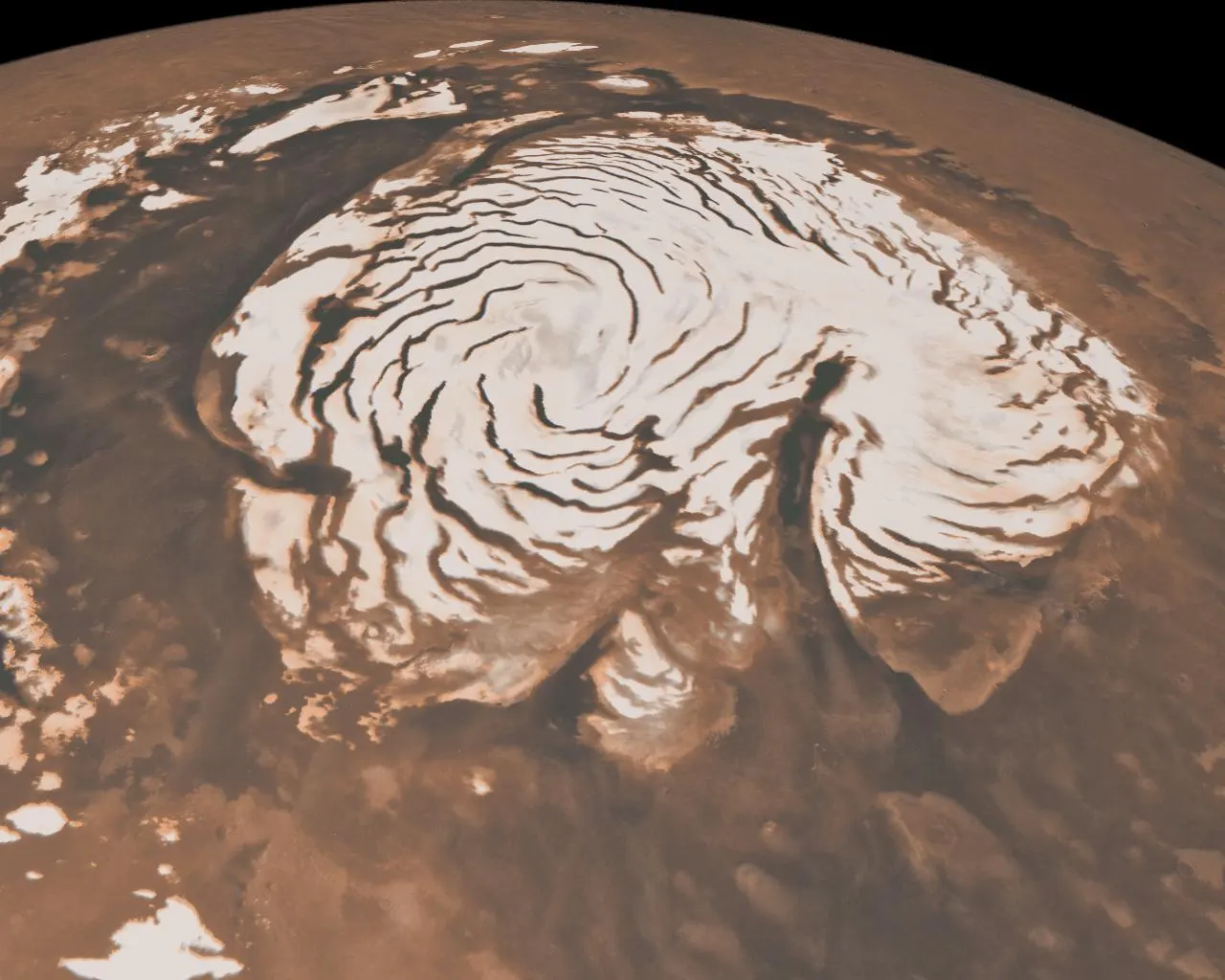
North and South Poles; north cap is water ice year-round, south cap CO2 ice over water ice
Estimated Quantity
~3.7 million km³ equivalent water
Enough water to cover Mars to a depth of ~35 meters if melted
As of 2021-01-01
Location & ISRU Feasibility
Where
Planum Boreum (~88°N) and Planum Australe (~87°S)
Extraction feasibility
Low feasibilityLargest confirmed water reservoirs, but the poles sit far from viable crewed landing zones (which must stay near the equator-to-mid-latitude band for thermal survival and descent margin), so polar ice is impractical as a first-mission feedstock.
Extraction technology
Conceptual surface/near-surface mining (heated drilling or thermal excavation) of high-purity layered ice mapped by MRO/SHARAD; not yet demonstrated on Mars.
Overview
Mars's polar caps contain substantial water ice. The north polar cap is nearly pure water ice (600 m deep, 1,000 km wide) covered in seasonal CO2 frost. SHARAD radar on MRO has mapped the layers in detail. MOLA topography confirms the south cap is offset from geographic south pole and buried under CO2. These are the largest confirmed water repositories on Mars.
ISRU Application
Electrolysis to produce rocket propellant (H₂+O₂), life support water and oxygen for crewed missions, radiation shielding via water walls
Reality Check
Polar ice is far from equatorial landing sites — nearest useful water ice deposits are mid-latitude subsurface glaciers
Sources
- [1] NASA Science (SWIM) — retrieved 2026-06-13
- [2] NASA MRO/SHARAD — retrieved 2026-06-01
Confidence: high · Last verified 2026-06-01
← All Mars ResourcesContinue your journey
Continue the story
Mars resource
Volcanic Basaltic Minerals
Continue the story
Continue the story
Mars resource
CO₂ Atmosphere
Continue the story
Continue the story
Mars resource
Potential Geothermal Energy
Continue the story
Continue the story
Mars resource
Iron Oxide Regolith (Martian Soil)
Continue the story
Continue the story
Mars resource
Perchlorate Compounds (ClO4⁻)
Continue the story
Continue the story
Mars resource
Solar Energy
Continue the story