EnergyDemonstration — lab/mission-tested
Solar Energy
Equatorial and low-latitude zones — usable globally but reduced by ~40-45% vs Earth
Estimated Quantity
~590 W/m² at perihelion, ~493 W/m² at aphelion (vs Earth's 1,361 W/m²)
As of 2021-01-01
Location & ISRU Feasibility
Where
Global, latitude-dependent; best at equatorial/low latitudes (the favored crewed landing band)
Extraction feasibility
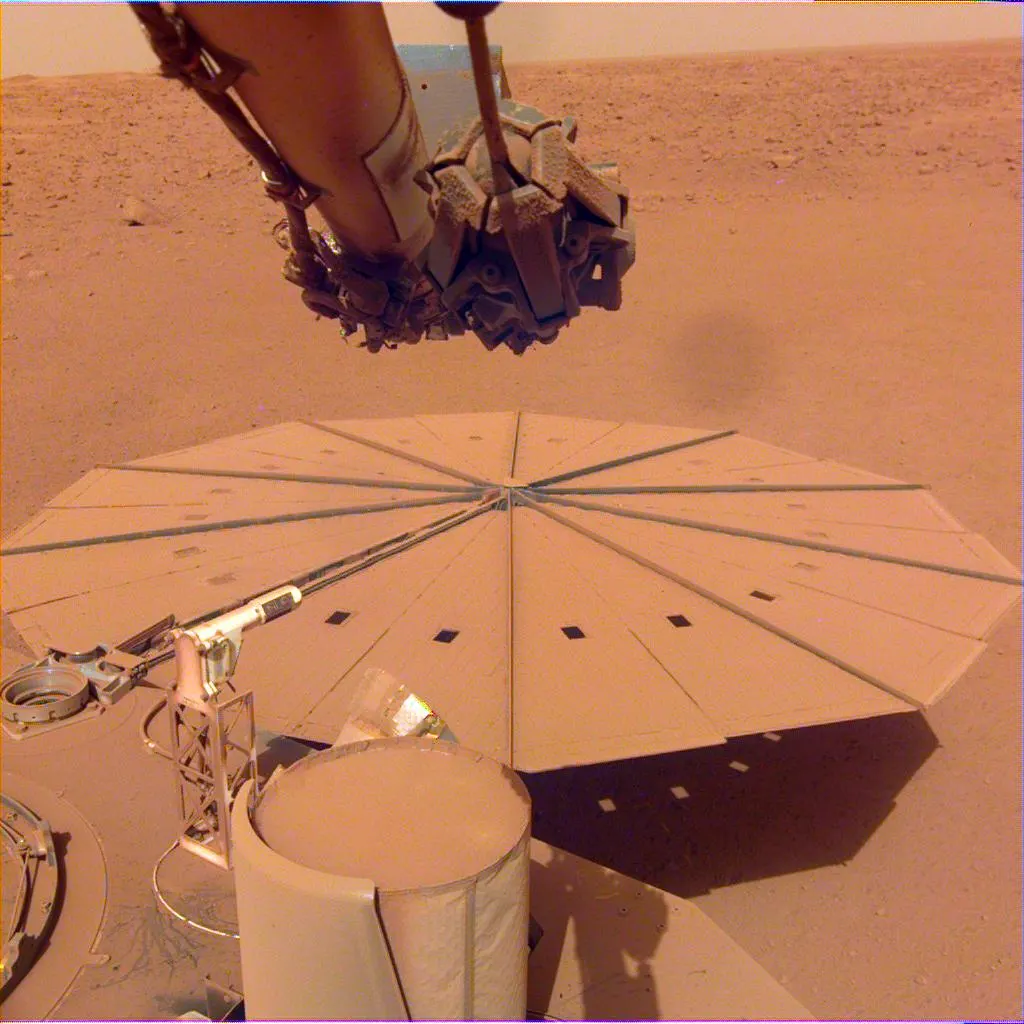
Moderate feasibilityReaches every site but Mars receives only ~43% of Earth's flux (~590 W/m² at perihelion), and global dust storms plus panel dust make it unreliable for sustained crewed power — hence NASA's baseline is fission surface power.
Extraction technology
Photovoltaics are flight-proven on Mars (Spirit, Opportunity, InSight, Ingenuity); for crewed bases NASA is developing ~40 kWe fission surface power to avoid dust-storm vulnerability.
Overview
Mars receives 43-52% of Earth's solar flux due to greater distance (1.38-1.67 AU). Both Curiosity and Spirit solar panels suffered dramatic output reduction during dust storms. InSight's dust accumulation problem showed solar power is viable until regolith begins coating panels. For crewed missions NASA's current baseline is fission surface power (Kilopower/10 kWe reactors) rather than solar arrays, specifically to avoid dust storm vulnerabilities.
ISRU Application
Primary power source for landed assets without RTGs — Perseverance uses RTG while Ingenuity uses solar panels as test case; future crewed habitats must use nuclear fission (Kilopower/KRUSTY) or large solar arrays
Sources
- [1] NASA (Fission Surface Power) — retrieved 2026-06-13
- [2] NASA STMD Kilopower — retrieved 2026-06-01
Confidence: high · Last verified 2026-06-01
← All Mars ResourcesContinue your journey
Continue the story
Mars resource
Volcanic Basaltic Minerals
Continue the story
Continue the story
Mars resource
CO₂ Atmosphere
Continue the story
Continue the story
Mars resource
Potential Geothermal Energy
Continue the story
Continue the story
Mars resource
Iron Oxide Regolith (Martian Soil)
Continue the story
Continue the story
Mars resource
Perchlorate Compounds (ClO4⁻)
Continue the story
Continue the story
Mars resource
Polar Water Ice Caps
Continue the story