Tiangong Space Station
China's T-shaped modular outpost — fully assembled in 2022 and continuously crewed ever since.
Vital statistics
01
Overview
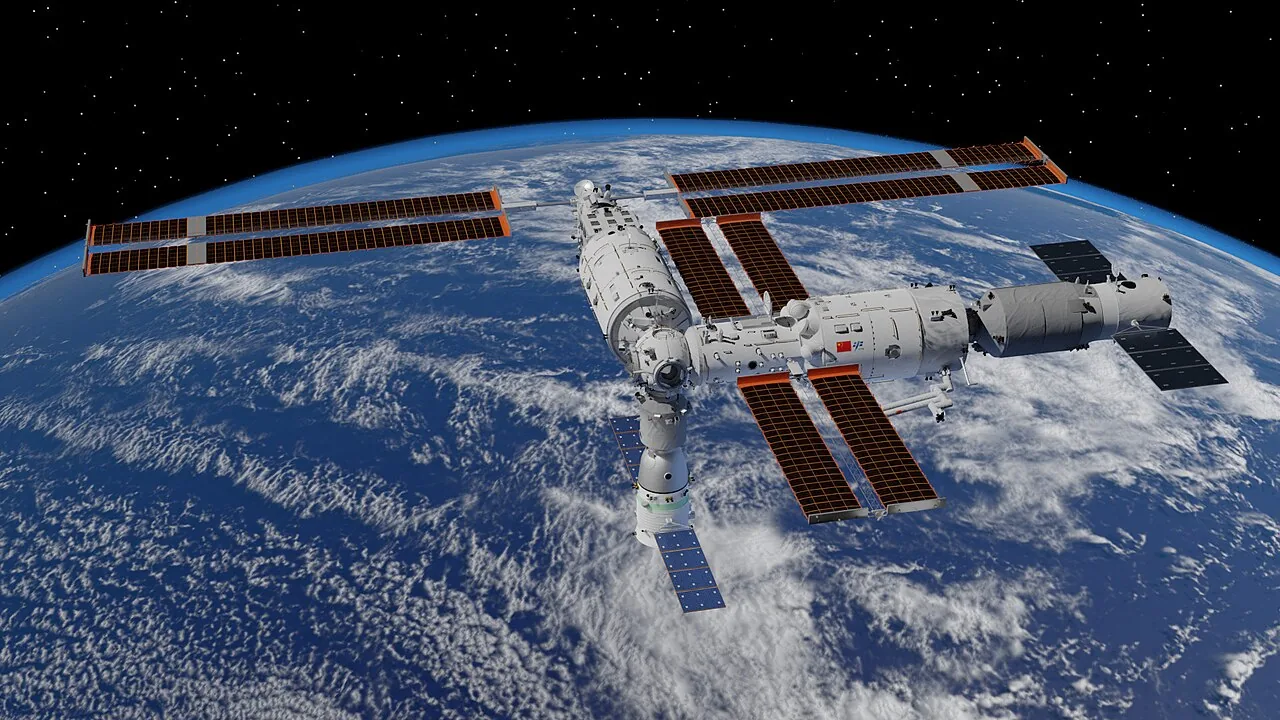
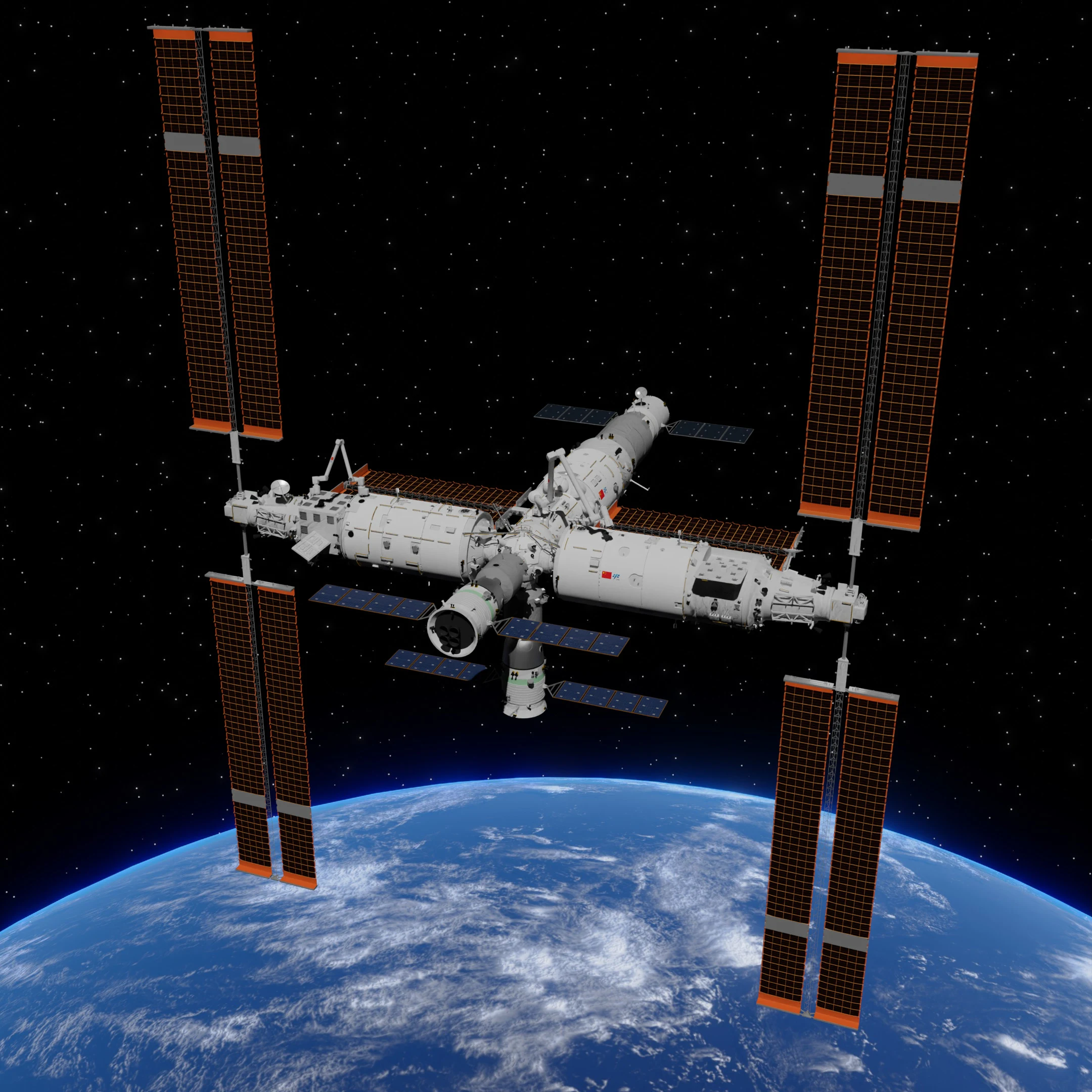
Tiangong — meaning "Heavenly Palace" — is China's third-generation space station and the only fully operational outpost besides the ISS. Operated by the China Manned Space Agency, the T-shaped complex was assembled across three launches in 2021 and 2022 and has been continuously crewed since June 2022. Three taikonauts typically live aboard for six-month rotations, conducting microgravity science, Earth observation, and technology demonstrations. China has stated that Tiangong is open to international collaboration and is actively expanding its experiment programme.
02
Composition
Tiangong's T-shape is built around three pressurised modules. Tianhe, the core module, hosts crew quarters, life support, propulsion, and the main robotic arm. Wentian and Mengtian, the two laboratory modules, dock to lateral ports and carry science racks, an airlock, and an external exposed facility for materials and astrobiology experiments. Visiting Shenzhou crew vehicles and Tianzhou cargo freighters dock at axial ports. Large flexible solar arrays generate power; CMSA has announced plans for additional expansion modules later in the decade.
05
Exploration
The Tianhe core launched on April 29, 2021, followed by Shenzhou-12 in June with the first three taikonauts. Wentian arrived in July 2022 and Mengtian in October 2022, completing the T configuration. Continuous crew rotations began with Shenzhou-14 in June 2022 and have run unbroken since. Crews have performed numerous spacewalks using the airlock on Wentian, hosted students in live "Tiangong Classroom" lessons broadcast across China, and operated experiments ranging from quantum communications to combustion physics in microgravity.
Did you know?
Tiangong is roughly one-fifth the mass of the ISS but was assembled in just 18 months across three launches.
The station's name, "Heavenly Palace", is borrowed from Chinese mythology and predates the modern space programme by centuries.
Tiangong's robotic arm can "walk" hand-over-hand across external grapple fixtures to relocate itself around the station.
During crew handovers, six taikonauts can live aboard simultaneously — Tiangong's short-term peak capacity.
China has invited international experiments aboard Tiangong through a partnership with the United Nations Office for Outer Space Affairs.
Tiangong orbits low enough that it is regularly visible to the naked eye as a bright moving star at dawn or dusk.
The station carries an external exposed-facility platform for long-duration experiments in vacuum and radiation.
Timeline
- 20212021
Tianhe core module launches on a Long March 5B on April 29.
- 20212021
Shenzhou-12 delivers the first three taikonauts to the station in June.
- 20222022
Wentian laboratory module docks in July, adding the airlock and science racks.
- 20222022
Mengtian module arrives in October, completing the T-shaped configuration.
- 20222022
Shenzhou-14 begins continuous occupation in June; handovers have been uninterrupted since.
- 20232023
Tiangong hosts its first batch of internationally selected experiments.