β Persei
Algol
The Demon Star · Eclipsing binary with a tertiary companion
At a glance
- Distance
- 89.9 ly
- Constellation
- Perseus
- Type
- B8V
- Apparent magnitude
- 2.09
- Absolute magnitude
- -0.07
- Mass
- 3.17 M☉
- Radius
- 2.73 R☉
- Luminosity
- 182 L☉
- Surface temp
- 13,000 K
The story
Algol's name comes from the Arabic Ra's al-Ghūl — 'the head of the ogre' — and for good reason: every 2 days, 20 hours, and 49 minutes, this star dims noticeably from magnitude 2.1 to 3.4 over roughly 10 hours, then recovers. It is the prototype of the entire class of Algol-type eclipsing variable stars, and likely the first variable star ever recognised. Ancient Egyptian astronomical texts from the Cairo Calendar (~1200 BCE) appear to record its 2.85-day period, suggesting its blinking was noticed thousands of years ago.
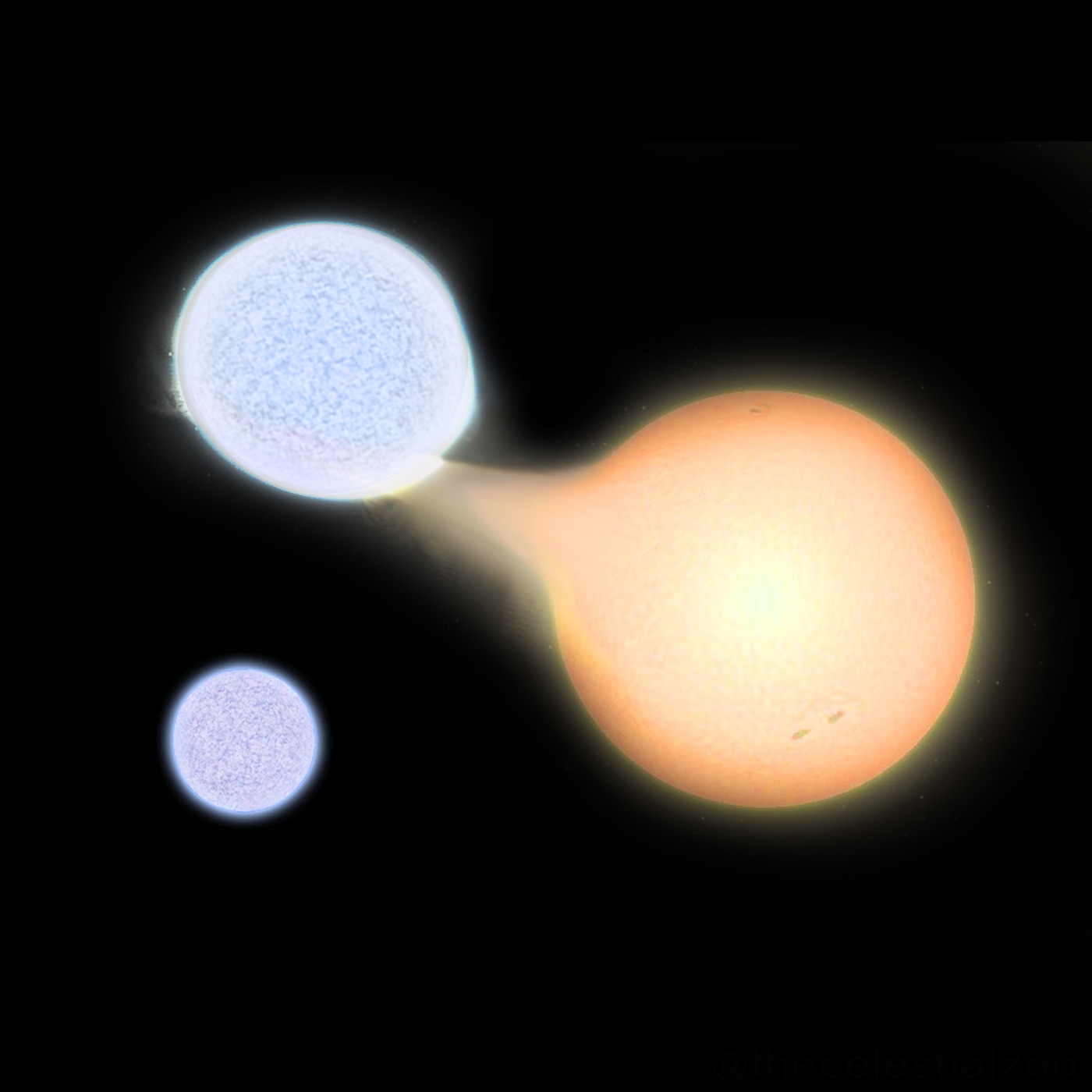
The system is a triple: Algol Aa1, a hot B8V main-sequence star of 3.17 solar masses and 13,000 K, is periodically eclipsed by its cooler subgiant companion Algol Aa2 (0.70 solar masses, 4,500 K, 3.48 solar radii), which swollen from the main sequence passes in front of the primary from Earth's perspective. A third star, Algol Ab (1.76 solar masses), orbits the inner pair every 681 days at roughly 2.69 AU. In 2009, the CHARA interferometer produced the first resolved images of the inner binary at half-milliarcsecond resolution.
Algol presents astronomers with the classic 'Algol paradox': the less massive secondary has evolved into a subgiant while the more massive primary is still on the main sequence — the opposite of what stellar evolution predicts. The resolution is mass transfer: the secondary was originally the more massive star but shed material onto the primary, reversing their mass ratio. The system contains roughly 189 solar luminosities combined, yet from 89 light-years away it sits serenely among the brighter stars of Perseus.
Compared to the Sun
Sun
This star · 2.73× radius
It shines about 182 times as bright as the Sun.
Its fate
Algol's primary (Aa1) will eventually exhaust its hydrogen and swell into a red giant, likely triggering further mass exchange with the already-evolved secondary. Both stars will ultimately shed their outer layers to become white dwarfs, leaving a compact double-degenerate system. The third companion will orbit this dense remnant pair essentially forever on its wide, centuries-long orbit.
Find it in the sky
Algol shines at about magnitude 2.1 when at maximum and sits prominently in Perseus, about 12° northeast of the Pleiades. It is circumpolar from most of the northern hemisphere. Its minimum is easily detected with the naked eye by comparing it to nearby eta and gamma Persei. Light-curve predictions are published in advance by variable star organisations.