α Cygni
Deneb
The Distant Blaze · Blue-white supergiant (A-type Ia)
At a glance
- Distance
- 1,411.9 ly
- Constellation
- Cygnus
- Type
- A2Ia
- Apparent magnitude
- 1.25
- Absolute magnitude
- -8.38
- Mass
- 19 M☉
- Radius
- 203 R☉
- Luminosity
- 196,000 L☉
- Surface temp
- 8,525 K
The story
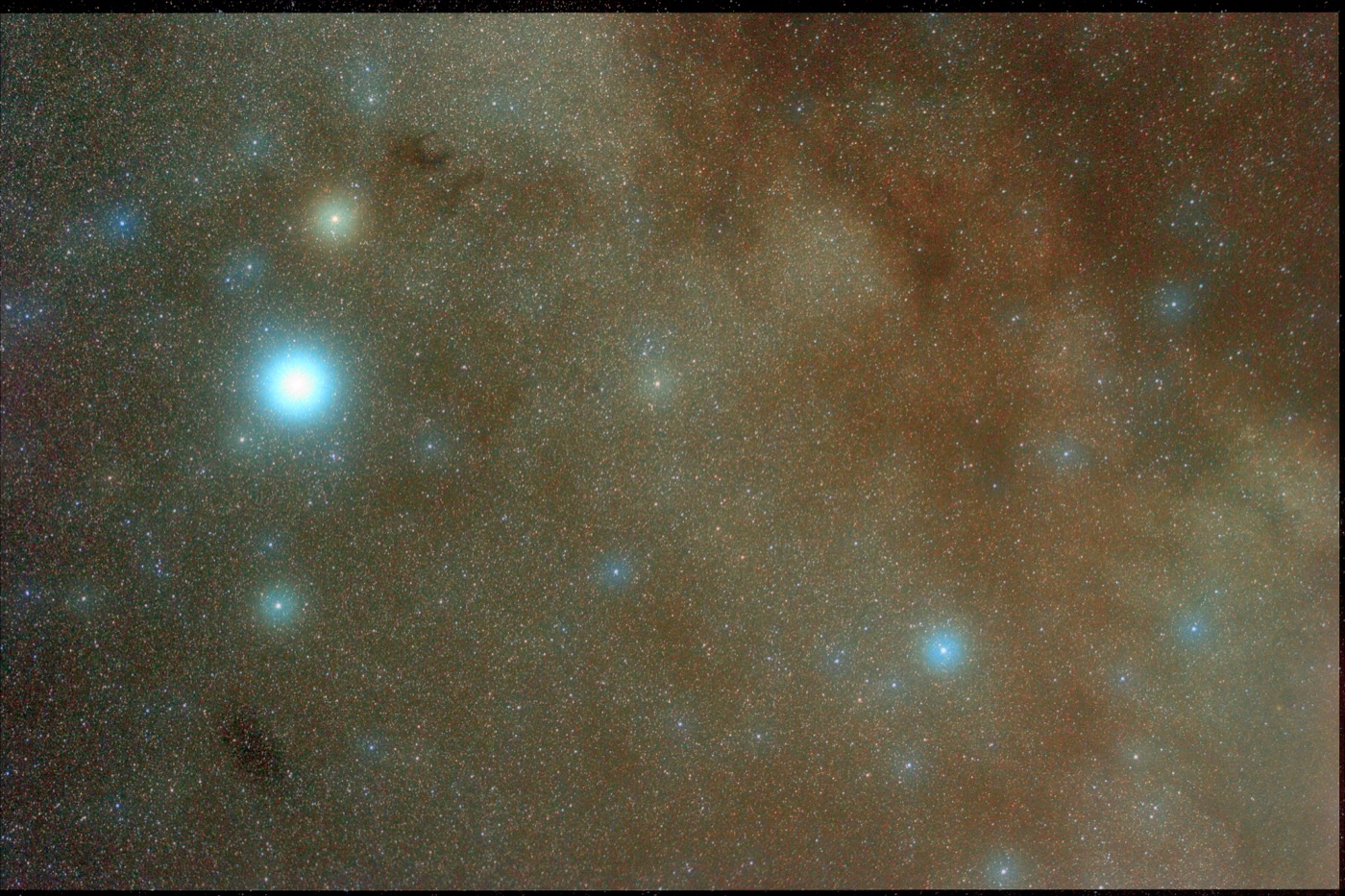
Deneb shines at magnitude 1.25 in Cygnus, the Swan, anchoring the tail of the celestial bird and forming the top of the Northern Cross. What makes it extraordinary is what that brightness hides: Deneb lies roughly 1,400 light-years from Earth — far beyond every other first-magnitude star — yet it still holds its own among the sky's brightest. Its intrinsic luminosity is staggering: around 196,000 times the Sun, making it one of the most luminous stars visible to the naked eye in the entire Milky Way.
The name comes from the Arabic Dhanab al-Dajājah, 'Tail of the Hen'. Deneb is one of the three vertices of the Summer Triangle alongside Vega and Altair, a great asterism that dominates northern summer and autumn nights. In Chinese astronomy it was the centre of the 'Northern Land of the Crane'. Polynesian navigators used the Northern Cross as a wayfinding aid. The star's extreme distance makes it a rare example of a first-magnitude star whose physical nature — a blue-white A-type supergiant 200 times the Sun's diameter — completely explains the brightness through raw power rather than proximity.
Deneb has already fused the hydrogen in its core and is now fusing heavier elements in shells, inflating its outer layers to immense size. It exhibits low-amplitude photometric and radial-velocity variability, placing it in the class of Alpha Cygni variables — slowly pulsating supergiants. Its distance is still debated: Hipparcos parallax measurement placed it variously between 1,400 and 2,600 light-years depending on the analysis, and the luminosity estimate scales with the square of distance, so published values range from 55,000 to 196,000 solar luminosities.
Compared to the Sun
Sun
This star · 203× radius
It shines about 196,000 times as bright as the Sun.
Its fate
Deneb is a supergiant on the verge of catastrophic collapse. With 19 solar masses, it has only a few million years left before its core fails and it explodes as a core-collapse supernova — a titanic event that, because of its distance, will present no hazard to Earth but could potentially rival Venus in brightness for weeks. The remnant will likely be a neutron star.
Find it in the sky
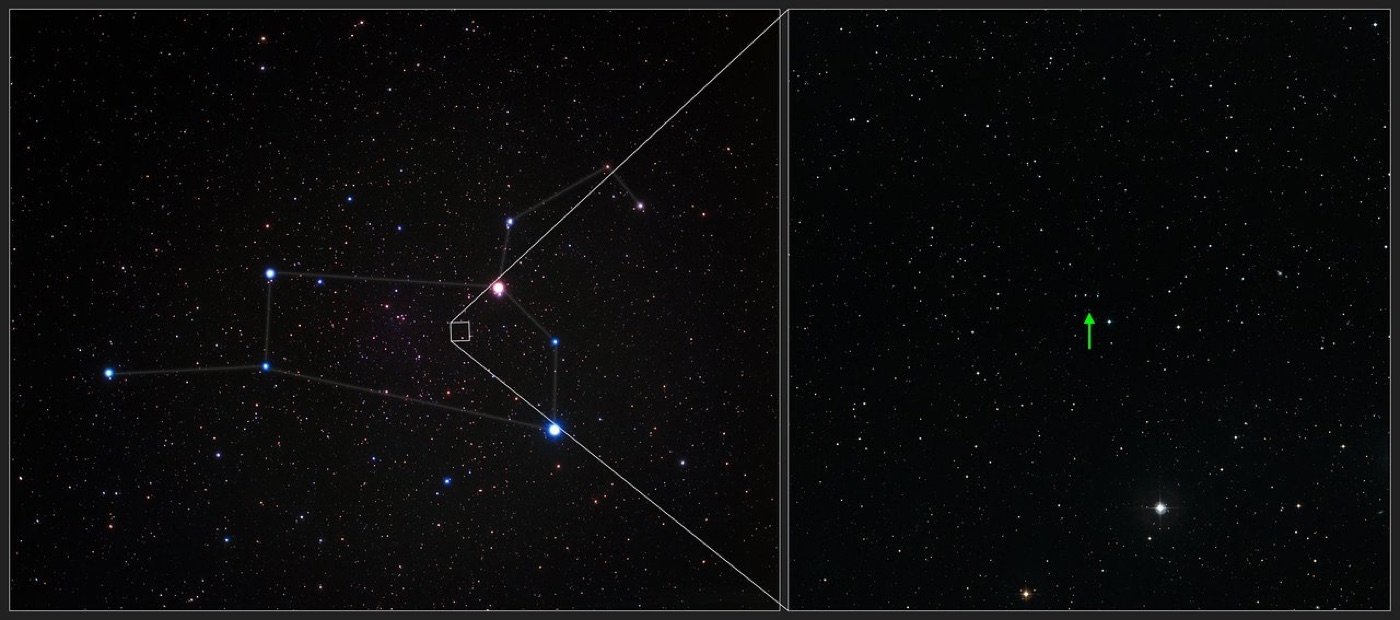
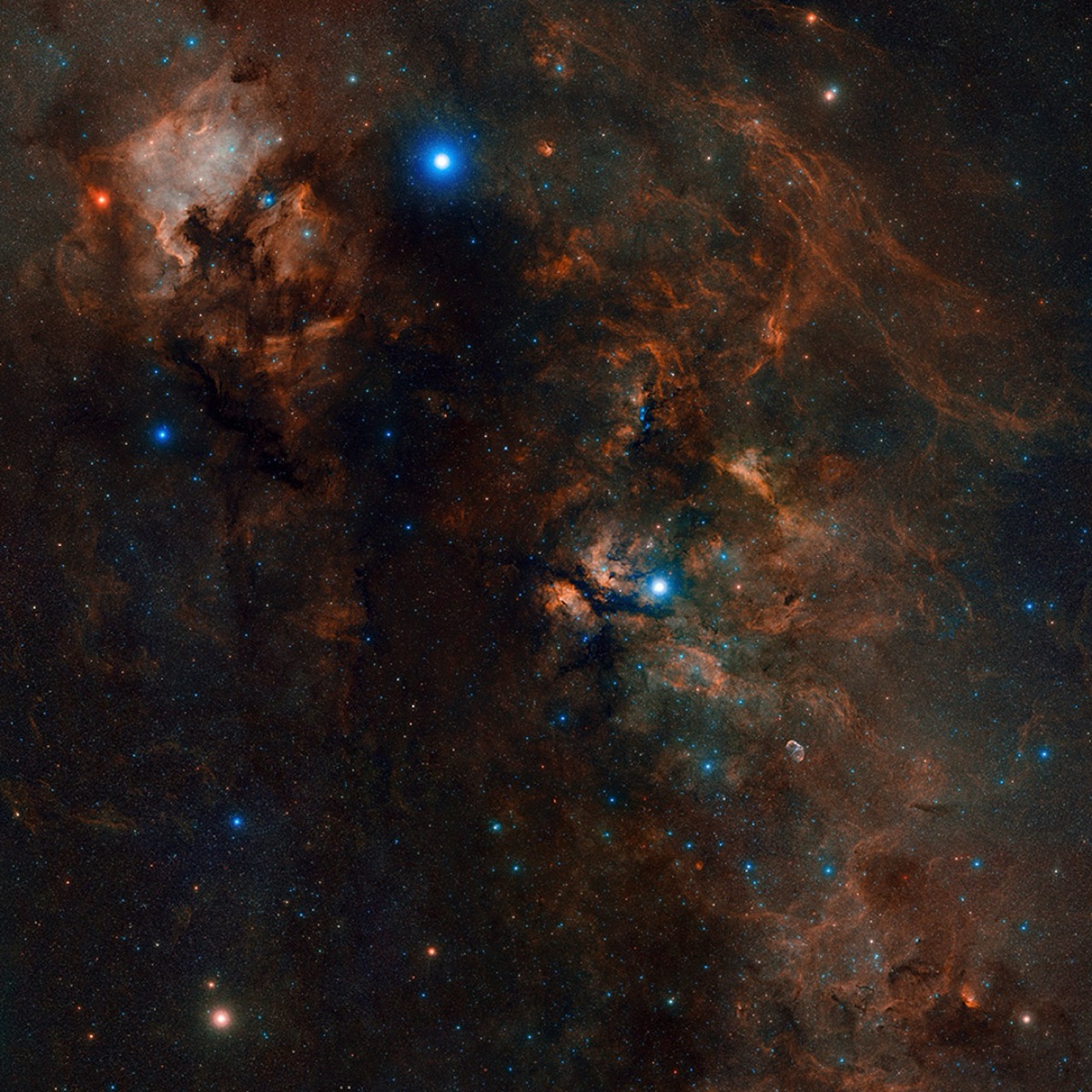
Deneb is the topmost star of the Northern Cross and marks the tail of Cygnus the Swan. It is circumpolar from latitudes above about 45°N. In the northern summer and autumn it passes nearly overhead for mid-northern observers and is easy to spot as the brightest point at the top of the Summer Triangle (the others being Vega and Altair). Watch for the long axis of the Northern Cross to point toward the horizon in winter evenings — Deneb will be at the top.