Not If, But When -- and How
For decades, the idea of a permanent base on the Moon belonged to science fiction. Domed cities, underground colonies, and lunar factories filled the pages of novels and the frames of movies. But today, multiple space agencies and private companies are actively designing, testing, and budgeting for real lunar habitats. The question is no longer whether humanity will build a permanent base on the Moon. The question is when, where, and how.
The answer, it turns out, involves 3D printers the size of buildings, inflatable rooms, nuclear reactors, and a whole lot of Moon dust.
The Two Big Plans: Artemis Base Camp and ILRS
Two distinct and competing visions for a permanent lunar base are currently taking shape, one led by the United States and its partners, and the other by China and Russia.
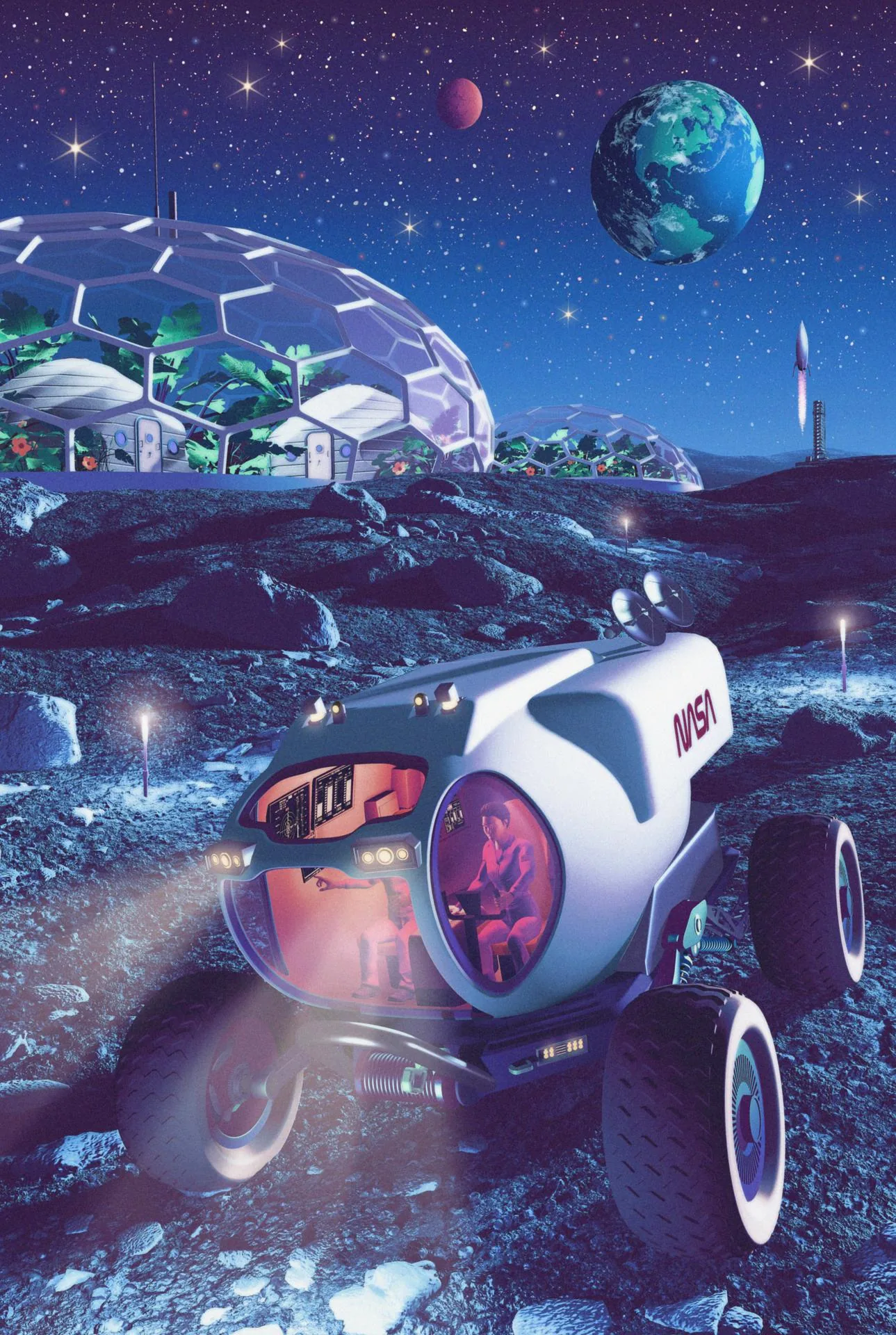
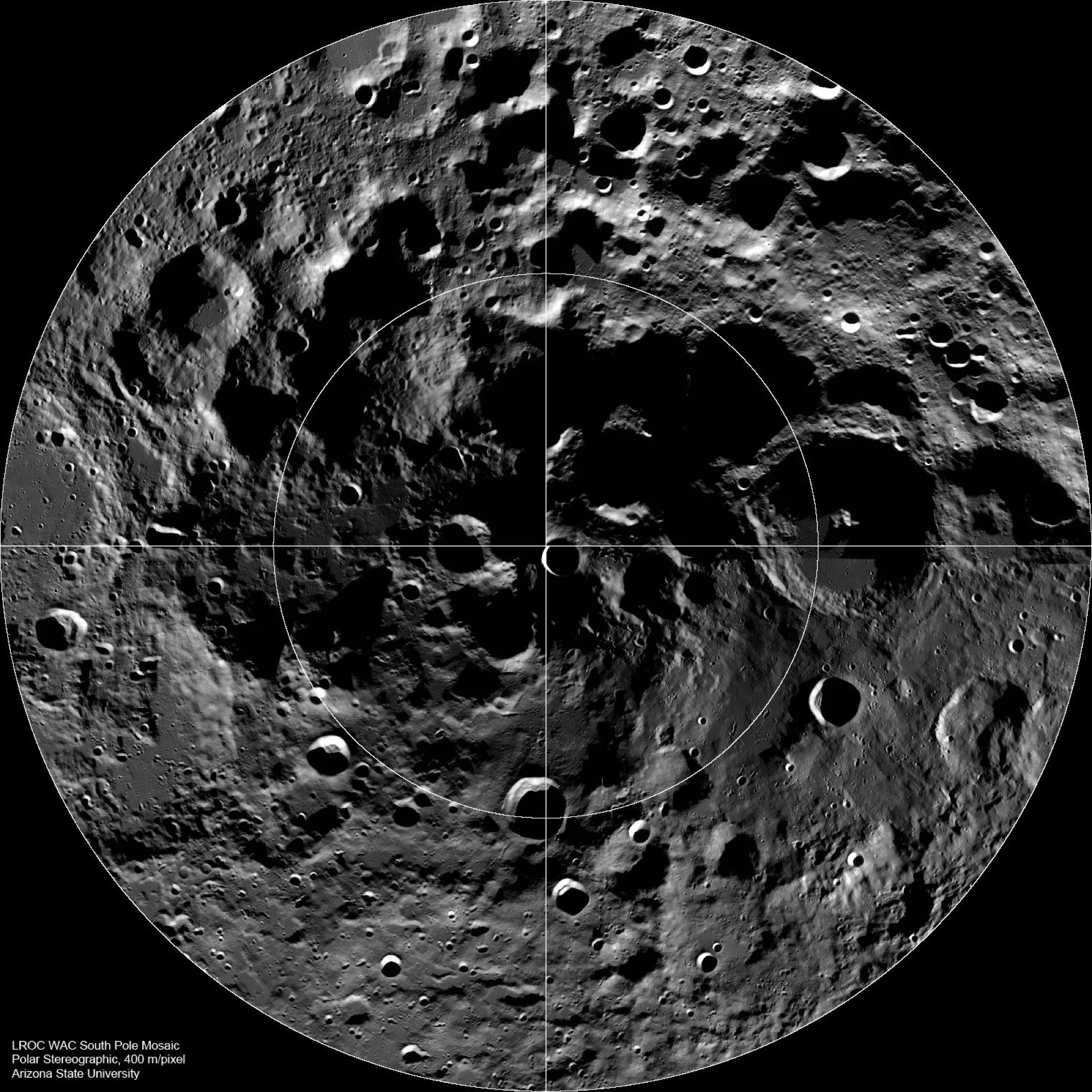
NASA's Artemis Base Camp is the American-led concept for a sustained human presence at the lunar south pole. The plan envisions three core elements: a surface habitat where astronauts can live and work for stays of up to two months, an unpressurized Lunar Terrain Vehicle (LTV) for local excursions, and a pressurized rover capable of carrying two astronauts on multi-day traverses lasting up to 45 days, covering distances of hundreds of kilometers from the base.
The surface habitat would initially support crews of four for missions lasting one to two months, with infrastructure gradually expanding over successive Artemis missions. Power would come from a combination of solar arrays and nuclear fission systems. ISRU (in-situ resource utilization) systems would eventually extract water from permanently shadowed regions and process it for life support and potentially propellant production. NASA has contracted several companies to study surface habitat designs, including proposals from Lockheed Martin, Northrop Grumman, and others.
The International Lunar Research Station (ILRS) is the China-Russia joint initiative, announced in 2021 and open to international partners. China has outlined a phased construction plan. Phase 1 (reconnaissance, 2025-2030) focuses on robotic missions to survey the south polar region, including Chang'e 7 (orbiter, lander, rover, and flying probe) and Chang'e 8 (technology verification for resource utilization and 3D printing construction). Phase 2 (construction, 2030-2035) would see the deployment of initial infrastructure modules. Phase 3 (utilization, 2035 onward) envisions a permanently crewed or semi-permanently crewed facility.
China has invited partner nations to participate, and several countries including Pakistan, Venezuela, South Africa, Azerbaijan, and Belarus have signed memoranda of understanding. The ILRS represents a direct alternative to the US-led Artemis framework and the Artemis Accords, creating a two-bloc dynamic in lunar exploration that echoes the original Space Race.
Building with Moon Dust: 3D Printing with Regolith
One of the most promising technologies for lunar construction is additive manufacturing -- commonly known as 3D printing -- using lunar regolith as the raw material. Shipping building materials from Earth to the Moon costs roughly $1 million per kilogram. But regolith is everywhere on the Moon, meters deep across virtually the entire surface. If you can turn that regolith into structural components, you dramatically reduce the mass that needs to be launched from Earth.
Several research teams and companies are developing methods to do exactly this. The European Space Agency has partnered with architectural firm Foster + Partners to design a concept for a 3D-printed lunar habitat using regolith. Their approach involves deploying an inflatable structural dome, then using autonomous robotic 3D printers to build a thick regolith shell over it, layer by layer. The regolith shell would provide thermal insulation, micrometeorite protection, and radiation shielding.
NASA's Moon-to-Mars Planetary Autonomous Construction Technology (MMPACT) project is testing robotic construction systems that could build infrastructure elements -- landing pads, roads, berms, and habitat shells -- from lunar regolith. In 2022, ICON, an Austin-based construction technology company, received a $57.2 million NASA contract to develop a lunar construction system using its large-scale 3D printing technology.
The process typically involves either sintering regolith (heating it until particles fuse together without fully melting) or mixing it with a binding agent. Tests using lunar regolith simulant on Earth have produced structural blocks and components with compressive strength comparable to concrete. The challenge is making this work reliably in the lunar environment: one-sixth gravity, vacuum, extreme temperature swings, and abrasive dust that can damage equipment.
Inflatable Habitats: Light to Launch, Spacious on Arrival
Another key technology for lunar bases is inflatable -- or more precisely, expandable -- habitats. The basic idea is elegant: launch a compact, folded structure that is light and fits inside a rocket fairing, then inflate it on the lunar surface to create a much larger pressurized volume.
Bigelow Aerospace pioneered this concept with the BEAM (Bigelow Expandable Activity Module) that was attached to the International Space Station in 2016. BEAM expanded from a compact 1.7-meter-long cylinder to a 4-meter-long, 3.2-meter-diameter room and has been performing well for years, demonstrating that expandable structures can maintain pressure integrity and provide adequate radiation and debris protection in space.
For the Moon, Sierra Space is developing the LIFE (Large Integrated Flexible Environment) habitat, a three-story expandable module that could provide approximately 300 cubic meters of pressurized volume -- roughly equivalent to a comfortable two-bedroom apartment. The LIFE module is designed to launch compactly aboard a single rocket and expand upon deployment.
The advantages of expandable habitats are compelling. They offer high volume-to-mass ratios, meaning you get a lot of living space for relatively little launch mass. Their flexible walls can incorporate multiple layers of radiation shielding, thermal insulation, and micrometeorite protection. And their interior can be configured modularly for different functions -- sleeping quarters, laboratories, medical facilities, or storage.
A likely lunar base architecture would combine rigid modules (for airlocks, equipment rooms, and critical systems) with expandable modules (for crew quarters and workspace), all covered by a thick layer of regolith shielding applied by 3D printing robots.
Powering a Lunar Base: The Nuclear Imperative
Solar power is abundant at certain locations near the lunar south pole -- ridges and crater rims that receive near-constant sunlight could host solar arrays that generate power for most of the lunar year. But solar has limitations. Even at the best locations, there are brief periods of darkness. More critically, any operations in permanently shadowed regions -- where the water ice is -- require power sources that do not depend on sunlight.
This is where nuclear fission comes in. NASA's Kilopower project successfully demonstrated a small fission reactor prototype called KRUSTY (Kilopower Reactor Using Stirling Technology) in a 28-hour test at the Nevada National Security Site in March 2018. KRUSTY used a uranium-235 core about the size of a paper towel roll to generate up to 1 kilowatt of electrical power via Stirling engines.
Building on Kilopower, NASA launched the Fission Surface Power (FSP) project in 2022, awarding contracts to Lockheed Martin, Intuitive Machines (in partnership with IX -- a joint venture with X-Energy), and Westinghouse to design 40-kilowatt fission power systems that could operate on the Moon. A 40-kilowatt reactor could power roughly 30 average American households and would provide abundant energy for habitat systems, ISRU processing, rover charging, and scientific instruments.
The beauty of nuclear fission for the Moon is that it works anywhere, anytime -- in permanent shadow, through the 14-day lunar night, during dust storms (not a lunar concern, but relevant for Mars), and at any latitude. A single compact reactor could provide a lunar base with reliable baseload power for a decade or more.
China has also announced plans for nuclear power on the Moon as part of the ILRS program, though fewer details have been made public about their specific reactor designs.
Life Support: Closing the Loop
A permanent base must recycle nearly everything. On the ISS, the Environmental Control and Life Support System (ECLSS) already recovers about 90 percent of the water from crew urine and humidity condensate. Lunar systems will need to push that figure even higher and also close the loop on oxygen and carbon dioxide.
Plants will likely play a role. Bioregenerative life support systems that use crops to convert carbon dioxide to oxygen while producing food are being studied intensively. In 2019, China's Chang'e 4 mission carried a small biosphere experiment to the far side of the Moon, successfully germinating cotton seeds -- the first plant growth on another world.
A mature lunar base might feature greenhouses where crops grow under artificial light, supplementing the crew's diet while contributing to air and water recycling. This is still early-stage technology, but it represents the path toward truly self-sustaining habitats.
Radiation: The Invisible Challenge
Radiation is one of the most serious obstacles to long-term habitation on the Moon. Without Earth's magnetic field and thick atmosphere for protection, the lunar surface is exposed to galactic cosmic rays (GCRs) and solar particle events (SPEs). GCRs are a constant background of high-energy particles from outside the solar system. SPEs are intense bursts of radiation from solar flares and coronal mass ejections.
On the lunar surface, the radiation dose is estimated at about 60 microsieverts per hour -- roughly 200 times the average dose rate on Earth's surface. Over a year, that translates to about 526 millisieverts, well above the recommended annual limit for radiation workers on Earth (20 millisieverts) and approaching the career dose limits NASA sets for astronauts.
The solution is shielding. Two to three meters of regolith covering a habitat would reduce radiation exposure to near-Earth levels. This is a primary driver behind the 3D-printing-with-regolith approach -- building thick protective shells is not just about structural integrity, it is about keeping people alive. For SPEs, which can deliver dangerous doses in hours, a heavily shielded "storm shelter" within the base would provide emergency protection.
When Will It Happen?
Realistic timelines suggest the first continuously inhabited lunar base is likely in the late 2030s or 2040s. NASA's Artemis program aims to establish foundational surface infrastructure in the late 2020s and early 2030s, with increasing mission duration and capability over time. China's ILRS roadmap calls for initial infrastructure by the early 2030s and utilization by 2035.
The critical milestone is not the first habitat on the Moon -- it is the first ISRU demonstration that successfully extracts usable resources from the lunar environment. Once we prove we can make water, oxygen, and fuel from local materials, the economics of a permanent base shift from prohibitive to compelling.
A Home Beyond Earth
Building a permanent Moon base is the hardest construction project humanity has ever attempted. It requires solving engineering problems in power, life support, radiation protection, construction, transportation, and resource extraction simultaneously, in an environment that is actively trying to kill you at every moment.
But we have the technology, or are very close to having it, for every single piece of the puzzle. What we are building now -- through Artemis, through ILRS, through CLPS, and through the work of hundreds of companies and thousands of engineers -- is the foundation for humanity's second home.
The Moon is not our destination. It is our first address off-world. And the construction crews are suiting up.