On the morning of September 24, 2014, a control room in Bengaluru held its breath. A small spacecraft roughly the size of a compact car, built for a fraction of what most nations spend, was about to fire an engine that had been dormant for 300 days in the deep cold of interplanetary space. If the burn failed, India's first voyage to another planet would sail silently past Mars and vanish into the dark. It did not fail. Minutes later, applause erupted, and a country of more than a billion people had done something no other had ever managed on a first try: it had put a robotic emissary into orbit around the Red Planet.
The mission was called the Mars Orbiter Mission — MOM for short — but almost everyone knows it by its Sanskrit nickname, Mangalyaan, "Mars craft." It remains one of the most quietly astonishing achievements in the history of planetary exploration, not because it did anything a superpower's probe could not, but because of how it got there, and what it cost.
A first-try success no one else has matched
Reaching Mars is genuinely hard. For decades, roughly half of all missions sent to the planet failed — engines misfired, spacecraft missed the planet entirely, landers slammed into the surface. The Soviet Union tried repeatedly through the 1960s and 1970s and was largely humbled. Even NASA, the gold standard, lost missions along the way. So when the Indian Space Research Organisation announced it would attempt Mars, skeptics were plentiful. This was, after all, an agency far better known for weather and communications satellites than for interplanetary flight.
Mangalyaan succeeded on the first attempt. That made India the fourth space power to reach Mars orbit — after the Soviet program, NASA, and the European Space Agency — and, crucially, the only one ever to arrive on its debut mission. It also made India the first Asian nation to orbit Mars, beating regional rivals to the milestone. The distinction is not mere trivia. Getting it right the first time meant getting a thousand small engineering decisions right simultaneously, with no chance to learn from a prior failure.
Frugal engineering, or the cost of a movie ticket
The number that made headlines around the world was the price tag: about ₹450 crore, or roughly $74 million. To put that in perspective, commentators noted it was less than the budget of the Hollywood film Gravity, released the same year. ISRO's chairman at the time, K. Radhakrishnan, offered an even more vivid comparison, pointing out that the cost worked out to about ₹7 per kilometer of the journey — cheaper than an auto-rickshaw ride across an Indian city. NASA's roughly contemporaneous MAVEN orbiter, by contrast, cost several times as much.
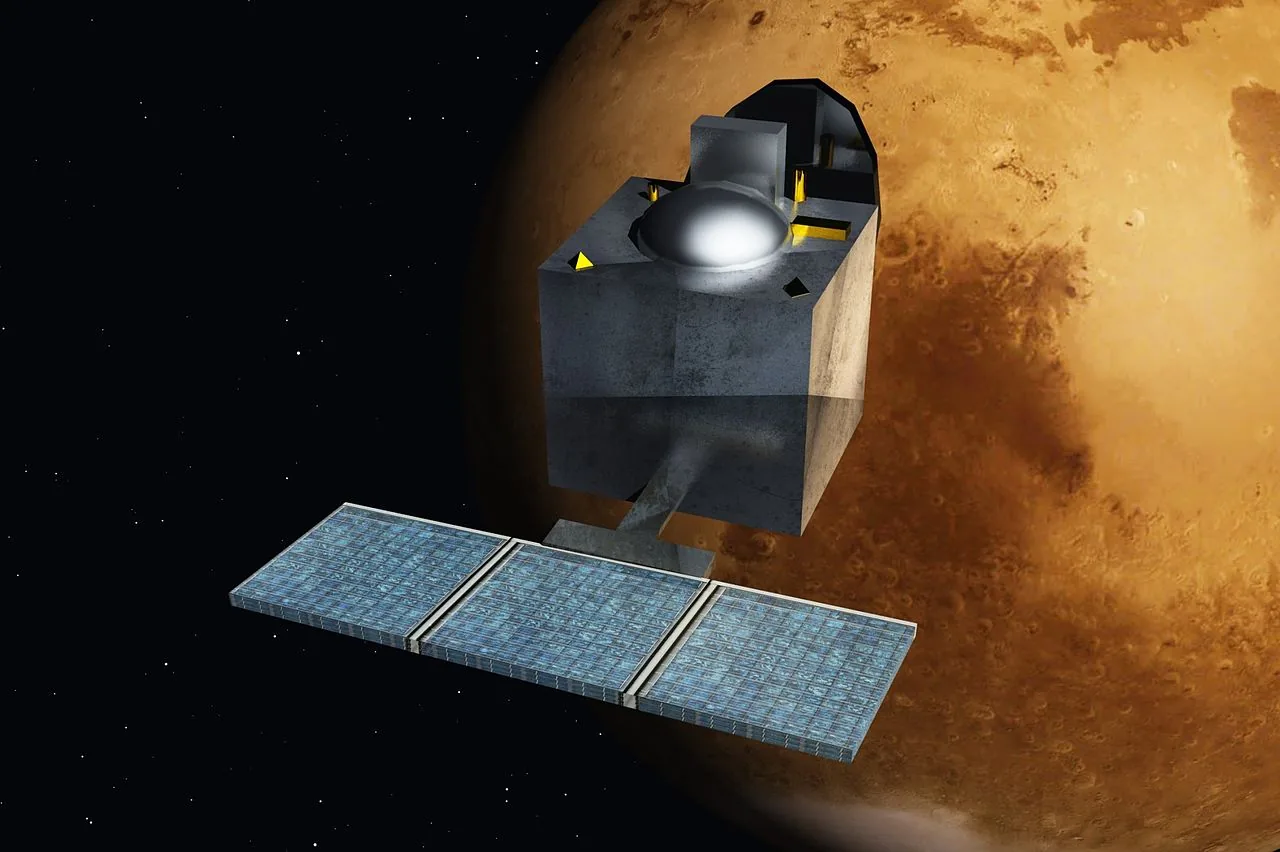
How was this possible? Partly through what engineers call frugal innovation — designing to the problem rather than to a wish list. ISRO kept the spacecraft light, at around 1,350 kilograms fully fueled, and modest in its scientific ambitions, carrying just five compact instruments with a combined mass under 15 kilograms. The team leaned heavily on hardware and know-how already proven on the Chandrayaan-1 lunar mission and on India's satellite programs, rather than inventing everything from scratch. Long working hours and comparatively low labor costs helped, but so did a culture of doing more with less that had defined ISRO since its earliest days launching sounding rockets on bicycles. The satellite portion alone came in at around ₹153 crore — about $16 million.
The slingshot to Mars
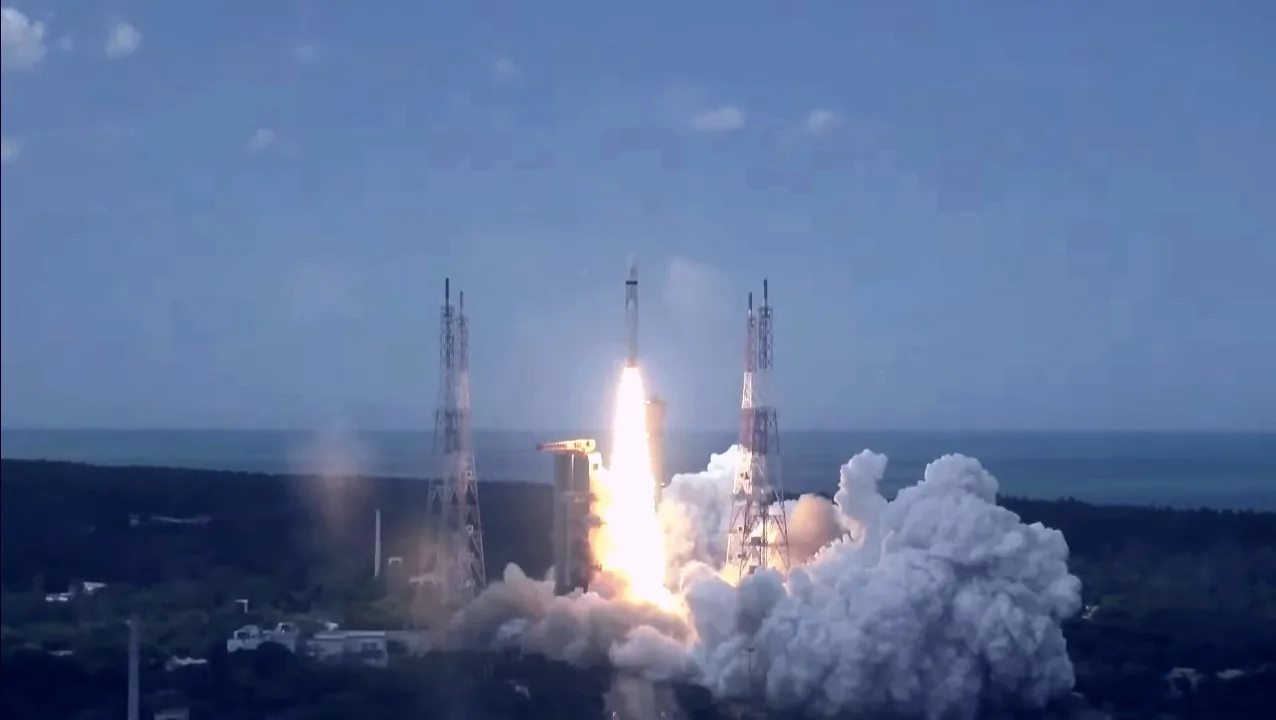
The cost discipline began with the rocket. India did not yet have a launcher powerful enough to fling a spacecraft directly onto a Mars trajectory, so ISRO used its dependable workhorse, the Polar Satellite Launch Vehicle, in its most powerful "XL" configuration. On November 5, 2013, PSLV-C25 lifted off from the Satish Dhawan Space Centre at Sriharikota and placed Mangalyaan into a highly elliptical parking orbit around Earth.
Then came the clever part. Rather than escaping Earth in one burn, the spacecraft fired its own engine at the low point of its orbit seven times over the following weeks, raising the far end of the orbit higher and higher — from an initial apogee of about 23,900 kilometers to nearly 193,000 kilometers. Each pass built up energy, like a child pumping a swing. On November 30, 2013, with the orbit stretched to its maximum, the engine fired for about 23 minutes in a trans-Mars injection burn that slung the craft out of Earth's grip and onto a long Hohmann transfer arc toward the Red Planet — a journey of some 780 million kilometers.
For nearly ten months, Mangalyaan coasted. The decisive moment arrived on September 24, 2014, when the main engine — silent for almost a year — reignited for roughly 23 minutes to slow the craft enough for Mars's gravity to capture it. The engine performed flawlessly. Mangalyaan settled into a highly elliptical orbit ranging from about 420 kilometers at its closest to nearly 77,000 kilometers at its farthest — a wide, looping path perfect for imaging the whole disc of the planet.
Five instruments, one big picture
Mangalyaan was officially a technology demonstrator — its primary purpose was to prove India could design, launch, navigate, and operate an interplanetary mission at all. But it was not scientifically empty. It carried five instruments chosen to sketch a broad portrait of Mars.
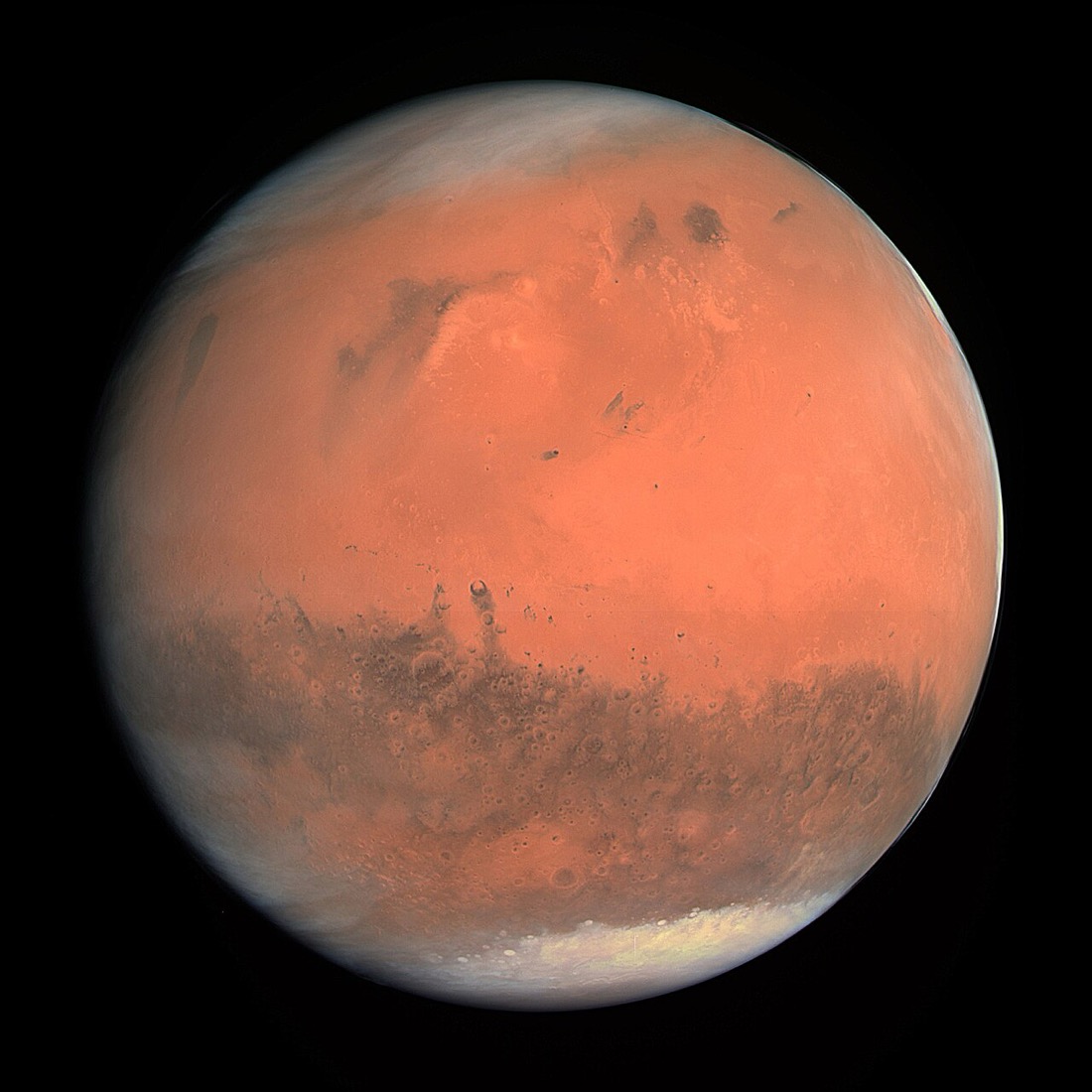
The Mars Colour Camera (MCC) became the mission's most beloved payload. Because of its wide, looping orbit, it could photograph the entire Martian disc in a single frame — full-globe portraits that most orbiters, hugging closer to the surface, cannot capture. It returned hundreds of striking color images of Mars, its polar caps, its dust storms, and its tiny moons.
The Methane Sensor for Mars (MSM) was designed to hunt for methane, a gas that on Earth is often tied to life and that had been tantalizingly, controversially reported at Mars. The Thermal Infrared Imaging Spectrometer (TIS) mapped surface temperature and mineral composition day and night. The Mars Exospheric Neutral Composition Analyser (MENCA) sampled the thin gas of the upper atmosphere, particle by particle. And the Lyman Alpha Photometer (LAP) measured the ratio of deuterium to ordinary hydrogen high above the planet — a chemical fingerprint of how much water Mars has lost to space over billions of years. Together, the instruments returned data on the escaping atmosphere, surface mineralogy, and the planet's dust environment, contributing modestly but genuinely to Mars science.
Six months planned, eight years delivered
Mangalyaan was built to last six months in Mars orbit. It lasted more than eight years. Long after its official mission ended, the little orbiter kept working, kept photographing, and kept sending data home — a testament to conservative engineering and careful operations. Over its lifetime it circled Mars thousands of times and returned a rich archive of imagery, including a Mars atlas assembled from its photographs.
The end came in April 2022. The spacecraft entered a series of long eclipses — periods when Mars blocked the Sun for hours at a stretch, far longer than the roughly one-and-a-half-hour shadow periods its batteries were built to endure. During one such eclipse, lasting about seven hours, the battery drained beyond recovery and the propellant needed to keep the craft oriented ran dry. Communication was lost. In October 2022, ISRO acknowledged that Mangalyaan was non-recoverable and had reached the end of its life. It had outlived its design lifetime many times over.
A mission that changed how India sees itself
Few space missions become cultural touchstones. Mangalyaan did. A photograph taken in ISRO's mission control on the day of orbit insertion — women scientists in colorful saris embracing in celebration — circled the globe and became an enduring image of Indian science, a rebuttal to every assumption about who does spaceflight. The mission inspired the 2019 Hindi film Mission Mangal, and the orbiter itself was featured on the reverse of India's ₹2,000 banknote, printing a Mars mission into the pockets of an entire nation.
More than symbolism, Mangalyaan reset expectations. It signaled that ambitious deep-space science need not be the exclusive preserve of the wealthiest agencies, and it gave ISRO the confidence — and the global credibility — to plan bolder ventures. The mission's frugal blueprint has since been studied by space agencies and startups worldwide as a model for doing interplanetary science on a budget.
What comes next: Mangalyaan-2
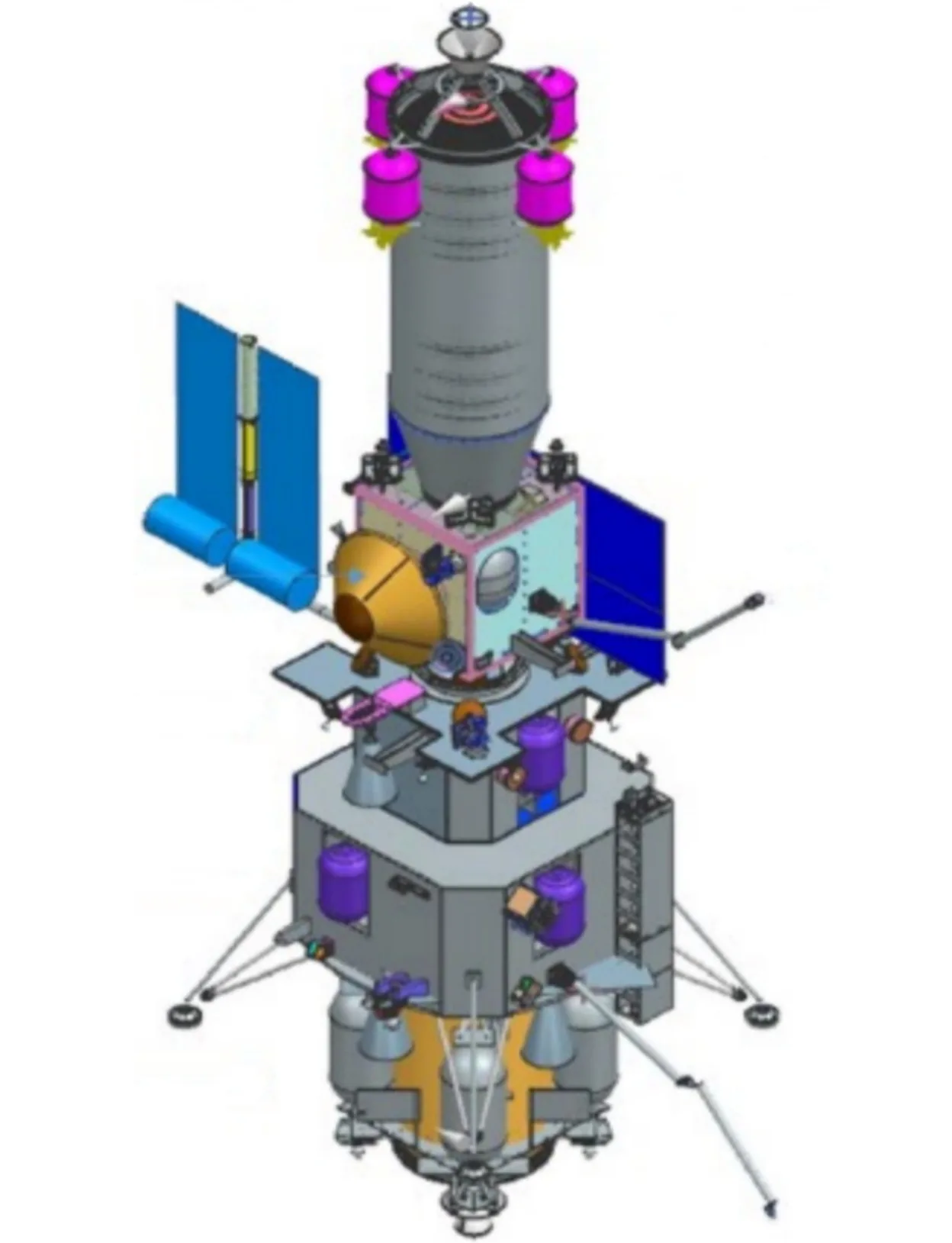
India is not finished with Mars. ISRO has been developing a far more ambitious successor, informally called Mangalyaan-2 and formally associated with a proposed Mars Lander Mission. Where the first mission was a lightweight orbiter meant to prove a point, the sequel aims much higher. As of 2026, mission concepts describe a spacecraft weighing in the range of 4,000 to 4,500 kilograms, launched aboard India's heavy-lift LVM3 rocket, and carrying a far larger scientific payload.
Reporting on the evolving design has pointed to an audacious surface component — potentially a lander delivered by a supersonic parachute and sky-crane system, along with a rover and even a small Mars helicopter, echoing the technologies NASA has demonstrated on the Red Planet. If any version of that plan succeeds, India would join the United States and China in the very small club of nations to have operated on the Martian surface. Timelines have slipped and shifted, as they often do for missions of this complexity, with launch estimates hovering around the second half of the decade rather than a firm date. ISRO has learned to under-promise and over-deliver.
Whatever form Mangalyaan-2 ultimately takes, its lineage is clear. It descends from a modest orbiter that a skeptical world watched arrive at Mars on its first attempt, built by a team that treated a shoestring budget not as a limitation but as a design brief. Mangalyaan proved that reaching another world is, above all, a matter of ingenuity — and that the distance between ambition and achievement can be measured, sometimes, in the price of a movie ticket.