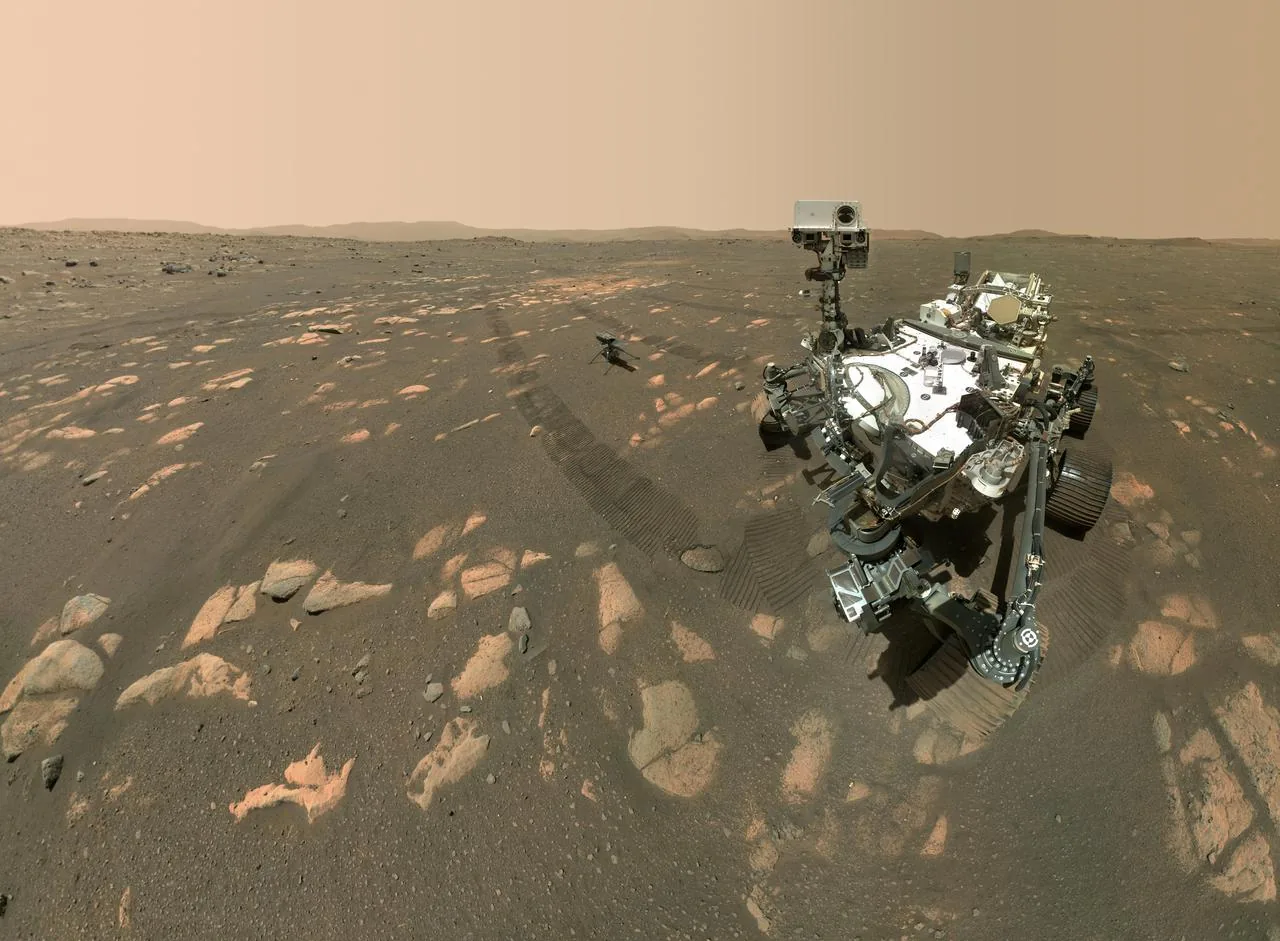
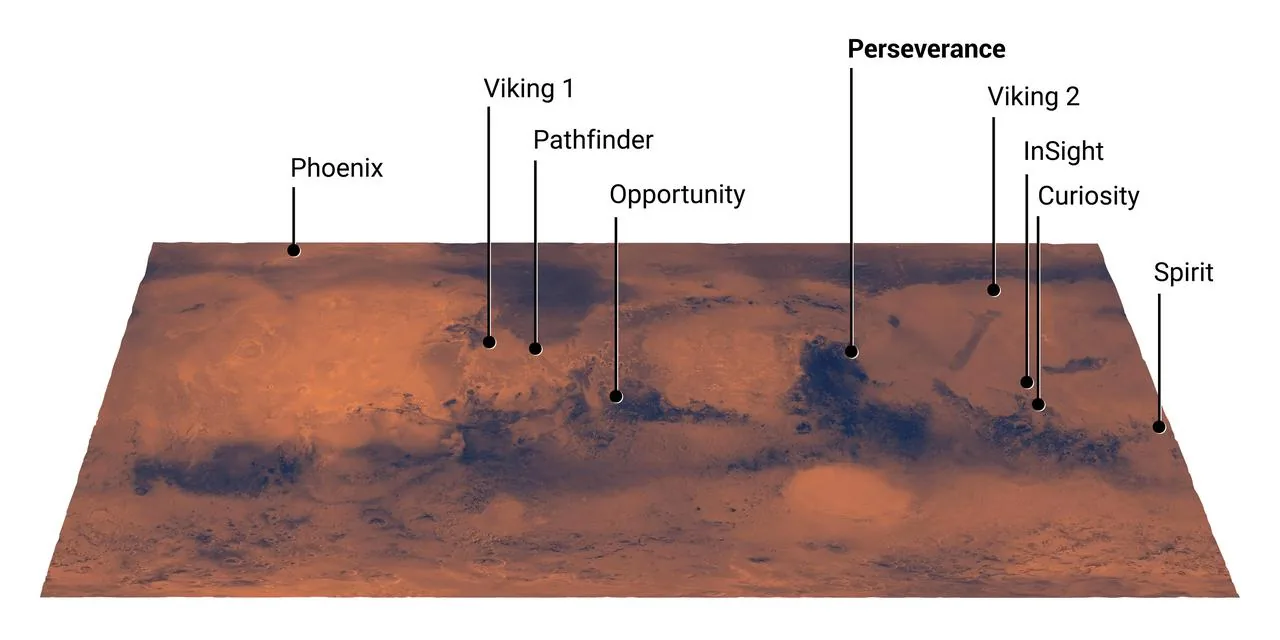
When NASA's Perseverance rover touched down in Jezero Crater on February 18, 2021, it carried with it the hopes of an entire generation of planetary scientists. The landing site was no accident -- Jezero was chosen because orbital imagery revealed an ancient river delta, the kind of geological feature where, on Earth, life leaves its most unmistakable calling cards. Four years later, Perseverance has delivered discoveries that have fundamentally reshaped our understanding of Mars. And honestly? It has exceeded even the wildest optimism of its mission planners.
Let me walk you through the highlights, because they deserve to be celebrated.
Jezero Crater: Reading the Story Written in Stone
The first thing Perseverance confirmed was that Jezero Crater really was a lake -- not just once, but potentially multiple times over billions of years. The rover's Mastcam-Z and SuperCam instruments revealed layered sedimentary rocks in the delta formation that are strikingly similar to river delta deposits on Earth. These are not volcanic rocks cooled from lava. These are rocks built grain by grain, carried by flowing water and laid down in still pools.
In 2022, Perseverance drove to the base of the delta and began its detailed investigation. What it found was extraordinary: mudstone layers interbedded with sandstone, exactly the pattern you would expect from a lake whose water levels rose and fell over time. Some layers showed clear evidence of flash flooding -- boulders up to a meter across had been deposited by violent currents that swept material into the crater from the river channel to the northwest.
For those of us who have spent decades wondering if Mars ever had the conditions to support life, this was not just data. It was validation.
Organic Molecules: The Discovery That Made Headlines

In July 2023, NASA announced that Perseverance's SHERLOC (Scanning Habitable Environments with Raman and Luminescence for Organics and Chemicals) instrument had detected organic molecules in multiple rock samples from the Jezero delta. Let me be clear about what this means and what it does not mean. Organic molecules are carbon-containing compounds that are essential building blocks for life as we know it. Their presence does not prove that life existed on Mars. But it proves that the chemistry necessary for life was present.
What made this detection particularly exciting was the context. The organic molecules were found in sedimentary rocks that formed in an aqueous environment -- rocks deposited by water in a habitable setting. SHERLOC detected aromatic hydrocarbons and other organic species that were concentrated in specific mineral grains, suggesting they were preserved during the original sedimentary process rather than delivered later by meteorite impacts.
The Perseverance science team, led by principal investigator Ken Farley of Caltech, was careful to note that geological processes can also produce organic molecules without any involvement of biology. But the abundance and distribution of these compounds in delta sediments is tantalizing. It is exactly the kind of finding that makes the Mars Sample Return mission so critically important -- because only Earth-based laboratories can perform the detailed isotopic analysis needed to determine whether these organics have a biological origin.
MOXIE: Breathing on Mars
One of Perseverance's most forward-looking experiments was MOXIE -- the Mars Oxygen In-Situ Resource Utilization Experiment. This toaster-sized instrument did something remarkable: it extracted oxygen from the Martian atmosphere, which is 96% carbon dioxide.
Over the course of its operational life, MOXIE successfully completed 16 oxygen-production runs between April 2021 and August 2023. During its final and most productive run, it generated 12 grams of oxygen per hour -- roughly twice its original design target. In total, MOXIE produced about 122 grams of oxygen during its mission, roughly the amount a small dog would breathe in 10 hours.
That might sound modest, but the implications are staggering. A scaled-up version of MOXIE, perhaps 200 times larger, could produce enough oxygen to sustain a crew of astronauts on the Martian surface. Even more importantly, it could produce the liquid oxygen needed as rocket propellant for the return trip to Earth. The Mars atmosphere, which seems so hostile and unbreathable, turns out to be a resource we can mine. MOXIE proved the concept works in actual Martian conditions -- not just in a lab on Earth, but on the surface of another planet, dealing with real dust, real temperature swings (from -20 to 50 degrees Celsius during operations), and real atmospheric pressure variations.
MOXIE's principal investigator, Michael Hecht of MIT, called it "a successful technology demonstration." I would call it a proof of concept for human survival on Mars.
Sample Caching: Preparing for the Most Ambitious Retrieval in History
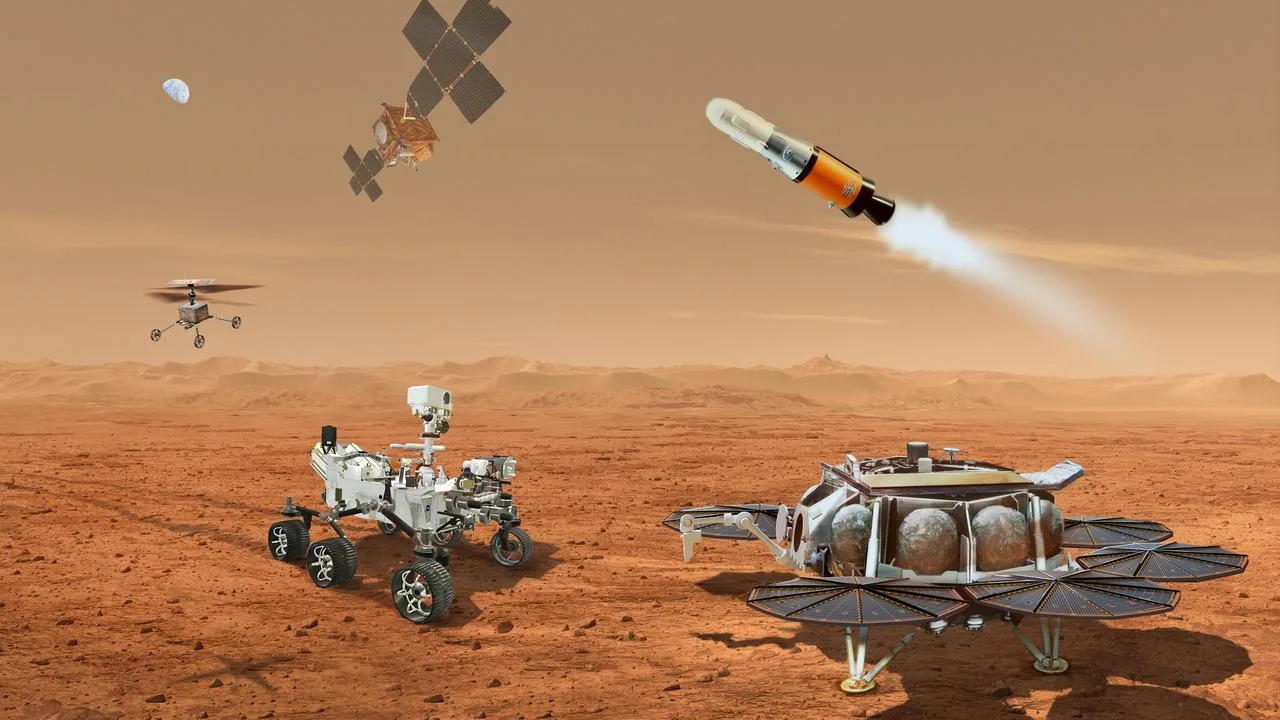
Perhaps the most consequential thing Perseverance has done is something that will not pay off for years: it has been methodically collecting and caching rock and soil samples in sealed titanium tubes for eventual return to Earth by the Mars Sample Return (MSR) mission.
As of early 2025, Perseverance has collected over 30 sample tubes, including rock cores, regolith samples, and atmospheric samples. The rover deposited a backup cache of 10 sample tubes on the Martian surface at a location called Three Forks in early 2023, creating an insurance policy in case the rover itself cannot deliver samples to a future lander. The primary plan, however, is for Perseverance to drive directly to the MSR lander and hand off its onboard samples.
The sample collection strategy has been meticulous. The science team prioritized samples from different geological environments: igneous rocks from the crater floor (which can be radiometrically dated to pin down the absolute age of the formations), sedimentary rocks from the delta (which might contain organic biosignatures), and even a sample of Martian dust and atmosphere. Each tube is about the size of a piece of classroom chalk, but together they represent the most carefully curated collection of extraterrestrial material ever assembled.
When these samples finally reach Earth-based laboratories -- equipped with instruments millions of times more sensitive than anything a rover can carry -- they could answer the question humanity has asked for centuries: did life ever arise on Mars?
The Sounds of Mars: A World We Can Finally Hear
Here is something that does not get nearly enough attention: Perseverance carries microphones. For the first time in the history of space exploration, we can hear another planet.
The rover's SuperCam microphone and its entry, descent, and landing (EDL) microphone have recorded the sounds of Mars, and they are hauntingly alien. The Martian wind sounds thin and reedy, filtered through an atmosphere only 1% as dense as Earth's. The snap and crack of the rover's laser vaporizing rock samples is audible, and the pitch and intensity of those sounds have actually been used as a scientific tool -- the acoustic properties of the laser impacts reveal information about rock hardness and composition.
In 2022, the science team published a landmark paper in Nature revealing that sound travels slower on Mars (approximately 240 meters per second versus 343 m/s on Earth) and that higher-frequency sounds travel faster than lower-frequency sounds on Mars -- a phenomenon not observed on Earth. This means that if you were standing on Mars, sounds would reach your ears in a slightly distorted sequence. It is a small detail, but it makes Mars feel real in a way that photographs alone never could.
Perseverance also recorded the sound of Ingenuity's rotor blades during flight, capturing the faint hum of the first aircraft on another world. That recording is, to my ears, one of the most beautiful sounds in the history of exploration.
What Comes Next
As of early 2025, Perseverance continues to operate well beyond its prime mission duration. The rover has driven over 28 kilometers across Jezero Crater, its wheels and instruments still performing admirably despite years of Martian dust and temperature extremes. The science team is now exploring the crater rim and the ancient terrain beyond the delta, searching for igneous rocks that could help scientists understand the volcanic history of the region.
Every sol (Martian day) that Perseverance continues to operate is a gift. Every sample it collects is an investment in future knowledge. And every discovery it makes adds another piece to the most compelling puzzle in science: the story of whether Mars, our neighboring world, ever harbored life.
I have been following Mars exploration since the Spirit and Opportunity rovers landed in January 2004. I remember the thrill of Curiosity's sky-crane landing in 2012. But Perseverance feels different. It feels like the mission that is actually laying the groundwork for the moment when we can definitively say what Mars is -- a dead world, or a world where life once flickered into existence under an ancient sky.
Either answer would be profound. And thanks to Perseverance, we are closer than ever to knowing.