There is one mission that planetary scientists have dreamed about for over 50 years, one mission that sits at the absolute top of every decadal survey priority list, one mission that could answer the most profound question in all of science: did life ever exist beyond Earth?
That mission is Mars Sample Return. And it is simultaneously the most important, most complex, and most troubled robotic space mission ever attempted.
Let me tell you why it matters, how it works, and why the road to bringing pieces of Mars to Earth has been anything but smooth.
Mars Sample Return Mission Architecture (2026)
| Phase | Spacecraft | Operator | Status (May 2026) | Earliest Launch | Earliest Earth Return | Mass Returned |
|---|---|---|---|---|---|---|
| 1. Sample Collection | Perseverance rover | NASA / JPL | Active since Feb 2021 — 30+ tubes sealed by 2026 | Already launched (2020) | — | ~600 g target across all tubes |
| 1a. Backup Cache | "Three Forks" depot at Jezero Crater | NASA / JPL | Complete (Jan 2023) — 10 backup tubes deposited | n/a | — | Backup if Perseverance fails |
| 2. Sample Retrieval Lander (SRL) | Sample Retrieval Lander + Mars Ascent Vehicle (MAV) | NASA + commercial (TBD post-2024 review) | Architecture under revision — proposals from SpaceX (Starship), Lockheed (heritage), Rocket Lab, JPL alternatives | 2030+ (TBD) | — | Carries MAV |
| 3. Mars Ascent | MAV (Mars Ascent Vehicle) | Lockheed Martin (current contractor) | In development; smaller solid-rocket version selected 2023 | Co-launches with SRL | — | Sample container to Mars orbit |
| 4. Earth Return | Earth Return Orbiter (ERO) | ESA + Airbus | In development | 2030+ (TBD) | — | Captures sample container in Mars orbit |
| 5. Earth Entry | Earth Entry Vehicle (EEV) | NASA Langley | In development | (carried by ERO) | 2033-2035 target (revised) | ~600 g samples land in Utah desert |
In April 2024, NASA opened the MSR architecture to industry and academic alternatives after the agency's Independent Review Board reported that the original $11B-plus program cost and 2040 sample-return date were unsustainable. Industry and lab proposals followed quickly: a SpaceX Starship-based architecture pitching a single-launch concept, a Lockheed Martin heritage architecture leveraging existing Mars-lander designs, a Rocket Lab Neutron-based slimmed-down concept, and an internal JPL pared-back version. NASA's stated targets are a $5–7B total program cost and sample return by the mid-2030s, with a final architecture decision expected mid-to-late 2026.
Caveat: Architecture decision is in active flux; verify current status at NASA's Mars Sample Return mission page. Sample return dates carry the largest uncertainty.
Why We Need to Bring Mars Rocks Home
You might reasonably ask: Perseverance is already on Mars with a suite of sophisticated instruments. It has detected organic molecules, characterized the geology of Jezero Crater, and cached dozens of samples. Why not just analyze everything on the surface?
The answer comes down to a simple but fundamental limitation: the most sensitive analytical instruments on Earth are enormous, delicate, and require controlled laboratory conditions that no rover can replicate. A mass spectrometer at a university lab might weigh several tons, require liquid helium cooling, and achieve measurements a million times more precise than the best instrument a rover can carry. Techniques like secondary ion mass spectrometry (SIMS), transmission electron microscopy (TEM), and synchrotron X-ray analysis can detect biosignatures at the molecular and isotopic level -- distinctions between biological and geological carbon that are simply invisible to rover instruments.
Every returned sample from the Apollo missions, which brought back 382 kilograms of lunar material between 1969 and 1972, continues to yield new discoveries more than 50 years later as analytical techniques improve. Mars samples would be studied for decades, perhaps centuries, with each generation of scientists bringing better tools to bear on the same precious material.
This is not a luxury. It is a scientific necessity. If we want to know whether Mars ever harbored life, we must bring samples home.
The Architecture: A Three-Mission Relay
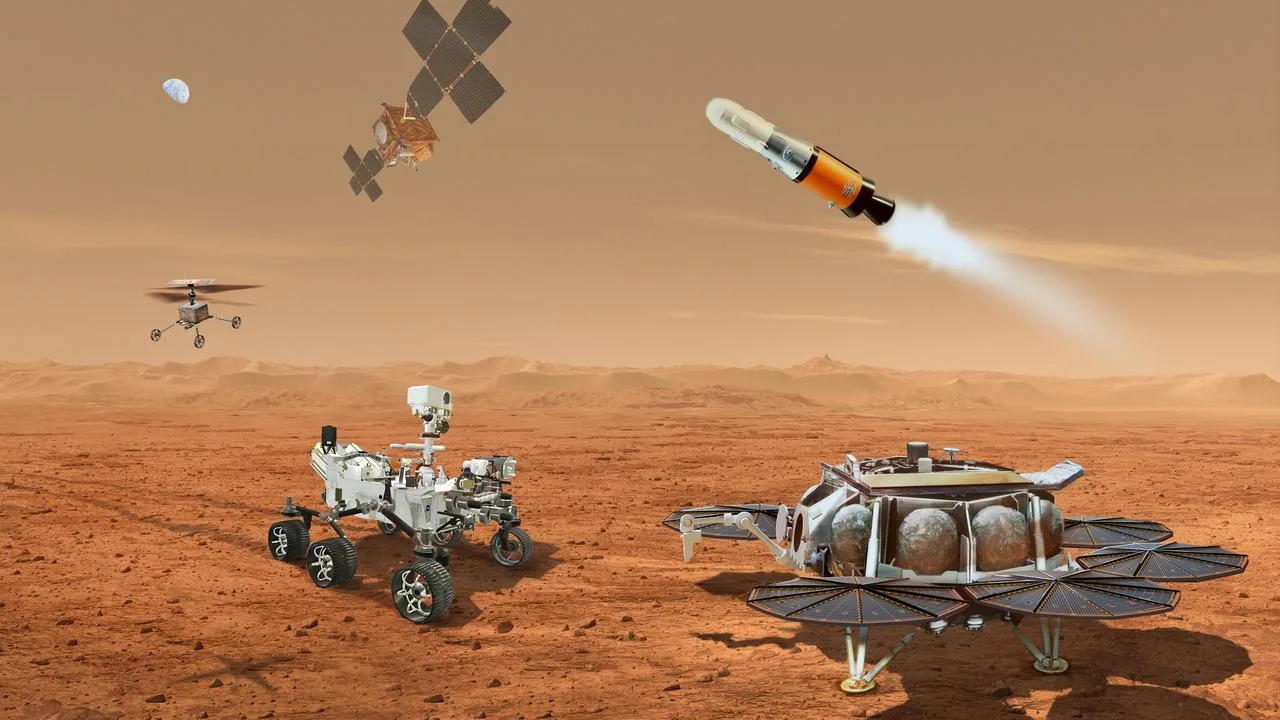
Mars Sample Return is not one mission. It is a relay involving multiple spacecraft, and the architecture has evolved significantly over the years. As of the most recent NASA planning, the core concept involves these major elements:
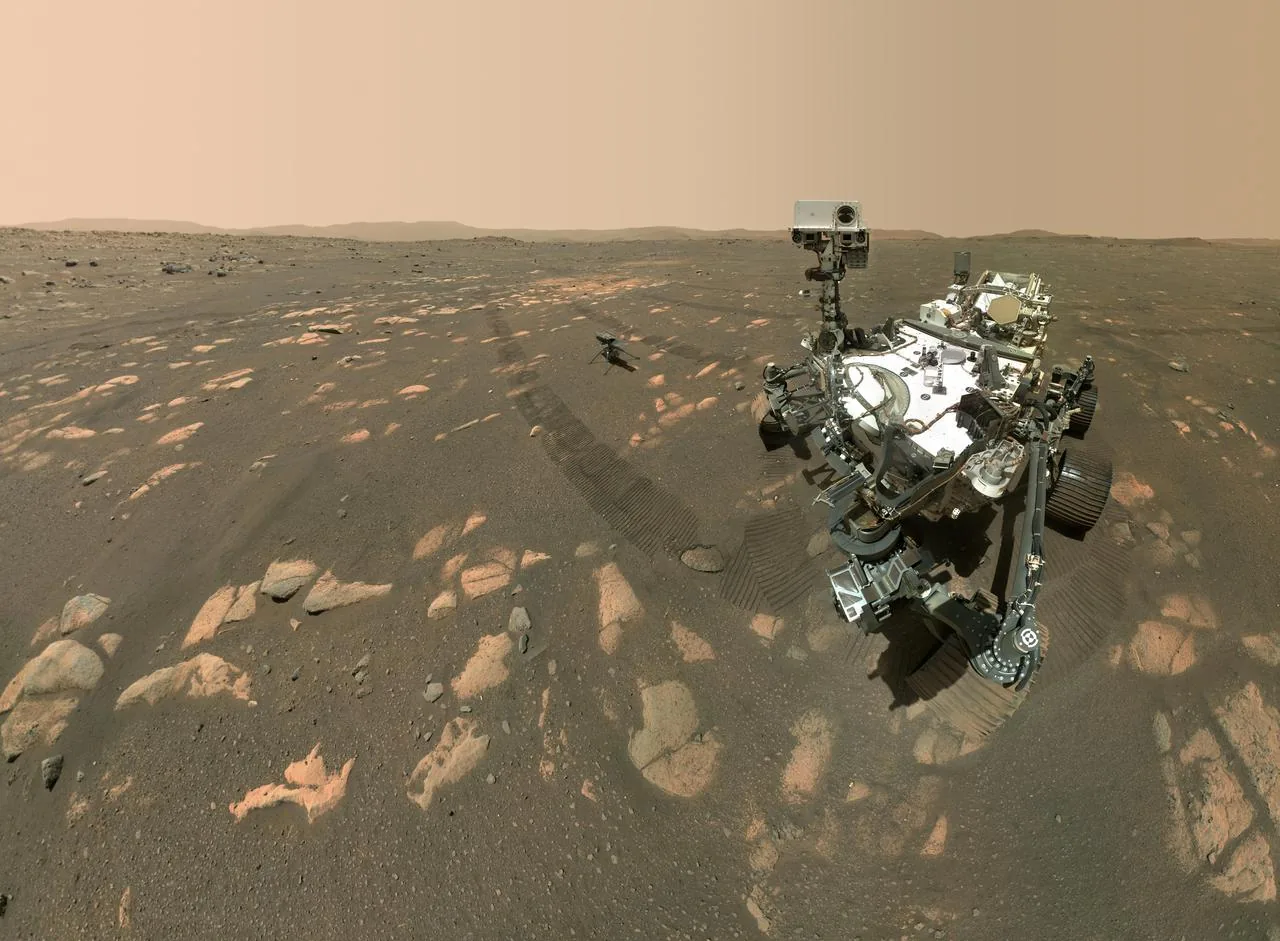
Phase 1: Sample Collection (Complete). Perseverance has already done its part brilliantly. The rover has collected over 30 sample tubes containing rock cores, regolith, and atmosphere from Jezero Crater. A backup cache of 10 tubes was deposited on the surface at Three Forks in early 2023, and the rover continues to carry additional samples onboard.
Phase 2: Sample Retrieval and Launch. A future lander mission would deliver a Sample Retrieval Lander (SRL) to the Martian surface near the cached samples. Under the original plan, two Ingenuity-derived helicopters would fly to the sample tubes, pick them up, and return them to the lander. The lander carries the Mars Ascent Vehicle (MAV), a small two-stage solid-fueled rocket that would be the first vehicle ever to launch from the surface of Mars. The MAV would carry the samples into Mars orbit in a basketball-sized container called the Orbiting Sample (OS).
Phase 3: Earth Return. An Earth Return Orbiter (ERO), built by the European Space Agency, would rendezvous with the OS in Mars orbit, capture it, seal it in a secondary containment system, and begin the long cruise back to Earth. Upon arrival, the sample container would be released for direct entry into Earth's atmosphere and landing in the Utah desert -- much like the Stardust mission's sample return capsule in 2006.
The whole sequence from launch of the retrieval missions to samples in a laboratory would take roughly a decade.
The Budget Problem: An $11 Billion Shock
Here is where the story gets complicated, and where I need to be honest about the challenges.
In September 2023, an independent review board (IRB) commissioned by NASA delivered a report that sent shockwaves through the planetary science community. The board concluded that the Mars Sample Return program, as then designed, would cost approximately $8 to $11 billion and could not return samples before 2040. The original budget estimate had been around $5 billion with a return date in the early 2030s.
The numbers were staggering. At $11 billion, MSR would consume a huge fraction of NASA's planetary science budget for over a decade, potentially starving other missions -- missions to Europa, Enceladus, Titan, and Venus -- of funding. The planetary science community, which had unanimously supported MSR as its top priority, suddenly faced an agonizing question: is one mission worth sacrificing a generation of other exploration?
NASA Administrator Bill Nelson responded by requesting the agency develop alternative architectures that could reduce cost and accelerate the timeline. In early 2024, NASA issued a call for proposals from industry and research institutions to reimagine MSR.
The Redesign: Faster, Cheaper, But How?
The redesign efforts have explored several approaches to bring the cost and timeline down. Some proposals suggest simplifying the retrieval architecture by relying more heavily on Perseverance itself to deliver samples directly to the lander, eliminating the need for sample-fetching helicopters. Others have proposed smaller, lighter Mars Ascent Vehicles or alternative orbiter designs.
Private companies, including SpaceX and Lockheed Martin, have submitted concepts. Some of the more radical proposals suggest using Starship's massive payload capacity to simplify the entire architecture -- potentially landing a much larger retrieval system on Mars that could accommodate simpler, more robust sample handling.
The European Space Agency remains a committed partner. ESA's Earth Return Orbiter, which has been in development at Airbus Defence and Space in Toulouse, France, represents a significant European investment. The capture-and-return portion of the mission is a technological marvel in its own right, requiring autonomous rendezvous in Mars orbit with a small, unpowered container -- a feat never before attempted at another planet.
As of May 2026, the revised MSR architecture is still being finalized, with a final decision expected mid-to-late 2026. NASA has indicated a desire to keep the total cost in the $5–7 billion range and return samples before the mid-2030s, but firm commitments have not yet been made. The mission remains in a state of active redesign, which is both encouraging (it is not cancelled) and concerning (every year of delay is a year that Perseverance ages on Mars).
Why It Still Matters More Than Anything
Despite the budget drama, I want to be absolutely clear about something: Mars Sample Return is worth fighting for. It is worth the money, the complexity, and the political battles, because the scientific return would be without parallel.
Consider what those sealed titanium tubes contain. Rock samples from an ancient lake bed where organic molecules have been detected. Igneous samples that can be radiometrically dated with extraordinary precision, anchoring the entire Martian geological timescale. Atmospheric samples that could reveal the history of Mars's climate. And possibly -- possibly -- the chemical fingerprints of ancient Martian life.
No other mission currently planned or even conceivable could deliver this kind of science. The samples are already collected. They are sitting on Mars right now, waiting. The hardest part -- finding the right rocks in the right place and sealing them in contamination-free containers -- has been done.
Walking away from those samples would be one of the greatest lost opportunities in the history of science.
The Bigger Picture
Mars Sample Return is also a proving ground for technologies that will be essential for human Mars exploration. The Mars Ascent Vehicle tests propulsion and autonomous launch from another planet's surface. The orbital rendezvous demonstrates autonomous deep-space operations. The Earth return and containment protocols establish planetary protection procedures that will be critical when astronauts eventually return from Mars.
Every dollar spent on MSR is an investment not just in science but in the engineering knowledge needed to make humans a multiplanetary species.
I think about those sample tubes often -- small cylinders of Martian rock, sealed and waiting in the red dust of Jezero Crater. They represent the culmination of decades of Mars exploration, from Mariner 4's first flyby photographs in 1965 to Perseverance's meticulous sample collection. They are, in a very real sense, the most valuable objects on Mars.
We owe it to ourselves, and to every scientist who has ever gazed at the red dot in the night sky and wondered, to bring them home.