The space economy is no longer a speculative bet on a distant future. It is a roughly $700 billion global industry in 2026 (Space Foundation, BryceTech) with dozens of publicly traded companies spanning launch, satellite communications, Earth observation, defense, and in-orbit services. For investors trying to navigate this landscape, the challenge is not finding space stocks. It is understanding which companies are positioned to capture real revenue in an industry that still punishes hype and rewards execution.
This guide covers every significant publicly traded space company in 2026, organized by sector, with ticker symbols, approximate market capitalizations, core products, and a one-line investment thesis for each. The live snapshot table below pulls current prices via Yahoo Finance every 15 minutes — sortable by sector, market cap, or day-change.
None of this is investment advice. Always verify current prices and read the latest filings before any trading decision.
Publicly Traded Space Companies (Q1 2026 Snapshot)
Publicly Traded Space Companies — Live Snapshot
Live prices via Yahoo Finance · refreshes every 15 minutes
| Thesis | |||||||
|---|---|---|---|---|---|---|---|
| LMT | Lockheed Martin NYSE | Defense Prime | — | — | $120–140B | ~$12B annual space revenue; deepest NASA/DoD ties | |
| NOC | Northrop Grumman NYSE | Defense Prime | — | — | $75–95B | Diversified across launch propulsion + classified | |
| LHX | L3Harris Technologies NYSE | Defense Prime | — | — | $40–55B | Key SDA proliferated-LEO sensor supplier | |
| BA | Boeing NYSE | Defense Prime | — | — | $100–140B | Heritage incumbent; Starliner + SLS execution overhang | |
| RTX | RTX Corporation NYSE | Defense Prime | — | — | $150–180B | Broad space-adjacent electronics exposure | |
| KTOS | Kratos Defense NASDAQ | Defense Prime | — | — | $3–5B | Tactical space + satellite ground systems | |
| PL | Planet Labs NYSE | Earth Observation | — | — | $1.5–2.5B | Largest daily-imaging constellation; ARR > $250M | |
| SPIR | Spire Global NYSE | Earth Observation | — | — | $200–500M | Differentiated weather + aviation data; dilution risk | |
| BKSY | BlackSky NYSE | Earth Observation | — | — | $400–800M | High-revisit imagery + defense-heavy backlog | |
| SATL | Satellogic NASDAQ | Earth Observation | — | — | $100–300M | Sub-meter imagery for emerging-market governments | |
| RDW | Redwire NYSE | Infrastructure | — | — | $600M–1.5B | Diversified infra; modest revenue scale | |
| MNTS | Momentus NASDAQ | Infrastructure | — | — | $20–80M | Concept-stage orbital transfer; viability questions | |
| KARMN | Karman Holdings NYSE | Infrastructure | — | — | $2–4B | 2024 IPO; propulsion + structures supplier | |
| VOYG | Voyager Technologies NYSE | Infrastructure | — | — | $1–2B | Starlab commercial station partner; gov-heavy backlog | |
| RKLB | Rocket Lab USA NASDAQ | Launch | — | — | $10–15B | Most credible #2 to SpaceX; Neutron + spacecraft business | |
| FLY | Firefly Aerospace NASDAQ | Launch | — | — | $2–4B | Post Blue Ghost-1 success; Alpha + Eclipse cadence | |
| LUNR | Intuitive Machines NASDAQ | Lunar | — | — | $1–3B | Pure-play lunar economy; CLPS + Near Space Network | |
| 9348.T | ispace Tokyo Growth | Lunar | — | — | $400–800M | Speculative Asia/Japan lunar exposure | |
| MDA.TO | MDA Space Toronto (TSX) | Robotics & Servicing | — | — | C$3–5B | Long-cycle gov contracts + satellite manufacturing | |
| MYNA | Mynaric NASDAQ | Robotics & Servicing | — | — | $50–200M | Pure-play optical inter-sat link bet; SDA contracts | |
| 186A.T | Astroscale Tokyo Growth | Robotics & Servicing | — | — | $300–600M | Active debris removal pure-play | |
| ASTS | AST SpaceMobile NASDAQ | SatComm | — | — | $5–10B | Most ambitious direct-to-cell bet; capex-heavy | |
| GSAT | Globalstar NYSE | SatComm | — | — | $3–5B | Apple Emergency SOS partnership de-risks revenue | |
| IRDM | Iridium Communications NASDAQ | SatComm | — | — | $7–9B | Profitable, FCF-positive — closest to a space utility | |
| ETL.PA | Eutelsat Group (OneWeb) Euronext Paris | SatComm | — | — | $2–4B | Multi-orbit operator; Starlink + integration risk | |
| TSAT | Telesat NASDAQ / TSX | SatComm | — | — | $500M–1B | Late LEO start; financing-constrained | |
| VSAT | Viasat NASDAQ | SatComm | — | — | $1.5–3B | Inmarsat scale; high debt, GEO transition risk | |
| SPCE | Virgin Galactic NYSE | Tourism | — | — | $100–300M | High-risk play on suborbital demand; cadence unproven |

A few notes on reading the table above:
- Live prices pull from Yahoo Finance and refresh every 15 minutes. Day-change is vs the previous trading-day close — pre-market and after-hours moves are not reflected.
- Market cap bands are deliberately wide because small-cap space stocks move 10–30% on single-launch news. Treat them as orientation, not precision.
- Pure-play exposure varies wildly — Iridium derives ~100% of revenue from space; Lockheed ~10%. Both are listed because both matter to the sector.
- International tickers (
ETL.PA,MDA.TO,9348.T,186A.T) require an international-friendly broker. See "How to Buy Space Stocks" below. - Watchlist toggles save to your browser only — no account needed.
Sector-by-Sector Detail
The narrative below complements the table — context, recent milestones, and the bull/bear case for each name.
Launch Services
The launch sector is the enabling layer of the entire space economy. Without reliable, affordable access to orbit, nothing else works. SpaceX dominates US launch (~85% of orbital flights in 2025), which is why every public competitor is judged on whether they can carve out a defensible niche behind it.
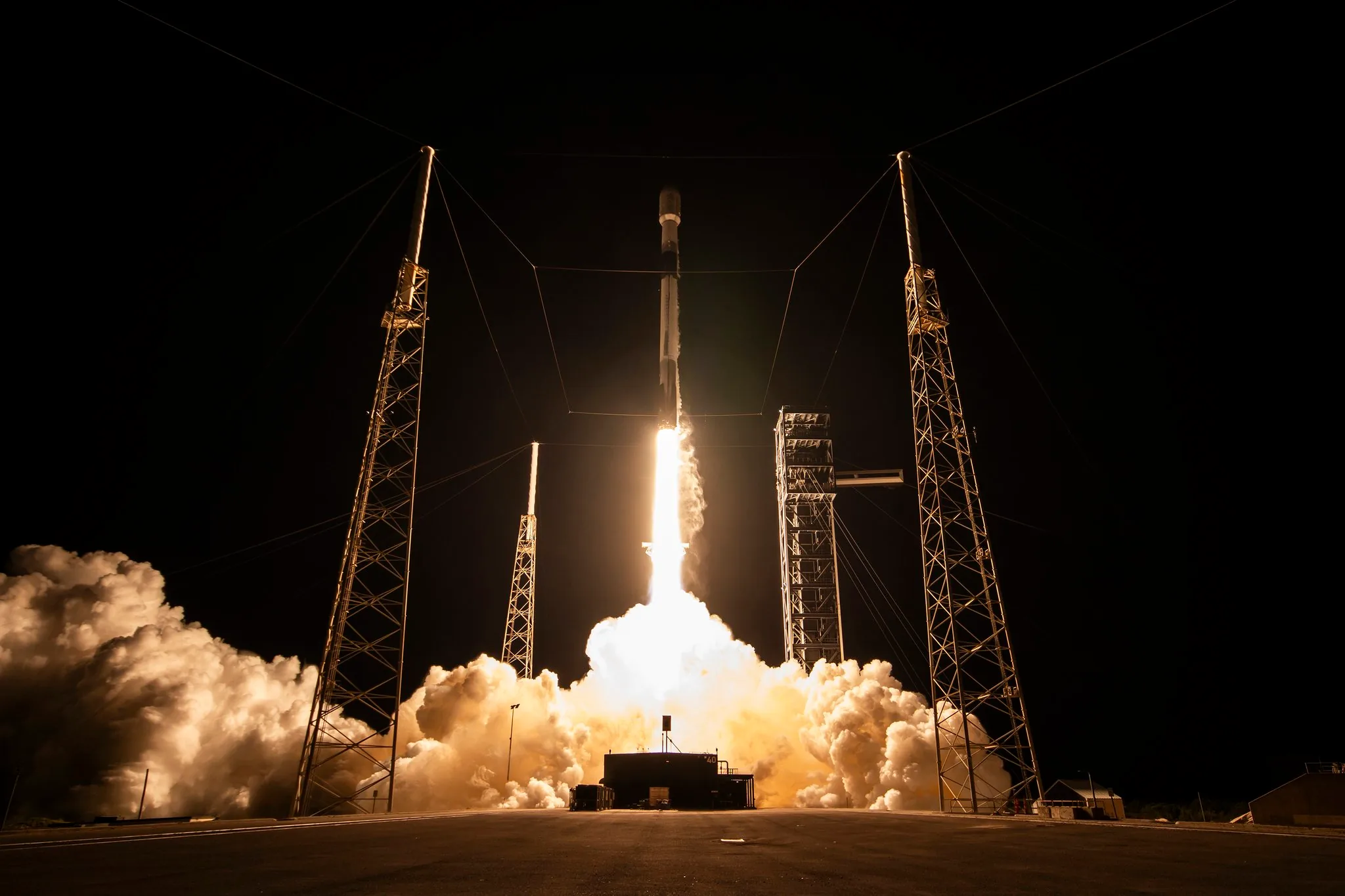
Rocket Lab USA (RKLB) | NASDAQ Rocket Lab operates the Electron small launch vehicle (75+ successful missions by January 2026) and is closing on the first launch of the medium-lift Neutron rocket targeted for 2026. Spacecraft and components now generate roughly half of total revenue. FY2025 revenue was $602M, up 38% YoY, against a $1.85B backlog (up 73% YoY) — the SDA Tranche 3 win in December 2025 added $816M alone. The stock hit an all-time closing high of $96.30 in January 2026, recovering more than 2,600% from its April 2024 low of $3.47. Thesis: Most credible second player in commercial launch with a diversified spacecraft business. Neutron success in 2026 would unlock a path to GAAP profitability; Neutron delays are the obvious risk.
Firefly Aerospace (FLY) | NASDAQ Firefly IPO'd in August 2025 at $45/share, raising $868M at a debut valuation near $9.8B. Blue Ghost-1 made the first fully successful commercial Moon landing in March 2025. The company holds a $176.7M NASA CLPS contract for a 2029 south-pole mission. The medium-lift Eclipse rocket (joint with Northrop Grumman) is targeting first flight no earlier than 2027. Thesis: Cleanest pure-play launch+lunar IPO since RKLB. Watch Alpha cadence and Eclipse milestones each quarter.
Virgin Galactic (SPCE) | NYSE Virgin Galactic suspended VSS Unity flights in mid-2024 and executed a 1-for-20 reverse split in June 2024 to avoid NYSE delisting. The company is now banking everything on its Delta-class vehicles, with testing slated for 2025–2026 and commercial flights targeted thereafter. Thesis: A cautionary tale about narrative-vs-fundamentals investing. Approach with extreme caution.
Lunar and Deep Space Exploration
The return to the Moon under Artemis and the Commercial Lunar Payload Services (CLPS) program have created a new public-company class.
Intuitive Machines (LUNR) | NASDAQ
IM-1 (Odysseus, February 2024) was the first American lunar landing in 50+ years. IM-2 launched in early 2026. Backlog stood at $943M in February 2026, anchored by a $4.82B near-space communication services award and additional CLPS contracts. Management guides to nearly 5x revenue growth in 2026. The pending NASA Lunar Terrain Vehicle Services contract ($4.6B if won) would be a step-change.
Thesis: Pure-play lunar economy company with a CLPS pipeline running through the late 2020s. Concentration in NASA is both stability and risk.
ispace (9348.T) | Tokyo Stock Exchange Growth Japanese lunar exploration company developing the HAKUTO-R lander series. Mission 1 (April 2023) crash-landed; Mission 2 was prepared with improved systems. ispace is building toward a cislunar transportation platform. Thesis: Speculative position on Japanese and international lunar exploration demand with significant execution risk.
Earth Observation
EO is one of the fastest-growing space segments — agriculture, insurance, defense, climate, and financial-intelligence buyers all want more frequent, higher-resolution imagery.
Planet Labs (PL) | NYSE Largest constellation of EO satellites in history (200+ active spacecraft) imaging the entire planet daily. Recent contract wins are meaningful: a EUR 240M deal with the German government in July 2025 for European defense and peacekeeping imagery, and a $230M agreement with SKY Perfect JSAT in January 2025 to build and operate Pelican satellites. Revenue is approaching the $700M range that management originally targeted for early 2026. Thesis: Dominant provider of daily, global EO with a defensible constellation. Profitability remains elusive but the data moat is real.
Spire Global (SPIR) | NYSE Constellation of 100+ nanosats collecting weather, maritime, and aviation data. Sold its maritime (AIS tracking) business to Belgium's Kpler for $241M in November 2024 to address debt and stabilize the balance sheet. Thesis: Differentiated weather/aviation data play. Small market cap and ongoing cash burn introduce dilution risk.
BlackSky (BKSY) | NYSE High-revisit imaging satellites paired with an AI-powered analytics platform. Deep ties to U.S. defense and intelligence customers. Thesis: Imagery + AI at the intersection of two growing markets. Defense concentration provides revenue visibility but customer concentration risk.
Satellogic (SATL) | NASDAQ Argentine-founded sub-meter imaging operator pursuing aggressive international sales, including sovereign-imagery deals with emerging-market governments. Thesis: Low-cost imaging for underserved international markets. Persistent cash constraints and small constellation limit near-term competitiveness.
Satellite Communications
The largest revenue segment in the space economy — broadband, IoT, mobile satellite services, and direct-to-device.
AST SpaceMobile (ASTS) | NASDAQ Building the first space-based cellular broadband network designed to connect directly to standard smartphones. Five BlueBird Block-1 satellites launched September 2024; BlueBird-6 (heaviest payload ever launched to LEO by India's LVM3) deployed December 2025; BlueBird-7 launched on Blue Origin's New Glenn in April 2026 but was released below operational altitude and will be deorbited — a reminder that hardware risk remains material. Partnerships now include Verizon ($100M), Vodafone (commercial through 2034), AT&T, and a $175M prepayment from Saudi Arabia's stc group in October 2025. Thesis: Most ambitious direct-to-device bet, with enormous addressable market potential and equally enormous technical and financial execution risk.
Globalstar (GSAT) | NYSE LEO voice/IoT operator. Apple's Emergency SOS via satellite (launched on iPhone 14) uses Globalstar's network; Apple has invested over $1.5B in the company. Thesis: Apple partnership transformed Globalstar's financial trajectory and dramatically de-risked the investment case.
Iridium Communications (IRDM) | NASDAQ Only constellation providing true pole-to-pole global coverage. 66 active LEO satellites, ~$200M annual free cash flow, 2M+ billable subscribers. Thesis: The closest thing to a profitable, cash-generative space utility. Defensible monopoly on truly global coverage.
Eutelsat Group (ETL.PA) | Euronext Paris Post-OneWeb merger, Eutelsat operates both GEO broadcast satellites and a LEO broadband constellation of ~630 satellites. Thesis: Multi-orbit strategy is differentiated. Integration complexity and Starlink competition are the central uncertainties.
Telesat (TSAT) | NASDAQ / TSX Canadian operator developing the Lightspeed LEO constellation for enterprise and government broadband. Thesis: Lightspeed could be transformational if executed; financing constraints and a late start vs Starlink/OneWeb are substantial risks.
SES (SESG.LU) | Luxembourg Stock Exchange GEO + MEO operator. The O3b mPOWER MEO constellation delivers high-throughput, low-latency connectivity for enterprise and maritime. Thesis: Differentiated MEO layer offers dividend-income potential. Structural broadcast-revenue headwinds weigh on the case.
Viasat (VSAT) | NASDAQ Satellite broadband for residential, aviation, and government. Inmarsat acquired in 2023 added maritime + aviation connectivity revenue. Thesis: Inmarsat merger creates a diversified connectivity platform. High debt and GEO-vs-LEO transition risk weigh on the case.
Defense Primes
Large defense contractors with significant space revenue — satellite manufacturing, launch systems, missile warning, and space domain awareness.
Lockheed Martin (LMT) | NYSE Space is ~$12B annual revenue: Orion, GPS III, missile warning systems, and the recently acquired Terran Orbital satellite manufacturing capability. Thesis: Largest pure space revenue among defense primes; deepest NASA + DoD relationships.
Northrop Grumman (NOC) | NYSE SLS solid rocket boosters, Cygnus cargo, JWST bus, missile defense, and classified space programs. Thesis: Diversified across launch propulsion, space logistics, and classified work.
L3Harris Technologies (LHX) | NYSE Space-based infrared sensors, comms payloads, navigation systems. Key supplier for the SDA's proliferated LEO architecture. Thesis: Leading sensor/payload manufacturer benefiting from the shift to proliferated, resilient space architectures.
Boeing (BA) | NYSE Starliner, SLS core stage, satellite manufacturing through legacy Hughes, and WGS / SDP military comms satellites. Thesis: Significant heritage and contract incumbency, but persistent execution challenges have eroded investor confidence in space.
RTX Corporation (RTX) | NYSE RTX (parent of Raytheon and Collins Aerospace) builds space sensors, comms hardware, GPS receivers, and space-based missile tracking. Thesis: Broad exposure to space-adjacent defense electronics with less direct space concentration than LMT or NOC.
Kratos Defense (KTOS) | NASDAQ Tactical satellite ground systems, software-defined satellite operations, and small-satellite hardware. Thesis: Underrated supplier-of-suppliers — meaningful exposure to SDA, USSF, and commercial constellation operators.
Robotics, Servicing, and Manufacturing
MDA Space (MDA.TO) | Toronto Stock Exchange Builds the Canadarm series of robotic arms for the ISS and Lunar Gateway, satellite subsystems, and geointelligence solutions. Holds the Canadarm3 contract for NASA's Gateway station. Thesis: Dominant position in space robotics with long-duration government contracts and a growing satellite-manufacturing business.
Mynaric (MYNA) | NASDAQ Laser communication terminals for satellite and airborne platforms. Has secured contracts with the Space Development Agency and commercial constellation operators. Thesis: Pure-play on the optical inter-satellite link market that is critical for next-generation constellations. Production scaling is the binary risk.
Astroscale (186A.T) | Tokyo Stock Exchange Growth Active debris removal and in-orbit servicing pure-play. Multiple JAXA and UK Space Agency contracts; commercial demonstrations ongoing. Thesis: Earliest credible commercial debris-removal operator. Long sales cycles and regulatory dependencies remain material.
Space Infrastructure
Redwire Corporation (RDW) | NYSE In-space manufacturing, 3D printing, solar arrays (ROSA / iROSA), digital engineering. Has flown manufacturing payloads to the ISS and is developing roll-out solar array technology for deep space. Thesis: Diversified infrastructure play with exposure to in-orbit manufacturing and next-gen power systems. Revenue scale remains modest.
Momentus (MNTS) | NASDAQ Vigoride orbital transfer vehicle for last-mile delivery and hosted payload services after rideshare launch. Thesis: Compelling concept, very low revenue, high cash burn, ongoing viability questions.
Karman Holdings (KARMN) | NYSE Propulsion components and structures supplier across defense and space programs. 2024 IPO. Thesis: Picks-and-shovels supplier to the launch and missile-defense buildup. Less binary than the prime-contractor names.
Voyager Technologies (VOYG) | NYSE Rebranded Voyager Space holding company. Core asset is the Starlab commercial space station program (with Airbus and other partners) targeting post-ISS commercial habitation. Thesis: Cleanest public play on the post-ISS station economy. Execution risk on Starlab is enormous and revenue is small relative to market cap.
Recent IPOs and New Listings (2024–2026)
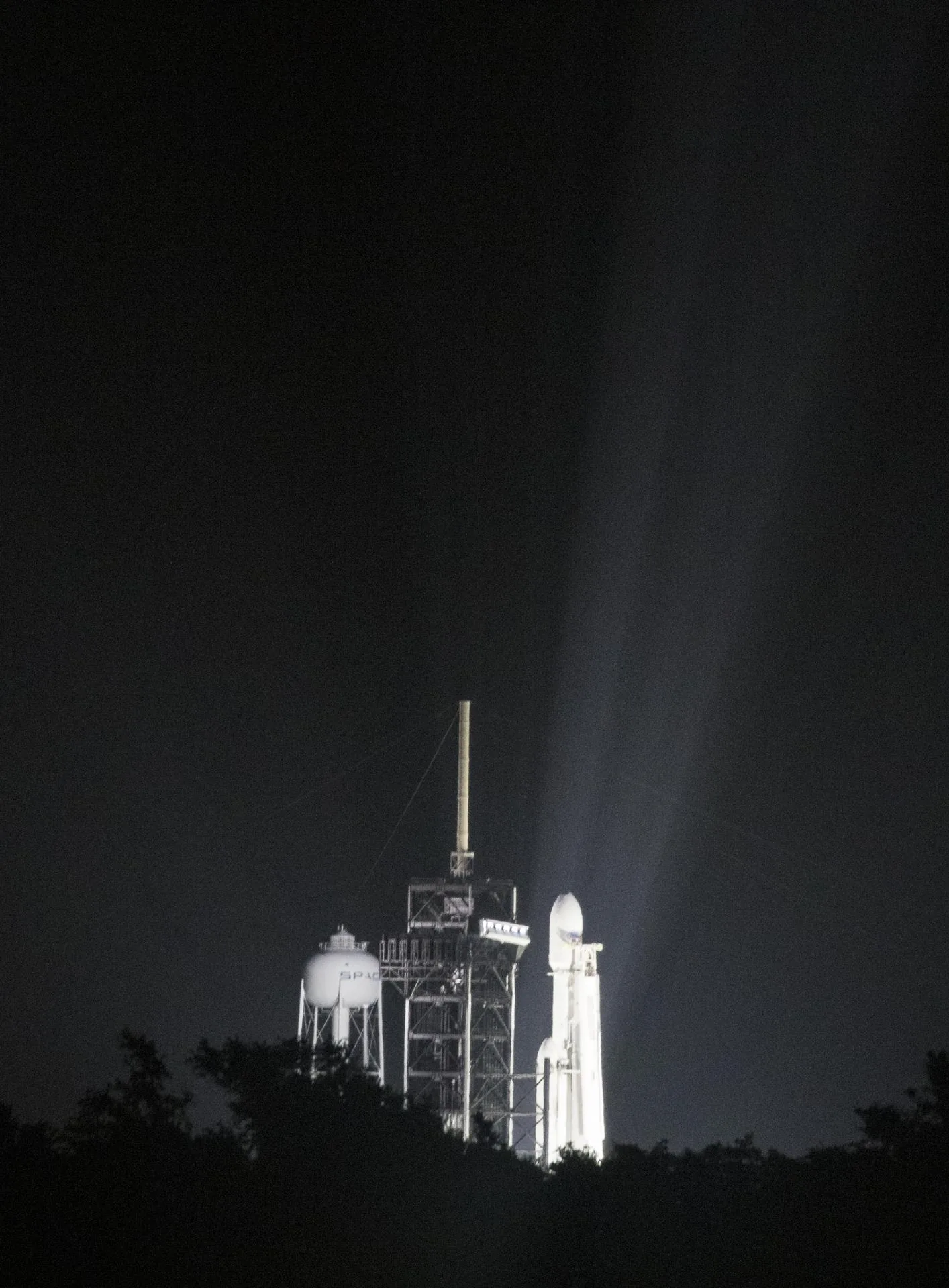
The pace of new public space-company listings accelerated meaningfully in 2024–2026. Investors should know the most consequential recent additions:
- Karman Holdings (KARMN) — IPO 2024. A propulsion-and-structures supplier across launch, missile defense, and hypersonics. Less hype, more durable backlog than most de-SPAC space names from 2021.
- Voyager Technologies (VOYG) — listed July 2025 (NYSE). Starlab commercial station partner with Airbus + Mitsubishi + MDA + Hilton. The clearest public proxy for the post-ISS station economy.
- Firefly Aerospace (FLY) — IPO August 2025 (NASDAQ) at $45/share, $868M raised, ~$9.8B debut valuation. The first major pure-play launch IPO since Rocket Lab's de-SPAC in 2021.
- Astroscale (186A.T) — Tokyo Growth Market IPO June 2024. The first publicly traded active-debris-removal company.
- Innospace (462350.KQ) — KOSDAQ IPO July 2024. Korean small-launch hybrid-propulsion company; speculative.
- SpaceX (private, S-1 filed) — On April 1, 2026, SpaceX filed a confidential draft S-1 with the SEC. Analyst valuations cluster between $1.75T and $2T, which would make it the largest IPO in U.S. history. A 2025 secondary share sale valued the company at $800B; a February 2026 transaction tied to xAI implied $1T. Retail allocations at IPO are likely to be small; secondary trading post-listing will set the tone for the entire sector.
The de-SPAC class of 2021 is largely behind us — the survivors (RKLB, ASTS, LUNR, RDW, BKSY, SPIR) are sorted from the casualties (LLAP/Terran Orbital acquired by Lockheed in 2024, Astra Space taken private). The 2024–2026 cohort is markedly more disciplined: smaller raises, real revenue at debut, and government-anchored backlogs.
How to Buy Space Stocks
Most US-listed space stocks (RKLB, ASTS, LUNR, PL, etc.) trade like any other US equity — any major US broker (Fidelity, Schwab, Vanguard, Robinhood, Webull) will let you buy them with no special requirements. The complications are:
- International tickers.
ETL.PA(Eutelsat, Paris),MDA.TO(MDA Space, Toronto),SESG.LU(SES, Luxembourg),9348.Tand186A.T(Tokyo) require a broker that supports international markets. Interactive Brokers is the most universally accessible; Schwab supports many European exchanges; Fidelity International covers TSX. In the EU, eToro, Saxo, and Trading 212 offer international exposure with fewer foreign-tax forms. - OTC pink-sheet versions. Some non-US tickers also trade as OTC ADRs in the US (e.g.
ETLLYfor Eutelsat). These have lower liquidity and wider spreads than the home-exchange listing — verify before buying. - Fractional shares. A handful of these names (LMT, RTX, BA, NOC) trade above $400 per share. Brokers that support fractional shares (Fidelity, Schwab, Robinhood, eToro) make these accessible at any account size.
- Foreign-tax considerations. Dividends from non-US companies (SES, Eutelsat, MDA) are subject to withholding tax in the country of origin. US investors typically reclaim part of this via a treaty rate; check with a tax professional before optimizing for yield.
- Index/ETF route. If picking individual names is more concentration risk than you want, a small allocation to a space-focused ETF (ARKX, UFO) or aerospace-and-defense ETF (ITA, PPA) gives broader exposure with single-stock-blow-up insurance. We cover ETF mechanics in the space stocks & ETFs investor guide.
If you are building your first space-stock position, a defensible starting framework: 60% in profitable cash-generative names (IRDM, GSAT, plus a defense prime) for ballast, 30% in a curated set of pure-play growth names (RKLB, ASTS, LUNR, PL) for upside, and 10% in a thematic ETF for diversification. Rebalance no more than quarterly; space stocks reward patience.
How to Think About Space Investing
Continue the investing pillar
- Space ETFs & individual stocksARKX, UFO, ITA — and the case for direct positions in RKLB, ASTS, FLY.
- How to evaluate a space companySix metrics that separate future giants from future bankruptcies. Includes an interactive scorecard.
- Reading NASA & DoD space contractsFront-run earnings calls by reading USASpending.gov. IDIQ, FFP, OTA explained.
The publicly traded space universe spans an enormous range of risk profiles, from blue-chip defense primes generating billions in free cash flow to pre-revenue startups burning through their IPO proceeds. A few principles can help investors navigate this landscape.
First, distinguish between companies that generate revenue today and those that are still building toward it. Iridium, Globalstar, and the defense primes are profitable businesses. Many of the smaller companies that came public via SPAC in 2021 and 2022 are still working toward sustainable unit economics.
Second, pay attention to contract backlogs and customer concentration. Companies with multi-year government contracts (Intuitive Machines, BlackSky, Rocket Lab) have more revenue visibility than those dependent on winning new commercial deals quarter by quarter. Our companion guide on reading NASA and DoD contracts walks through how to verify obligations on USASpending.gov.
Third, understand the capital intensity of the space industry. Building and launching satellite constellations requires hundreds of millions or billions of dollars. Companies that went public with insufficient capital to complete their constellations face dilution risk that can devastate shareholder value.
Fourth, the framework matters more than the ticker. The same six metrics — backlog, unit economics, technology readiness, government-versus-commercial mix, burn rate, and a credible path to profitability — apply across the entire universe. The how-to-evaluate-a-space-company guide turns this framework into a scorecard you can apply to any company in the table above.
The space economy is real, growing, and increasingly investable. But it demands the same rigor and skepticism that any capital-intensive, technology-driven sector requires.
Frequently Asked Questions
What is the largest publicly traded space company?
By total market capitalization, the diversified defense primes dominate: RTX ($150–180B), Lockheed Martin ($120–140B), Boeing ($100–140B). By pure-play space exposure, Iridium Communications ($7–9B), AST SpaceMobile ($5–10B), and SES ($4–6B) are the largest, with Rocket Lab joining that tier after its 2025–2026 run.
Can retail investors buy SpaceX stock?
No, not yet. SpaceX is privately held and filed a confidential S-1 with the SEC on April 1, 2026 — but no IPO has priced as of this writing. Until SpaceX lists publicly, retail exposure is limited to (a) secondary-market platforms like EquityZen or Forge Global, which typically require accredited-investor status and have steep minimums; (b) ARK ETFs (ARKX) which hold private SpaceX positions at small allocations; or (c) Alphabet (GOOGL), which is a meaningful SpaceX shareholder via early Google investments.
What is the safest space stock?
There is no truly "safe" space stock, but Iridium Communications (IRDM) is the most defensible: profitable, FCF-positive, with a constellation monopoly on global coverage and a stable subscriber base. Lockheed Martin (LMT) and the other defense primes provide ballast through diversification — space is a meaningful but not dominant share of revenue. Globalstar (GSAT) is increasingly de-risked by the Apple Emergency SOS contract.
Which space stocks are profitable?
As of 2026, the profitable pure-play space companies are: Iridium Communications (sustained free cash flow), Globalstar (anchored by Apple), and SES (legacy GEO broadcast operator with dividend). The defense primes (LMT, NOC, LHX, BA, RTX, KTOS) are profitable as overall businesses with profitable space segments. Most pure-play newer names (RKLB, ASTS, LUNR, PL, BKSY, SPIR) are not yet GAAP-profitable but vary in their proximity to breakeven.
Are there ETFs for space stocks?
Yes. The two pure-play space ETFs are ARKX (ARK Space Exploration & Innovation, ~0.75% expense ratio) and UFO (Procure Space ETF, requires holdings to derive at least 50% of revenue from space). For broader aerospace + defense exposure with meaningful space allocation, ITA (iShares U.S. Aerospace & Defense) and PPA (Invesco Aerospace & Defense) are larger and more liquid. Full breakdown in our space stocks & ETFs guide.
How do I track new space IPOs?
Three sources cover the bulk: (1) SEC EDGAR — search for S-1 filings under SIC code 3812 (search/detection/navigation instruments) or 3669 (communications equipment); confidential filings (like SpaceX's) appear as "DRS" filings. (2) SpaceNews and Payload Space report on filings within days. (3) Renaissance Capital publishes an IPO calendar. We also flag major listings in our weekly newsletter.
What is the difference between a space stock and a space-adjacent stock?
A "space stock" generally derives at least 30–50% of revenue directly from space activities — Iridium, Planet Labs, AST SpaceMobile, Rocket Lab, MDA Space. A "space-adjacent" stock has meaningful but minority space exposure — Lockheed Martin (~10%), Boeing, RTX, Palantir (defense + space analytics), Trimble (GPS hardware). Both belong in a diversified space allocation, but the risk-return profiles differ sharply: pure-plays have higher upside and higher single-event risk; adjacents are more diversified but capture less of the sector's growth.
Last verified: 2026-05-10. Live prices via Yahoo Finance v8 chart API (15-minute cache). Company list, sectors, and theses cross-checked against SEC filings, company investor-relations pages, BryceTech and Space Foundation reports, SpaceNews, and Payload Space coverage. Market-cap bands are deliberately wide and shift daily — verify before any trading decision. None of this is investment advice.